
Herman Melville
There is more than one author with this name Herman Melville was an American novelist, short story writer, and poet of the American Renaissance period. Among his best-known works are Moby-Dick (1851); Typee (1846), a romanticized account of his experiences in Polynesia; and Billy Budd, Sailor, a posthumously published novella. At the time of his death, Melville was no longer well known to the public, but the 1919 centennial of his birth was the starting point of a Melville revival. Moby-Dick eventually would be considered one of the great American novels. Melville was born in New York City, the third child of a prosperous merchant whose death in 1832 left the family in dire financial straits. He took to sea in 1839 as a common sailor on a merchant ship and then on the whaler Acushnet, but he jumped ship in the Marquesas Islands. Typee, his first book, and its sequel, Omoo (1847), were travel-adventures based on his encounters with the peoples of the islands. Their success gave him the financial security to marry Elizabeth Shaw, the daughter of the Boston jurist Lemuel Shaw. Mardi (1849), a romance-adventure and his first book not based on his own experience, was not well received. Redburn (1849) and White-Jacket (1850), both tales based on his experience as a well-born young man at sea, were given respectable reviews, but did not sell well enough to support his expanding family. Melville's growing literary ambition showed in Moby-Dick (1851), which took nearly a year and a half to write, but it did not find an audience, and critics scorned his psychological novel Pierre: or, The Ambiguities (1852). From 1853 to 1856, Melville published short fiction in magazines, including "Benito Cereno" and "Bartleby, the Scrivener". In 1857, he traveled to England, toured the Near East, and published his last work of prose, The Confidence-Man (1857). He moved to New York in 1863, eventually taking a position as a United States customs inspector. From that point, Melville focused his creative powers on poetry. Battle-Pieces and Aspects of the War (1866) was his poetic reflection on the moral questions of the American Civil War. In 1867, his eldest child Malcolm died at home from a self-inflicted gunshot. Melville's metaphysical epic Clarel: A Poem and Pilgrimage in the Holy Land was published in 1876. In 1886, his other son Stanwix died of apparent tuberculosis, and Melville retired. During his last years, he privately published two volumes of poetry, and left one volume unpublished. The novella Billy Budd was left unfinished at his death, but was published posthumously in 1924. Melville died from cardiovascular disease in 1891.
30 Books Written

A masterpiece of storytelling, this epic saga pits Ahab, a brooding and fantastical sea captain, against the great white whale that crippled him. In telling the tale of Ahab's passion for revenge and the fateful voyage that ensued, Melville produced far more than the narrative of a hair-raising journey; Moby-Dick is a tale for the ages that sounds the deepest depths of the human soul.Interspersed with graphic sketches of life aboard a whaling vessel, and a wealth of information on whales and 19th-century whaling, Melville's greatest work presents an imaginative and thrilling picture of life at sea, as well as a portrait of heroic determination. The author's keen powers of observation and firsthand knowledge of shipboard life (he served aboard a whaler himself) were key ingredients in crafting a maritime story that dramatically examines the conflict between man and nature."A valuable addition to the literature of the day," said American journalist Horace Greeley on the publication of Moby-Dick in 1851 — a classic piece of understatement about a literary classic now considered by many as "the great American novel." Read and pondered by generations, the novel remains an unsurpassed account of the ultimate human struggle against the indifference of nature and the awful power of fate.Much of Moby Dick was inspired by the 1821 work Narratives of the Wreck of the Whale-Ship Essex , which in turn inspired the 2015 movie In the Heart of the Sea , directed by Ron Howard and starring Chris Hemsworth.
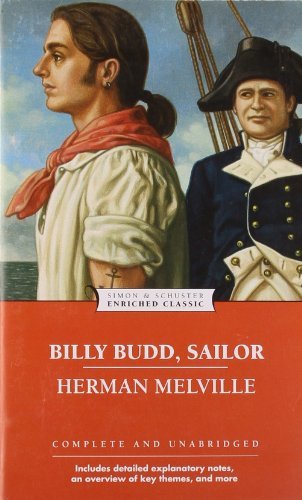
A handsome young sailor is unjustly accused of plotting mutiny in this timeless tale of the sea.--back cover
Academics hail it as the beginning of modernism, but to readers around the world—even those daunted by Moby-Dick—Bartleby the Scrivener is simply one of the most absorbing and moving novellas ever. Set in the mid-19th century on New York City's Wall Street, it was also, perhaps, Herman Melville's most prescient story: what if a young man caught up in the rat race of commerce finally just said, "I would prefer not to"?The tale is one of the final works of fiction published by Melville before, slipping into despair over the continuing critical dismissal of his work after Moby-Dick, he abandoned publishing fiction. The work is presented here exactly as it was originally published in Putnam's magazine—to, sadly, critical disdain.

On an island off the coast of Chile, Captain Amaso Delano, sailing an American sealer, sees the San Dominick, a Spanish slave ship, in obvious distress. Capt. Delano boards the San Dominick, providing needed supplies, and tries to learn from her aloof and disturbed captain, Benito Cereno, the story of how this ship came to be where she is. Dealing with racism, the slave trade, madness, the tension between representation and reality, and featuring at least one unreliable narrator, Melville's novella has both captivated and frustrated critics for decades.

Typee is a fast-moving adventure tale, an autobiographical account of the author's Polynesian stay, an examination of the nature of good and evil, and a frank exploration of sensuality and exotic ritual.The 100 Greatest Masterpieces of American Literature a limited edition collection is published under the auspices of The American Revolution Bicentennial Administration

Tales of compelling power by one of America's greatest writersStung by the critical reception and lack of commercial success of his previous two works, Moby-Dick and Pierre, Herman Melville became obsessed with the difficulties of communicating his vision to readers. His sense of isolation lies at the heart of these later works. "Billy Budd, Sailor," a classic confrontation between good and evil, is the story of an innocent young man unable to defend himself against a wrongful accusation. The other selections here--"Bartleby," "The Encantadas," "Benito Cereno," and "The Piazza"--also illuminate, in varying guises, the way fictions are created and shared with a wider society.In his introduction Frederick Busch discusses Melville's preoccupation with his "correspondence with the world," his quarrel with silence, and why fiction was, for Melville,"a matter of life and death."Bartleby --The piazza --The Encantadas --The bell-tower --Benito Cereno --The paradise of bachelors and the tartarus of maids --Billy Budd, sailor.

Male, female, deft, fraudulent, constantly shifting: which of the masquerade of passengers on the Mississippi steamboat Fidele is the confidence man? The central motif of Melville's last and most modern novel can be seen as a symbol of American cultural history.

Herman Melville towers among American writers not only for his powerful novels, but also for the stirring novellas and short stories that flowed from his pen. Two of the most admired of these — "Bartleby" and "Benito Cereno" — first appeared as magazine pieces and were then published in 1856 as part of a collection of short stories entitled The Piazza Tales."Bartleby" (also known as "Bartleby the Scrivener") is an intriguing moral allegory set in the business world of mid-19th-century New York. A strange, enigmatic man employed as a clerk in a legal office, Bartleby forces his employer to come to grips with the most basic questions of human responsibility, and haunts the latter's conscience, even after Bartleby's dismissal."Benito Cereno," considered one of Melville's best short stories, deals with a bloody slave revolt on a Spanish vessel. A splendid parable of man's struggle against the forces of evil, the carefully developed and mysteriously guarded plot builds to a dramatic climax while revealing the horror and depravity of which man is capable.Reprinted here from standard texts in a finely made, yet inexpensive new edition, these stories offer the general reader and students of Melville and American literature sterling examples of a literary giant at his story-telling best.--back cover

Initially dismissed as "a dead failure" and "a bad book," and declined by Melville's British publisher, Pierre has since struck critics as modern in its psychological probings and literary technique—fit, as Carl Van Vechten said in 1922, to be ranked with The Golden Bowl, Women in Love, and Ulysses. None of Melville's other "secondary" works has so regularly been acknowledged by its most thorough critics as a work of genuine grandeur, however flawed.When Pierre Glendinning's lifelong desire for a sister is seemingly realized on the eve of his marriage, his world is suddenly turned upside down, for he must choose between acknowledging his illegitimate half-sister or perpetuating his unsullied family legacy. Melville unfolds the story of an idealistic young man whose steadfast beliefs lead him to destroy his world and himself.HarperCollins is proud to present this controversial masterpiece of American literature, now restored to its original form and illuminated with 30 full-color pictures by Maurice Sendak.

Between 1849 and 1851, Melville wrote three masterful stories of the sea (including the classic Moby-Dick) that captured colorful and comic glimpses of shipboard life, the excitement of the whale hunt, and seascapes that move from the brutal to the sublime; they also displayed a marvelous command of language that mixes the ordinary talk of sailors with the rhythms of the Bible and Shakespearean hyperbole. Together the works in this Library of America volume reveal Melville’s obsession with the possibilities of human freedom, the sacrifice of that freedom to the demands of social cohesion, and the submission of social groups—represented by the shipboard community—to traditional forms of authority.

Melville’s continuing adventures in the South Seas Following the commercial and critical success of Typee , Herman Melville continued his series of South Sea adventure-romances with Omoo . Named after the Polynesian term for a rover, or someone who roams from island to island, Omoo chronicles the tumultuous events aboard a South Sea whaling vessel and is based on Melville’s personal experiences as a crew member on a ship sailing the Pacific. From recruiting among the natives for sailors to handling deserters and even mutiny, Melville gives a first-person account of life as a sailor during the nineteenth century filled with colorful characters and vivid descriptions of the far-flung locales of Polynesia.For more than seventy years, Penguin has been the leading publisher of classic literature in the English-speaking world. With more than 1,700 titles, Penguin Classics represents a global bookshelf of the best works throughout history and across genres and disciplines. Readers trust the series to provide authoritative texts enhanced by introductions and notes by distinguished scholars and contemporary authors, as well as up-to-date translations by award-winning translators.

Included in this Herman Melville collection are six tales that range considerably -- from "The Encantadas" (an allegorical travelogue) to the haunting "Bartleby, the Scrivener." Opening the volume is "The Piazza," a pastoral sketch that frames the collection. "Benito Cereno" -- a subversive satire -- of grows out of a true story of mutiny among the enslaved . . .1."The Piazza"2."Bartleby the Scrivener" (first published in Putnam's November and December 1853)3."Benito Cereno" (first published in Putnam's October, November and December 1855)4."The Lightning-Rod Man" (first published in Putnam's August 1854)5."The Encantadas or Enchanted Isles" (first published in Putnam's March, April, and May 1854)6."The Bell-Tower" (first published in Putnam's August 1855)

The mixture of journalism, history and fiction; the presentation of a sequence of striking characters; the metaphor of a sailing ship as the world in miniature—all of these prefigure his next novel, Moby-Dick. The symbolism of the color white, introduced in this novel in the form of the narrator's jacket, is more fully expanded upon in Moby-Dick, where it becomes an all-encompassing "blankness." Melville's (best known for his classic whaling novel) White Jacket was first published in 1850 and is considered to be a semi-biographical book, written from Melville's own personal experiences while returning home to the Atlantic Coast from the South Seas with the American Navy on a man-o'-war vessel. In the note preceding the novel, Melville states, "In the year 1843 I shipped as 'ordinary seaman' on board of a United States frigate then lying in a harbor of the Pacific Ocean. After remaining in this frigate for more than a year, I was discharged from the service . . ."

Wellingborough Redburn is a fifteen-year-old from the state of New York, with only one dream - to run away to sea. However, when he does fulfil this long-held fantasy, he quickly finds that reality as a cabin boy is far harsher than he ever imagined. Mocked by the crew on board the Highlander for his weakness and bullied by the vicious and merciless sailor Jackson, Wellingborough must struggle to endure the long journey from New York to Liverpool. But when he does reach England, he is equally horrified by what he finds there: poverty, desperation and moral corruption. Inspired by Melville's own youthful experiences on board a cargo ship, this is a compelling tale of innocence transformed, through bitter experience, into disillusionment. A fascinating sea journal and coming-of-age tale, Redburn provides a unique insight into the mind of one of America's greatest novelists.

THE PIAZZA - BARTLEBY - BENITO CERENO - THE LIGHTNING-ROD MAN - THE ENCANTADAS - THE BELL TOWER - THE TOWN-HO’S STORYThe short stories of Herman Melville are considered today to be among the small masterpieces of American fiction. BILLY BUDD, Melville's posthumously published novella, is a classic tale of innocence, evil, and murder that depicts the rivalry between a simple, handsome young sailor and a demonic superior. BARTLEBY is the subtly comic tale of an apathetic scrivener, and BENITO CERENO is the story of a Spanish sea captain caught up in a slave revolt on his ship. Included in this volume are THE PIZZA TALES as well as THE TOWN-HO'S STORY, a chapter from MOBY-DICK. By turns haunting and comic, and always compelling, these fine stories convey the diversity and grandeur of Melville's talent as well as the depth of his themes.--back cover

Collected in this volume are Bartleby the Scrivener, Benito Cereno, and Billy Budd—presented in the best texts available, those published during Melville's lifetime and corrected by the author.Each text has been carefully edited and annotated for student readers.As his writing reflects, Melville was extraordinarily well read. "Contexts" collects important sources for each novel, including writings by Ralph Waldo Emerson, Amasa Delano, and Nathaniel Hawthorne."Criticism" includes twenty-eight essays about the novels sure to promote classroom discussion. Contributors include Leo Marx, Elizabeth Hardwick, Frederick Busch, Robert Lowell, Herschel Parker, Carolyn L. Karcher, Thomas Mann, and Hannah Arendt.A Selected Bibliography is included.--wwnorton.co.uk

BabyLit: A series of board books for brilliant babies.BabyLit is a fashionable way to introduce your toddler to the world of classic literature. With clever, simple text by Jennifer Adams, paired with stylish design and illustrations by Sugar's Alison Oliver, these books are a must for every savvy parent's nursery library.

The inaugural volume of The Library of America presents one of America’s greatest writers, Herman Melville (1819–1891). These three early novels are stirring romances of the South Seas; many of their fictional details resemble some of the events in Melville’s own life in the early 1840s. Like the hero-narrator of Typee and Omoo, Melville shipped out on a whaler, jumped ship in exotic ports, was held captive by native tribes—though here he might have exaggerated his own exploits a bit—and escaped to find passage home in the service of the United States Navy.Exuberant, highly pictorial, with a clear, swift narrative, Typee (1846) was his most popular work well into the 20th century, outselling all his others, including Moby-Dick. It offers a mostly idyllic account of life among the “cannibals” in which civilized innocence is contrasted with the corrosive effects of 19th-century industrial society.A sequel to Typee, Omoo (1847) continues this inquiry into Pacific culture and those who intruded upon it, specifically in Tahiti. Melville details the misadventures of the unruly and overworked crew of the Australian trader Julia after they are imprisoned for insubordination; the story will perhaps surprise today’s readers with its humor.With Mardi (1849), Melville abandons a literary Polynesia for a mythical one. “Mardi” is the Polynesian word for “the world,” and the voyage through imaginary South Sea archipelagoes stops off at Dominora (Britain), Porpheero (Europe), and Vivenza (the United States). Tracing the quest for the elusive and beautiful Yillah, it remains a timely political allegory and a thrilling adventure.Together, these three romances give early evidence of the genius and daring that make Melville the master novelist of the sea and a precursor of modernist literature.

Billy Budd, Sailor and Bartleby, the Scrivener are two of the most revered shorter works of fiction in history. Here, they are collected along with 19 other stories in a beautifully redesigned collection that represents the best short work of an American master.As Warner Berthoff writes in his introduction to this volume, "It is hard to think of a major novelist or storyteller who is not also a first-rate entertainer . . . a master, according to choice, of high comedy, of one or another robust species of expressive humour, or of some special variety of the preposterous, the grotesque, the absurd. And Melville, certainly, is no exception. A kind of vigorous supervisory humour is his natural idiom as a writer, and one particular attraction of his shorter work is the fresh further display it offers of this prime element in his literary character."The town-ho's story --Bartleby, the scrivener : a story of Wall-Street --Cock-a-doodle-doo! or, The crowing of the noble cock Beneventano --The encantadas or Enchanted Isles --The two temples --Poor man's pudding and rich man's crumbs --The happy failure : a story of the river Hudson --The lightning-rod man --The fiddler --The paradise of bachelors and the tartarus of maids --The bell-tower --Benito Cereno --Jimmy Rose --I and my chimney --The 'Gees --The apple-tree table, or Original spiritual manifestations --The piazza --The Marquis de Grandvin --Three "Jack Gentian sketches" --John Marr --Daniel Orme --Billy Budd, sailor.

Though best-known for his epic masterpiece Moby-Dick, Herman Melville also left a body of short stories arguably unmatched in American fiction. In the sorrowful tragedy of Billy Budd,Sailor; the controlled rage of Benito Cereno; and the tantalizing enigma of Bartleby, the Scrivener; Melville reveals himself as a singular storyteller of tremendous range and compelling power. In these stories, Melville cuts to the heart of race, class, capitalism, and globalism in America, deftly navigating political and social issues that resonate as clearly in our time as they did in Melville's. Also including The Piazza Tales in full, this collection demonstrates why Melville stands not only among the greatest writers of the nineteenth century, but also as one of our greatest contemporaries.This Penguin Classics edition features the Reading Text of Billy Budd, Sailor, as edited from a genetic study of the manuscript by Harrison Hayford and Merton M. Sealts, Jr., and the authoritative Northwestern-Newberry text of The Piazza Tales.

Herman Melville's brilliant works remain vital and provocative for their dark ebullience and visionary power. The sweep of his writings- encompassing ferocious social satire, agonized reflection, and formal experimentation-is represented in this comprehensive edition. Here are Melville's masterpieces: Moby-Dick in its entirety; Billy Budd; "Bartleby, The Scrivener"; "The Encantadas, or Enchanted Isles"; the essay "Hawthorne and His Mosses"; and 21 poems, including "The House-top", an anguished response to the New York draft riots.

Largely neglected in his own lifetime, Herman Melville mastered not only the great American novel but also the short story and novella forms. In Billy Budd and The Piazza Tales, Melville reveals an uncanny awareness of the inscrutable nature of reality.Published posthumously in 1924, Billy Budd is a masterpiece second only to Melville’s Moby-Dick. This complex short novel tells the story of “the handsome sailor” Billy who, provoked by a false charge, accidentally kills the satanic master-at-arms. Unable to defend himself due to a stammer, he is hanged, going willingly to his fate. Although typically ambiguous, Billy Budd is seen by many as a testament to Melville’s ultimate reconciliation with the incongruities and injustices of life.The Piazza Tales (1856) comprises six short stories, including the perpetually popular “Benito Cereno” and “Bartleby,” a tale of a scrivener who repeatedly distills his mordant criticism of the workplace into the deceptively simple phrase “I would prefer not to.” Billy BuddThe piazza --Bartleby --Benito Cereno --The lightning-rod man --The encantadas --The bell-tower --

In the Galapagos Islands with Herman Melville, the Encantadas or Enchanted Isles
by Herman Melville
Rating: 3.4 ⭐
Sail to the exotic Galapagos Islands with Herman Melville , author of Moby-Dick . Let History and Legend, Fiction and Fact, Myth and Mystery swirl around you as you enter "The Encantadas," a unique island world stretching along our planet's Equator. ~ Discover teeming seabird rookeries, stark volcanic landscapes, and world famous giant tortoises . . . ~ Meet buccaneers and explorers, colonists and castaways, whalers and naturalists . . . ~ Explore these Enchanted Isles with one of America's greatest writers . . . ~ Enrich your once-in-a-lifetime visit to . . . The Galapagos Islands. Travelers have been arriving in the Galapagos Islands since at least 1535. While naturalist Charles Darwin made these volcanic peaks famous, Spanish explorers, English buccaneers, American whalers, Ecuadorian colonists, and a United States President all put in appearances here over the centuries. Herman Melville was one such visitor. He first glimpsed the Galapagos Islands as a young seaman on the whaler Acushnet out of New Bedford, Massachusetts. Years later, after the failure of his novel Moby-Dick , he tried to regain his lost popularity with the reading public by writing a series ten of magazine sketches he called "The Encantadas or Enchanted Isles," recalling the strange worlds he found in the Galapagos archipelago. Written for today's visitor, or armchair visitor, In the Galapagos Islands with Herman Melville includes these ten sketches, and more. Bring it with you to the Galapagos Islands or read it before you leave home. Enhance your enjoyment of the Enchanted Isles with these glimpses of their captivating natural and human history written over 150 years ago by that famous fellow traveler. In the Galapagos Islands with Herman Melville includes . . .~ Herman Melville's ten sketches that he called "The Encantadas or Enchanted Isles."~ Forty of Moses Michelsohn's striking b&w photographs (in color in the ebook) from the Galapagos birds, iguanas, giant tortoises, sea lions, exotic plants, and volcanic landscapes.~ Lynn Michelsohn's introduction to the work, and to each individual sketch. We hope you enjoy your visit to the Galapagos Islands!

'No voice, no low, no howl is heard; the chief sound of life here is a hiss.' Stories and poems by Herman Melville drawn from his years at sea Introducing Little Black Classics: 80 books for Penguin's 80th birthday. Little Black Classics celebrate the huge range and diversity of Penguin Classics, with books from around the world and across many centuries. They take us from a balloon ride over Victorian London to a garden of blossom in Japan, from Tierra del Fuego to 16th century California and the Russian steppe. Here are stories lyrical and savage; poems epic and intimate; essays satirical and inspirational; and ideas that have shaped the lives of millions. Herman Melville (1819-1891). Melville's works available in Penguin Classics are Moby-Dick, Pierre, The Confidence-Man, Omoo, Redburn, Israel Potter and Billy Budd, Sailor and Other Stories.

Pierre / Israel Potter / The Piazza Tales / The Confidence-Man / Uncollected Prose / Billy Budd
by Herman Melville
Rating: 4.2 ⭐
Forgoing the narratives of the sea that prevailed in his earlier works, Melville's later fiction contains some of the finest and many of his keenest and bleakest observations of life, not on the high seas, but at home in America. With the publication of this Library of America volume, the third of three volumes, all Melville's fiction has now been restored to print for the first time.Pierre; or, The Ambiguities, published in 1852 (the year after Moby-Dick), moves between the idyllic Berkshire countryside and the nightmare landscape of early New York City. Its hero, a young American patrician trying to redeem the secret sins of his father, elopes to the city, discovers Bohemian life, attempts a literary epic, and struggles his way through incest, murder, and madness. Long a controversial work, it is Melville's darkest satire of American life and letters and one of his most powerful books.A pivotal work, both for Melville's career and for American literature, Pierre was followed by Israel Potter, the story of a veteran of the Revolution, victim of a thousand mischances, and a long-suffering exile in England. Along the way are memorable episodes of war and intrigue, with personal portraits of Benjamin Franklin, John Paul Jones, and George III. In the exploits of this touchingly optimistic soldier, Melville offers a scathing image of the collapse of revolutionary hopes.The Piazza Tales demonstrates Melville's dazzling mastery of many styles, including "The Encantadas," about nature's two faces--enchanting and horrific; the famous "Bartleby the Scrivener," about a Wall Street copyist who "would prefer not to"; and the enigmatic "Benito Cereno," about a credulous Yankee sea captain who stumbles into an intricately plotted mutiny aboard a disabled slave ship.The Confidence-Man, Melville's last published novel, is in many ways a forerunner of modernist American fiction. An extended meditation on faith, hope, and charity as these are manifested on board a Mississippi riverboat one April Fools' Day, it presents a menagerie of Americans buying and selling, borrowing and lending, believing and mistrusting, as they are carried toward the auction blocks of New Orleans.Many pieces never before collected are also included: the "Authentic Anecdotes of Old Zack" (burlesque sketches of Zachary Taylor's Mexican campaign), "Fragments from a Writing-Desk" (Melville's earliest surviving prose), reviews of Hawthorne, Parkman, and Cooper, and all the tales Melville published in magazines during the 1850s.Finally, there is the posthumously published masterpiece Billy Budd, Sailor, the haunting story of a beautiful, innocent sailor who is pressed into naval service, slandered, provoked to murder, and sacrificed to military justice. While encouraging questions for which there are no answers, it invites us to meditate on the conflicts central to all Melville's work: between freedom and fate, innocence and civilized corruption.

Herman Melville's Israel Potter is the fictionalised tale of a man who really did fight in the American Revolution - a man who lived a life of very real adventure. After fighting in the revolution, he went on to be a part of the newly-established United States Navy, ended up serving as a secret courier for Benjamin Franklin. Bits of this are fiction, and may be even more spectacular. . . .

„Poniektórzy powiadają, że wieloryb nie jest zdolen otworzyć swej paszczy, to wszelako jest bajką”. – „Podróż do Grenlandii”, A.D. 1671, Harris Collection„Oczywiście, że [biały wieloryb] to symbol. Ale symbol czego? Myślę, że nawet Melville tego nie wiedział. I to jest najlepsze w Moby Dicku!”– D.H. Lawrence„Wszelkie omówienie czy też wprowadzenie do tej powieści musi przypominać próbę zapakowania wieloryba do puszki po sardynkach. «Moby Dick» to […] epika najwyższych lotów, podejmująca wiele wątków mitologicznych i biblijnych. To utwór metafizyczny, prometejski, nihilistyczny, komiczny, tragiczny, mistyczno-erotyczny, nietzscheański […]”– fragmenty eseju Mikołaja Wiśniewskiego

A short story from the Classic Shorts The Happy Failure by Herman Melville

A short story from the Classic Shorts The Happy Failure by Herman Melville

„Wieloryb to zwierzę ssące, pozbawione tylnych kończyn”.– Baron Cuvier„«Moby Dick» jest pełen znaczeń, ale jego znaczenie to nierozwiązywalny problem. Błędem byłoby traktować [nazwę statku] «Rozkosz» lub trumnę [Queequega] jako symbole: nawet jeśli takie symboliczne odczytanie jest trafne, spłaszcza ono książkę. O «Moby Dicku» nie możemy powiedzieć nic ponadto, że jest polem walki”– E.M. Forster„[…] na koniec swoich rozważań o cetologii, w rozdziale XXXII, Melville-Izmael stwierdza: «Niechaj Bóg mnie strzeże przed ukończeniem czegokolwiek! Cała ta książka to ledwie szkic – nie: szkic szkicu!». W tym samym też duchu należy czytać «Moby Dicka», to znaczy – nigdy nie kończyć”. – z posłowia Mikołaja Wiśniewskiego