
Herman Bavinck
Herman Bavinck (1854-1921) succeeded Abraham Kuyper as professor of systematic theology at the Free University of Amsterdam in 1902. His nephew was Johan Herman Bavinck.
30 Books Written

The timeliness of this book, first published in 1901, is shown by the fact that a great number of academic texts quote from it. "The Certainty of Faith" is one of the small but powerful classics written by one of the greatest theologians Holland has ever produced. Bavinck examines the difference between the certainty of science and that of religion historically, biblically, and theologically.

In partnership with the Dutch Reformed Translation Society, Baker Academic is proud to offer the first volume of Herman Bavinck's complete Reformed Dogmatics in English for the very first time. Bavinck's approach throughout is meticulous. As he discusses the standard topics of dogmatic theology, he stands on the shoulders of giants such as Augustine, John Calvin, Francis Turretin, and Charles Hodge. This masterwork will appeal to scholars and students of theology, research and theological libraries, and pastors and laity who read serious works of Reformed theology.

110 years after its original publication, The Wonderful Works of God remains one of the finest single-volume systematic theologies ever written. Adapting the magisterial systematic theology found in his four-volume Reformed Dogmatics, this is perhaps Bavinck’s most eminently practical work – a single, accessible volume for the college classroom and the family bookshelf. Previously published in America as Our Reasonable Faith, this book has had a deep and lasting influence on the growth and development of Reformed theology. It is the publisher’s hope that in its new form, this book continues to astonish readers with the wonderful works of God, and provide a deeper knowledge of their triune God.

In partnership with the Dutch Reformed Translation Society, Baker Academic is proud to offer the second volume of Herman Bavinck's complete Reformed Dogmatics in English for the very first time. This masterwork will appeal to scholars, students, pastors, and laity interested in Reformed theology and to research and theological libraries. "Bavinck was a man of giant mind, vast learning, ageless wisdom, and great expository skill. Solid but lucid, demanding but satisfying, broad and deep and sharp and stabilizing, Bavinck's magisterial Reformed Dogmatics remains after a century the supreme achievement of its kind."-J. I. Packer, Regent College

For the First Time in English, a Foundational Work of One of the Church's Most Important Theologians As some point in life, we all wonder: Who am I? What is the world, and what is my place within it? Only Christianity offers answers to these questions in a way that meets our truest needs and satisfies our deepest longings. In this important book, translated into English for the first time, Herman Bavinck provides a framework for understanding why the Christian worldview is the only solution to the discord we feel between ourselves, the world, and God.

In partnership with the Dutch Reformed Translation Society, Baker Academic is proud to offer in English for the very first time the third volume of Herman Bavinck's complete Reformed Dogmatics. This masterwork will appeal not only to scholars, students, pastors, and laity interested in Reformed theology but also to research and theological libraries. "Bavinck was a man of giant mind, vast learning, ageless wisdom, and great expository skill. Solid but lucid, demanding but satisfying, broad and deep and sharp and stabilizing, Bavinck's magisterial Reformed Dogmatics remains after a century the supreme achievement of its kind."--J. I. Packer, Regent College "This magisterial work exhibits Bavinck's vast knowledge and appreciation of the Christian tradition. Written from a Reformed perspective, it offers a perceptive critique of modern theology. . . . Recommended."--Library Journal

In partnership with the Dutch Reformed Translation Society, Baker Academic is proud to offer in English for the very first time the fourth and final volume of Herman Bavinck's complete Reformed Dogmatics, now also available as a four-volume set. This volume includes the combined indexes for all four volumes. In addition, editor John Bolt introduces each chapter and has enhanced the footnotes and bibliography. This masterwork will appeal not only to scholars, students, pastors, and laity interested in Reformed theology but also to research and theological libraries.

A century ago when this book was first published, marriage and the family were already weathering enormous changes, and that trend has not abated. Yet by God’s power the unchanging essence of marriage and the family remains proof, as Bavinck notes, that God’s “purpose with the human race has not yet been achieved.”Neither a ten-step guide nor a one-sided approach, this book embodies a Christian theology of marriage and the family. Accessible, thoroughly biblical, and astonishingly relevant, it offers a mature and concise handling of the origins of marriage and family life and the effects of sin on these institutions, an appraisal of historic Christian approaches, and an attempt to apply that theology.Aptly reminding Christians that “the moral health of society depends on the health of family life,” Bavinck issues an evergreen challenge to God’s people: “Christians may not permit their conduct to be determined by the spirit of the age, but must focus on the requirement of God’s commandment.”

Herman Bavinck's four-volume "Reformed Dogmatics" is one of the most important theological works of the twentieth century. The recently completed English translation has received wide acclaim. Now John Bolt, one of the world's leading experts on Bavinck and editor of Bavinck's four-volume set, has abridged the work in one volume, offering students, pastors, and lay readers an accessible summary of Bavinck's masterwork. This volume presents the core of Bavinck's thought and offers explanatory materials, making available to a wider audience some of the finest Dutch Reformed theology ever written.

In addition to exegetical, biblical, and systematic theology, there is room also for a philosophy of revelation which will trace the idea of revelation, both in its form and in its content, and correlate it with the rest of our knowledge and life, writes the author, one of the most distinguished Reformed theologians of the twentieth century. Theological thought has always felt the need of such a science. Thus Philosophy of Revelation, first published in 1909, is part of the same discipline and heritage as James Orr's 'The Christian View of God and the World' (1893) and Gordon Clark's 'A Christian View of Men and Things' (1952). Bavinck deals with the relationship between revelation and (in chapters 2-3) philosophy, (4) nature, (5) history, (6) religion, (7) Christianity, (8) religious experience, (9) culture, and (10) the future. He contends that the word cannot be explained without God, that the natural and social sciences presuppose metaphysics, and that none of the subjects under consideration here is intelligible or meaningful apart from special revelation.

In partnership with the Dutch Reformed Translation Society, Baker Academic is proud to offer in English for the very first time all four volumes of Herman Bavinck's complete "Reformed Dogmatics." This masterwork will appeal not only to scholars, students, pastors, and laity interested in Reformed theology but also to research and theological libraries.

Herman Bavinck's four-volume Reformed Dogmatics is one of the most important theological works of the twentieth century. Leading Bavinck expert John Bolt edited that work, which has received wide acclaim. Now Bolt brings forth a recently discovered manuscript from Bavinck, in print for the first time, which serves as a companion to Reformed Dogmatics. Reformed Ethics mines the moral teachings of the early church and medieval and Puritan spirituality while addressing a variety of topics, offering readers Bavinck's mature reflections on ethical issues. This book is the first of three planned volumes.

Dutch theologian Herman Bavinck (1854-1921) is widely celebrated as one of the most eloquent divines in the Reformed tradition. And yet there is a curious gap between Bavinck the theologian and the preachers who read him in the present day. How Bavinck preached, or what and how he thought about the act of preaching, are largely unknown. The largest barrier is that his writings on preaching were previously untranslated--until now. Herman Bavinck on Preaching & Preachers is a welcome translation from Dutch of Bavinck's thoughts on preaching and preachers, and includes one of his only written sermons.For Bavinck, the sermon was the most important part of the worship service, and the preaching of the word is the decisive mark of the church. He believed that the preacher must be a student of the word, search it in all its riches and depth, in its unity and diversity. Translator and editor James Eglinton describes this book as a "useful and very interesting text on how to preach theology" and a "message that sorely needs to be heard if pulpits during our own time are to improve." This is the first time this book is in print. Herman Bavinck on Preaching & Preachers has never been published before in either Dutch or English.

In this classic work, theologian Herman Bavinck reflects on the Christian's call to publicly profess the name of Christ.Chapters The Basis or Foundation of ConfessionII. The Training or Bringing Up Unto ConfessionIII. The Rule of ConfessionIV. The Essence of ConfessionV. The Contents of ConfessionVI. The Diversity of ConfessionVII. The Universality of ConfessionVIII. The Obligation to ConfessionIX. The Opposition to ConfessionX. The Strength for ConfessionXI. The Reward of ConfessionXII. The Triumph of Confession

The doctrine of God is the foundation of Christian theology and the prerequisite of all true faith. Yet, despite this, few books expound the biblical teaching on the being and character of God himself, or encourage that glorifying of his name for which man is made and redeemed. Observing this need, William Hendriksen also saw how admirably it had been met, for those able to read Dutch, in the second volume of Herman Bavinck's Gereformeerde Dogmatiek (Reformed Dogmatics). The result was this present translation, making available some of the most important of Bavinck's material for the English-speaking world and providing, in the words of Hendriksen, 'a spiritual treat' for the serious reader. More fully this volume has been described as a 'model of exhaustive and balanced exegesis. Careful historical presentation, painstaking effort to do justice to both sides of a question and always a welath of biblical material to support its views make The Doctrine of God an unusually accurate and authoritative volume. The chapters God's Incomprehensibility, God's Knowability, God's Names, God's Incommunicable Attributes, God's Communicable Attributes, The Holy Trinity, and God's Counsel.' The Christian Church has had many historians of theology but few men who were themselves master theologians. Bavinck belonged to that small grop and as will always be found in such cases, he possessed both high gifts of intellect and real consecration to Christ. His memorable words at death, 'My learning does not help me now...faith alone saves me', exemplified the spirit in which he had sought to live.

In this book, Dutch theologian Herman Bavinck (1854–1921) provides a historical sketch on the nature of Christianity and the unifying power of Christ. He proceeds from unity to diversity―on where the Christian church agrees to the areas where it differs. It is apologetic and evangelistic, ecumenical and Reformed, and historical and theological in scope. In this succinct book, Bavinck traces the history of Christian doctrine and life, distinguishing the East from the West, and then focusing on the West through the Reformation to the twentieth century. Both at the beginning and the end of the book, he places before the reader what he deemed the most important religious and theological question of the Who is Jesus?“It is no small task which Dr. Bavinck has undertaken, to tell in sixty-two small pages all that Christianity is, and that, in a series in which it is brought into comparison with other ‘great religions’. He has fulfilled this task, however, in a most admirable manner. His method is, first, to point out what all Christians are agreed upon; and then to give an historical account of Christianity in its origins and it its progressive manifestations in the great forms of the Orthodox Eastern, the Romish, the Lutheran, Reformed Churches, with further descriptions of the forms it has taken since, in Anabaptism and Socinianism, and the New Protestantism rooted in the Enlightenment. His plan thus resolves itself into an informal sketch of the historical development of Christianity. This sketch is written with remarkable grasp of details and an equally remarkable power of synthesis. We cannot imagine how the work could be done better.” ―B.B. Warfield

Herman Bavinck, the premier theologian of the Kuyper-inspired, neo-Calvinistic revival in the late-nineteenth-century Netherlands, is an important voice in the development of Protestant theology. Essays on Religion, Science, and Society is the capstone of his distinguished career. These seminal essays offer an outworking of Bavinck's systematic theology as presented in his Reformed Dogmatics and engage enduring issues from a biblical and theological perspective. The work presents his mature reflections on issues relating to ethics, education, politics, psychology, natural science and evolution, aesthetics, and philosophy of religion.This collection--Bavinck's most significant remaining untranslated work--is now available in English for the first time. Pastors, students, and scholars of Reformed theology will value this work.
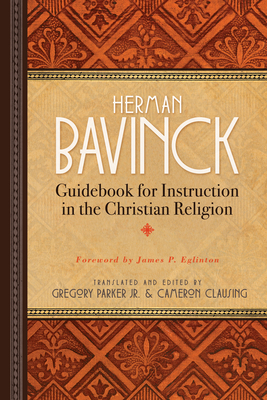
“In writing this Guidebook,” Bavinck says in his preface, “I had in mind, the pupils in the highest classes of our Christian gymnasium, public schools, in the education of teachers, and in normal schools, etc. and moreover those who desire to understand the main content of our Christian, Reformed confession of faith through a not too comprehensive or expensive book.”Herman Bavinck completed Guidebook for Instruction in the Christian Religion in 1913 and reprinted it in the Netherlands in 1931. He originally intended it for high school students and Christians of every confession. Bavinck’s goal was to make Christians more familiar with the rich, deep thoughts of Scripture as universally expressed in the Christian faith.Guidebook for Instruction in the Christian Religion is an introductory systematic theology by one of the foremost theologians of the past century. Alongside The Sacrifice of Praise , this is Bavinck at his best doing catechetical theology. To this end, Bavinck sets off to explain in a simplified manner the main contents of the Christian religion, even giving it a title that is a tip of the hat to John Calvin’s Institute of the Christian Religion. While Bavinck’s lengthy Reformed Dogmatics is an academic work, Guidebook for Instruction serves a more egalitarian aim. It is a theological guide for the everyday person in the pew. In this one―and much shorter―volume, Bavinck walks Christian readers through all the major topics covered in Reformed Dogmatics with theological depth and insight.

This Companion to Theologian Herman Bavinck’s Christian Worldview Explores Christianity’s Contributions to Higher EducationAfter writing his well-known book Christian Worldview, Dutch Calvinist theologian and scholar Herman Bavinck focused his attention on how the Christian faith benefits higher learning, particularly religious studies, natural sciences, and the humanities.Christianity and Science explores the pros and cons of Christian science and features brief, informative sections on the natural sciences, the humanities, theological science and religious studies, the doctrine of revelation, the benefits of Christianity for scholarship, and what it means to develop a Christian university. Responding to the challenges of the modern age, Bavinck recognizes the significance of faith in education. Edited and translated in English for the first time by N. Gray Sutanto, James Eglinton, and Cory C. Brock, this fundamental work will inspire Christian teachers, practitioners, and seminarians in their pursuits. Foundational Text on Christian Analyzes how faith shapes various disciplines of higher education, with a section highlighting the construction of the Free University of Amsterdam in 1880 Each short section is packed with important information on the natural sciences, the humanities, and more Ideal for Educators, Students, and Considers holistic ways to teach future generations in a world that’s resistant to Christianity Companion to Bavinck’s Book Christian Worldview

In the late nineteenth century, two distinct reform movements coming out of the Dutch State Reformed Church (the Afscheiding of 1834 and the Doleantie of 1886) merged to form The Reformed Churches of the Netherlands (De Geereformeerde Kerken in Nederland). While both groups had much in common, there remained fundamental points of disagreement, which erupted into controversies over such doctrines as immediate regeneration and presumptive regeneration.In Saved by Grace, Herman Bavinck discusses God s gracious work in bringing fallen sinners to new life and salvation. He gives a careful historical analysis that shows how Reformed theologians have wrestled to understand and express the Holy Spirit s work in calling and regeneration since the seventeenth century. Bavinck also brings exegetical precision and theological clarity to the discussion, carefully avoiding the errors of undervaluing and overvaluing the use of means in work of salvation. This book, therefore, takes up questions with which every new generation of Reformed writers must grapple.

Herman Bavinck's four-volume Reformed Dogmatics is one of the most important theological works of the twentieth century. The English translation was edited by leading Bavinck expert John Bolt, who now brings forth a recently discovered manuscript from Bavinck that is being published for the first time. Serving as a companion to Reformed Dogmatics , Reformed Ethics offers readers Bavinck's mature reflections on ethical issues. This book, the second of three planned volumes, covers the duties of the Christian life and includes Bavinck's exposition of the Ten Commandments.

Born on December 13, 1854, in Hoogeveen, Drenthe, Holland, Herman Bavinck was the son of the Reverend Jan Bavinck, a leading figure in the secession from the State Church of the Netherlands in 1834. After theological study in Kampen, and at the University of Leiden, he graduated in 1880, and served as the minister of the congregation at Franeker, Friesland, for a year. According to his biographers, large crowds gathered to hear his outstanding exposition of the Scriptures.In 1882, he was appointed a Professor of theology at Kampen, and taught there from 1883 until his appointment, in 1902, to the chair of systematic Theology in the Free University of Amsterdam, where he succeeded the great Abraham Kuyper, then recently appointed Prime Minister of the Netherlands. In this capacity — an appointment he had twice before declined — Bavinck served until his death in 1921.

The great Reformed theologian Herman Bavinck (1854–1921) was famous for his study of many disciplines, including psychology. The pinnacle of his studies in theological psychology is Biblical and Religious Psychology. The book is divided into two parts which work in harmony to cultivate a theological anthropology that attends to who man psychologically is, in relation to God, according to both special and general revelation. Both readers acquainted with Bavinck and new readers will be captivated by the author’s typically rich and erudite style. Biblical and Religious Psychology, translated by Herman Hanko and edited by Gregory Parker Jr, with revisions by Annemarieke Ryskamp, is an enlightening and stimulating work that will help all readers think more deeply about the relationship between theology and psychology and appreciate the theological complexities of being human.

This short work first appeared in The Princeton Theological Review Vol. 7 No. 3 (1909), translated by Geerhardus Vos. Bavinck observes, "The Christian religion is by no means the sole content of history; long before Christianity made its appearance there existed in Greece and Rome a rich culture, a complete social organism, a powerful political system, a plurality of religions, an order of moral virtues and actions. And even now, underneath and side by side with the Christian religion a rich stream of natural life continues to flow. What, then, is the relation of Christianity to this wealth of natural life, which, originating in creation, has, under the law there imposed upon it, developed from age to age? What is the connection between nature and grace, creation and regeneration, culture and Christianity, earthly and heavenly vocation, the man and the Christian?"

Dios ama a su Iglesia. A tal punto Dios ama a su pueblo, que envió a su Hijo a vivir, morir y resucitar por su novia. Y no sólo eso, sino que también envió a su Espíritu Santo para aplicar todas las bendiciones del pacto que se encuentran en el libro del pacto, la Biblia.Es el Espíritu Santo, aquel que infaliblemente inspiró las Santas Escrituras, quien aplica a lo más profundo de nuestro corazón la realidad del pacto de gracia. Ese pacto expresa la potente y dulce voz del Dios trino que «Yo soy vuestro Dios, y ustedes son mi pueblo». En base a ese determinado tipo de relación, los creyentes pueden decir, «Dios, y solamente Dios, es el bien supremo del hombre». Tomado del prólogo, escrito por Israel Guerrero

Recent discussions of creation have centered on the skirmishes between creationists and evolutionists. However, as the editor of this volume points out, there is much more to the Christian doctrine of creation than scientific battles about origins and the age of the earth. To Herman Bavinck, the doctrine of creation, affirming the distinction between the Creator and his creature, is the starting point of true religion. Though Bavincks In the Beginning contains relevant treatments of frequently addressed topics, such as evolution, Darwinism, and the age of humanity, it also broadens the theological discussion of creation by exploring other elements of this essential doctrine, including angels and the spiritual world, the image of God in humans, the destiny of creation and humanity, and Gods providential care over creation. Herman Bavinck stands as one of historys finest Reformed theologians, yet his writings are only now being made available in English. In the Foundations of Creation Theology is the second installment in the Dutch Reformed Translation Societys translation of Bavincks classic Gereformeerde Dogmatiek (Reformed Dogmatics). The first installment is The Last Things.

Written a century ago, Bavinck's stately theology of "the last things"--from death to the parousia--offers sound exegetical guidance.

"The figure we encounter in the person of Christ on the pages of Scripture is a unique figure. On the one hand, He is very man. Nevertheless this same man was distinguished from all men and raised high above them."Divine and Human Nature of Christ is a dedicated reflection on the incarnation of Jesus Christ. Written with the Christological tenets of Anselm's Cur Deus Homo, this advantages of this essay is more basic speak, toned to meet the inquiries of those on the quest for the "Historical Jesus." Though Bavinck does paint an earthy portrait of Jesus, he demonstrates how this actually complements the divine nature of Christ.

This eBook comes complete with an active linked Table of Contents, making navigation quicker and easier.Table of ContentsThe Origin, Essence, and Purpose of ManDevelopment of the Doctrine of PredestinationSupralapsarianism and InfralapsarianismThe Knowledge of GodThe Divine and Human Nature of ChristThe FallDeathThe Covenant of GraceThe Divine Trinity The Greatness of GodThe Greatness and Miserableness of ManThe Present State of the WorldCalvin and Common Grace

The Foremost Problems of Contemporary Dogmatics: On Faith, Knowledge, and the Christian Tradition
by Herman Bavinck
Rating: 4.4 ⭐
Herman Bavinck on the challenges theologians faceHerman Bavinck’s counsel to theologiansA unique window into Bavinck’s thoughtAn overlooked work from a key Neo-Calvinist thinkerIn The Foremost Problems of Contemporary Dogmatics, Herman Bavinck identifies the primary challenges confronting Protestant theologians in the early twentieth century. Since the main difficulties do not concern specific heads of doctrine but arise in theological method, Bavinck’s focus narrows to the act of faith. Bavinck demonstrates the necessity of viewing faith as knowledge rather than mere trust, recounting the development of doctrine from the biblical authors through the dawn of the twentieth century. This book provides a unique window into Bavinck’s thought, as he speaks candidly about the limitations and failures of Reformed theology and the relative merits of modern thinkers. The Foremost Problems of Contemporary Dogmatics was a series of lectures delivered at the Free University shortly after Bavinck moved to Amsterdam in 1902. Edited and translated by Gert de Kok and Bruce R. Pass, these previously unpublished lectures are available for the first time in English.