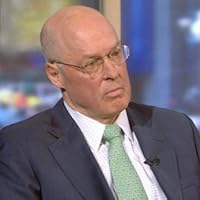
Henry M. Paulson Jr.
Henry Merritt "Hank" Paulson, Jr. (born March 28, 1946) is an American banker who served as the 74th United States Secretary of the Treasury. He had served as the Chairman and Chief Executive Officer of Goldman Sachs, and is now chairman of the Paulson Institute, which he founded in 2011 to promote sustainable economic growth and a cleaner environment around the world, with an initial focus on the United States and China. Paulson was born in Palm Beach, Florida, to Marianna (née Gallauer) and Henry Merritt Paulson, a wholesale jeweler. A star athlete at Barrington High School, Paulson was a champion wrestler and stand-out football player, graduating in 1964. Paulson received his A.B. in English from Dartmouth College in 1968; at Dartmouth he was a member of Phi Beta Kappa and Sigma Alpha Epsilon and he was an All-Ivy, All-East, and honorable mention All American as an offensive lineman. Paulson received his Master of Business Administration degree from Harvard Business School in 1970. He met his wife, Wendy Judge, a Wellesley College graduate, during his senior year. The couple have two adult children, sports-team owner Henry Merritt Paulson III, more commonly known as Merritt Paulson, and journalist Amanda Paulson. The Paulsons became grandparents in June 2007. They maintain homes in both Barrington Hills and Chicago. Paulson was Staff Assistant to the Assistant Secretary of Defense at The Pentagon from 1970 to 1972. He then worked for the administration of U.S. President Richard Nixon, serving as assistant to John Ehrlichman from 1972 to 1973. He joined Goldman Sachs in 1974, working in the firm's Chicago office under James P. Gorter, covering large industrial companies in the Midwest. He became a partner in 1982. From 1983 until 1988, Paulson led the Investment Banking group for the Midwest Region, and became managing partner of the Chicago office in 1988. From 1990 to November 1994, he was co-head of Investment Banking, then Chief Operating Officer from December 1994 to June 1998, eventually succeeding Jon Corzine as chief executive. His compensation package, according to reports, was $37 million in 2005, and $16.4 million projected for 2006. His net worth has been estimated at over $700 million. Paulson was nominated on May 30, 2006, by U.S. President George W. Bush to succeed John Snow as the Treasury Secretary. On June 28, 2006, he was confirmed by the United States Senate to serve in the position. Paulson was sworn in at a ceremony held at the Treasury Department on the morning of July 10, 2006. Paulson identified the wide gap between the richest and poorest Americans as an issue on his list of the country's four major long-term economic issues to be addressed, highlighting the issue in one of his first public appearances as Secretary of Treasury. Paulson conceded that chances were slim for agreeing on a method to reform Social Security financing, but said he would keep trying to find bipartisan support for it. He also helped to create the Hope Now Alliance to help struggling homeowners during the subprime mortgage crisis. After leaving his role as Treasury Secretary, Paulson spent a year at the Paul H. Nitze School of Advanced International Studies at Johns Hopkins University as a distinguished visiting fellow, and a fellow at the university's Bernard Schwartz Forum on Constructive Capitalism. His memoir, On the Brink Inside the Race to Stop the Collapse of the Global Financial System, was published by Hachette Book Group on February 1, 2010. On June 27, 2011, Paulson announced the formation of the Paulson Institute, an independent center located at the University of Chicago, dedicated to fostering international engagement to address issues of global scope, with particular emphasis on cooperation between the United States and China. Paulson was also named as a senior fellow at the University of Chicago's Harris School of Public Policy. His five-year appointment took effect July 1, 2
10 Books Written

Dealing with China: An Insider Unmasks the New Economic Superpower
by Henry M. Paulson Jr.
Rating: 4.1 ⭐
• 4 recommendations ❤️
The New York Times bestselling author of Dealing with China takes the reader behind closed doors to witness the creation and evolution and future of China's state-controlled capitalism.Hank Paulson has dealt with China unlike any other foreigner. As head of Goldman Sachs, Paulson had a pivotal role in opening up China to private enterprise. Then, as Treasury secretary, he created the Strategic Economic Dialogue with what is now the world's second-largest economy. He negotiated with China on needed economic reforms, while safeguarding the teetering U.S. financial system. Over his career, Paulson has worked with scores of top Chinese leaders, including Xi Jinping, China's most powerful man in decades.In Dealing with China , Paulson draws on his unprecedented access to modern China's political and business elite, including its three most recent heads of state, to answer several key How did China become an economic superpower so quickly?How does business really get done there?What are the best ways for Western business and political leaders to work with, compete with, and benefit from China?How can the U.S. negotiate with and influence China given its authoritarian rule, its massive environmental concerns, and its huge population's unrelenting demands for economic growth and security?Written in the same anecdote-rich, page-turning style as Paulson's bestselling memoir, On the Brink, Dealing with China is certain to become the classic and definitive examination of how to engage China's leaders as they build their economic superpower.

On the Brink: Inside the Race to Stop the Collapse of the Global Financial System
by Henry M. Paulson Jr.
Rating: 3.8 ⭐
When Hank Paulson, the former CEO of Goldman Sachs, was appointed in 2006 to become the nation's next Secretary of the Treasury, he knew that his move from Wall Street to Washington would be daunting and challenging. But Paulson had no idea that a year later, he would find himself at the very epicenter of the world's most cataclysmic financial crisis since the Great Depression. Major institutions including Bear Stearns, Fannie Mae, Freddie Mac, Lehman Brothers, AIG, Merrill Lynch, and Citigroup, among others-all steeped in rich, longstanding tradition-literally teetered at the edge of collapse. Panic ensnared international markets. Worst of all, the credit crisis spread to all parts of the U.S. economy and grew more ominous with each passing day, destroying jobs across America and undermining the financial security millions of families had spent their lifetimes building. This was truly a once-in-a-lifetime economic nightmare. Events no one had thought possible were happening in quick succession, and people all over the globe were terrified that the continuing downward spiral would bring unprecedented chaos. All eyes turned to the United States Treasury Secretary to avert the disaster. This, then, is Hank Paulson's first-person account. From the man who was in the very middle of this perfect economic storm, ON THE BRINK is Paulson's fast-paced retelling of the key decisions that had to be made with lightning speed. Paulson puts the reader in the room for all the intense moments as he addressed urgent market conditions, weighed critical decisions, and debated policy and economic considerations with of all the notable players-including the CEOs of top Wall Street firms as well as Ben Bernanke, Timothy Geithner, Sheila Bair, Nancy Pelosi, Barney Frank, presidential candidates Barack Obama and John McCain, and then-President George W. Bush. More than an account about numbers and credit risks gone bad, ON THE BRINK is an extraordinary story about people and politics-all brought together during the world's impending financial Armageddon.

Five Years Later: On the Brink - The New Prologue: A Look Back on What Happened, Why it Did, and Could it Happen Again?
by Henry M. Paulson Jr.
Rating: 3.6 ⭐
Henry M. Paulson, former Treasury Secretary, looks back on the financial crisis on its five year anniversary, and examines what happened, why it happened, and if it could happen again.

...


《紐約時報》2015年暢銷書二十年深度交往中國領導人與商界精英前美國財長、高盛總裁獨家講述中國與世界接軌的背後故事● 借重香港,國企巨頭重組上市的商業內幕中國電信、中石油、粵海企業、中銀香港、中國工商銀行● 眼光獨具的精英人物速寫習近平、李克強、王岐山、周小川、江澤民、朱鎔基、吳儀、薄熙來、周永康、李嘉誠● 與中國打交道的精彩回合朱鎔基掌舵重組中國電信;高盛結識李嘉誠開拓香港市場;與王岐山和周小川合作共渡金融危機● 一段非同尋常的香港故事大雨如注的港交所IPO上市日、9•11翌日的半島早餐、君悅酒店500位等待中的銀行家…… 較之大多數西方人,保爾森先生更加瞭解中國、中國政治以及中國領導人。──Andrew Ross Sorkin,《紐約時報》(New York Times)美國前財長亨利·保爾森在十數年間深入接觸中國的精英們。在西方, 除了基辛格外無人可以與其媲美。因此,《與中國打交道》是本非常重要的書。……任何巨權在握且又需要與中國打交道的人,都絕不應該錯過這本書。對普通讀者而言,這本書會帶來許多饒有趣味的題外細節。這些細節展現了中國領導人作為普通人的一面,而這往往是他們在塑造對外形象時刻意抹去的。保爾森筆下的一些ă

O livro trata do relato pessoal de Henry Paulson, ex Secretário do Tesouro Nacional Americano, um dos personagens da crise econômica/financeira que abalou o mundo. 'À beira do abismo financeiro' mostra a memória dos fatos que armaram o palco para a crise mundial. No livro, o autor que conta seus próprios erros.

Sự trỗi dậy của Trung Quốc thành một siêu cường kinh tế chắc chắn được xếp vào một trong những câu chuyện phi thường nhất trong lịch sử nhân loại.Chỉ trong gần ba thập kỷ, đất nước từng lạc hậu và cô lập này đã đưa hàng trăm triệu người thoát khỏi đói nghèo, đồng thời chuyển mình thành nền kinh tế lớn thứ hai thế giới. Sự nổi lên của Mỹ trở thành một siêu cường về công nghiệp đã manh nha sau cuộc Nội chiến, nhưng Trung Quốc đã vượt qua cuộc chạy đua vĩ đại của Mỹ và họ vẫn chưa dừng lại. Trong tương lai không xa, họ có thể vượt qua Mỹ để trở thành nền kinh tế lớn nhất thế giới, đánh bật vị trí số một mà nước Mỹ đã thống lĩnh trong gần 150 năm. Nhiều người Mỹ đang tự hỏi : Làm thế nào mà thế giới lại đảo lộn quá nhanh như vậy ?Người Trung Quốc thực sự muốn gì? Tại sao họ lại chi tiêu quá nhiều tiền cho quân đội? Họ là bạn hay kẻ thù, là đối tác thương mại hay là đối thủ về kinh tế và địa chính trị? Nói tóm lại, chúng ta phải đối phó với Trung Quốc như thế nào?Cuốn sách Ứng xử với Trung Quốc giải quyết các câu hỏi đó thông qua những kinh nghiệm của cá nhân tác giả khi làm việc với người Trung Quốc. Với tư cách một người Mỹ quan tâm sâu sắc đến vị thế, đến sức khỏe của nền kinh tế, và triển vọng lâu dài cho công dân của đất nước Mỹ, Henry M. Paulson cho rằng tất cả những điều này sẽ được hưởng lợi từ mối quan hệ tích cực với Trung Quốc, và rằng sự hợp tác có chọn lọc và mang tính xây dựng sẽ là cách tốt nhất để thúc đẩy lợi ích của Mỹ. Người Trung Quốc là một đối thủ đáng gờm. Tuy nhiên Mỹ không nên sợ cạnh tranh hoặc co lại vì điều đó.Paulson không phải là một học giả hay nhà lí thuyết. Ông là một doanh nhân có kiến thức thực tế về Trung Quốc và các nhà lãnh đạo công ty cũng như chính trị Trung Quốc. Những kiến thức ấy được Paulson thu thập từ hơn 100 lần đến Trung Quốc và trong gần 25 năm làm việc với quan chức nước này (từ Giang Trạch Dân, Chu Dung Cơ vào thập niên 1990, Hồ Cẩm Đào, Ôn Gia Bảo vào đầu thế kỉ 21 và Tập Cận Bình, Lý Khắc Cường hiện ) về những vấn đề thương mại khi làm việc tại Goldman Sachs, về những vấn đề của nhà nước và chính sách vĩ mô khi làm Bộ trưởng Tài chính Mỹ và giờ đây là chủ tịch của Viện Paulson thuộc ĐH Chicago.Paulson cho rằng mối quan hệ Mỹ-Trung sẽ cân bằng, an toàn và hiệu quả hơn cho cả hai bên nếu mỗi quốc gia thực hiện một vài điều chỉnh. Người Mỹ lo ngại về những hoạt động quân sự ngày càng tăng của Trung Quốc; trong khi đó Trung Quốc lại coi hành động “xoay trục hướng về châu Á” của Mỹ là một nỗ lực ngầm nhằm cản trở sự trỗi dậy của họ. Mỹ muốn Trung Quốc mở cửa thị trường cho các công ty của Mỹ đồng thời muốn họ tuân theo các quy tắc hiện tại khi hội nhập sâu hơn vào hệ thống quốc tế. Trong khi đó Trung Quốc lại thích sửa đổi các quy tắc này và muốn được tôn trọng hơn trên toàn cầu.Rõ ràng sẽ chẳng có lợi ích gì nếu hai cường quốc kinh tế quan trọng nhất thế giới chống lại nhau. Nhưng hợp tác và cư xử thế nào lại là nhiều bài toán khó tiên lượng. Và Ứng xử với Trung Quốc Paulson sẽ đưa ra những lời giải tường tận, khả thi.Giá sản phẩm trên Tiki đã bao gồm thuế theo luật hiện hành. Tuy nhiên tuỳ vào từng loại sản phẩm hoặc phương thức, địa chỉ giao hàng mà có thể phát sinh thêm chi phí khác như phí vận chuyển, phụ phí hàng cồng kềnh, .....

Global Partnerships, The Third Paradigm in Missions
by Henry M. Paulson Jr.
Ships directly from Amazon!

Pōruson kaikoroku
by Henry M. Paulson Jr.