
Henry James
Henry James was an American-British author. He is regarded as a key transitional figure between literary realism and literary modernism, and is considered by many to be among the greatest novelists in the English language. He was the son of Henry James Sr. and the brother of philosopher and psychologist William James and diarist Alice James. He is best known for his novels dealing with the social and marital interplay between émigré Americans, the English, and continental Europeans, such as The Portrait of a Lady. His later works, such as The Ambassadors, The Wings of the Dove and The Golden Bowl were increasingly experimental. In describing the internal states of mind and social dynamics of his characters, James often wrote in a style in which ambiguous or contradictory motives and impressions were overlaid or juxtaposed in the discussion of a character's psyche. For their unique ambiguity, as well as for other aspects of their composition, his late works have been compared to Impressionist painting. His novella The Turn of the Screw has garnered a reputation as the most analysed and ambiguous ghost story in the English language and remains his most widely adapted work in other media. He wrote other highly regarded ghost stories, such as "The Jolly Corner". James published articles and books of criticism, travel, biography, autobiography, and plays. Born in the United States, James largely relocated to Europe as a young man, and eventually settled in England, becoming a British citizen in 1915, a year before his death. James was nominated for the Nobel Prize in Literature in 1911, 1912, and 1916. Jorge Luis Borges said "I have visited some literatures of East and West; I have compiled an encyclopedic compendium of fantastic literature; I have translated Kafka, Melville, and Bloy; I know of no stranger work than that of Henry James."
32 Books Written

Widely recognized as one of literature's most gripping ghost stories, this classic tale of moral degradation concerns the sinister transformation of two innocent children into flagrant liars and hypocrites. The story begins when a governess arrives at an English country estate to look after Miles, aged ten, and Flora, eight. At first, everything appears normal but then events gradually begin to weave a spell of psychological terror.One night a ghost appears before the governess. It is the dead lover of Miss Jessel, the former governess. Later, the ghost of Miss Jessel herself appears before the governess and the little girl. Moreover, both the governess and the housekeeper suspect that the two spirits have appeared to the boy in private. The children, however, adamantly refuse to acknowledge the presence of the two spirits, in spite of indications that there is some sort of evil communication going on between the children and the ghosts.Without resorting to clattering chains, demonic noises, and other melodramatic techniques, this elegantly told tale succeeds in creating an atmosphere of tingling suspense and unspoken horror matched by few other books in the genre. Known for his probing psychological novels dealing with the upper classes, James in this story tried his hand at the occult - and created a masterpiece of the supernatural that has frightened and delighted readers for nearly a century.

During a trip to Europe, Christopher Newman, a wealthy American businessman, asks the charming Claire de Cintre to be his wife. To his dismay, he receives an icy reception from the heads of her family, who find Newman to be a vulgar example of the American privileged class. Brilliantly combining elements of comedy, tragedy, romance and melodrama, this tale of thwarted desire vividly contrasts nineteenth-century American and European manners.

(Book Jacket Status: Not Jacketed) Contents of Volume 1 A Landscape-PainterA Light ManA Passionate PilgrimThe Madonna of the FutureMadame de MauvesBenvolioDaisy Miller: A StudyAn International EpisodeThe Pension BeaurepasThe Point of ViewThe Siege of LondonLady BarberinaThe Author of "Beltraffio"Louisa PallantThe Aspern PapersThe LiarThe Lesson of the MasterThe PatagoniaThe PupilThe MarriagesThe ChaperonSir Edmund Orme

Henry James' short novel Daisy Miller enjoyed a great succes de scandale when it was first published in 1879, dealing as it does with the contrast between old and new world values.American Daisy Miller visits Europe with her mother and finds that her freshness and innocence are misinterpreted as immodesty and forwardness. This brings her into conflict with the differences in the two cultural traditions, inviting shock and disaster.Also included in this collection of stories from Henry James are Four Meetings, Longstaff's Marriage, and Benvolio.

When Isabel Archer, a beautiful, spirited American, is brought to Europe by her wealthy Aunt Touchett, it is expected that she will soon marry. But Isabel, resolved to determine her own fate, does not hesitate to turn down two eligible suitors. She then finds herself irresistibly drawn to Gilbert Osmond, who, beneath his veneer of charm and cultivation, is cruelty itself. A story of intense poignancy, Isabel's tale of love and betrayal still resonates with modern audiences.

James was a great travel writer as well as a great novelist. He visited Italy 14 times over a period of almost 40 years, his first visit in 1869 and his last in 1907 when he was 64 years old. This selection of his essays and correspondence is arranged by topographical subject and then chronologically to make an accessible and evocative companion for travellers and others. Annotation copyright Book News, Inc. Portland, Or.

It was in Rome during the autumn of 1877; a friend then living there but settled now in a South less weighted with appeals and memories happened to mention -- which she might perfectly not have done -- some simple and uninformed American lady of the previous winter, whose young daughter, a child of nature and of freedom, accompanying her from hotel to hotel, had "picked up" by the wayside, with the best conscience in the world, a good-looking Roman, of vague identity, astonished at his luck, yet (so far as might be, by the pair) all innocently, all serenely exhibited and introduced: this at least till the occurrence of some small social check, some interrupting incident, of no great gravity or dignity, and which I forget I had never heard, save on this showing, of the amiable but not otherwise eminent ladies, who weren't in fact named, I think, and whose case had merely served to point a familiar moral; and it must have been just their want of salience that left a margin for the small pencil-mark inveterately signifying, in such connections, "Dramatize, dramatize!" The result of my recognizing a few months later the sense of my pencil-mark was the short chronicle of DAISY MILLER. -- Henry James

Washington Square follows the coming-of-age of its plain-faced, kindhearted heroine, Catherine Sloper. Much to her father’s vexation, a handsome opportunist named Morris Townsend woos the long-suffering heiress, intent on claiming her fortune. When Catherine stubbornly refuses to call off her engagement, Dr. Sloper forces Catherine to choose between her inheritance and the only man she will ever truly love. Cynthia Ozick, in her Introduction to what she calls Henry James’s “most American fiction,” writes that “every line, every paragraph, every chapter [of Washington Square ] is a fleet-footed light brigade, an engine of irony.” Precise and understated, this charming novel endures as a matchless study of New York in the mid-nineteenth century.

Set amid the splendor of London drawing rooms and gilded Venetian palazzos, The Wings of the Dove is the story of Milly Theale, a naïve, doomed American heiress, and a pair of lovers, Kate Croy and Merton Densher, who conspire to obtain her fortune. In this witty tragedy of treachery, self-deception, and betrayal, Henry James weaves together three ill-fated and wholly human destinies unexpectedly linked by desire, greed, and salvation. As Amy Bloom writes in her Introduction, “The Wings of the Dove is a novel of intimacy. . . . [James] gives us passion, he gives us love in its terrible and enchanting forms.”

Concerned that her son Chad may have become involved with a woman of dubious reputation, the formidable Mrs Newsome sends her 'ambassador' Strether from Massachusetts to Paris to extricate him. Strether's mission, however, is gradually undermined as he falls under the spell of the city and finds Chad refined rather than corrupted by its influence and that of his charming companion, the comtesse de Vionnet. As the summer wears on, Mrs Newsome comes to the conclusion that she must send another envoy to Paris to confront the errant Chad, and a Strether whose view of the world has changed profoundly. James's favourite novel and one of the greatest of his late works, The Ambassadors is a subtle and often witty exploration of different American responses to a European environment.

Wealthy American widower Adam Verver and his daughter Maggie live in Europe, where they collect art and relish each other's company. Through the efforts of the manipulative Fanny Assingham, Maggie becomes engaged to Amerigo, an Italian prince in reduced circumstances, but remains blind to his rekindled affair with her longtime friend Charlotte Stant. Maggie and Amerigo marry, and later, after Charlotte and Adam have also wed, both spouses learn of the ongoing affair, though neither seeks a confrontation. Not until Maggie buys the gilded crystal bowl of the title as a birthday present for Adam does truth crack the veneer of propriety.

A young, inexperienced governess is charged with the care of Miles and Flora, two small children abandoned by their uncle at his grand country house. She sees the figure of an unknown man on the tower and his face at the window. It is Peter Quint, the master's dissolute valet, and he has come for little Miles. But Peter Quint is dead.Like the other tales collected here - Sir Edmund Orme, Owen Wingrave, and The Friends of the Friends - The Turn of the Screw is to all immediate appearances a ghost story. But are the appearances what they seem? Is what appears to the governess a ghost or a hallucination? Who else sees what she sees? The reader may wonder whether the children are victims of corruption from beyond the grave, or victims of the governess's `infernal imagination', which torments but also entrals her?The Turn of the Screw is probably the most famous, certainly the most eerily equivocal, of all ghostly tales. Is it a subtle, self-conscious exploration of the haunted house of Victorian culture, filled with echoes of sexual and social unease? Or is it simply, 'the most hopelessly evil story that we have ever read'?

In Henry James''s "Daisy Miller, a young American woman ventures into sophisticated European society, where her naivete provokes scandal and tragedy. Graham Greene called "Washington Square "the only novel in which a man has successfully invaded the feminine field and produced work comparable to Jane Austen''s." Each work weaves an intricate tale of marriage, money, and manners.

'The apparition had reached the landing half-way up and was therefore on the spot nearest the window, where, at the sight of me, it stopped short'Oscar Wilde called James's chilling The Turn of the Screw 'a most wonderful, lurid poisonous little tale.' It tells of a young governess sent to a country house to take charge of two orphans, Miles and Flora. Unsettled by a sense of intense evil within the house, she soon becomes obsessed with the belief that malevolent forces are stalking the children in her care. Obsession of a more worldly variety lies at the heart of The Aspern Papers, the tale of a literary historian determined to get his hands on some letters written by a great poet-and prepared to use trickery and deception to achieve his aims. Both works show James's mastery of the short story and his genius for creating haunting atmosphere and unbearable tension.Anthony Curtis's wide-ranging introduction traces the development of the two stories from initial inspiration to finished work and examines their critical reception.

The Bostonians is a novel by Henry James, first published as a serial in The Century Magazine in 1885-1886 and then as a book in 1886. This satire of the women’s rights movement in America is the story of the ravishing inspirational speaker Verena Tarrant and the bitter struggle between two distant cousins who seek to control her. Will the privileged Boston feminist Olive Chancellor succeed in turning her beloved ward into a celebrated activist and lifetime companion? Or will Basil Ransom, a conservative southern lawyer, steal Verena’s heart and remove her from the limelight?

Arguably the most popular and critically successful of James longer works, The Aspern Papers tells the story of a poetry enthusiast and aspiring biographer driven to desperate lengths to procure the last letters of a recently passed American poet, Jeffrey Aspern. Reflecting many of James own reservations about publicity and biographical exploitation, The Aspern Papers remains a powerful defense of the dignity and privacy that should be afforded all authors in life and in death.

After her parents' bitter divorce, young Maisie Farange finds herself turned into a 'little feathered shuttlecock' to be swatted back and forth by her selfish mother, Ida, and her vain father, Beale, who value her only as a means of provoking one another. And when both take lovers and remarry, Maisie-solitary, observant and wise beyond her years- is drawn into an entangled adult world of intrigue and sexual betrayal, until she is finally compelled to choose her own future. Published in 1897 when Henry James was becoming increasingly experimental with narrative technique and fascinated by the idea of the child's-eye view, What Maisie Knew is a subtle, intricate yet devastating portrayal of an innocent adrift in a corrupt society.

The Beast in the Jungle was first published in London by Henry James in 1903 by Methuen Publishing in the collection "The Better Sort".It is the story of John Marcher, a man who, for as long as he can remember, has been obsessed by the feeling that some life-changing - even catastrophic - event lies in wait for him like a jungle animal. Then the tragic day arrives on which the terrible true nature of the beast is revealed.Excerpt:speech that startled him in the course of their encounter scarcely matters, being probably but some words spoken by himself quite without intention—spoken as they lingered and slowly moved together after their renewal of acquaintance. He had been conveyed by friends an hour or two before to the house at which she was staying; the party of visitors at the other house, of whom he was one, and thanks to whom it was his theory, as always, that he was lost in the crowd, had been invited over to luncheon. There had been after luncheon much dispersal, all in the interest of the original motive, a view of Weatherend itself and the fine things, intrinsic features, pictures, heirlooms, treasures of all the arts, that made the place almost famous; and the great rooms were so numerous that guests could wander at their will, hang back from the principal group and in cases where they took such matters with the last seriousness give themselves up to mysterious appreciations and measurements.

Eugenia, the daughter of American expatriates, is the morganatic wife of a German prince, who is being urged to divorce her in favor of a state marriage. She and her artist brother, Felix, travel to Boston to meet distant cousins relatives, partially in hopes of making a wealthy marriage. Its wit, gaiety, and what Rebecca West calls its "clear sunlit charm" have made this masterly short novel one of the most popular of James's novels.

Travelling in Europe with her family, Daisy Miller, an exquisitely beautiful young American woman, presents her fellow-countryman Winterbourne with a dilemma he cannot resolve. Is she deliberately flouting social convention in the outspoken way she talks and acts, or is she simply ignorant of those conventions? In Daisy Miller, Henry James created his first great portrait of the enigmatic and dangerously independent American woman, a figure who would come to dominate his later masterpieces.Oscar Wilde called James' chilling The Turn of the Screw 'a most wonderful, lurid poisonous little tale'. It tells of a young governess sent to a country house to take charge of two orphans, Miles and Flora. Unsettled by a sense of intense evil within the houses, she soon becomes obsessed with the belief that malevolent forces are stalking the children in her care.

Short story by the prolific American-born author and literary critic of the late 19th and early 20th centuries. He spent much of his life in Europe and became a British subject shortly before his death. He is primarily known for novels, novellas and short stories based on themes of consciousness and morality.

Six classic stories-one volume This indispensible anthology collects the short novels of Henry James, offering readers the full range of his skill and vision-the singular art and imagination of an author who profoundly influenced American literatureAn international episode --Daisy Miller: A study --The Aspern papers --The altar of the dead --The turn of the screw --The beast in the jungle.

With an Introduction and Notes by Martin Scofield, University of Kent at Canterbury. Henry James was arguably the greatest practitioner of what has been called the psychological ghost story. His stories explore the region which lies between the supernatural or straightforwardly marvellous and the darker areas of the human psyche. This edition includes all ten of his ghost stories, and as such is the fullest collection currently available. The stories range widely in tone and type. They include 'The Jolly Corner', a compelling story of psychological doubling; 'Owen Wingrave', which is also a subtle parable of military tradition; 'The Friends of the Friends', a strange story of uncanny love; and 'The Private Life', which finds a shrewd, high comedy in its ghostly theme. The volume also includes James's great novella The Turn of the Screw , perhaps the most ambiguous and disturbing ghost story ever written.

Mrs. Gereth, widowed chatelaine of Poynton, is fighting to keep her house with its priceless objets d'art from her son Owen and his lovely, utterly philistine fiancée. When she discovers that her young friend and sympathizer Fleda Vetch is secretly in love with Owen, she thrusts her into the battle-line.The power struggle that ensues between the three women leaves Owen vacillating. What is at stake is not the mere possession of tables and chairs; it is, for Fleda, a conflict between aesthetic ideals, ethical imperatives, and her innermost feelings, in which she risks betraying, and being betrayed by, all that she holds most dear.About the For over 100 years Oxford World's Classics has made available the broadest spectrum of literature from around the globe. Each affordable volume reflects Oxford's commitment to scholarship, providing the most accurate text plus a wealth of other valuable features, including expert introductions by leading authorities, voluminous notes to clarify the text, up-to-date bibliographies for further study, and much more.

The Turn of the Screw, The Aspern Papers and Two Stories, by Henry James, is part of the Barnes & Noble Classics series, which offers quality editions at affordable prices to the student and the general reader, including new scholarship, thoughtful design, and pages of carefully crafted extras. Here are some of the remarkable features of Barnes & Noble Classics:All editions are beautifully designed and are printed to superior specifications; some include illustrations of historical interest. Barnes & Noble Classics pulls together a constellation of influences—biographical, historical, and literary—to enrich each reader's understanding of these enduring works. Joseph Conrad once said of his friend Henry James, “As is meet for a man of his descent and tradition, Mr. James is the historian of fine consciences.” As it turns out, James was also incredibly gifted at writing exceptional ghost stories. This collection—including “The Beast in the Jungle” and “The Jolly Corner”—features James’s finest supernatural tales, along with criticism, a discussion of the legacies of James’s writing, and provocative study questions.David L. Sweet is a professor of American and comparative literature at The American University in Cairo. He has also taught at Princeton, The City University of New York, The American University of Paris, and Columbia University, where he received his doctorate in Comparative Literature. His book Savage Sight/Constructed Noise: Poetic Adaptations of Painterly Techniques in the French and American Avant-Gardes will be published next year by the University of North Carolina.
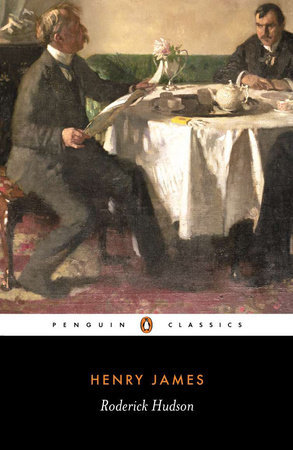
This is his first full-length novel and executed with such blazing, confident, thirty-one-year-old talent that even if he had produced nothing else, his fame would have been assured.Roderick Hudson, egotistical, beautiful and an exceptionally gifted sculptor, but poor, is taken from New England to Rome by Rowland Mallet, a rich man of fine appreciative sensibilities, who intends to give Roderick the scope to develop his genius. Together they seem like twins or lovers, opposing halves of what should have been an ideal whole. Subtext : blazing unspoken sexuality.

"You know as well as you sit there that you'd put a pistol-ball into your brain if you had written my books!"Exemplifying Henry James's famous belief that "Art makes life," The Lesson of the Master is a piercing study of the life that art makes. When the tale's protagonist—a gifted young writer—meets and befriends a famous author he has long idolized, he is both repelled by and attracted to the artist's great the emotional costs of a life dedicated to art.With extraordinary psychological insight and devastating wit, the novella asks the question of whether art is, ultimately, demeaning or ennobling for the artist, while capturing the ambiguities of a life devoted to art, and the choices artists must make. The expatriate James knew these choice well by the time he published the novella in the Universal Review in 1888, and the work reveals him at the height of his powers.The Art of The Novella SeriesToo short to be a novel, too long to be a short story, the novella is generally unrecognized by academics and publishers. Nonetheless, it is a form beloved and practiced by literature's greatest writers. In the Art Of The Novella series, Melville House celebrates this renegade art form and its practitioners with titles that are, in many instances, presented in book form for the first time.

The Awkward Age is a novel by Henry James, first published as a serial in Harper's Weekly in 1898-1899 and then as a book later in 1899.Making her debut in London society, Nanda Brookenham is being groomed for the marriage market. Thrust suddenly into the superficial circle that surrounds her mother, the innocent but independent-minded young woman even finds herself in competition with Mrs Brookenham for the affection of the man she admires. Only an elderly bachelor, Mr Longdon, is immune to this world of scheming, and determines to rescue Nanda from its influences out of loyalty to the deep love he once felt for her grandmother. In The Awkward Age, James explores the English character, and the clash between old and new money with a light and subtly ironic touch to create a devastating critique of society and its machinations.Excerpt:That young lady, in this relation, was certainly a figure to have offered a foundation for the highest hopes. As slight and white, as delicately lovely, as a gathered garden lily, her admirable training appeared to hold her out to them all as with precautionary finger-tips. She presumed, however, so little on any introduction that, shyly and submissively, wait- ing for the word of direction, she stopped short in the centre of the general friendliness till Mrs Brookenham fairly became, to meet her, also a shy little girl — put out a timid hand with wonder-struck, innocent eyes that hesitated whether a kiss of greeting might be dared. ‘Why, you dear, good, strange “ickle” thing, you haven’t been here for ages, but it is a joy to see you, and I do hope you’ve brought your doll!’ — such might have been the sense of our friend’s fond murmur while, looking at her up and down with pure pleasure, she drew the rare creature to a sofa. Little Aggie presented, up and down, an arrangement of dress exactly in the key of her age, her complexion, her emphasized virginity. She might have been prepared for her visit by a cluster of doting nuns, cloistered daughters of ancient houses and educators of similar products, whose taste, hereditarily good, had grown, out of the world and most delightfully, so queer as to leave on everything they touched a particular shade of distinction. The Duchess had brought in with the child an air of added confidence for which, in a moment, an observer would have seen the grounds, the association of the pair being so markedly favourable to each. Its younger member carried out the style of her aunt’s presence quite as one of the accessory figures effectively thrown into old portraits. The Duchess, on the other hand, seemed, with becoming blandness, to draw from her niece the dignity of a kind of office of state — hereditary governess of the children of the blood. Little Aggie had a smile as softly bright as a southern dawn, and the friends of her relative looked at each other, according to a fashion frequent in Mrs Brooken- ham’s drawing-room, in free communication of their happy impression. Mr Mitchett was, none the less, scantly diverted.

The Princess Casamassima is a novel written by Henry James, first published in 1886. The story follows the life of Hyacinth Robinson, a young man who lives in poverty in London. Hyacinth is a bookbinder by trade, but he is also involved in revolutionary politics. He becomes friends with a group of anarchists and is drawn into their world of political activism.One day, Hyacinth is approached by the Princess Casamassima, a wealthy and beautiful woman who is also involved in revolutionary politics. She asks him to help her with a secret mission, and Hyacinth becomes deeply involved in her cause. As he becomes more and more involved in the politics of the day, Hyacinth finds himself torn between his loyalty to his friends and his love for the Princess.The Princess Casamassima is a complex and thought-provoking novel that explores the themes of class, politics, and love. James' writing style is known for its depth and complexity, and this novel is no exception. The characters are richly drawn and the plot is full of twists and turns. The Princess Casamassima is a must-read for anyone interested in the works of Henry James or in Victorian literature in general.He sank upon the old yellow sofa, the sofa of his lifetime and of so many years before, and buried his head on the shabby, tattered arm. A succession of sobs broke from his lips -- sobs in which the accumulated emotion of months and the strange, acute conflict of feelings that had possessed him for the three weeks just past found relief and a kind of solution. Lady Aurora sat down beside him, and laid her finger-tips gently on his hand. So, for a minute, while his tears flowed and she said nothing, he felt her timid, consoling touch. At the end of the minute he raised his head; it came back to him that she had said ""we"" just before, and he asked her whom she meant.--This is the version serialized 1885-86 by the Atlantic Monthly.This scarce antiquarian book is a facsimile reprint of the old original and may contain some imperfections such as library marks and notations. Because we believe this work is culturally important, we have made it available as part of our commitment for protecting, preserving, and promoting the world's literature in affordable, high quality, modern editions, that are true to their original work.

The Jolly Corner was first published in 1908 in The English Review. Henry James describes the adventures of Spencer Brydon as he explores the empty New York house where he grew up. He encounters a "sensation more complex than had ever before found itself consistent with sanity." The Jolly Corner is the nickname he gave to his childhood home. Brydon begins to believe that his alter ego-the ghost of the man he might have been is haunting the house. The theme of unlived lives runs throughout the story.Excerpt:"Every one asks me what I 'think' of everything," said Spencer Brydon; "and I make answer as I can-begging or dodging the question, putting them off with any nonsense. It wouldn't matter to any of them really," he went on, "for, even were it possible to meet in that stand-and-deliver way so silly a demand on so big a subject, my 'thoughts' would still be almost altogether about something that concerns only myself." He was talking to Miss Staverton, with whom for a couple of months now he had availed himself of every possible occasion to talk; this disposition and this resource, this comfort and support, as the situation in fact presented itself, having promptly enough taken the first place in the considerable array of rather unattenuated surprises attending his so strangely belated return to America.

It had occurred to her early that in her position - that of a young person spending, in framed and wired confinement, the life of a guinea-pig or a magpie - she should know a great many persons without their recognising the acquaintance. That made it an emotion the more lively - though singularly rare and always, even then, with opportunity still very much smothered - to see any one come in whom she knew outside, as she called it, any one who could add anything to the meanness of her function. Her function was to sit there with two young men - the other telegraphist and the counter-clerk; to mind the "sounder," which was always going, to dole out stamps and postal-orders, weigh letters, answer stupid questions, give difficult change and, more than anything else, count words as numberless as the sands of the sea, the words of the telegrams thrust, from morning to night, through the gap left in the high lattice, across the encumbered shelf that her forearm ached with rubbing. This transparent screen fenced out or fenced in, according to the side of the narrow counter on which the human lot was cast, the duskiest corner of a shop pervaded not a little, in winter, by the poison of perpetual gas, and at all times by the presence of hams, cheese, dried fish, soap, varnish, paraffin and other solids and fluids that she came to know perfectly by their smells without consenting to know them by their names.

Work by the prolific American-born author and literary critic of the late 19th and early 20th centuries. He spent much of his life in Europe and became a British subject shortly before his death. He is primarily known for novels, novellas and short stories based on themes of consciousness and morality.