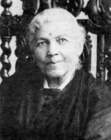
Harriet Ann Jacobs
Harriet Ann Jacobs, usually wrote under the name Harriet Jacobs but also used the pseudonym Linda Brent. Harriet was born in Edenton, North Carolina to Daniel Jacobs and Delilah. Her father was a mulatto carpenter and slave owned by Dr. Andrew Knox. Her mother was a mulatto slave owned by John Horniblow, a tavern owner. Harriet inherited the status of both her parents as a slave by birth. She was raised by Delilah until the latter died around 1819. She then was raised by her mother's mistress, Margaret Horniblow, who taught her how to sew, read, and write. In 1823, Margaret Horniblow died, and Harriet was willed to Horniblow's niece, Mary Matilda Norcom, whose father, Dr. James Norcom, became her new master. She and her brother John went to live with the Norcoms in Edenton. Norcom subjected her to sexual harassment for nearly a decade. He refused to allow her to marry any other man, regardless of status, and pressured her to become his concubine and to live in a small house built for her just outside the town. Attempting to deflect Norcom’s advances, she became involved with a consensual lover, Samuel Sawyer, a free white man and a lawyer who eventually became a Senator. She and Sawyer were parents to two children, Joseph and Louisa Matilda (named Benny and Ellen in the book), also owned by Norcom. Harriet reported that Norcom threatened to sell her children if she refused his sexual advances. She then moved to her grandmother’s house, and was allowed to stay there because Norcom’s jealous wife would no longer allow her to live in the Norcom house. By 1835, her domestic situation had become unbearable; her lack of cooperation prompted Norcom to send her to work on a plantation in Auburn. Upon finding out that Norcom planned to send her children into labor as well, she decided to escape. She reasoned that with her gone, Norcom would deem her children a nuisance and would sell them. First she found shelter at neighbors’ homes before returning to her grandmother’s house. For nearly seven years, she lived in a small crawlspace in her grandmother's attic, through periods of extreme heat and cold, and she spent the time practicing her reading and writing. After Norcom sold Harriet's brother John and her two children to a slave trader, Sawyer purchased them and brought them to live with Harriet's grandmother. Sawyer was elected to Congress in 1837, and took John with him during travels in the North. John eventually escaped in 1838. Harriet’s daughter Louisa was summoned to take John’s place, before she was sent to live with Sawyer’s cousins in New York City. Aided by the Vigilant Committee, Harriet escaped by boat to Philadelphia, Pennsylvania. She started living as a free woman and later moved to New York City in 1842. She found employment there as a nursemaid. Her most notable employer was the abolitionist Nathaniel Parker Willis. She reunited briefly with her daughter in Brooklyn. When she learned that Norcom planned to come to New York searching for her, she retreated to Boston, where her brother was staying. She made arrangements for her son in Edenton to be sent to Boston, and she soon returned to New York. Reward noticed issued for the return of Harriet JacobsIn October 1844, she revealed to Mary Willis, wife of Nathaniel, that she was an escaped slave. To avoid further endangerment, she and her daughter were granted escape to Boston again, where Harriet briefly worked as a seamstress. The following spring, Mary Willis died, and Harriet returned to Nathaniel Willis to care for his daughter. By 1849, Harriet had taken residence in Rochester, New York, where much abolitionist work took place. She befriended Amy Post, who suggested she write about her life as a slave. The next year she fled to Massachusetts yet again, after Norcom’s daughter, Mary, and Mary’s husband, Daniel Messmore, attempted to reclaim Harriet and her children, on the basis that Mary had inherited Harriet, and
25 Books Written

The true story of an individual's struggle for self-identity, self-preservation, and freedom, Incidents in the Life of a Slave Girl remains among the few extant slave narratives written by a woman. This autobiographical account chronicles the remarkable odyssey of Harriet Jacobs (1813–1897) whose dauntless spirit and faith carried her from a life of servitude and degradation in North Caroli

Culled from the annals of early African American history, these personal narratives recount the stories of men and women who survived the cruel injustice of slavery to become prominent leaders in the struggle for freedom and equality. Incidents in the Life of a Slave Girl by Harriet Jacobs Narrative of Sojourner Truth by Sojourner Truth Narrative of the Life of Frederick


"Of these female slave narratives, Harriet Jacobs's book is the crowning achievement. Manifesting a command of rhetorical devices and narrative strategies rivaled only by that of Frederick Douglass, Jacobs's autobiography is one of the major works of Afro-American literature."--Alida S. Becker, New York TimesOur long-term debate against rape and the objectivation of women as sexual sla

Black Holocaust (Translated & Annotated) English-Korean
by Harriet Ann Jacobs
(Pandora has published Korean translation of English classic literature for Korean readers. Our translation in Korean is the first of its kind and complete and up-to-date.) <책 소개> 가족이 경매장에서 팔려가 뿔뿔이 흩어져 가정이 파괴되는 노예제도의 참혹함을 묘사한 실제 장면이 있다. “재능 있는 화가에게는 이 불행한 사람들만큼 좋은 묘사의 대상이 없었을 것이다. 노예 엄마의 눈물, 염려, 고통, 그리고 많은 사람들이 응시하는 가운데 입찰자들의 각기 다른 표정을 바라보는 엄마의 시선, 그리고 아이들을 바

White Fragility: Race, Racism and the Future of Black Lives Matter in America
by Harriet Ann Jacobs
Rating: 4.6 ⭐
TABLE OF CONTENTSPrefaceTwelve Years A Slave by Solomon NorthupIncidents in the Life of a Slave Girl by Harriet JacobsNarrative of Sojourner TruthThe Narrative of the Life of An American Slave by Frederick DouglassMy Bondage and My Freedom by Frederick DouglassThe Negro Problem by Booker T. Washington, et al.The Souls of Black Folk by WEB Du Bo

In Their Own Voices: First-hand Histories of Formerly Enslaved People
by Harriet Ann Jacobs
This boxset of five titles is a forceful reminder of the tremendous impact that the slave trade of the 16th-19th centuries had on those coerced into servitude and, subsequently, their descendants. Through kidnapping, murder and trickery, families were destroyed forever as they were taken from their homelands, split up and treated as less than human. But brutal as their experiences were, there are

The Marrow of Tradition and Incidents in the Life of a Slave Girl: - The Best Black Authors Of All Time
by Harriet Ann Jacobs
Rating: 4.7 ⭐
The Marrow of Tradition and Incidents in the Life of a Slave Girl -The Best Black Authors Of All Time"As man sows, so shall he reap. In works of fiction, such men are sometimes converted. More often, in real life, they do not change their natures until they are converted into dust."― Charles W. Chesnutt"Reader, did you ever hate? I

Incidents of the Life of a Slave Girl, Book 4 of 4
by Harriet Ann Jacobs
Incidents in the Life of a Slave Gir l is one of the few surviving slave narratives written by a woman. It tells the story of Harriet Jacobs, born in 1813, who lived a life of servitude in North Carolina until she was set free and reunited with her children in the North. After writing her book, Jacobs continued to help those left behind by slavery, including founding two schools for black students

Incidents in the Life of a Slave Girl & Narrative of the Life of Frederick Douglass: Two Memoirs of Notable African-Americans During the Nineteenth Century
by Harriet Ann Jacobs
Rating: 4.4 ⭐
The ordeals of two famous African AmericansThis special Leonaur edition combines the account of Harriet Ann Jacobs with that of Frederick Douglass. They were contemporaries and African Americans of note who shared a common background of slavery and, after their liberation, knew each other and worked for a common cause. The first account, a justifiably well known and highly regarded wor

Incidents in the Life of a Slave Girl VOL 1: Super Large Print Edition Specially Designed for Low Vision Readers with a Giant Easy to Read Font
by Harriet Ann Jacobs
Special Edition for Low Vision ReadersPart One of this Super Large Print edition of Incidents in the Life of a Slave Girl contains the complete and unabridged text of Chapters 1-10. To find the 3 other volumes which complete the story, please visit superlargeprint.comAbout Super Large PrintThis book is printed with a font twice the size of a traditional large print book. Th

Incidents in the Life of a Slave Girl VOL 3: Super Large Print Edition Specially Designed for Low Vision Readers with a Giant Easy to Read Font
by Harriet Ann Jacobs
Special Edition for Low Vision ReadersVolume 3 of this Super Large Print edition of Incidents in the Life of a Slave Girl contains the complete and unabridged text of Chapters 20-29. To find the 3 other volumes which complete the story, please visit superlargeprint.comAbout Super Large PrintThis book is printed with a font twice the size of a traditional large print book. T

Incidents in the Life of a Slave Girl VOL 4: Super Large Print Edition Specially Designed for Low Vision Readers with a Giant Easy to Read Font
by Harriet Ann Jacobs
Special Edition for Low Vision ReadersVolume 4 of this Super Large Print edition of Incidents in the Life of a Slave Girl contains the complete and unabridged text of Chapters 30-41. If you are looking for the first 3 volumes, please visit superlargeprint.comAbout Super Large PrintThis book is printed with a font twice the size of a traditional large print book. That means

Incidents in the Life of a Slave Girl VOL 2: Super Large Print Edition Specially Designed for Low Vision Readers with a Giant Easy to Read Font
by Harriet Ann Jacobs
Rating: 4.0 ⭐
Special Edition for Low Vision ReadersVolume 2 of this Super Large Print edition of Incidents in the Life of a Slave Girl contains the complete and unabridged text of Chapters 11-19. All 4 volumes can be found at superlargeprint.comAbout Super Large PrintThis book is printed with a font twice the size of a traditional large print book. That means each letter of each word is

The Most Powerful Voices: 10 Influential Slave Narratives
by Harriet Ann Jacobs
This collection presents the memoirs that had the greatest historical. These powerful voices unco-vered the unfeasible truth about the horrors of slavery, they changed the way people think and feel about the institution itself, and they had a far reaching influence on the expansion of anti-slavery movement in the Northern States of America and British Empire. This edition The Interesti

Incidents in the Life of a Slave Girl, Book 1 of 4
by Harriet Ann Jacobs
Incidents in the Life of a Slave Girl is one of the few surviving slave narratives written by a woman. It tells the story of Harriet Jacobs, born in 1813, who lived a life of servitude in North Carolina until she was set free and reunited with her children in the North. After writing her book, Jacobs continued to help those left behind by slavery, including founding two schools for black students.

Incidents in the Life of a Slave Girl, Book 3 of 4
by Harriet Ann Jacobs
Incidents in the Life of a Slave Girl is one of the few surviving slave narratives written by a woman. It tells the story of Harriet Jacobs, born in 1813, who lived a life of servitude in North Carolina until she was set free and reunited with her children in the North. After writing her book, Jacobs continued to help those left behind by slavery, including founding two schools for black students.

Incidents in the Life of a Slave Girl, Book 2 of 4
by Harriet Ann Jacobs
Incidents in the Life of a Slave Girl is one of the few surviving slave narratives written by a woman. It tells the story of Harriet Jacobs, born in 1813, who lived a life of servitude in North Carolina until she was set free and reunited with her children in the North. After writing her book, Jacobs continued to help those left behind by slavery, including founding two schools for black students.

Incidents in the Life of a Slave Girl: African American History and the Personal Struggle of American Slavery
by Harriet Ann Jacobs

Incidents in the Life of a Slave Girl: African American history and the personal struggle of American Slavery
by Harriet Ann Jacobs

INCIDENTS IN THE LIFE OF A SLAVE GIRL. Written by Herself (Annotated): This is a Narrative of a Slave Girl, Harriet Jacobs. A Book About Slavery, Her Life as a Slave Girl, From Slavery to Freedom.
by Harriet Ann Jacobs
Rating: 4.4 ⭐
Incidents in the Life of a Slave Girl by Harriet Jacobs is a powerful and deeply personal autobiography that recounts Jacobs’s life under slavery and her courageous escape to freedom. Writing under the pseudonym Linda Brent, Jacobs highlights the unique struggles faced by enslaved women, particularly sexual abuse and the fight to protect her children. This poignant narrative is a significant contr

Incidents in the Life of a Slave Girl: An Autobiographical Account of an Escaped Slave and Abolitionist
by Harriet Ann Jacobs
Rating: 4.5 ⭐


One of the first personal narratives written by an ex-slave, this is also one of the few written by a woman. Harriet Jacobs (1813-97) was enslaved, along with her family, in North Carolina under a ruthless master who sexually harassed her. After several failed escape attempts, and several years of hiding, she finally made her way North to freedom, where she was eventually reunited with her childre