
H. Rider Haggard
Sir Henry Rider Haggard, KBE was an English writer of adventure novels set in exotic locations, predominantly Africa, and the creator of the Lost World literary genre. His stories, situated at the lighter end of the scale of Victorian literature, continue to be popular and influential. He was also involved in agricultural reform and improvement in the British Empire. His breakout novel was King Solomon's Mines (1885), which was to be the first in a series telling of the multitudinous adventures of its protagonist, Allan Quatermain. Haggard was made a Knight Bachelor in 1912 and a Knight Commander of the Order of the British Empire in 1919. He stood unsuccessfully for Parliament as a Conservative candidate for the Eastern division of Norfolk in 1895. The locality of Rider, British Columbia, was named in his memory.
30 Books Written

H. Rider Haggard's King Solomon's Mines has entertained generations of readers since its first publication in 1885. Following a mysterious map of dubious reliability, a small group of men trek into southern Africa in search of a lost friend-and a lost treasure, the fabled mines of King Solomon. Led by the English adventurer and fortune hunter Allan Quartermain, they discover a frozen corpse, survive untold dangers in remote mountains and deserts, and encounter the merciless King Twala en route to the legendary hoard of diamonds.For more than seventy years, Penguin has been the leading publisher of classic literature in the English-speaking world. With more than 1,700 titles, Penguin Classics represents a global bookshelf of the best works throughout history and across genres and disciplines. Readers trust the series to provide authoritative texts enhanced by introductions and notes by distinguished scholars and contemporary authors, as well as up-to-date translations by award-winning translators.

On his twenty-fifth birthday, Leo Vincey opens the silver casket that his father has left to him. It contains a letter recounting the legend of a white sorceress who rules an African tribe and of his father’s quest to find this remote race. To find out for himself if the story is true, Leo and his companions set sail for Zanzibar. There, he is brought face to face with Ayesha, She-who-must-be-obeyed: dictator, femme fatale, tyrant and beauty. She has been waiting for centuries for the true descendant of Kallikrates, her murdered lover, to arrive, and arrive he does – in an unexpected form. Blending breathtaking adventure with a brooding sense of mystery and menace, She is a story of romance, exploration discovery and heroism that has lost none of its power to enthrall.

Sequel to "King Solomon's Mines", this adventure story is about three men and their guide, who trek into remote Africa in search of a lost white race. Their perilous journey takes them to Zu-Vendis, a kingdom ruled by the beautiful twin sisters, Nyleptha and Sorais.

The People of the Mist is the tale of a British adventurer seeking wealth in the wilds of Africa, finding romance, and discovering a lost race and its monstrous god.
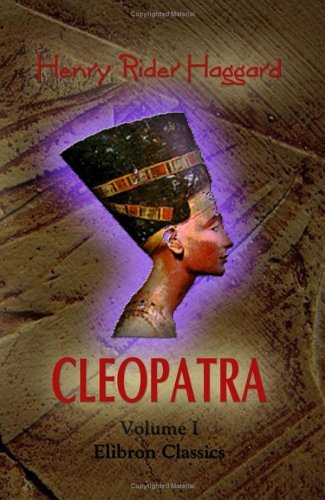
The story is set in the Ptolemaic era of ancient Egyptian history and revolves around the survival of a dynasty bloodline protected by the Priesthood of Isis. The main character Harmachis (the living descendant of this bloodline) is charged by the Priesthood to overthrow the supposed impostor Cleopatra, drive out the Romans, and restore Egypt to its golden era.As is the case with the majority of Haggard's works, the story draws heavily upon adventure and exotic concepts. The story, told from the point of view of the Egyptian priest Harmachis, is recounted in biblical language, being in the form of papyrus scrolls found in a tomb. Haggard's portrait of Cleopatra is quite stunning, revealing her wit, her treachery, and her overwhelming presence. All of the characters are mixtures of good and evil, and evoke both sympathy and loathing.

This remarkable novel by adventure writer H. Rider Haggard can be enjoyed on many levels. As a tale of adventure, it takes the reader through 16th-century England, Spain, and Mexico at the time of the Spanish Conquest. But on a deeper level, the author's hopes for humanity shine through the darkness of this time to illuminate the reader with his spiritual philosophy. The closing chapters on the fall of the Aztec capital of Tenoctitlan under the assault of Cortez are profoundly moving. Montezuma's Daughter is a fascinating historical novel and love story, with enough action to keep even the most jaded reader on the edge of the chair. And those who value the deeper aspects of the author's writing will not be disappointed. This publication from Boomer Books is specially designed and typeset for comfortable reading.

Ayesha, the Return of She is a gothic-fantasy novel by English Victorian author H. Rider Haggard, published in 1905, as a sequel to She. Chronologically, it is the final novel of the Ayesha and Allan Quatermain series. It was serialised in the Windsor Magazine issues 120 (December 1904) to 130 (October 1905), It was published by Newcastle Publishing Company as the fourteenth volume of the Newcastle Forgotten Fantasy Library series in October 1977.In the introduction, Haggard links the name Ayesha to Muhammad's wives, and the Arabic name (Arabic: عائشة, ʻĀʼishah, pronounced [ˈʕaːʔɪʃa]), stating that it should be pronounced "Assha" although the pronunciation A-ye-sha is perhaps more common. Along with the other three novels in the series, Ayesha, the Return of She was adapted into the 1935 film She.

"I do not know; I only know this, that in that wall, as in others, a door will be found. Trouble not for the future, but leave it in the hand of Him Who shapes all futures. Sufficient to the day is the evil thereof. So He said. Accept the saying and be grateful. It is something to have gained the love of such a one as this Roman, for, unless the wisdom which I have gained through many years is at fault, he is true and honest; and that man must be good at heart who can be reared in Rome and in the worship of its gods and yet remain honest.

"I believe it was the old Egyptians – a very wise people, probably indeed much wiser than we know for in the leisure of their ample centuries they had time to think out things – who declared that each individual personality is made up of six or seven different elements, although the Bible only allows us three, namely body soul and spirit..."Wanting to learn if he can communicate with deceased loved ones, adventurer and trader Allan Quatermain seeks a meeting with the feared Zulu witch-doctor Zikali. He tells Allan he must seek out a great white sorceress who rules a hidden kingdom far to the north, and he charges Allan to take a message to her. En route, Quatermain encounters emigrant Scotsmen, cannibals, witch doctors, the beautiful Inez, and of course the mysterious She, or Ayesha.Although third in order of publication, this book is first in the chronology of the adventures of She.

This stirring novel is set in the climactic months before the opening of the Third Crusade, called the Kings' Crusade. The Brethren is a classic tale of love and chivalry, unfolding amidst the touching story of two English knights who are in love with the same maiden. The devotion of these men is tested when their beloved is carried away against her will to Palestine and eventually to the court of the famous Muslim leader, Saladin.Excerpt:From the sea-wall on the coast of Essex, Rosamund looked out across the ocean eastwards. To right and left, but a little behind her, like guards attending the person of their sovereign, stood her cousins, the twin brethren, Godwin and Wulf, tall and shapely men. Godwin was still as a statue, his hands folded over the hilt of the long, scabbarded sword, of which the point was set on the ground before him, but Wulf, his brother, moved restlessly, and at length yawned aloud. They were beautiful to look at, all three of them, as they appeared in the splendour of their youth and health. The imperial Rosamund, dark-haired and eyed, ivory skinned and slender-waisted, a posy of marsh flowers in her hand; the pale, stately Godwin, with his dreaming face; and the bold-fronted, blue-eyed warrior, Wulf, Saxon to his finger-tips, notwithstanding his father's Norman blood. At the sound of that unstifled yawn, Rosamund turned her head with the slow grace which marked her every movement. "Would you sleep already, Wulf, and the sun not yet down?" she asked in her rich, low voice, which, perhaps because of its foreign accent, seemed quite different to that of any other woman.

Allan and the Holy Flower is a 1915 novel by H. Rider Haggard featuring Allan Quatermain. It first appeared serialised in The Windsor Magazine from issue 228 to 239, illustrated by Maurice Greiffenhagen, and in New Story Magazine from December 1913 through June 1914.Brother John, who has been living in Africa for many years, gives Allan Quatermain the largest orchid he has ever seen. Later, in England, he has a meeting with Mr. Somers, an orchid collector who is prepaired to finance an expedition to search for the plant. Join Allan as he sets out to find this rare orchid ... and finds something more.Excerpt:Now I, the listener, thought for a moment or two. The words of this fighting savage, Mavovo, even those of them of which I had heard only the translation, garbled and beslavered by the mean comments of the unutterable Sammy, stirred my imagination. Who was I that I should dare to judge of him and his wild, unknown gifts? Who was I that I should mock at him and by my mockery intimate that I believed him to be a fraud?

Shipped from UK, please allow 10 to 21 business days for arrival. 1st Edition First Edition

Adventurer Allan Quatermain helps his Zulu friend Saduko win 100 cattle to buy his true love Mameena ("Child of Storm"). The mysterious Mameena, however, has other ideas—she wants to marry Allan Quatermain. This publication from Boomer Books is specially designed and typeset for comfortable reading.

It was evening in Egypt, thousands of years ago, when the Prince Abi, governor of Memphis and of great territories in the Delta, made fast his ship of state to a quay beneath the outermost walls of the mighty city of Uast or Thebes, which we moderns know

The discovery of a ring, given to the Queen of Sheba by King Solomon himself, launches this tale of romance and adventure from master storyteller H. Rider Haggard, the author of King Solomon's Mines.

A tale of good and evil, of epic battles, and of a hero with copmlete integrity who values duty above all else.

On the third day he asked Zweete how it was that his left hand was white and shriveled and who were Umslopogaas and Nada, of whom he had let fall some words. Then the old man told him the tale that is set out here. Day by day he told some of it till it was finished. It was the past that spoke to his listener, telling of deeds long forgotten, of deeds that are no more known. And because the history of Nada the Lily and of those with whom her life was intertwined moved him strangely, and in many ways, he has done more, he has printed it that others may judge of it.

While Quartermain visits Lord Randall, two foreigners come asking for Macumazana -- that is, asking for Allan Quartermain by the name he used among the Africans. The two visitors are Harut and Marut, priests and doctors of the White Kendah People and they have come to ask Allan Quartermain for his help. The White Kendah people are at war with the Black Kendah people who have an evil spirit for a god. And that spirit of the god resides in the largest elephant they have ever seen, an elephant that no man can kill -- save Allan Quartermain. And now our intrepid hero must return to Africa and destroy this evil spirit before it kills every one of the White Kendah People.Excerpt from The Ivory Child Now I, Allan Quatermain, come to the story of what was, perhaps, one of the strangest of all the adventures which have befallen me in the course of a life that so far can scarcely be called tame or humdrum. Amongst many other things it tells of the war against the Black Kendah people and the death of Jana, their elephant god. Often since then I have wondered if this creature was or was not anything more than a mere gigantic beast of the forest. It seems improbable, even impossible, but the reader of future days may judge of this matter for himself. Also he can form his own opinion as to the religion of the White Kendah and their pretensions to a certain degree of magical skill. Of this magic I will make only one If it existed at all, it was by no means infallible. To take a single instance. Harut and Marut were convinced by divination that I, and I only, could kill Jana, which was why they invited me to Kendahland. Yet in the end it was Hans who killed him. Jana nearly killed me! Now to my tale.

Maiwa is a woman who is set on revenge, And what Maiwa wants, Maiwa gets!

In King Solomon's Mines, Sir Henry Curtis and Captain Good persuade Allan Quatermain to help them find Sir Henry's brother George, who has gone missing in the unexplored African interior while searching for the legendary treasure trove of a lost kingdom. Quatermain agrees to lead the expedition, though he has little hope they will return alive. After suffering unimaginable hardships, they find the treasure hidden deep within a mountain, but while they are admiring the hoard the vast stone door closes. Their store of food and water rapidly runs out and the trapped men prepare to die, but in the nick of time they find a way of escape. On their return trek to civilisation they succeed in the purpose of their expedition when they miraculously come upon George Curtis, alive and well. They return to England with enough of the treasure to live in style, but Allan Quatermain lures them back for more African adventures.In Allan Quatermain, the trio undertake the search for the kingdom of a warlike 'white' race, another expedition fraught with danger. A hazardous canoe journey along an underground river leads them to Zu-Vendi, a land ruled by two beautiful queens. Both queens fall in love with Sir Henry and this explosive situation leads to civil war, several battles, many funerals and a wedding.

These three great novels of African adventure continue to be favorite reading of those who love a thrilling tale. Perhaps the reason that they continue to be part of the public imagination, delighting each new generation afresh, is that they are filled with qualities close to the human adventure, discovery, desire for immortality, terror, the search for the primitive . . . for what is unadorned by civilization. As Kipling said of Haggard's work, "It goes, and it grips, and it moves with all the freshness of youth."Haggard had lived for many years among primitive peoples in Africa, and his knowledge of the Dark Continent was matched by few men. Yet beyond his personal knowledge of Africa, his experience of savage life and wild lands, and his faculty for making us believe impossible tales ― lies a feeling for the supernatural. Adventure alone was not enough for Haggard. As he said, "The thing must have a heart; mere adventures are not enough ― I can turn them out by the peck." About "She," one of the great mythical creations of the late 19th century, he said, "The only clear notion that I had was that of an immortal woman inspired by immortal love . . . and it came―it came faster than my poor aching hand could set it down." Kipling simply said, "You did not write 'She,' you know. Something wrote it through you."His novels have been called parables, asking "What are science, learning, and consciousness of knowledge and power, in the face of Omnipotence?" They have been called romance. And they have been called excitingly alive and imaginative by almost everyone who has ever picked up a volume, from R. L. Stevenson to George Orwell."Do any of the moderns equal H. Rider Haggard as spinners of suspense yarns?" ― Los Angeles Times "Haggard could spin a yarn so full of suspense and color that you couldn't put the story down." ― Washington Post

"A tale that deals with the marvellous Incas of Peru; with the legend also that, long before the Spanish Conquerors entered on their mission of robbery and ruin, there in that undiscovered land lived and died a White God risen from the sea."

Unlike some other reproductions of classic texts (1) We have not used OCR(Optical Character Recognition), as this leads to bad quality books with introduced typos. (2) In books where there are images such as portraits, maps, sketches etc We have endeavoured to keep the quality of these images, so they represent accurately the original artefact. Although occasionally there may be certain imperfections with these old texts, we feel they deserve to be made available for future generations to enjoy.

Hunter Quatermain's Story: The Uncollected Adventures of Allan Quatermain
by H. Rider Haggard
Rating: 3.7 ⭐
Over a century after the debut of the intrepid hunter explorer Allan Quatermain in King Solomon's Mines , he remains one of the great heroes of literature whose adventures have been adapted for cinema and television. This new anthology brings to light a novelette and four short stories which have never been collected in one volume. Introducing the tales with a detailed resume of the author's life and career, this compendium provides information about the inspiration and creation of Allan Quatermain. A chronology of the explorer's life linked to the novels and stories is also included.

"This is the story of certain of the days that I, the scribe Ana, son of Meri, lived through, here upon this earth . . .""I tell of Merapi -- who was named Moon of Israel! -- and of her people, the Hebrews, who dwelt for long in Egypt and departed thence -- having paid us back in loss and shame for all the good and ill we gave them. ""And now I -- the King's Companion, the great scribe, the beloved of the Pharaohs who have lived beneath the sun with me -- tell of the war between the gods of Egypt and the god of Israel . . . I write of these matters now when I am very old in the reign of Rameses, before death takes me . . ."

A gripping novel which takes us and the hero, adventurer Allan Quatermain, back in time. It relates several exciting adventures like a lion hunt, wrestling with a crocodile, and a large-scale battle between various armies.Excerpt:"Now I, Allan Quatermain, come to the weirdest (with one or two exceptions perhaps) of all the experiences which it has amused me to employ my idle hours in recording here in a strange land, for after all England is strange to me. I grow elderly. I have, as I suppose, passed the period of enterprise and adventure and I should be well satisfied with the lot that Fate has given to my unworthy self. To begin with, I am still alive and in health when by all the rules I should have been dead many times over. I suppose I ought to be thankful for that but, before expressing an opinion on the point, I should have to be quite sure whether it is better to be alive or dead. The religious plump for the latter, though I have never observed that the religious are more eager to die than the rest of us poor mortals."

An extraordinarily beautiful Indian princess and a white Englishman fall in love but suffer deeply because of their feelings.

This novel is the final volume of the Allan Quatermain saga, and it comprises the fourth part of a loosely linked series begun with Allan and the Holy Flower. Once more Quatermain takes the hallucinogenic taduki drug, as he did in previous novels, and he finds himself reliving as Wi, an civilized man living in the barbaric ice age as part of a clan of cavemen.

Complete and unabridged edition.Benita (alternatively titled The Spirit of Bambatse) is a novel by H. Rider Haggard. In an adventure mingling romance and the supernatural, the clairvoyant heroine Benita assists in a hunt for a lost Portuguese treasure buried in the Transvaal. Description from Wikipedia, the free encyclopedia.

The author writes, "This book, although it can be read as a separate story, is the third of the trilogy of which Marie and Child of Storm are the first two parts. It narrates, through the mouth of Allan Quatermain, the consummation of the vengeance of the wizard Zikali, alias The Opener of Roads, or 'The-Thing-that-should-never-have-been-born,' upon the royal Zulu House of which Senzangacona was the founder and Cetewayo, our enemy in the war of 1879, the last representative who ruled as a king. Although, of course, much is added for the purposes of romance, the main facts of history have been adhered to with some faithfulness." This publication from Boomer Books is specially designed and typeset for comfortable reading.