
H.R. McMaster
Herbert Raymond McMaster (born July 24, 1962) is a retired United States Army lieutenant general who served as the 25th United States National Security Advisor from 2017 to 2018. He is also known for his roles in the Gulf War, Operation Enduring Freedom, and Operation Iraqi Freedom. In February 2017, McMaster succeeded Michael Flynn as President Donald Trump's National Security Advisor. He remained on active duty as a lieutenant general while serving as National Security Advisor, and retired in May 2018. McMaster resigned as National Security Advisor on March 22, 2018, effective April 9,and accepted an academic appointment to Stanford University in 2018. McMaster is the Fouad and Michelle Ajami Senior Fellow at the Hoover Institution, the Bernard and Susan Liautaud Visiting Fellow at the Freeman Spogli Institute for International Studies and a lecturer in management at the Stanford Graduate School of Business.
10 Books Written

Battlegrounds: The Fight to Defend the Free World
by H.R. McMaster
Rating: 4.1 ⭐
• 2 recommendations ❤️
From Lt. General H.R. McMaster, U.S. Army, ret., the former National Security Advisor and author of the bestselling classic Dereliction of Duty, comes a bold and provocative re-examination of the most critical foreign policy and national security challenges that face the United States, and an urgent call to compete to preserve America's standing and security.Across multiple administrations since the end of the Cold War, American foreign policy has been misconceived, inconsistent, and poorly implemented. As a result, America and the free world have fallen behind rivals in power and influence. Meanwhile threats to security, freedom, and prosperity, such as nuclear proliferation and jihadist terrorism have grown. In Battlegrounds, H.R. McMaster describes efforts to reassess and fundamentally shift policies while he was National Security Advisor. And he provides a clear pathway forward to improve strategic competence and prevail in complex competitions against our adversaries.Battlegrounds is a groundbreaking reassessment of America's place in the world, drawing from McMaster's long engagement with these issues, including 34 years of service in the U.S. Army with multiple tours of duty in battlegrounds overseas and his 13 months as National Security Advisor in the Trump White House. It is also a powerful call for Americans and citizens of the free world to transcend the vitriol of partisan political discourse, better educate themselves about the most significant challenges to national and international security and work together to secure peace and prosperity for future generations.

Dereliction of Duty: Lyndon Johnson, Robert McNamara, the Joint Chiefs of Staff, and the Lies That Led to Vietnam
by H.R. McMaster
Rating: 4.0 ⭐
"The war in Vietnam was not lost in the field, nor was it lost on the front pages of the New York Times or the college campuses. It was lost in Washington, D.C." - H. R. McMaster (from the Conclusion) Dereliction Of Duty is a stunning new analysis of how and why the United States became involved in an all-out and disastrous war in Southeast Asia. Fully and convincingly researched, based on recently released transcripts and personal accounts of crucial meetings, confrontations and decisions, it is the only book that fully re-creates what happened and why. It also pinpoints the policies and decisions that got the United States into the morass and reveals who made these decisions and the motives behind them, disproving the published theories of other historians and excuses of the participants.Dereliction Of Duty covers the story in strong narrative fashion, focusing on a fascinating cast of characters: President Lyndon Johnson, Robert McNamara, General Maxwell Taylor, McGeorge Bundy and other top aides who deliberately deceived the Joint Chiefs of Staff, the U.S. Congress and the American public.Sure to generate controversy, Dereliction Of Duty is an explosive and authoritative new look at the controversy concerning the United States involvement in Vietnam.

A revealing account of National Security Advisor H.R. McMaster’s turbulent and consequential thirteen months in the Trump White House.At War with Ourselves is the story of helping a disruptive President drive necessary shifts in U.S. foreign policy at a critical moment in history. McMaster entered an administration beset by conflict and the hyper partisanship of American politics. With the candor of a soldier and the perspective of a historian, McMaster rises above the fray to lay bare the good, the bad, and the ugly of Trump’s presidency and give readers insight into what a second Trump term would look like.While all administrations are subject to backstabbing and infighting, some of Trump’s more unscrupulous political advisors were determined to undermine McMaster and others to advance their narrow agendas. McMaster writes candidly about Cabinet officials who, deeply disturbed by Trump’s language and behavior, prioritized controlling the President over collaborating to provide the President with options.McMaster offers a frank and fresh assessment of the achievements and failures of his tenure as National Security Advisor and the challenging task of maintaining one’s bearings and focus on the mission in a hectic and malicious environment.Determined to transcend the war within the administration and focus on national security priorities, McMaster forged coalitions in Washington and internationally to help Trump advance U.S. interests. Trump’s character and personality helped him make tough decisions, but sometimes prevented him from sticking to them. McMaster adroitly assesses the record of Trump’s presidency in comparison to the Obama and Biden administrations.With the 2024 election on the horizon, At War with Ourselves highlights the crucial importance of competence in foreign policy, and makes plain the need for leaders who possess the character and intellect to guide the United States in a tumultuous world.

The United States faces significant dangers and opportunities in the coming century. Malicious actors have harnessed new technologies such as drones, missiles, and offensive cyber weapons to threaten and, in some cases, attack America and its allies. Jihadist terrorist organizations are pursuing more destructive capabilities and are growing in strength as the United States disengages from protracted counterterrorism operations abroad. Since the end of the Cold War, US foreign policy and national security strategy have suffered from strategic narcissism—the tendency to define complex challenges and opportunities abroad only in relation to the United States—and to underappreciate the interests, emotions, and aspirations that drive and constrain rivals, adversaries, and enemies.Former US National Security Advisor H. R. McMaster designed and delivered the 12 lectures of Assessing America’s National Security Threats. A retired US Army lieutenant general; military historian; and expert in international relations, international security, and diplomacy H. R. McMaster packed this course with compelling histories, striking firsthand accounts, and contemporary case studies. Together, you will examine the risk of nuclear proliferation on the Korean peninsula. You will investigate the threats in new security domains like space and cyberspace and discover how hostile actors like Russia and China operate within them. You will explore how Afghanistan and Pakistan sit at a global epicenter of jihadist terrorism. You will dive into the ideologies that drive Iran’s theocratic dictatorship and its aggression towards the United States, Israel, and its Arab neighbors. And so much more. Ultimately, this course is designed to help restore strategic competence through the study of history, deepen understanding of the challenges and opportunities we face, and emphasize the policies and strategies needed to secure a peaceful and prosperous future.

Before 9/11, the rugby team at West Point learned to bond on a sports field. This is what happened when those 15 young men became leaders in war.Filled with drama, tragedy, and personal transformations, this is the story of a unique brotherhood. It is a story of American rugby and a story of the U. S. Army created through intimate portraits of men shaped by West Point’s “Duty, Honor, Country.”Some of the players deployed to Afganistan and Iraq, some to Europe. Some became infantry, others became fliers. Some saw action, some did not. One gave his life on a street in Baghdad when his convoy was hit with an IED. Two died away from the battlefield but no less tragically.Journalist Martin Pengelly, a former rugby player himself, was given extraordinary access to tell this story, a story of a brutal sport and even more brutal warfare.

A fundamentally flawed and ahistorical vision of future conflict that de-emphasises the human, psychological, political and cultural dimensions of war persists in strategic thought in spite of recent experience. This paper will challenge the widely held belief that ‘revolutionary’ surveillance, information-gathering and precision-strike technologies will permit modern military forces to win future wars rapidly and efficiently. The paper will examine the character of recent and ongoing conflicts in Lebanon, Afghanistan and Iraq to illuminate future challenges to security and recommend changes to military and inter-agency doctrine, organisation and professional education to address those challenges.

The New Yorker Magazine, 30 April 2018 | A General's Struggle for Dignity Under Trump
by H.R. McMaster
Rating: 3.0 ⭐
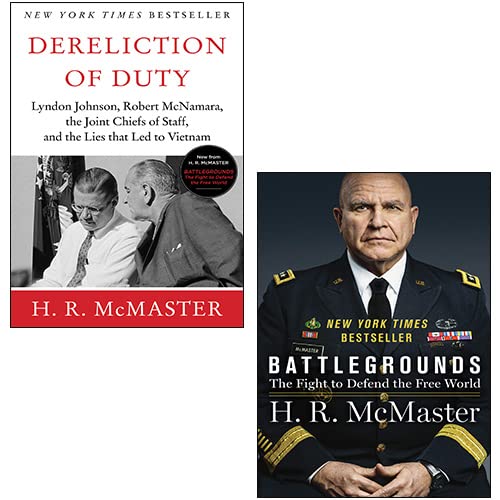
H. R. McMaster 2 Books Collection Set
by H.R. McMaster
Please Note That The Following Individual Books As Per Original ISBN and Cover Image In this Listing shall be Dispatched H. R. McMaster 2 Books Collection Dereliction of Dereliction Of Duty is a stunning analysis of how and why the United States became involved in an all-out and disastrous war in Southeast Asia. Fully and convincingly researched, based on transcripts and personal accounts of crucial meetings, confrontations and decisions, it is the only book that fully re-creates what happened and why. McMaster pinpoints the policies and decisions that got the United States into the morass and reveals who made these decisions and the motives behind them, disproving the published theories of other historians and excuses of the participants.Across multiple administrations since the end of the Cold War, American foreign policy has been misconceived, inconsistent, and poorly implemented. As a result, America and the free world have fallen behind rivals in power and influence. Meanwhile threats to security, freedom, and prosperity, such as nuclear proliferation and jihadist terrorism have grown. In BATTLEGROUNDS, H.R. McMaster describes efforts to reassess and fundamentally shift policies while he was National Security Advisor. And he provides a clear pathway forward to improve strategic competence and prevail in complex competitions against our adversaries.