
Greg Egan
Greg Egan specialises in hard science fiction stories with mathematical and quantum ontology themes, including the nature of consciousness. Other themes include genetics, simulated reality, posthumanism, mind transfer, sexuality, artificial intelligence, and the superiority of rational naturalism over religion. He is a Hugo Award winner (and has been shortlisted for the Hugos three other times), and has also won the John W Campbell Memorial Award for Best Novel. Some of his earlier short stories feature strong elements of supernatural horror, while due to his more popular science fiction he is known within the genre for his tendency to deal with complex and highly technical material (including inventive new physics and epistemology) in an unapologetically thorough manner. Egan is a famously reclusive author when it comes to public appearances, he doesn't attend science fiction conventions, doesn't sign books and there are no photos available of him on the web. Excerpted from Wikipedia.
30 Books Written
What happens when your digital self overpowers your physical self?A life in Permutation City is unlike any life to which you’re accustomed. You have Eternal Life, the power to live forever. Immortality is a real thing, just not the thing you’d expect.Life is just electronic code. You have been digitized, scanned, and downloaded into a virtual reality program. A Copy of a Copy. For Paul Durham, he keeps making Copies of himself, but the issue is that his Copies keep changing their minds and shutting themselves down.You also have Maria Deluca, who is nothing but an Autoverse addict. She spends every waking minute with the cellular automaton known as the Autoverse, a world that lives by the mathematical “laws of physics.”Paul makes Maria an offer to design and drop a seed into the Autoverse that will allow her to indulge in her obsession. There is, however, one catch: you can no longer terminate, bail out, and remove yourself. You will never be your normal flesh-and-blood life again. The question then becomes: Is this what she really wants? Is this what we really want?From the brilliant mind of Greg Egan, Permutation City, first published in 1994, comes a world of wonder that makes you ask if you are you, or is the Copy of you the real you?

“All right. He’s dead. Go ahead and talk to him.”It is the year 2055, and the battle of the sexes has seven combatants rather than two. “The illusion of empathy” has been dispensed with, and a few idealistic souls try to create a utopia with pirated technology.But a wired journalist, Andrew Worth, doesn’t want any part of the pop “Frankenscience” regularly dished out to the masses. Burned-out after completing a documentary on controversial developments in biotechnology, he turns down a chance to report on a baffling new mental disorder known as Distress and instead takes an assignment covering the Einstein Centenary Conference on the artificial island of Stateless. There, a young South African physicist, Violet Mosala, is expected to unveil her candidate for a Theory of Everything.But the assignment is not the tropical respite Worth was expecting. Unfortunately academia’s facade of civility is dangerously cracked with a seething maelstrom of plotting, assassination attempts, and rebellion, and Worth is dragged down into the nightmare. The world’s only hope for survival lies in Violet Mosala’s development of a final Theory of Everything, but whether it will lead to the total destruction of life as we know it or the complete remaking of the universe may be a risk too dangerous to take.Greg Egan’s audacious voice and literary scope create a fragmented futuristic world where technology and bioengineering threaten humanity’s very existence.

A quantum Brave New World from the boldest and most wildly speculative writer of his generation.Since the Introdus in the twenty-first century, humanity has reconfigured itself drastically. Most chose immortality, joining the polises to become conscious software. Others opted for gleisners: disposable, renewable robotic bodies that remain in contact with the physical world of force and friction. Many of these have left the solar system forever in fusion-drive starships.And there are the holdouts: the fleshers left behind in the muck and jungle of Earth—some devolved into dream apes, others cavorting in the seas or the air—while the statics and bridgers try to shape out a roughly human destiny.But the complacency of the citizens is shattered when an unforeseen disaster ravages the fleshers and reveals the possibility that the polises themselves might be at risk from bizarre astrophysical processes that seem to violate fundamental laws of nature. The orphan Yatima, a digital being grown from a mind seed, joins a group of citizens and flesher refugees in a search for the knowledge that will guarantee their safety—a search that puts them on the trail of the ancient and elusive Transmuters, who have the power to reshape subatomic particles, and to cross into the macrocosmos, where the universe we know is nothing but a speck in the higher-dimensional vacuum.

It's late in the 21st century and bioengineering is now so common that people are able to modify their minds in any way they wish. It is an era which has been shaped by information systems so vast that security, in any form, is easily breached. Now you can be whatever you want to be, and do whatever you want to do. On Earth anyway. One night, thirty three years ago, the stars went out. 'The Bubble' - a perfect sphere centred on the sun - appeared in the sky, isolating the solar system from the rest of the universe. For thirty-three years, humanity has lived with the religious cults and terrorism which spawned in the wake of the darkness. We are now alone. Humanity has been cut off. Quarantined.
Axiomatic is a collection of Greg Egan's short stories that appeared in various science fiction magazines (mostly Interzone and Asimov's) between 1989 and 1992. Contents:The Infinite Assassin (1991)The Hundred Light-Year Diary (1992)Eugene (1990)The Caress (1990)Blood Sisters (1991)Axiomatic (1990)The Safe-Deposit Box (1990)Seeing (1995)A Kidnapping (1995)Learning to Be Me (1990)The Moat (1991)The Walk (1992)The Cutie (1989)Into Darkness (1992)Appropriate Love (1991)The Moral Virologist (1990)Closer (1992)Unstable Orbits in the Space of Lies (1992)
Twenty thousand years into the future, an experiment in quantum physics has had a catastrophic result, creating an enormous, rapidly expanding vacuum that devours everything it comes in contact with. Now humans must confront this deadly expansion. Tchicaya, aboard a starship trawling the border of the vacuum, has allied himself with the Yielders-- those determined to study the vacuum while allowing it to grow unchecked. But when his fiery first love, Mariama, reenters his life on the side of the Preservationists-- those working to halt and destroy the vacuum-- Tchicaya finds himself struggling with an inner turmoil he has known since childhood.However, in the center of the vacuum, something is developing that neither Tchicaya and the Yielders nor Mariama and the Preservationists could ever have imagined possible: life.

In Yalda's universe, light has no universal speed and its creation generates energy.On Yalda's world, plants make food by emitting their own light into the dark night sky.As a child Yalda witnesses one of a series of strange meteors, the Hurtlers, that are entering the planetary system at an immense, unprecedented speed. It becomes apparent that her world is in imminent danger — and that the task of dealing with the Hurtlers will require knowledge and technology far beyond anything her civilisation has yet achieved.Only one solution seems tenable: if a spacecraft can be sent on a journey at sufficiently high speed, its trip will last many generations for those on board, but it will return after just a few years have passed at home. The travellers will have a chance to discover the science their planet urgently needs, and bring it back in time to avert disaster.

The long-awaited new novel from Greg Egan! Hugo Award-winning author Egan returns to the field with Incandescence, a new novel of hard SF. The Amalgam spans nearly the entire galaxy, and is composed of innumerable beings from a wild variety of races, some human or near it, some entirely other. The one place that they cannot go is the bulge, the bright, hot center of the galaxy. There dwell the Aloof, who for millions of years have deflected any and all attempts to communicate with or visit them. So when Rakesh is offered an opportunity to travel within their sphere, in search of a lost race, he cannot turn it down. Roi is a member of that lost race, which is not only lost to the Amalgam, but lost to itself. In their world, there is but toil, and history and science are luxuries that they can ill afford. Rakesh's journey will take him across millennia and light years. Roi's will take her across vistas of learning and discovery just as vast.
LUMINOUS collects together one original story plus nine previously unpublished in book form. Greg Egan's short fiction is at the cutting edge of the genre. His stories range from near future predictions to far future, far space improvisations. His grasp of the latest scientific breakthroughs is unparalleled in science fiction. The stories include 'Transition Dreams', 'Cocoon', 'Our Lady of Chernobyl', the title story 'Luminous' and 'The Planck Drive'. Egan's particular interests range from the farther shores of chaos theory and black hole science to bio-technology and cloning.Contents:Chaff (1993)Mitochondrial Eve (1995)Luminous (1995)Mister Volition (1995)Cocoon (1994)Transition Dreams (1993)Silver Fire (1995)Reasons to Be Cheerful (1997)Our Lady of Chernobyl (1994)The Planck Dive (1998)
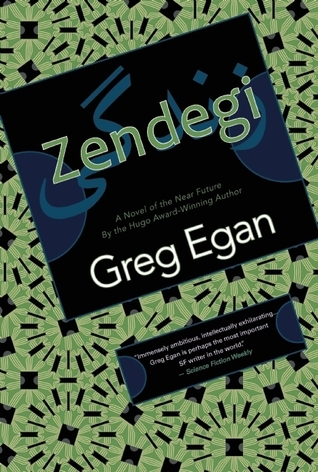
Set in a near future Iran (where the theocracy has been overthrown, but where Muslim religion still dominates the culture), an Arab/Muslim focused MMORG gaming companies cutting edge AI software might hold the key achieving "uploaded consciousness."Martin is an Australian journalist who covered uprising and overthrow of the Iranian theocracy, and has since “gone native” with a Iranian wife and child. As tragedy strikes his multi-cultural family, Martin struggles to maintain his place in his adapted culture, and to provide for his child.Zendegi explores what it means to be human, and the lengths one will go to in order to provide for ones children. This emotional roller coaster explores a non-Western-European near future that both challenges ideas of global mono-culture and emphasizes the humanity we all share.
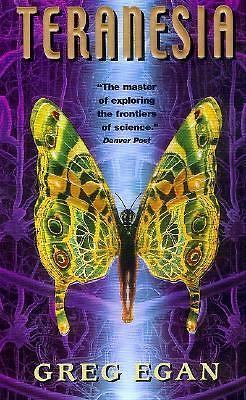
Two decades after an Indonesian uprising had decimated a family of scientists, the two surviving children return as adults to investigate bizarre reports of genetic mutations rising out of the war-shattered region. Reprint.

Collected together here for the first time are twelve stories by the incomparable Greg Egan, one of the most exciting writers of science fiction working today. In these dozen glimpses into the future Egan continues to explore the essence of what it is to be human, and the nature of what - and who - we are, in stories that range from parables of contemporary human conflict and ambition to far-future tales of our immortal descendants. Return to the universe of the meta-civilisation known as the Amalgam, which Egan explored in his critically acclaimed novel Incandescence: 'Riding the Crocodile', which recounts an epic endeavour a million years from now to bridge the divide between the Amalgam and the reclusive Aloof; 'Glory', set in the same future, in which two archaeologists strive to decipher the artefacts of an ancient civilisation, and 'Hot Rock', where an obscure, sunless world conceals mind-spinning technological marvels, bitter factional struggles, and a many-layered secret history. This superb collection also includes the title story, the Hugo Award-winning 'Oceanic': a boy is inducted into a religion that becomes the centre of his life, but as an adult he must face evidence that casts a new light on his faith.Contents:Border Guards (1999)Crystal Nights (2008)Dark Integers (2007)Glory (2007)Hot Rock (2009)Induction (2007)Lost Continent (2008)Oceanic (1998)Oracle (2000)Riding the Crocodile (2005)Singleton (2002)Steve Fever (2007)

Greg Egan’s The Clockwork Rocket introduced readers to an exotic universe where the laws of physics are very different from our own, where the speed of light varies in ways Einstein would never allow, and where intelligent life has evolved in unique and fascinating ways. Now Egan continues his epic tale of alien beings embarked on a desperate voyage to save their world . . . .The generation ship Peerless is in search of advanced technology capable of sparing their home planet from imminent destruction. In theory, the ship is traveling fast enough that it can traverse the cosmos for generations–and still return home only a few years after they departed. But a critical fuel shortage threatens to cut their urgent voyage short, even as a population explosion stretches the ship’s life-support capacity to its limits.When the astronomer Tamara discovers the Object, a meteor whose trajectory will bring it within range of the Peerless, she sees a risky solution to the fuel crisis. Meanwhile, the biologist Carlo searches for a better way to control fertility, despite the traditions and prejudices of their society. As the scientists clash with the ship’s leaders, they find themselves caught up in two equally dangerous revolutions: one in the sexual roles of their species, the other in their very understanding of the nature of matter and energy.The Eternal Flame lights up the mind with dazzling new frontiers of physics and biology, as only Greg Egan could imagine them.

Greg Egan's Perihelion Summer is a story of people struggling to adapt to a suddenly alien environment, and the friendships and alliances they forge as they try to find their way in a world where the old maps have lost their meaning.Taraxippus is coming: a black hole one tenth the mass of the sun is about to enter the solar system.Matt and his friends are taking no chances. They board a mobile aquaculture rig, the Mandjet, self-sustaining in food, power and fresh water, and decide to sit out the encounter off-shore. As Taraxippus draws nearer, new observations throw the original predictions for its trajectory into doubt, and by the time it leaves the solar system, the conditions of life across the globe will be changed forever.

“Instantiation” is a collection of eleven science fiction stories by Hugo Award winning author Greg • “The Discrete Charm of the Turing Machine”• “Zero For Conduct”• “Uncanny Valley”• “Seventh Sight”• “The Nearest”• “Shadow Flock”• “Bit Players”• “Break My Fall”• “3-adica”• “The Slipway”• “Instantiation”

Hard science fiction’s grand master delivers the stunning conclusion to his Orthogonal trilogy.In a universe where the laws of physics and the speed of light are completely alien to our own, the travelers on the ship Peerless have completed a generations-long struggle to develop advanced technology in a desperate attempt to save their home world. But as tensions mount over the risks of turning the ship around and starting the long voyage home, a new complication arises: the prospect of constructing a messaging system that will give the Peerless news of its own future.While some see this as a guarantee of safety and a chance to learn of their mission’s ultimate success, others are convinced that the knowledge will be oppressive or worse—that the system could be abused. The conflict over this proposed communication system tears the travelers’ society apart, culminating in terrible violence. To save the Peerless and its mission, two rivals must travel to a world where time runs in reverse.Continuing the epic multiple generation-spanning scope of The Clockwork Rocket and The Eternal Flame, Greg Egan’s Orthogonal series has continuously pushed the boundaries of scientific fiction without ever losing track of the lives of the individuals carrying out this grand mission. The Arrows of Time brings this fascinating space opera to a close.

Seth is a surveyor, along with his friend Theo, a leech-like creature running through his skull who tells Seth what lies to his left and right. Theo, in turn, relies on Seth for mobility, and for ordinary vision looking forwards and backwards. Like everyone else in their world, they are symbionts, depending on each other to survive.In the universe containing Seth's world, light cannot travel in all directions: there is a “dark cone” to the north and south. Seth can only face to the east (or the west, if he tips his head backwards). If he starts to turn to the north or south, his body stretches out across the landscape, and to rotate as far as north-north-east is every bit as impossible as accelerating to the speed of light.Every living thing in Seth’s world is in a state of perpetual migration as they follow the sun’s shifting orbit and the narrow habitable zone it creates. Cities are being constantly disassembled at one edge and rebuilt at the other, with surveyors mapping safe routes ahead.But when Seth and Theo join an expedition to the edge of the habitable zone, they discover a terrifying threat: a fissure in the surface of the world, so deep and wide that no one can perceive its limits. As the habitable zone continues to move, the migration will soon be blocked by this unbridgeable void, and the expedition has only one option to save its city from annihilation: descend into the unknown.

Greg Egan is arguably Australia’s greatest living science fiction writer. In a career spanning more than thirty years, he has produced a steady stream of novels and stories that address a wide range of scientific and philosophical concerns: artificial intelligence, higher mathematics, science vs religion, the nature of consciousness, and the impact of technology on the human personality. All these ideas and more find their way into this generous and illuminating collection, the clear product of a man who is both a master storyteller and a rigorous, exploratory thinker.The Best of Greg Egan contains twenty stories and novellas arranged in chronological order, and each of them is a brilliantly conceived, painstakingly developed gem. The book opens with “Learning to be Me,” about a society in which the organic human brain can be replaced by a miraculous piece of technology called “the jewel,” a “mock brain” that confers, among other things, a kind of immortality on its recipients. “Bit Players”—the opening movement in a trio of tales that continues with “3-adica” and “Instantiation”—posits a world in which cheaply generated software beings are exploited for the basest commercial purposes. (Other sets of interconnected stories—all of them reprinted here—include the mathematically-themed “Luminous” and “Dark Integers,” and a pair of stories centered on the complex marriage of a physicist and a mathematician: “Singleton” and “Oracle.”) “Reasons to be Cheerful,” concerns a young boy whose brain tumor has an unexpected effect on his life, moods, and view of the world. “Axiomatic” tells the story of a society in which “implants” can be used to alter the human personality, with potentially lethal results. And the Hugo Award-winning novella “Oceanic” is a powerful account of a boy whose deeply held religious beliefs are undermined by what he comes to learn about the laws of the physical world.This book really does represent the best of Greg Egan, and it therefore takes its place among the best of contemporary SF. Startling, intelligent and always hugely entertaining, it provides an ideal introduction to one of the most accomplished and original writers working today. This is an important and provocative collection, and it deserves a place on the serious science fiction reader’s permanent shelf.Limited: 1000 numbered hardcover copiesTable of Contents: Learning to Be Me Axiomatic Appropriate Love Into Darkness Unstable Orbits in the Space of Lies Closer Chaff Luminous Silver Fire Reasons to be Cheerful Oceanic Oracle Singleton Dark Integers Crystal Nights Zero For Conduct Bit Players Uncanny Valley 3-adica Instantiation Afterword

Camille is desperate to escape her home on colonized asteroid Vesta, journeying through space in a small cocoon pod covertly and precariously attached to a cargo ship. Anna is a newly appointed port director on asteroid Ceres, intrigued by the causes that have led so-called riders like Camille to show up at her post in search of asylum.Conditions on Vesta are quickly deteriorating—for one group of people in particular. The original founders agreed to split profits equally, but the Sivadier syndicate contributed intellectual property rather than more valued tangible goods. Now the rest of the populace wants payback. As Camille travels closer to Ceres, it seems ever more likely that Vesta will demand the other asteroid stop harboring its fugitives.With The Four Thousand, the Eight Hundred, acclaimed author Greg Egan offers up a stellar, novella-length example of hard science fiction, as human and involving as it is insightful and philosophical.

Del lives in a world of many skies: by passing through the Hoops embedded in the ground, her people can walk freely between land that lies beneath a new set of constellations for every circuit they make around the edge of a Hoop.When archaeologists find a copy of the famed Book of All Skies, Del takes delivery of the manuscript in her role as conservator at the Museum of Apasa, hoping it will shed light on the fate of the Tolleans, the ancient civilisation that produced it. But when the book is stolen, the theft sets in motion a series of events that will see her travelling farther than she had ever imagined possible, and her understanding of her world and its history irrevocably transformed.

Welcome to Tvibura and Tviburi, the richly imagined twin planets that stand at the center of Greg Egan’s extraordinary new novella, Phoresis.These two planets—one inhabited, one not—exist in extreme proximity to one another. As the narrative begins, Tvibura, the inhabited planet, faces a grave and imminent threat: the food supply is dwindling, and the conditions necessary for sustaining life are growing more and more erratic. Faced with the prospect of eventual catastrophe, the remarkable women of Tvibura launch a pair of ambitious, long-term initiatives. The first involves an attempt to reanimate the planet’s increasingly dormant ecosphere. The second concerns the building of a literal “bridge between worlds” that will connect Tvibura to its (hopefully) habitable sibling.These initiatives form the core of the narrative, which is divided into three sections and takes place over many generations. The resulting triptych is at once an epic in miniature, a work of hard SF filled with humanist touches, and a compressed, meticulously detailed example of original world building. Most centrally, it is a portrait of people struggling—and sometimes risking everything—to preserve a future they will not live to see. Erudite and entertaining, Phoresis shows us Egan at his formidable best, offering the sort of intense, visionary pleasures only science fiction can provide.

Immortality, but at what price, in what form, and how could you be you? In the near future it’s possible to build a new you, a better you, one that could carry on forever. But if you could carry on, if you could make choices about who you would be forever, how much of your past would you bring with you? Would you be tempted to maybe…edit? Adam isn’t all that he used to be, but he wants to be.At the Publisher's request, this title is being sold without Digital Rights Management Software (DRM) applied.

When a detective, a new mother, is assigned to the case of a horrific triple murder, it appears to be a self-contained domestic tragedy, a terrible event but something that doesn’t affect the rest of the community. But it slowly becomes clear that something much darker may be at play, something that spreads out from the scene of the crime to corrode the closest relationships of everyone it touches.

In a world where the cells that make up our bodies are not committed to any one organism, Marla is confronted by the fickleness of her cytes, and resolves to understand them with help from Ada, a centuries-old Flourisher. Swappers like Ruth embrace fluidity, and meet with others to exchange cytes, seeking the perfect mix. But Ruth faces her own crisis, and as the technology to manipulate cytes advances, all three are drawn into a struggle to shape the future of life.

Sleep and the Soul contains ten stories from Hugo Award-winning author Greg Egan.“You and Whose Army?”“This Is Not the Way Home”“Zeitgeber”“Crisis Actors”“Sleep and the Soul”“After Zero”“Dream Factory”“Light Up the Clouds”“Night Running”“Solidity”

When electronics importer Cara Leon goes missing, private investigator Sam Mujrif is hired by her sister to investigate. Cara is eight times taller than Sam, but evidence soon points to players much smaller than either of them. As Sam and his cross-scale colleagues pursue the case, it becomes apparent that Cara’s disappearance is linked to the development of technology with the potential to reshape their whole society, and radically alter the balance of power between the scales.

A brand new short story collection by one of science fiction's modern masters. This five tale, 80,000 word book includes Luminous, Riding the Crocodile, Dark Integers. Glory, and Oceanic.

A 12-year-old boy develops a deadly brain tumor that inadvertently floods his system with Leu-enkephalin, the neuropeptide that triggers happiness. Unwaveringly optimistic at his chance of survival, the risky surgery that saves his life also ends the euphoric bliss, leaving his brain with a cavernous hole where the pleasure centers used to be. The 18 years of sadness that follow are a downward spiral of despair, and as a last resort he agrees to another treatment that gives him conscious control over what makes him happy. As he attempts to re-enter the world beyond the hospitals and his gloomy apartment, he faces the ultimate dilemma of self-control ... how happy would you be if you could make yourself as happy as you want? Locus Poll Award Nominee

Far in the distant, post-human future, the Cater-Zimmermann community set out to refute the theory that the universe is created exclusively for mankind by cloning themselves a thousand times over and sending each copy to a different star within the galaxy. One of the copies of Cater-Zimmermann, Paolo Venetti, arrives at Orpheus; a water-world inhabited by floating mats that perform as a Turing machine.

The nine stories in Greg Egan's new collection range from parables of contemporary human conflict and ambition to far-future tales of our immortal descendants.In "Lost Continent", a time traveler seeking refuge from a war-torn land faces hostility and bureaucratic incompetence. "Crystal Nights" portrays a driven man s moral compromises as he chases an elusive technological breakthrough, while in "Steve Fever" the technology itself falls victim to its own hype."TAP" brings us a new kind of poetry, where a word is more powerful than a thousand images. "Singleton" shows us a new kind of child, born of human DNA modeled in a quantum computer who, in "Oracle", journeys to a parallel world to repay a debt to an intellectual ancestor."Induction" chronicles the methods and motives behind humanity s first steps to the stars. "Border Guards" reflects on the painful history of a tranquil utopia. And in the final story, "Hot Rock", two immortal citizens of the galaxy-spanning Amalgam find that an obscure, sunless world conceals mind-spinning technological marvels, bitter factional struggles, and a many-layered secret history.Greg Egan is the author of seven novels and over fifty short stories. He is a winner of the Hugo Award and the John W. Campbell Memorial Award.