
Gina Kolata
Kolata graduated from the University of Maryland and studied molecular biology at the graduate level at MIT for a year and a half. Then she returned to the University of Maryland and obtained a master’s degree in applied mathematics. Kolata has taught writing as a visiting professor at Princeton University and frequently gives lectures across the country. She lives in Princeton, New Jersey, with her family.
22 Books Written

Flu: The Story Of the Great Influenza Pandemic of 1918 and the Search for the Virus That Caused It
by Gina Kolata
Rating: 3.9 ⭐
• 4 recommendations ❤️
In 1918 the Great Flu Epidemic killed an estimated 40 million people virtually overnight. If such a plague returned today, taking a comparable percentage of the U.S. population with it, 1.5 million Americans would die.The fascinating, true story of the world's deadliest disease.In 1918, the Great Flu Epidemic felled the young and healthy virtually overnight. An estimated forty million people died as the epidemic raged. Children were left orphaned and families were devastated. As many American soldiers were killed by the 1918 flu as were killed in battle during World War I. And no area of the globe was safe. Eskimos living in remote outposts in the frozen tundra were sickened and killed by the flu in such numbers that entire villages were wiped out.Scientists have recently rediscovered shards of the flu virus frozen in Alaska and preserved in scraps of tissue in a government warehouse. Gina Kolata, an acclaimed reporter for "The New York Times," unravels the mystery of this lethal virus with the high drama of a great adventure story. Delving into the history of the flu and previous epidemics, detailing the science and the latest understanding of this mortal disease, Kolata addresses the prospects for a great epidemic recurring, and, most important, what can be done to prevent it.

Mercies in Disguise: A Story of Hope, a Family's Genetic Destiny, and the Science That Rescued Them
by Gina Kolata
Rating: 3.9 ⭐
The phone rings. The doctor from California is on the line. "Are you ready Amanda?" The two people Amanda Baxley loves the most had begged her not to be tested--at least, not now. But she had to find out.If your family carried a mutated gene that foretold a brutal illness and you were offered the chance to find out if you'd inherited it, would you do it? Would you walk toward the problem, bravely accepting whatever answer came your way? Or would you avoid the potential bad news as long as possible? In Mercies in Disguise, acclaimed New York Times science reporter and bestselling author Gina Kolata tells the story of the Baxleys, an almost archetypal family in a small town in South Carolina. A proud and determined clan, many of them doctors, they are struck one by one with an inscrutable illness. They finally discover the cause of the disease after a remarkable sequence of events that many saw as providential. Meanwhile, science, progressing for a half a century along a parallel track, had handed the Baxleys a resolution--not a cure, but a blood test that would reveal who had the gene for the disease and who did not. And science would offer another dilemma--fertility specialists had created a way to spare the children through an expensive process. A work of narrative nonfiction in the tradition of the The Immortal Life of Henrietta Lacks, Mercies in Disguise is the story of a family that took matters into its own hands when the medical world abandoned them. It's a story of a family that had to deal with unspeakable tragedy and yet did not allow it to tear them apart. And it is the story of a young woman--Amanda Baxley--who faced the future head on, determined to find a way to disrupt her family's destiny.
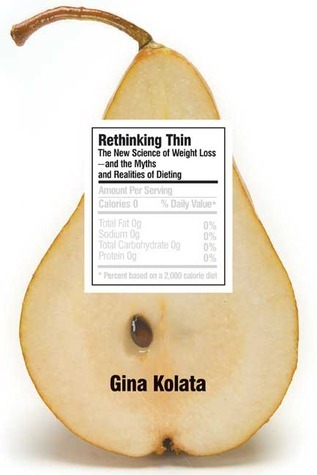
Rethinking Thin: The New Science of Weight Loss--and the Myths and Realities of Dieting
by Gina Kolata
Rating: 3.8 ⭐
In this eye-opening book, "New York Times" science writer Gina Kolata shows that our society's obsession with dieting and weight loss is less about keeping trim and staying healthy than about money, power, trends, and impossible ideals."Rethinking Thin" is at once an account of the place of diets in American society and a provocative critique of the weight-loss industry. Kolata's account of four determined dieters' progress through a study comparing the Atkins diet to a conventional low-calorie one becomes a broad tale of science and society, of social mores and social sanctions, and of politics and power. "Rethinking Thin" asks whether words like "willpower" are really applicable when it comes to eating and body weight. It dramatizes what it feels like to spend a lifetime struggling with one's weight and fantasizing about finally, at long last, getting thin. It tells the little-known story of the science of obesity and the history of diets and dieting--scientific and social phenomena that made some people rich and thin and left others fat and miserable. And it offers commonsense answers to questions about weight, eating habits, and obesity--giving us a better understanding of the weight that is right for our bodies.

From the highly acclaimed New York Times science writer Gina Kolata, the book for people who love exercise as much as they value the truth.In Ultimate Fitness , Gina Kolata, science reporter for The New York Times , takes a fascinating journey into the fads, fictions, and genuine innovations that have defined the world of physical fitness. From weight lifting for men and women in the early days, to jogging in the 1970s, cycling in the 1980s, aerobics in the 1990s, and now Spinning, Kolata explains the science of conditioning and the objective evidence behind commonly accepted prescriptions.Ultimate Fitness is also a book about the individuals who have challenged and influenced or failed to influence the industry, and the many of us who have participated inthis multimillion-dollar corner of American culture.

The birth of Dolly -- the world's first clone -- placed in our hands the secret of creation. Few discoveries have so altered our notion of what it means to be human, or presented such a Gordian knot of ethical, spiritual, and scientific questions. Noted science journalist Gina Kolata broke the news nationally in The New York Times and was the first reporter to speak with Dr. Ian Wilmut, the embryologist who cloned Dolly. Now Kolata reveals the story behind Dolly, interweaving the social and cultural tales of our fear and fascination with cloning, reaching back nearly a century, with the riveting scientific accountof how a clone came to be and the mind-boggling questions Dolly presents for our future.Clone is a compelling blend of scientific suspense, dreams dashed, and frauds exposed, with provocative philosophical questions and an astute assessment of why Dolly's birth was only possible now. Like The Making of the Atomic Bomb, Lucy, and Chaos, this book gives us a window on history in the making, and an understanding of its profound effect on our lives.

The New York Times Book of Medicine: More than 150 Years of Reporting on the Evolution of Medicine
by Gina Kolata
Rating: 3.9 ⭐
Today we live longer, healthier lives than ever before in history—a transformation due almost entirely to tremendous advances in medicine. This change is so profound, with many major illnesses nearly wiped out, that it's hard now to imagine what the world was like in 1851, when the New York Times began publishing. Treatments for depression, blood pressure, heart disease, ulcers, and diabetes came later; antibiotics were nonexistent, viruses unheard of, and no one realized yet that DNA carried blueprints for life or the importance of stem cells. Edited by award-winning writer Gina Kolata, this eye-opening collection of 150 articles from the New York Times archive charts the developing scientific insights and breakthroughs into diagnosing and treating conditions like typhoid, tuberculosis, cancer, diabetes, Alzheimer's, and AIDS, and chronicles the struggles to treat mental illness and the enormous success of vaccines. It also reveals medical mistakes, lapses in ethics, and wrong paths taken in hopes of curing disease. Every illness, every landmark has a tale, and the newspaper's top reporters tell each one with perceptiveness and skill.

The smart patient mistakes we make about our health-and how to avoid them
by Gina Kolata
Rating: 4.0 ⭐
Covers very useful information on the dangers of anecdotal evidence,and observational studies. Emphasizes usefulness of obtaining a second opinion and the need to carefully consider what to ask your doctor and yourself about medical conditions.This book will be of interest and use to anyone who seeks medical care.

Describes the developments being made in fetal medicine, including surgical techniques and medical therapies designed to treat and save babies while still in the womb


Barcelona. 23 cm. 279 p. Encuadernación en tapa blanda de editorial ilustrada. Colección 'Documento'. Traducción de Justo E. Vasco y Cristina Macía. Traducido del inglés. Clonación. Documento (Editorial Planeta) .. Este libro es de segunda mano y tiene o puede tener marcas y señales de su anterior propietario. 8408023764

Alzheimer’s disease is frightening and debilitating. It robs people of memory, of the ability to be self-sufficient and, ultimately, of the ability to function. It creates a huge burden for families — emotionally, practically and financially.And it is on the rise. More than 5 million Americans are estimated to have Alzheimer’s, about one in eight people over the age of 65. Worldwide, the number is estimated at about 35 million. By some predictions, the numbers will double by 2030 as medicine becomes better at treating illnesses that people used to die from before they became old enough to develop Alzheimer’s. Already, Alzheimer’s is the sixth leading cause of death in the United States.For years, scientists have tried and failed to find treatments or therapies that can turn back the clock of Alzheimer’s, or at least stop it in its tracks. But recently, intriguing and promising scientific developments have been taking place. Scientists have made strides in identifying genetic mutations that increase the risk of Alzheimer’s, and in screening for proteins that accumulate in the brains and spinal fluid of people with Alzheimer’s. They have also developed more sensitive cognitive tests that can detect subtle changes in memory and thinking before full-blown dementia sets in.All this presents new opportunities for science to develop effective therapies and to seek ways to prevent or delay the disease.For more than two decades, The New York Times has been on the cutting edge of the Alzheimer’s story — chronicling the devastation of the disease, investigating treatment failures and clinical trials, and tracking tantalizing scientific clues. Our reporting has helped shape the direction of public policy and government funding. It has debunked myths and provided an honest and realistic look at the pitfalls and the promise of medicine. And, in relating tales of courage, ingenuity, pain, fear and resilience, we have tried to shine a light on the glimmers of progress and hope.This is an exciting and critical time in the story of Alzheimer’s disease. The stakes are very high. — PAM BELLUCK

The New York Times Book of Medicine: More than 150 Years of Reporting on the Evolution of Medicine
by Gina Kolata
Today we live longer, healthier lives than ever before in history—a transformation due almost entirely to tremendous advances in medicine. This change is so profound, with many major illnesses nearly wiped out, that it's hard now to imagine what the world was like in 1851, when the New York Times began publishing. Treatments for depression, blood pressure, heart disease, ulcers, and diabetes came later; antibiotics were nonexistent, viruses unheard of, and no one realized yet that DNA carried blueprints for life or the importance of stem cells. Edited by award-winning writer Gina Kolata, this eye-opening collection of 150 articles from the New York Times archive charts the developing scientific insights and breakthroughs into diagnosing and treating conditions like typhoid, tuberculosis, cancer, diabetes, Alzheimer's, and AIDS, and chronicles the struggles to treat mental illness and the enormous success of vaccines. It also reveals medical mistakes, lapses in ethics, and wrong paths taken in hopes of curing disease. Every illness, every landmark has a tale, and the newspaper's top reporters tell each one with perceptiveness and skill.
Flu The Story of The Great Influenza Pandemic of 1918
by Gina Kolata
Flu
by Gina Kolata

Rethinking Thin: The New Science of Weight Loss---And the Myths and Realities of Dieting
by Gina Kolata

Rethinking Thin Lib/E: The New Science of Weight Loss---And the Myths and Realities of Dieting
by Gina Kolata

Rethinking Thin: The New Science of Weight Loss - And the Myths and Realities of Dieting
by Gina Kolata
In this eye-opening audiobook, New York Times science writer Gina Kolata shows that our society's obsession with dieting and weight loss is less about keeping trim and staying healthy than about money, power, trends, and impossible ideals. Rethinking Thin is at once an account of the place of diets in American society and a provocative critique of the weight-loss industry. Kolata's account of four determined dieters' progress through a study comparing the Atkins diet to a conventional low-calorie one becomes a broad tale of science and society, of social mores and social sanctions, and of politics and power.Rethinking Thin asks whether words like willpower are really applicable when it comes to eating and body weight. It dramatizes what it feels like to spend a lifetime struggling with one's weight and fantasizing about finally getting thin. It tells the little-known story of the science of obesity and the history of diets and scientific and social phenomena that have made some people rich and thin and left others fat and miserable. And it offers commonsense answers to questions about weight, eating habits, and obesity, giving us a better understanding of the weight that is right for our bodies.
Rethinking Thin: The New Science Of Weight Loss--And The Myths And Realities Of Dieting
by Gina Kolata

Cloni. Da Dolly all'uomo?
by Gina Kolata
. 8vo pp. 302 Brossura (wrappers) Scienza e Idee. Collana diretta da Giulio Giorello Perfetto (Mint)