
Gertrude Stein
Gertrude Stein was an American writer who spent most of her life in France, and who became a catalyst in the development of modern art and literature. Her life was marked by two primary relationships, the first with her brother Leo Stein, from 1874-1914, and the second with Alice B. Toklas, from 1907 until Stein's death in 1946. Stein shared her salon at 27 rue de Fleurus, Paris, first with Leo and then with Alice. Throughout her lifetime, Stein cultivated significant tertiary relationships with well-known members of the avant garde artistic and literary world of her time.
30 Books Written

The Autobiography of Alice B Toklas: Gertrude Stein Collection
by Gertrude Stein
Rating: 2.0 ⭐
• 2 recommendations ❤️
The Autobiography of Alice B. Toklas was written in 1933 by Gertrude Stein in the guise of an autobiography authored by Alice B. Toklas, who was her lover. It is a fascinating insight into the art scene in Paris as the couple were friends with Paul Cézanne, Henri Matisse and Pablo Picasso. They begin the war years in England but return to France, volunteering for the American Fund for the French Wounded, driving around France, helping the wounded and homeless. After the war Gertrude has an argument with T. S. Eliot after he finds one of her writings inappropriate. They become friends with Sherwood Anderson and Ernest Hemingway. It was written to make money and was indeed a commercial success. However, it attracted criticism, especially from those who appeared in the book and didn't like the way they were depicted.

Before becoming the patron of Lost Generation artists, Gertrude Stein established her reputation as an innovative author whose style was closer to painting than literature. Stein's strong influence on 20th-century literature is evident in this 1915 work of highly original prose rendered in thought-provoking experimental techniques.

The literary theories of American expatriate Gertrude Stein (1874–1946) strongly influenced a generation of young American writers (notably Hemingway), and her ideas about writing still provoke and stimulate.Although much of her own work embodies innovative experimentation with language and sound, the present volume is fairly conventional in style and quite accessible. Regarded by some critics as a minor masterpiece, Three Lives was Stein's first published book. In it she tells the stories of three working class women — Anna, a conscientious but rigid serving woman; Melanctha, a worldly-wise and sensitive black girl; and Lena, a gentle but feeble-minded maid.Although these are relatively ordinary women, in Stein's hands their lives and minds take on extraordinary interest. Told in clear, carefully crafted prose, these stories are not only memorable works in themselves but an excellent entree to Stein's later work.

For more than a generation, Gertrude Stein's Paris home at 27 rue de Fleurus was the center of a glittering coterie of artists and writers, one of whom was Pablo Picasso. In this intimate and revealing memoir, Stein tells us much about the great man (and herself) and offers many insights into the life and art of the 20th century's greatest painter.Mixing biological fact with artistic and aesthetic comments, she limns a unique portrait of Picasso as a founder of Cubism, an intimate of Appollinaire, Max Jacob, Braque, Derain, and others, and a genius driven by a ceaseless quest to convey his vision of the 20th century. We learn, for example, of the importance of his native Spain in shaping Picasso's approach to art; of the influence of calligraphy and African sculpture; of his profound struggle to remain true to his own vision; of the overriding need to empty himself of the forms and ideas that welled up within him.Stein's close relationship with Picasso furnishes her with a unique vantage point in composing this perceptive and provocative reminiscence. It will delight any admirer of Picasso or Gertrude Stein; it is indispensable to an understanding of modern art.

Stein's incomparable, impressionistic memoir of Paris. Published in 1940, on the day that Paris fell to the Germans, Paris France blends Stein's childhood memories of Paris with trenchant observations about everything French. It is a witty fricassee of food and fashion, pets and painters, musicians, friends, and artists, served up with a healthy garnish of "Steinien" humor and self-indulgence. For readers who have previously considered Gertrude Stein to be a difficult or even unreadable author, Paris France provides a delightful window on her personal and unique world.

An alternate-cover edition for ISBN 9781569579053 can be seen here: The World is Round Based on the imagined adventures of a young neighbor in the French farming community of Bilignin, this book tells the story of Rose, a little girl determined to find her place in the world.

"Il y avait un bébé qui venait de naître et qui s'appelait Ida. Sa mère l'avait retenu de ses mains pour empêcher Ida de naître mais le moment venu Ida était venue. et avec Ida était venue sa jumelle, et c'est comme ça qu'elle était là, Ida-Ida. " Ida est sûrement un des plus beaux livres deux femmes qui soient. Chacune disant à l'autre les mots qui sont en elles, Gertrude stein et Ida, une seule femme, répétée à l'infini pour faire d'un être anonyme un personnage de légende.

"This collection, a retrospective exhibit of the work of a woman who created a unique place for herself in the world of letters, contains a sample of practically every period and every manner in Gertrude Stein's career. It includes The Autobiography of Alice B. Toklas in its entirety; selected passages from The Making of Americans; "Melanctha"from Three Lives; portraits of the painters Cezanne, Matisse, and Picasso; Tender Buttons; the opera Four Saints in Three Acts; and poem, plays, lectures, articles, sketches, and a generous portion of her famous book on the Occupation of France, Wars I Have Seen.

Sadder than salad.From apples to artichokes, these glittering, fragmented, painterly portraits of food by the avant-garde pioneer Gertrude Stein are redolent of sex, laughter and the joy of everyday life.

In The Making of Americans, Gertrude Stein sets out to tell "a history of a family's progress," radically reworking the traditional family saga novel to encompass her vision of personality and psychological relationships. As the history progresses over three generations, Stein also meditates on her own writing, on the making of The Making of Americans, and on America.
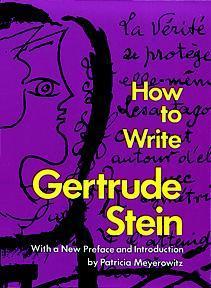
First published in 1931, this book contains Gertrude Stein’s thoughts about the craft of writing. It is written in her usual experimental style, yet it is not difficult to understand, and even traditionalists will find that it has many things to say to them.Her experimental style includes such elements as disconnectedness, a love of refrain and rhyme, a search for rhythm and balance, a dislike of punctuation (especially the comma), a dismissal of the conventional significance of words, and a repetition of words and phrases. Her approach to writing is impossible to summarize, but many critics see a strain of American humor in her work, borne out immediately by some of the chapter titles: “Saving the Sentence,” “Arthur a Grammar,” “Regular Regularly in Narrative,” and “Finally George a Vocabulary.”Readers who have not encountered Gertrude Stein or who have had difficulty with her other work will find this book useful as an entry into her writing. It is also in itself a unique, exhilarating experience.

Everybody’s Autobiography is Stein at her most accessible and her most serious In 1937, Gertrude Stein wrote a sequel to The Autobiography of Alice B. Toklas , but this darker and more complex work was long misunderstood and neglected. An account of her experiences in the wake of having authored a bestseller, Everybody’s Autobiography is as funny and engaging as The Autobiography of Alice B. Toklas , but it is also a meditation on the meaning of success and identity in America.


Written in 1932 at the house that Gertrude Stein and Alice B. Toklas had rented in the Rhone Valley, Stanzas in Meditation is one of Stein's most abstract and complex works. It is almost as if Stanzas was conceived as a mirror opposite of The Autobiography of Alice B. Toklas, penned in the same year. The latter, written in a more direct and normative language, brought Stein international acclaim and resulted in the attention she received from 1934 on, while the former remained unavailable until its publication, after her death, in 1956.To Stein readers and admirers, however, this is one of her most important works, a poetic achievement central to her canon. From John Ashbery's groundbreaking essay-review of Stanzas in 1957 to Richard Bridgman's 1970 publication, Gertrude Stein in Pieces, poets and critics have recognized the importance of this masterpiece.

Three short stories and prose poetry by the famous feminist... Three Lives is "a fine new kind of realism." (William James) Tender Buttons is "to writing what cubism is to art." (W.G. Rogers)

Stein's typically enigmatic prose depicts the mystery of an unsolved murder

From one of the modern era's most influential and boldly experimental writers—a generous collection of poems, stories and plays—all dating from 1910–1920. Wide range of the author's styles reveal Stein as philosopher, poet, portraitist, dramatist and short story writer, as the investigator of the nature of language, and much more. Superb sampling of works drew attention to the artistic avant-garde movements of the early 20th century and introduced new directions in experimental writing.

Lectures delivered during Stein's 1934 tour center on her personal ideas concerning the fine arts

Wars I Have Seen first published in 1945 is the follow-up to Stein's very successful Paris France. With her great wit and highly original style, Stein gives an account of her life in France during two world wars. As a lesbian and as an American Jew, Stein had plenty to cope with under the Nazi occupation, and the humorous exploits she undertook to harass the Germans show us a side of Stein that may help to explain her strength in dismissing the whole literary establishment to pursue her own modernist writings. In this first British paperback edition of Wars I Have Seen Stein shows her best form and established beyond doubt her place as a pioneer and founder of contemporary literature.

This selection of Gertrude Stein's work is taken from the period between 1905 and 1936, when the iconic modernist poet was engaged in an astounding number of still-surprising literary experiments, whose innovations continue to influence all the arts. Editor Joan Retallack has chosen complete texts or selections that lend themselves to a clarified vision of Stein's oeuvre. In her brilliant introduction, Retallack provides the historical and biographical context for Stein's lifelong project of composing a "continuous present," an effort which parallels many of the most important technological and scientific developments of her era―from moving pictures to Einstein's revision of our understanding of space and time. Retallack also addresses persistent questions about Stein's work and the best way to read it in our contemporary moment. In suggesting a performative "reading poesis" for these works, Retallack follows Stein's dictum by arguing that to actively experience the work is to enjoy it, and to enjoy it is to understand it.

Breaking decisively with all previous literary traditions and grammatical norms, Gertrude Stein forged a unique idiom—abstract and down-to-earth, playful and subversive, philosophical and erotic by turns—which influenced writers as varied as Ernest Hemingway, William Carlos Williams, Thornton Wilder, and John Ashbery. This Library of America volume, along with its companion, surveys a literary trajectory that from the beginning of the 20th century to the end of World War II marked her as a fearless and uncompromising experimenter. She was also a master of anecdote and aphorism, many of whose phrases—from “rose is a rose is a rose” to “there is no there there” and “when this you see remember me”—have passed into the language.This first volume, containing works written between 1903 and 1932, takes Stein from her first, more traditional fictional works to the exuberant and astonishing experiments of the early Paris years. She was a devoted student of William James, with whom she studied psychology at Radcliffe in the 1890s, and took an early interest in memory and the function of repetition in human character. In her early works, she sought a new kind of realism exemplified here by Q.E.D. (written 1903, published posthumously), a novel about lesbian entanglements at college, and the modern classic Three Lives (1909), a set of novellas about the lives of three ordinary women, described in the simplest and most direct of prose.In her brilliant abstract “portraits” Stein uses an extraordinary array of verbal techniques to evoke those friends and collaborators—Matisse, Picasso, Apollinaire, Juan Gris, Satie, Mabel Dodge, Carl Van Vechten, Sherwood Anderson, Virgil Thomson—with whom she shared decades of revolutionary ferment in the arts. Her play Four Saints in Three Acts (1927), which became the basis for an opera by Virgil Thomson, is written for a freewheeling theater of the mind where everything becomes possible. In “Lifting Belly” and other works she joyously celebrates her lifelong relationship with Alice B. Toklas, one of the most famous domestic partnerships of that century. The Autobiography of Alice B. Toklas (1933), Stein’s oblique and playful memoir, became an immediate bestseller and sealed Stein’s international celebrity.

Come volevasi dimostrare, il romanzo di Gertrude Stein dimenticato nel cassetto, cela tra le righe una verità privata. Nel tratteggiare i personaggi, l'autrice ci regala un esempio di modernismo fuori dal comune, i cui temi, tutt'oggi, non smettono di essere dibattuti. In un mondo che non le riconosce forti e indipendenti al pari degli uomini, tre giovani studentesse, protagoniste di un triangolo amoroso, rifiutano l'ideologia di genere per diventare inconsapevoli portatrici di un femminismo ante litteram. Adele, perno della storia, si arrenderà all'inconsistenza dei suoi propositi e della sua repulsione nei confronti dell'amore, guidando il lettore in un viaggio attraverso la psicologia femminile che ambisce a diventare universale.

"A superb initiation into the mysteries of Miss Stein." ― Christian Science Monitor Gertrude Stein began the creative work that was to earn her the reputation as one of the most original writers of this century with the three pieces in this volume. Fernhurst , a fictional episode based on a Bryn Mawr scandal of the early 1900s, explores the labyrinth of love between man and woman and between woman and woman; Q.E.D. fictionalizes an early Stein romance (doomed finally by a rival); and the third selection is an early draft of The Making of Americans , which records Stein's struggle toward maturity as woman and artist. Essential works of a significant twentieth-century literary voice.

Three Lives is comprised of the stories "The Good Anna," "Melanchtha," and "The Gentle Lena." "Melanchtha" is an adaptation of Q.E.D., Stein's first completed novel, which remained unpublished until four years after her death. "Contexts" is divided into two sections--"Biography" and "Intellectual Backgrounds"--that highlight the inspirations for and evolutions ofThree Lives and discuss the difficult reception Stein's experimental writing met with in the publishing world. "Criticism" collects 19 chronologically arranged essays on Stein's life and work, from pieces written during the decades in which her work was regarded as important primarily for its influence on writers such as Ernest Hemingway and Sherwood Anderson to the more laudatory scholarship of recent years. Feminism and form, queer studies, interrelations of race and sexuality, African American studies, and primitivism and eugenics are all represented. Among the critical pieces are William Carlos Williams's commentary on Stein's complexity and originality, Richard Bridgman's study of Stein's work as a possible compensation and camouflage for her lesbianism, and Lisa Ruddick's essay connecting feminist analysis to theories of consciousness A Chronology and Selected Bibliography are also included.

The first paperback edition of the great children/adult novel by Gertrude Stein.

First published in 1936 and long out of print, The Geographical History of America brings together prose pieces, dialogues, philosophical meditations, and playlets by one of the century's most influential experimental writers. This short but brilliant book offers a dimension of Gertrude Stein's thinking not available elsewhere. Here Stein sets forth her view of the human what it is, how it works, and how it is different from - and more interesting than - human nature.Geographical History also elaborates on Stein's concepts of identity, landscape, presence, and composition. Today, as literary discourse pays more attention to textuality, to voice, reader-response, and phenomenology, Stein emerges as a pioneering modernist to whom the century is slowly catching up. For those in the performing arts, Geographical History further addresses the notion of play as landscape, one of Stein's most influential theatrical ideas, as well as such issues as dialogue, character, and dramatic structure - in a book that is itself a model of modern experimentation.

This Library of America volume, along with its companion, presents a full-scale gathering of the achievement of Gertrude Stein, the most radical innovator in 20th-century literature. With her fresh, irreverent approach to syntax and meaning itself, she proposed nothing less than a reinvention of language from the ground up. From her home in Paris she conducted the most famous salon of modern times, tirelessly promoting modernism in all the arts and holding court for an audience that included the foremost creative figures of her day.This second volume includes works written between 1932 and her death in 1946, years in which she gained a wider readership and made a triumphant return to the United States as a lecturer, but chose ultimately to remain in France during World War II. It opens with the poetic sequence Stanzas in Meditation (complete text published posthumously in 1946), perhaps Stein’s most austere and rigorous experiment in linguistic abstraction. In Lectures in America (1935) and The Geographical History of America (1936), she made the most of her newfound status as a public figure, exploring with brilliance and humor the philosophical implications of her writings, the difference between English and American literature, the importance of space in American culture, and much else. Picasso (1938) is a book-length study of the painter who was one of her closest associates, and whose work was a lifelong inspiration for her.Stein’s playfulness is given full scope in the children’s book The World is Round (1939) and in Ida (1941), an enchanting exercise in pure verbal invention. The plays Doctor Faustus Lights the Lights (written 1938, published 1949) and The Mother of Us All (1947), inspired by the life of women’s rights activist Susan B. Anthony, give new twists to legendary and historical figures, while “Three Sisters Who Are Not Sisters” (1946) pays tribute to the melodramas that delighted Stein in her childhood. In her last major work, Brewsie and Willie (1946), a striking stylistic departure, she pays homage to the American soldiers she came to know after the liberation of France with a remarkable evocation of their speech and aspirations.

Gertrude Stein’s 1946 novella Brewsie and Willie explores and articulates the anxieties of a group of young American soldiers and nurses caught in the limbo between the end of the World War II and their return home to civilian life.

This important collection presents Gertrude Stein for the first time in her brilliant modernity. Ulla E. Dydo's textual scholarship demonstrates Stein's constant questioning of convention, and A Stein Reader changes the balance of work in print, concentrating on Stein's experimental work and including many key works that are virtually unknown or unavailable.A Stein Reader includes unpublished work, such as the portrait "Article"; shows the astonishing stylistic change in the neglected "A Long Gay Book"; draws attention to the many unknown plays such as "Reread Another;" and offers fascinating portraits of Matisse, Picasso, and Sitwell. Illuminating headnotes bring out connections between pieces and provide invaluable keys to Stein's motifs and thought patterns.