
George Steiner
See also: George A. Steiner, author on Management and Planning. Dr. Francis George Steiner was an essayist, novelist, philosopher, literary critic, and educator. He wrote for The New Yorker for over thirty years, contributing over two hundred reviews. Among his many awards, he received The Truman Capote Lifetime Achievement Award from Stanford University 1998. He lived in Cambridge, England, with his wife, historian Zara Shakow Steiner. In 1950 he earned an M.A. from Harvard University, where he won the Bell Prize in American Literature, and received his Ph.D. from Oxford University (Balliol College) on a Rhodes Scholarship in 1955. He was then a scholar at the Institute for Advanced Study in Princeton, New Jersey, for two years. He became a founding fellow of Churchill College at the University of Cambridge in 1961, and has been an Extraordinary Fellow there since 1969. Additionally, Steiner accepted the post of Professor of English and Comparative Literature at the University of Geneva in 1974, which he held for 20 years, teaching in four languages. He became Professor Emeritus at Geneva University on his retirement in 1994, and an Honorary Fellow at Balliol College at Oxford University in 1995. He later held the positions of the first Lord Weidenfeld Professor of Comparative Literature and Fellow of St. Anne's College at Oxford University from 1994 to 1995, and Norton Professor of Poetry at Harvard University from 2001 to 2002.
30 Books Written

Language & Silence: Essays on Language, Literature, and the Inhuman
by George Steiner
Rating: 4.2 ⭐
• 2 recommendations ❤️
"When Steiner deals with transactions between languages . . . as in discussion of various English versions of the Bible or Robert Lowell`s translation of Racine, we see a keenly discriminating literary mind at work on what it loves."-Robert Gorham Davis, New York Times Book Review "An extraordinarily sharp, brilliant, and thoughtful discussion of the strange conditions into which modern writing has worked itself. . . . Few, very few writers today have as much that is worthwhile to say on today`s writing as does the author."-Joseph G. Harrison, Christian Science Monitor "Whoever has valued and needed this book for its insights into some one particular matter . . . will upon rereading discover the astounding breadth of attention in [it]: from Homer to Thomas Mann, from Marshall McLuhan to The Warsaw Diary of Chaim Kaplan. In each of these essays, a single sentence, and often more than one, can endlessly provoke and illuminate thought."-John Felstiner How do we evaluate the power and utility of language when it has been made to articulate falsehoods in certain totalitarian regimes or has been charged with vulgarity and imprecision in a mass-consumer democracy? How will language react to the increasingly urgent claims of more exact speech such as mathematics and symbolic notation? These are some of the questions Steiner addresses in this elegantly written book, first published in 1967 to international acclaim.

“Four impressive lectures about the culture of recent times (from the French Revolution) and the conceivable culture of times to come. Mr. Steiner’s discussion of the break with the traditional literary past (Jewish, Christian, Greek, and Latin) is illuminating and attractively undogmatic. He writes as a man sharing ideas, and his original notions, though scarcely cheerful, have the bracing effect that first-rate thinking always has.” –New Yorker“In Bluebeard’s Castle is a brief and brilliant book. An intellectual tour de force, it is also a book that should generate a profound excitement and promote a profound unease…like the great culturalists of the past. Steiner uses a dense and plural learning to assess his topic: his book has the outstanding quality of being not simply a reflection on culture, but an embodiment of certain contemporary resources within it. The result is one of the most important books I have read for a very long time.”—New Society

In this remarkable short book, the foremost intellectual of our age brings a lifetime of erudition to bear on a subject that he has grappled with for decades, and whose future is profoundly uncertain. The Idea of Europe finds George Steiner reckoning with Europe from a number of different angles. “Europe,” he writes, “is the place where Goethe’s garden almost borders on Buchenwald, where the house of Corneille abuts on the market-place in which Joan of Arc was hideously done to death.” It is, in other words, a continent rich with contradiction, whose many tensions—cultural, social, political, economic, and religious—have for centuries conspired to pull it apart, even as it has become more and more unified. But what lies ahead for a continent whose borders are growing and economic might is strengthening, even as its cultural identity recedes? A continent where, in Steiner’s words, “young Englishmen choose to rank David Beckham high above Shakespeare and Darwin in their list of national treasures”? This is the trajectory that Steiner explores so brilliantly in The Idea of Europe.

When it first appeared in 1975, After Babel created a sensation, quickly establishing itself as both a controversial and seminal study of literary theory. In the original edition, Steiner provided readers with the first systematic investigation since the eighteenth century of the phenomenology and processes of translation both inside and between languages. Taking issue with the principal emphasis of modern linguistics, he finds the root of the Babel problem in our deep instinct for privacy and territory, noting that every people has in its language a unique body of shared secrecy. With this provocative thesis he analyzes every aspect of translation from fundamental conditions of interpretation to the most intricate of linguistic constructions.For the long-awaited second edition, Steiner entirely revised the text, added new and expanded notes, and wrote a new preface setting the work in the present context of hermeneutics, poetics, and translation studies. This new edition brings the bibliography up to the present with substantially updated references, including much Russian and Eastern European material. Like the towering figures of Derrida, Lacan, and Foucault, Steiner's work is central to current literary thought. After Babel, Third Edition is essential reading for anyone hoping to understand the debates raging in the academy today.

«Schelling, entre outros, atribui à existência humana uma tristeza fundamental, inescapável. Mais particularmente, esta tristeza oferece o fundamento sombrio sobre o qual assentam a consciência e a cognição. Este fundamento sombrio deve, na verdade, ser a base de toda a perceção, de todo o processo mental. O pensamento é rigorosamente inseparável de uma “melancolia profunda e indestrutível”. A cosmologia atual oferece uma analogia à crença de Schelling. Aquela do “ruído de fundo”, dos comprimentos de onda cósmica, esquivos mas inescapáveis, que são os vestígios do Big Bang, do surgimento do ser.»

Writer and scholar George Steiner's Massey Lectures are just as cogent today as when he delivered them in 1974 -- perhaps even more so. He argues that Western culture's moral and emotional emptiness stems from the decay of formal religion. He examines the alternate mythologies (rise of Marxism, sweeping success of Freudian psychoanalysis, popular establishment of Levis Strauss' structural anthropology etc.) and fads of irrationality (astrology, the occult). Steiner argues that this decay and the failure of the mythologies have created a nostalgia for the absolute that is growing and leading us to a massive clash between truth and human survival.Ultimately he suggests that we can only reduce the impact of this collision course if we continue, as disinterestedly as possible, to ask questions and seek answers in the face of our increasingly complex world.

Can there be major dimensions of a poem, a painting, a musical composition created in the absence of God? Or, is God always a real presence in the arts? Steiner passionately argues that a transcendent reality grounds all genuine art and human communication."A real tour de force. . . . All the virtues of the author's astounding intelligence and compelling rhetoric are evident from the first sentence onward."—Anthony C. Yu, Journal of Religion

George Steiner's Tolstoy or Dostoevsky has become a classic among scholars of Russian literature. An essay in poetic and philosophic criticism that bears mainly on the Russian masters, Tolstoy or Dostoevsky deals also with larger the epic tradition extending from Homer to Tolstoy; the continuity of a "tragic world view" from Oedipus Rex to King Lear and The Brothers Karamazov; the contrasts between the epic and dramatic modes, between irreconcilably opposed views of God and of history."A must for the teacher, student, and intellectually serious reader."— Kirkus Reviews"This is a book that provides new and stimulating insight into the literary masterpieces and thought of the great Russian novelists. Moreover, in this work Steiner shows a great depth and breadth of literary knowledge and criticism that is not limited alone to the Russian writers under discussion but to writers of all genres and all literary periods."— Journal of Religion"His is a work of personal criticism, often ingenious, always deeply felt."— The New York Times"Brilliant, provocative, full of insights, this classic study still stands alone and unchallenged in modern criticism as a lucid and erudite study of the contrasting genius of Tolstoy and Dostoevsky. Steiner's book is a must for the student, scholar, or general reader who wishes to approach the Russian giants in their full literary and philosophical ambience."—Robert L. Jackson

With characteristic lucidity and style, Steiner makes Heidegger's immensely difficult body of work accessible to the general reader. In a new introduction, Steiner addresses language and philosophy and the rise of Nazism."It would be hard to imagine a better introduction to the work of philosopher Martin Heidegger."—George Kateb, The New Republic

«Del espíritu vienés, y de esa Europa judaizada ahora desaparecida, Steiner conserva la espontánea provocación de una magnífica ironía [...] al tiempo que una curiosa modestia. Su obra, que nos hace reflexionar sobre nuestro legado, nos obsequia además con una inmensa cultura, un puñado de bromas inteligentes y el perfume de la anarquía».Le Magazine LittéraireGeorge Steiner es un apasionado de lo absoluto. Algunos temen su espíritu mordaz y sus críticas cáusticas. Otros lo admiran por su cultura políglota, por su conocimiento de los textos clásicos, por su compromiso intelectual y por su creencia ciega, después del Holocausto, en que una comunidad humana todavía es posible.Acompañado de la complicidad de la prestigiosa periodista francesa Laure Adler, George Steiner rememora en esta obra su juventud, su educación en Estados Unidos, su postura frente al judaísmo y su amor por los idiomas y las grandes mitologías de nuestro el psicoanálisis, el marxismo y el estructuralismo. También nos habla de su gran pasión por aquello que da sentido a su la música.Un largo sábado reúne entrevistas realizadas entre 2002 y 2014 a uno de los grandes eruditos del siglo XX y supone quizá la mejor introducción al pensamiento de este incansable defensor de la alta cultura.

Imagine, thirty years after the end of World War II, Israeli Nazi-hunters, some of whom lost relatives in the gas chambers of Nazi Germany, find a silent old man deep in the Amazon jungle. He is Adolph Hitler. The narrative that follows is a profound and disturbing exploration of the nature of guilt, vengeance, language, and the power of evil—each undiminished over time. George Steiner's stunning novel, now with a new afterword, will continue to provoke our thinking about Nazi Germany's unforgettable past."Two readings have convinced me that this is a fiction of extraordinary power and thoughtfulness. . . . [A] remarkable novel."—Bernard Bergonzi, Times Literary Supplement"In this tour de force Mr. Steiner makes his reader re-examine, to whatever conclusions each may choose, a history from which we would prefer to avert our eyes."—Edmund Fuller, Wall Street Journal" Portage largely avoids both the satisfactions of the traditional novel and the horrifying details of Holocaust literature. Instead, Steiner has taken as his model the political imaginings of an Orwell or Koestler. . . . He has produced a philosophic fantasy of remarkable intensity."—Otto Friedrich, Time

George Steiner, one of the great literary minds of our century, here relates the story of his own life and the ways that people, places, and events have colored the central ideas and themes of his work. Brilliant and witty, his memoir reveals Steiner's thoughts on the meaning of the western tradition and its philosophic and religious premises.

"This book is important―and portentous―for if it is true that tragedy is dead, we face a vital cultural loss. . . . The book is bound to start controversy. . . . The very passion and insight with which he writes about the tragedies that have moved him prove that the vision still lives and that words can still enlighten and reveal."―R.B. Sewall, New York Times Book Review "A remarkable achievement. . . . The knowledge is marshalled here with the skill and authority of a great general, and from it a large strategic argument emerges with clarity and force. . . . A brilliantly thoughtful and eloquent book which deserves to be read with the greatest attention and respect."―Philip Toynbee, The Observer "As brilliant, thorough, and concerned a contemplation of the nature of dramatic art as has appeared in many years."―Richard Gilman, Commonweal "A rich and illuminating study, full of intelligence and sensibility."― Times Literary Supplement (London) "His merits are shining and full of the capacity to give both delight and illumination. . . . His style is throughout vigorous, sensitive, and altogether worthy of its subject."―Harold Hobson, Christian Science Monitor "Immensely useful and [a book] to be reckoned with by everyone working in this field."―Raymond Williams, The Guardian

Between 1967 and 1997, George Steiner wrote more than 130 pieces on a great range of topics for The New Yorker, making new books, difficult ideas, and unfamiliar subjects seem compelling not only to intellectuals but to “the common reader.” He possesses a famously dazzling mind: paganism, the Dutch Renaissance, children’s games, war-time Britain, Hitler’s bunker, and chivalry attract his interest as much as Levi-Strauss, Cellini, Bernhard, Chardin, Mandelstam, Kafka, Cardinal Newman, Verdi, Gogol, Borges, Brecht, Wittgenstein, Chomsky, and art historian/spy Anthony Blunt. Steiner makes an ideal guide from the Risorgimento in Italy to the literature of the Gulag, from the history of chess to the enduring importance of George Orwell. Again and again everything Steiner looks at in his New Yorker essays is made to bristle with some genuine prospect of turning out to be freshly thrilling or surprising.

"We have no more beginnings", George Steiner begins in this, his most radical book to date. A far-reaching exploration of the idea of creation in Western thought, literature, religion, and history, this volume can fairly be called a magnum opus. He reflects on the different ways we have of talking about beginnings, on the "coretiredness" that pervades our end-of-the-millennium spirit, and on the changing grammar of our discussions about the end of Western art and culture. With his well-known elegance of style and intellectual range, Steiner probes deeply into the driving forces of the human spirit and our perception of Western civilization's lengthening afternoon shadows.Roaming across topics as diverse as the Hebrew Bible, the history of science and mathematics, the ontology of Heidegger, and the poetry of Paul Celan, Steiner examines how the twentieth century has placed in doubt the rationale and credibility of a future tense -- the existence of hope. Acknowledging that technology and science may have replaced art and literature as the driving forces in our culture, Steiner warns that this has not happened without a significant loss. The forces of technology and science alone fail to illuminate inevitable human questions regarding value, faith, and meaning. And yet it is difficult to believe that the story out of Genesis has ended, Steiner observes, and he concludes this masterful volume of reflections with an eloquent evocation of the endlessness of beginnings.
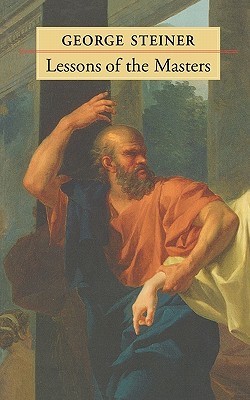
When we talk about education today, we tend to avoid the rhetoric of "mastery," with its erotic and inegalitarian overtones. But the charged personal encounter between master and disciple is precisely what interests George Steiner in this book, a sustained reflection on the infinitely complex and subtle interplay of power, trust, and passions in the most profound sorts of pedagogy. Based on Steiner's Norton Lectures on the art and lore of teaching, "Lessons of the Masters" evokes a host of exemplary figures, including Socrates and Plato, Jesus and his disciples, Virgil and Dante, Heloise and Abelard, Tycho Brahe and Johann Kepler, the Baal Shem Tov, Confucian and Buddhist sages, Edmund Husserl and Martin Heidegger, Nadia Boulanger, and Knute Rockne.Pivotal in the unfolding of Western culture are Socrates and Jesus, charismatic masters who left no written teachings, founded no schools. In the efforts of their disciples, in the passion narratives inspired by their deaths, Steiner sees the beginnings of the inward vocabulary, the encoded recognitions of much of our moral, philosophical, and theological idiom. He goes on to consider a diverse array of traditions and disciplines, recurring throughout to three underlying themes: the master's power to exploit his student's dependence and vulnerability; the complementary threat of subversion and betrayal of the mentor by his pupil; and the reciprocal exchange of trust and love, of learning and instruction between master and disciple.Forcefully written, passionately argued, "Lessons of the Masters" is itself a masterly testament to the high vocation and perilous risks undertaken by true teacher and learner alike.

From the distinguished polymath George Steiner comes a profound and illuminating vision of the inseparability of Western philosophy and its living language. With his hallmark forceful discernment, George Steiner presents in The Poetry of Thought his magnum an examination of more than two millennia of Western culture, staking out his claim for the essential oneness of great thought and great style. Sweeping yet precise, moving from essential detail to bracing illustration, Steiner spans the entire history of philosophy in the West as it entwines with literature, finding that, as Sartre stated, in all philosophy there is “a hidden literary prose.”“The poetic genius of abstract thought,” Steiner believes, “is lit, is made audible. Argument, even analytic, has its drumbeat. It is made ode. What voices the closing movements of Hegel’s Phenomenology better than Edith Piaf’s non de non , a twofold negation which Hegel would have prized? This essay is an attempt to listen more closely.”

By one of the world’s foremost intellectuals, George Steiner’s My Unwritten Books meditates upon seven books he had long had in mind to write, but never did. Massively erudite, the essays are also brave, unflinching, and wholly personal. In this fiercely original and audacious work, George Steiner tells of seven books which he did not write. Because intimacies and indiscretions were too threatening. Because the topic brought too much pain. Because its emotional or intellectual challenge proved beyond his capacities. The actual themes range widely and defy conventional the torment of the gifted when they live among―when they confront―the very great; the experience of sex in different languages; a love for animals greater than for human beings; the costly privilege of exile; a theology of emptiness. Yet a unifying perception underlies this diversity. The best we have or can produce is only the tip of the iceberg. Behind every good book, as in a lit shadow, lies the book which remained unwritten, the one that would have failed better.

According to Greek legend, Antigone, the daughter of Oedipus, secretly buried her brother in defiance of the order of Creon, king of Thebes. Sentenced to death by Creon, she forestalled him by committing suicide. The theme of the conflict between Antigone and Creon―between the state and the individual, between man and woman, between young and old―has captured the Western imagination for more than 2000 years. George Steiner here examines the far-reaching legacy of this great classical myth. He considers its treatment in Western art, literature, and thought―in drama, poetry, prose, philosophic discourse, political tracts, opera, ballet, film, and even the plastic arts. A study in poetics and in the philosophy of reading, Antigones leads us to look again at the influence the Greek myths exercise on twentieth-century culture."A remarkable feat of intellectual agility."― Washington Post Book World"[An] intellectually demanding but rewarding book. . . consistently stimulating and sometimes disturbing."― The New Republic"An. . . account of the various treatments of the Antigone theme in European languages. . . Penetrating and novel."― The New York Times Book Review"A tradition of intelligence and style lives in this prolific man."― Los Angeles Times" Antigones triumphantly demonstrates that Antigone could fill several volumes of study without becoming tedious or exhausted."― The New York Review of Books

Temos tendência para esquecer que os livros, eminentemente vulneráveis, podem ser suprimidos ou destruídos. Têm a sua história, como todas as outras produções humanas, uma história cujos primórdios contêm, em gérmen, a possibilidade, a eventualidade de um fim. George Steiner sublinha assim a permanência incessantemente ameaçada e a fragilidade da escrita, interessando-se paradoxalmente por aqueles que quiseram - ou querem - o fim do livro. A sua abordagem entusiástica da leitura une-se aqui a uma crítica radical das novas formas de ilusão, de intolerância e de barbárie produzidas no seio de uma sociedade dita esclarecida. Esta fragilidade, responde Michel Crépu, não nos remeterá para um sentido íntimo da finitude que nos é transmitido precisamente pela experiência da leitura? Esta estranha e doce tristeza que se encontra no âmago de todos os livros como uma luz de sombra. A nossa época está prestes a esquecer-se disto. Nunca os verdadeiros livros foram tão silenciosos.

Os livros são a nossa chave de acesso para nos tornarmos melhores do que somos. A capacidade deles de produzir essa transcendência suscitou discussões, alegorizações e desconstruções sem fim. O encontro com o livro, assim como com o homem ou a mulher, que vai mudar a nossa vida, frequentemente em um instante de reconhecimento do qual não se é consciente, pode ser completamente casual. O texto que nos converterá a uma fé, nos fará aderir a uma ideologia, dará a nossa existência um fim e um critério, podia estar ali a nos esperar na estante dos livros em promoção, dos livros usados e em desconto. Talvez empoeirado e esquecido, na estante exatamente ao lado do livro que procurávamos.

La troballa (fictícia) d’un pergamí malmès pel foc, a les ruïnes d’una vil•la d’Herculà, convida George Steiner a interpretar el sentit que podria tenir el text original, que alguns atribueixen a Epicarn d’Agra. El llegat d’aquest suposat moralista i retòric del segle II aC es confon amb el que podria ser, pròpiament, una síntesi dels interessos intel•lectuals i vitals de l’autor d’aquest llibre. George Steiner reflexiona, tot jugant amb la conjectura, sobre l’eloqüència del silenci (el no dit) en la poesia i la filosofia, les gratificacions de l’amistat, el potencial de l’educació i la raresa del talent, la realitat ontològica del mal, l’omnipotència dels diners, els perills de la religió, la transcendència de la música i la llibertat d’escollir la mort.

George Steiner is one of the preeminent essayists and literary thinkers of our era. In this remarkable book he concerns himself with language and the relation of language to literature and to religion. Written during a period when the art of reading and the status of a text have been threatened by literary movements that question their validity and by computer technology, Steiner's essays affirm the primacy of reading in the classical sense.Steiner covers a wide range of subjects, from the Hebrew Bible, Homer, and Shakespeare to Kafka, Kierkegaard, Simone Weil, Husserl, and Freud. The theme of Judaism's tragic destiny winds through his thinking, in particular as he muses about whether Jewish scripture and the Talmud are the Jew's true homeland, the parallels between the "last supper" of Socrates and the Last Supper of Jesus, and the necessity for Christians to hold themselves accountable for their invective and impotence during the Holocaust.

As an incisive and provocative critic of literature, language, and culture, George Steiner has acquired an international reputation and a devoted following. "He scatters bright ideas everywhere," writes The New York Times Book Review, "and they are sure to be picked up." This volume presents a rich sampling of Steiner's ideas, including selections from his seminal books The Death of Tragedy , After Babel , Tolstoy or Dostoevsky , and Language and Science . Aside from pointing to work that lies ahead, this anthology offers a rich retrospective of the intellectual ground Steiner has already covered. Whether discussing Marxist literary theory, the significance of Tolstoy, or the problems of treating sexual material in literature, Steiner's writings give us the pleasure of watching an astute and nimble mind constantly at work.

Extraterritorial: Ensayos sobre literatura y la revolución lingüística
by George Steiner
Rating: 3.9 ⭐
Extraterritorial: Papers on Literature and the Language Revolution (Peregrine Books) [Import] [Paperback]

Eight essays by the literary critic probe the history and formal structure of inward speech as well as the relationship between linguistics and poetics and between language and literature

Brillante conversador, además de erudito, George Steiner (en contraposición dialéctica con su interlocutor, Antoine Spire) se abre a un relato vivo, apasionado, que nos lleva al límite de la paradoja y la provocación. Desde aspectos de su propia biografía a los asuntos más espinosos abordados en la obra de este gigante de la cultura europea, sus pensamientos tocan la música, la filosofía, la poesía y la literatura, el lugar que corresponde a un hombre culto enfrentado a la barbarie, así como la relación a menudo trágica y ambigua entre la filosofía y el despotismo, entre el judaísmo y Auschwitz como símbolo del mal absoluto. Y todo ello sin perder de vista la crítica lúcida de otros filósofos contemporáneos, como Sartre y Derrida, una crítica en que el punto de vista de Steiner se hace más nítido y afilado. La barbarie de la ignorancia —que publicamos ahora con una nueva traducción, un apartado final, "Stacca to", no recogido en la edición castellana anterior, y un epílogo en el que Antoine Spire rememora un encuentro no del todo fácil con el filósofo— seguirá sorprendiendo al lector por la lucidez y la combatividad de un autor cuya libertad de pensamiento y exigencia intelectual y moral constituyen hoy como ayer un aldabonazo para nuestras conciencias.

This collection of short stories includes "Proofs", a literary thriller which explores the conflict between fact and fiction in life and literature. Also included are "Noel, Noel", "Desert Island Disks" and "Conversation Piece".

In un periodo di profonda trasformazione del libro e dell'editoria, una delle più importanti voci del pensiero occidentale contemporaneo riflette con intelligenza sull'importanza e la necessità dei libri e della scrittura. Passando da Dante a Tolstoj, da Socrate a Shakespeare, George Steiner ci racconta lo straordinario potere della letteratura sulle nostre vite e la sua capacità di suscitare in ciascuno sensazioni potenti e vitali. È proprio per continuare a rendere possibile questo scambio intimo e necessario che, suggerisce Steiner, i libri hanno bisogno di noi: della nostra attenzione, della nostra cura e della nostra passione perché siano scritti, letti e protetti da ogni tipo di rogo e di censura.

Los textos reunidos en esta obra significan un recorrido crítico por las bases teóricas que han sustentado la obra de George Steiner. Su concepción del arte, su visión "logocrática" del lenguaje -que sostiene que "el hombre no es el dueño del lenguaje, sino su servidor"-, su relación con el libro y las "religiones del libro", entre otras perspectivas y lecturas culturales de gran peso se encuentran expuestas en estas páginas. Steiner muestra en este libro que la concepción misma del arte y de la crítica supone una filosofía del lenguaje. En una época en la que el espacio de la lectura está llamado a disminuir, el autor desprende un conjunto de reflexiones que explican cómo la escritura puede constituir a una persona. Steiner afirma que "El poder indeterminado de los libros es incalculable", y fundamenta este señalamiento.