
Garry Wills
Garry Wills is an American author, journalist, political philosopher, and historian, specializing in American history, politics, and religion, especially the history of the Catholic Church. He won a Pulitzer Prize for General Non-Fiction in 1993. Wills has written over fifty books and, since 1973, has been a frequent reviewer for The New York Review of Books. He became a faculty member of the history department at Northwestern University in 1980, where he is an Emeritus Professor of History.
30 Books Written

From one of America's most distinguished historians comes this classic analysis of Richard Nixon. By considering some of the president's opinions, Wills comes to the controversial conclusion that Nixon was actually a liberal. Both entertaining and essential, Nixon Agonistes captures a troubled leader and a struggling nation mired in a foolish Asian war, forfeiting the loyalty of its youth, puzzled by its own power, and looking to its cautious president for confidence. In the end, Nixon Agonistes reaches far beyond its assessment of the thirty-seventh president to become an incisive and provocative analysis of the American political machine.

Lincoln at Gettysburg: The Words That Remade America
by Garry Wills
Rating: 4.2 ⭐
• 2 recommendations ❤️
In a masterly work, Garry Wills shows how Lincoln reached back to the Declaration of Independence to write the greatest speech in the nation’s history.The power of words has rarely been given a more compelling demonstration than in the Gettysburg Address. Lincoln was asked to memorialize the gruesome battle. Instead he gave the whole nation “a new birth of freedom” in the space of a mere 272 words. His entire life and previous training and his deep political experience went into this, his revolutionary masterpiece.By examining both the address and Lincoln in their historical moment and cultural frame, Wills breathes new life into words we thought we knew, and reveals much about a president so mythologized but often misunderstood. Wills shows how Lincoln came to change the world and to effect an intellectual revolution, how his words had to and did complete the work of the guns, and how Lincoln wove a spell that has not yet been broken.

A bestselling historian examines the life of a Founding Father.Renowned historian and social commentator Garry Wills takes a fresh look at the life of James Madison, from his rise to prominence in the colonies through his role in the creation of the Articles of Confederation and the first Constitutional Congress. Madison oversaw the first foreign war under the constitution, and was forced to adjust some expectations he had formed while drafting that document. Not temperamentally suited to be a wartime President, Madison nonetheless confronted issues such as public morale, internal security, relations with Congress, and the independence of the military. Wills traces Madison's later life during which, like many recent Presidents, he enjoyed greater popularity than while in office.

“Garry Wills brings his signature brand of erudite, unorthodox thinking to his latest book of revelations. . . . A tour de force and a profound show of faith.” ( O, the Oprah Magazine) In what are billed “culture wars,” people on the political right and the political left cite Jesus as endorsing their views. But in this New York Times-bestselling masterpiece, Garry Wills argues that Jesus subscribed to no political program. He was far more radical than that. In a fresh reading of the gospels, Wills explores the meaning of the “reign of heaven” Jesus not only promised for the future but brought with him into this life. It is only by dodges and evasions that people misrepresent what Jesus plainly had to say against power, the wealthy, and religion itself. But Wills is just as critical of those who would make Jesus a mere ethical teacher, ignoring or playing down his divinity. An illuminating analysis for believers and nonbelievers alike, What Jesus Meant is a brilliant addition to our national conversation on religion.

A synthesis of the apostle's thought and influence evaluates the disparate qualities attributed to his character in the Bible and throughout history, arguing that Paul's intentions were consistent with the teachings of Jesus and sought to manage controversy throughout the early days of Christianity. By the Pulitzer Prize-winning author of Lincoln at Gettysburgh. 75,000 first printing.

America’s leading religious scholar and public intellectual introduces lay readers to the Qur’an with a measured, powerful reading of the ancient textGarry Wills has spent a lifetime thinking and writing about Christianity. In What the Qur’an Meant, Wills invites readers to join him as he embarks on a timely and necessary reconsideration of the Qur’an, leading us through perplexing passages with insight and erudition. What does the Qur’an actually say about veiling women? Does it justify religious war? There was a time when ordinary Americans did not have to know much about Islam. That is no longer the case. We blundered into the longest war in our history without knowing basic facts about the Islamic civilization with which we were dealing. We are constantly fed false information about Islam—claims that it is essentially a religion of violence, that its sacred book is a handbook for terrorists. There is no way to assess these claims unless we have at least some knowledge of the Qur’an. In this book Wills, as a non-Muslim with an open mind, reads the Qur’an with sympathy but with rigor, trying to discover why other non-Muslims—such as Pope Francis—find it an inspiring book, worthy to guide people down through the centuries. There are many traditions that add to and distort and blunt the actual words of the text. What Wills does resembles the work of art restorers who clean away accumulated layers of dust to find the original meaning. He compares the Qur’an with other sacred books, the Old Testament and the New Testament, to show many parallels between them. There are also parallel difficulties of interpretation, which call for patient exploration—and which offer some thrills of discovery. What the Qur’an Meant is the opening of a conversation on one of the world’s most practiced religions.

Look out for a new book from Garry Wills, What The Qur'an Meant , coming fall 2017.Pulitzer Prize winner Garry Wills brings the same fresh scholarship, lively prose, and critical appreciation that characterize his well-known books on religion and American history to this outstanding biography of one of the most influential Christian philosophers. Saint Augustine follows its subject from his youth in fourth-century Africa to his conversion and subsequent development as a theologian. It challenges the widely held misconceptions about Augustine’s sexual excesses and shows how, in embracing classical philosophy, Augustine managed to enlist “pagan authors” in the defense of Christianity. The result is a biography that makes a spiritual ancestor feel like our contemporary.

From Pulitzer Prize-winning historian Garry Wills, a groundbreaking examination of how the atomic bomb profoundly altered the nature of American democracy and has left us in a state of war alert ever since.In Bomb Power , Garry Wills reveals how the atomic bomb transformed our nation down to its deepest constitutional roots-by dramatically increasing the power of the modern presidency and redefining the government as a national security state-in ways still felt today. A masterful reckoning from one of America's preeminent historians, Bomb Power draws a direct line from the Manhattan Project to the usurpations of George W. Bush.The invention of the atomic bomb was a triumph of official secrecy and military discipline-the project was covertly funded at the behest of the president and, despite its massive scale, never discovered by Congress or the press. This concealment was perhaps to be expected in wartime, but Wills persuasively argues that the Manhattan Project then became a model for the covert operations and overt authority that have defined American government in the nuclear era. The wartime emergency put in place during World War II extended into the Cold War and finally the war on terror, leaving us in a state of continuous war alert for sixty-eight years and counting.The bomb forever changed the institution of the presidency since only the president controls "the button" and, by extension, the fate of the world. Wills underscores how radical a break this was from the division of powers established by our founding fathers and how it in turn has enfeebled Congress and the courts. The bomb also placed new emphasis on the president's military role, creating a cult around the commander in chief. The tendency of modern presidents to flaunt military airs, Wills points out, is entirely a postbomb phenomenon. Finally, the Manhattan Project inspired the vast secretive apparatus of the national security state, including intelligence agencies such as the CIA and NSA, which remain largely unaccountable to Congress and the American people.Wills recounts how, following World War II, presidential power increased decade by decade until reaching its stunning apogee with the Bush administration. Both provocative and illuminating, Bomb Power casts the history of the postwar period in a new light and sounds an alarm about the continued threat to our Constitution.

Look out for a new book from Garry Wills, What The Qur'an Meant , coming fall 2017."The truth, we are told, will make us free. It is time to free Catholics, lay as well as clerical, from the structures of deceit that are our subtle modern form of papal sin. Paler, subtler, less dramatic than the sins castigated by Orcagna or Dante, these are the quiet sins of intellectual betrayal."--from the IntroductionFrom Pulitzer Prize-winning author Garry Wills comes an assured, acutely insightful--and occasionally stinging--critique of the Catholic Church and its hierarchy from the nineteenth century to the present.Papal Sin in the past was blatant, as Catholics themselves realized when they painted popes roasting in hell on their own church walls. Surely, the great abuses of the past--the nepotism, murders, and wars of conquest--no longer prevail; yet, the sin of the modern papacy, as revealed by Garry Wills in his penetrating new book, is every bit as real, though less obvious than the old sins.Wills describes a papacy that seems steadfastly unwilling to face the truth about itself, its past, and its relations with others. The refusal of the authorities of the Church to be honest about its teachings has needlessly exacerbated original mistakes. Even when the Vatican has tried to tell the truth--e.g., about Catholics and the Holocaust--it has ended up resorting to historical distortions and evasions. The same is true when the papacy has attempted to deal with its record of discrimination against women, or with its unbelievable assertion that "natural law" dictates its sexual code.Though the blithe disregard of some Catholics for papal directives has occasionally been attributed to mere hedonism or willfulness, it actually reflects a failure, after long trying on their part, to find a credible level of honesty in the official positions adopted by modern popes. On many issues outside the realm of revealed doctrine, the papacy has made itself unbelievable even to the well-disposed laity.The resulting distrust is in fact a neglected reason for the shortage of priests. Entirely aside from the public uproar over celibacy, potential clergy have proven unwilling to put themselves in a position that supports dishonest teachings.Wills traces the rise of the papacy's stubborn resistance to the truth, beginning with the challenges posed in the nineteenth century by science, democracy, scriptural scholarship, and rigorous history. The legacy of that resistance, despite the brief flare of John XXIII's papacy and some good initiatives in the 1960s by the Second Vatican Council (later baffled), is still strong in the Vatican.Finally Wills reminds the reader of the positive potential of the Church by turning to some great truth tellers of the Catholic tradition--St. Augustine, John Henry Newman, John Acton, and John XXIII. In them, Wills shows that the righteous path can still be taken, if only the Vatican will muster the courage to speak even embarrassing truths in the name of Truth itself.

In this provocative work, which could not be timelier, Garry Wills, one of our country's most noted writers and historians, offers a powerful statement of his Catholic faith. Beginning with a reflection on his early experience of that faith as a child and later as a Jesuit seminarian, Wills reveals the importance of Catholicism in his own life. He goes on to challenge, in clear and forceful terms, the claim that criticism or reform of the papacy is an assault on the faith itself. For Wills, a Catholic can be both loyal and critical, a loving child who stays with his father even if the parent is wrong.Wills turns outward from his personal experiences to present a sweeping narrative covering two thousand years of church history, revealing that the papacy, far from being an unchanging institution, has been transformed dramatically over the millennia -- and can be reimagined in the future. At a time when the church faces one of its most difficult crises, Garry Wills offers an important and compelling entrée into the discussion of the church's past -- and its future.Intellectually brisk and spiritually moving, Why I Am a Catholic poses urgent questions for Catholic and non-Catholic readers alike.

The author of What Paul Meant and What Jesus Meant presents a biblical analysis of the gospels of Matthew, Mark, Luke, and John, evaluating each for their evangelistic style and goals while revealing key differences in how each writer portrayed Jesus. 100,000 first printing.

From one of America's foremost historians, The Kennedy Imprisonment is the definitive historical and psychological analysis of the Kennedy clan. The winner of a Pulitzer Prize, Garry Wills reveals a family that enjoyed public adulation but provided fluctuating leadership, that experienced both unparalleled fame and odd failures, and whose basic values ensnared its men in their own myths of success and masculinity. In the end, Wills reveals that the the Kennedys' crippling conception of power touched every part of their public and private lives, including their relationships with women and world leaders. Sometimes gossipy, sometimes philosophical, The Kennedy Imprisonment is a book that is as true, insightful, and relevant as ever.

In his most provocative book yet, Pulitzer Prize–winner Garry Wills asks the radical question: Why do we need priests? Bestselling author of Papal Sin and Why I Am a Catholic, Garry Wills spent five years as a young man at a Jesuit seminary and nearly became a priest himself. But after a lifetime of study and reflection, he now poses some challenging questions: Why do we need priests at all? Why did the priesthood arise in a religion that began without it and opposed it? Would Christianity be stronger without the priesthood, as it was at its outset? Meticulously researched, persuasively argued, and certain to spark debate, Why Priests? asserts that the anonymous Letter to Hebrews, a late addition to the New Testament canon, helped inject the priesthood into a Christianity where it did not exist, along with such concomitants as belief in an apostolic succession, the real presence in the Eucharist, the sacrificial interpretation of the Mass, and the ransom theory of redemption. But Wills does not expect the priesthood to fade entirely away. He just reminds us that Christianity did without it in the time of Peter and Paul with notable success. Wills concludes with a powerful statement of his own beliefs in a book that will appeal to believers and nonbelievers alike and stand for years to come as a towering achievement.

In "Negro President," the best-selling historian Garry Wills explores a controversial and neglected aspect of Thomas Jefferson's presidency: it was achieved by virtue of slave "representation," and conducted to preserve that advantage.Wills goes far beyond the recent revisionist debate over Jefferson's own slaves and his relationship with Sally Heming to look at the political relationship between the president and slavery. Jefferson won the election of 1800 with Electoral College votes derived from the three-fifths representation of slaves, who could not vote but who were partially counted as citizens. That count was known as "the slave power" granted to southern states, and it made some Federalists call Jefferson the Negro President -- one elected only by the slave count's margin.Probing the heart of Jefferson's presidency, Wills reveals how the might of the slave states was a concern behind Jefferson's most important decisions and policies, including his strategy to expand the nation west. But the president met with resistance: Timothy Pickering, now largely forgotten, was elected to Congress to wage a fight against Jefferson and the institutions that supported him. Wills restores Pickering and his allies' dramatic struggle to our understanding of Jefferson and the creation of the new nation.In "Negro President," Wills offers a bold rethinking of one of American history's greatest icons.
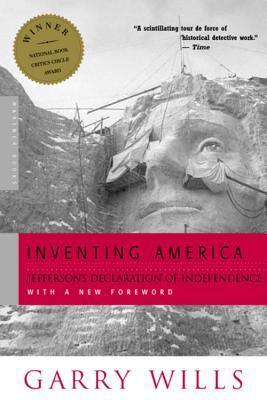
From one of America's foremost historians, Inventing America compares Thomas Jefferson's original draft of the Declaration of Independence with the final, accepted version, thereby challenging many long-cherished assumptions about both the man and the document. Although Jefferson has long been idealized as a champion of individual rights, Wills argues that in fact his vision was one in which interdependence, not self-interest, lay at the foundation of society.

Gary Wills has won significant acclaim for his bestselling works of religion and history. Here, for the first time, he combines both disciplines in a sweeping examination of Christianity in America throughout the last 400 years. Wills argues that the struggle now?as throughout our nation?s history?is between the head and the heart, reason and emotion, enlightenment and Evangelism. A landmark volume for anyone interested in either politics or religion, Head and Heart concludes that, while religion is a fertile and enduring force in American politics, the tension between the two is necessary, inevitable, and unending.

18 years after his death, John Wayne is still America's favorite movie star. He was less an actor than a symbol, the most popular pop icon of the 20th century, & one of the most important political figures in America. People shaped their lives or adopted political stands to conform to him as a template of authentic Americanism. Wayne became the lens which people saw their own & their country's history. In this groundbreaking study of the relationship between politics & popular culture, Pulitzer Prize-winning author Wills focuses on the manufacture of "John Wayne" from the raw materials of Marion Morrison, the person born in Iowa who became a myth, his own reality swallowed up in his meaning as master directors such as John Ford crafted films that made him a personification of America's frontier myth. Unlike other actors & actresses with whom we associate political views, Wayne embodied a politics of large meanings--a politics of gender (male), ideology (patriot), character (self-reliant) & personal responsibility. It was a politics of implicit dogmas often transcending his own views & behavior. Altho Wayne avoided serving in WWII, he became, thru screen roles, the model of the American soldier. Likewise, altho his popular image is that of a staunch anti-Communist, in reality he avoided taking a stand in the ideological war that raged in Hollywood until after the issue had been decided. He acquired his larger political meaning gradually, as he moved from one film role to the next: from the young, individualist cowboy hero (Ringo Kid in Stagecoach) to the middle-aged authority figure weighed down with responsibility (Sergeant Stryker in Sands of Iwo Jima) to the cool, determined patriot in the midst of Cold War dangers (Davy Crockett in The Alamo) to the elderly lone survivor of a past heroic time (Rooster Cogburn in True Grit). Wayne himself became aware of his larger political meaning only thru a progressive act of self-identification, in much the same way that his fans came to associate their ideals with his screen personae. In this work, the biography of an idea, Wills shows how Wayne & the Hollywood image factories distorted or ignored important facts of his life to create his myth. Wills shows how Wayne, thru his screen characters, spoke to the needs of his audience at crucial periods in history, & how in response Americans invested their emotions in that embodiment of their deepest myths. John Wayne's America traces the way Wayne's countrymen became "entangled in his story, by the dreams he shaped or inhibited in us or in others, by the things he validated & those he scorned, by the particular definition he gave to 'being American.'"

In A Necessary Evil, Pulitzer Prize-winning author Wills shows that distrust of government is embedded deep in the American psyche. From the revolt of the colonies against king & parliament to present-day tax revolts, militia movements & term limits debates, he shows that American antigovernment sentiment is based on a fundamental misunderstanding of history. By debunking myths about the Founding Fathers, the Constitution & the taming of the frontier, he shows how tendencies to hold our elected government in disdain are misguided.1 Revolutionary myths. MinutemenTerm limits 2 Constitutional myths. Sovereign statesChecking efficiency Co-equal branches The uses of factionBill of Rights No standing army3 Nullifiers. John Taylor of Caroline: father of nullificationJefferson: prophet of nullificationMadison: abettor of nullificationNullification North: Hartford ConventionNullification South: John C. CalhounAcademic nullifiers4 Seceders. Civil War5 Insurrectionists. From Daniel Shays to Timothy McVeighAcdemic insurrectionists6 Vigilantes. Groups: from regulators to clinic bombingsIndividuals: frontierIndividuals: NRA7 Withdrawers. Individuals: from Thoreau to MenckenGroups: from Brook Farm to hippie communes8 Disobeyers. From Dr King to SDS9 A necessary good. The uses of governmentThe uses of fear

Look out for a new book from Garry Wills, What The Qur'an Meant , coming fall 2017.Ronald Reagan achieved magical accord with the American people, attuning them to his moral vision of a nation made up of optimistic individualists, tough yet God-fearing, blessed with a special destiny. In Reagan's America , Pulitzer Prize winning author and historian Garry Wills seeks to understand Reagan's appeal through understanding his audience, the Americans who found in him everything they wanted to believe about themselves. An authoritative biography and a fascinating cultural history, Reagan's America reveals how this savvy, charismatic leader restored a nation's fading sense of innocence and faith in itself.

The New York Times bestselling historian takes on a pressing question in modern religion—will Pope Francis embrace change?Pope Francis, the first Jesuit pope and the first from the Americas, offers a challenge to his church. Can he bring about significant change? Should he? Garry Wills, the Pulitzer Prize-winning historian, argues provocatively that, in fact, the history of the church throughout is a history of change. In this brilliant and incisive study, Wills describes the deep and serious changes that have taken place in the church or are in the process of occurring. These include the change from Latin, the growth and withering of the ecclesiastical monarchy, the abandonment of biblical literalism, the assertion and nonassertion of infallibility, and the erosion of church patriarchy. In such developments we see the living church adapting itself to the new historical circumstances. As Wills contends, it is only by examining the history of the church that we can understand Pope Francis's and the church's challenges.

Garry Wills's Venice: Lion City is a tour de force -- a rich, colorful, and provocative history of the world's most fascinating city in the fifteenth and sixteenth centuries, when it was at the peak of its glory. This was not the city of decadence, carnival, and nostalgia familiar to us from later centuries. It was a ruthless imperial city, with a shrewd commercial base, like ancient Athens, which it resembled in its combination of art and sea empire.Venice: Lion City presents a new way of relating the history of the city through its art and, in turn, illuminates the art through the city's history. It is illustrated with more than 130 works of art, 30 in full color. Garry Wills gives us a unique view of Venice's rulers, merchants, clerics, laborers, its Jews, and its women as they created a city that is the greatest art museum in the world, a city whose allure remains undiminished after centuries.Like Simon Schama's The Embarrassment of Riches, on the Dutch culture in the Golden Age, Venice: Lion City will take its place as a classic work of history and criticism.

What makes a leader? How do we identify effective leadership, and how should—and shouldn’t—that power be used? In Certain Trumpets , Garry Wills presents portraits of eminent leaders including FDR to Ross Perot, King David, Martha Graham, and many others, offering an illuminating lens for studying society and ourselves. Dividing these portraits into sixteen leadership categories ranging from military to charismatic, intellectual, rhetorical, and elected, Wills highlights what makes each of his subjects unique, crafting along the way a distinct and incisive definition of leadership as a reciprocal engagement between two contrasting wills that serves to mobilize us toward a common good, and explaining why leadership is so often a contentious and emotionally charged subject. “A stunningly literate and thoughtful examination of what makes a leader…[and] a welcome antidote to some of the more egregious ‘management style’ drivel,” ( Kirkus Reviews ), Certain Trumpets is an inspiring and edifying tour through the history of an indispensable social art.

Look out for a new book from Garry Wills, What The Qur'an Meant , coming fall 2017.In an age when self -help methods abound and meditation is a common prescriptive, Garry Wills-one of the most respected writers on religious topics today-offers an extraordinary journey through one of the oldest aids to spiritual contemplation. Drawing together history and readings from scripture, Wills explains the beads on the rosary and the moments in Christ's life they represent, illustrating each mystery with a stunning Tintoretto painting. The result is an illuminating and poignant exploration of the power of prayer that will edify and inspire readers.

An eye-opening profile of the greatest historian of the nineteenth century assesses the seminal role and influence of Henry Adams on the study of history, discussing his use of archival sources, firsthand reportage, eyewitness accounts, and other techniques that transformed historical study and created a paradoxical view of American history that still informs modern-day policy. 60,000 first printing.

In this brief and incisive book, Pulitzer Prize-winning historian Garry Wills tells the story of the "Confessions"—what motivated Augustine to dictate it, how it asks to be read, and the many ways it has been misread in the one-and-a-half millennia since it was composed. Following Wills's biography of Augustine and his translation of the "Confessions," this is an unparalleled introduction to one of the most important books in the Christian and Western traditions.Understandably fascinated by the story of Augustine's life, modern readers have largely succumbed to the temptation to read the "Confessions" as autobiography. But, Wills argues, this is a mistake. The book is not autobiography but rather a long prayer, suffused with the language of Scripture and addressed to God, not man. Augustine tells the story of his life not for its own significance but in order to discern how, as a drama of sin and salvation leading to God, it fits into sacred history. "We have to read Augustine as we do Dante," Wills writes, "alert to rich layer upon layer of Scriptural and theological symbolism." Wills also addresses the long afterlife of the book, from controversy in its own time and relative neglect during the Middle Ages to a renewed prominence beginning in the fourteenth century and persisting to today, when the "Confessions" has become an object of interest not just for Christians but also historians, philosophers, psychiatrists, and literary critics.With unmatched clarity and skill, Wills strips away the centuries of misunderstanding that have accumulated around Augustine's spiritual classic.

"One of the country's most distinguished intellectuals [and] one of its most provocative."- The New York TimesBookish and retiring, Garry Wills has been an outsider in the academy, in journalism, even in his church. Yet these qualities have, paradoxically, prompted people to share intimate insights with him- perhaps because he is not a rival, a competitor, or a threat. Sometimes this made him the prey of con men like conspiratorialist Mark Lane or civil rights leader James Bevel. At other times it led to close friendship with such people as William F. Buckley, Jr., or singer Beverly Sills. The result is the most personal book Wills has ever written.With his dazzling style and journalist's eye for detail, Wills brings history to life, whether it's the civil rights movement; the protests against the Vietnam War; the presidential campaigns of Richard Nixon, Jimmy Carter, and Bill Clinton; or the set of Oliver Stone's Nixon . Illuminating and provocative, Outside Looking In is a compelling chronicle of an original thinker at work in remarkable times.

In Under God, Garry Wills, one of our liveliest and most eminent political observers, moves through the tapestry of American history, illuminating the instances where American politics and American religion have collided.Beginning with the 1988 presidential contest, an election that included two ministers and a senator accused of sin, Wills surveys our history to show the continuity of present controversies with past religious struggles and argues that the secular standards of the Founding Fathers have been misunderstood. He shows that despite reactionary fire-breathers and fanatics, religion has often been a progressive force in American politics and explains why the policy of a separate church and state has, ironically, made the position of the church stronger.Marked by the extraordinary quality of observation that has defined the work of Garry Wills, Under God is a rich, original look at why religion and politics will never be separate in the United States.

A dazzling study of the operas Verdi adapted from Shakespeare- and a spellbinding account of their creation. In Verdi's Shakespeare, Pulitzer Prize winner and lifelong opera devotee Garry Wills explores the writing and staging of Verdi's three triumphant Shakespearian Macbeth, Othello, and Falstaff . An Italian composer who couldn't read a word of English but adored Shakespeare, Verdi devoted himself to operatic productions that authentically incorporated the playwright's texts. Wills delves into the fast-paced worlds of these men of the theater, focusing on the intense working relationships both Shakespeare and Verdi had with the performers and producers of their works. We see Verdi study the Shakespearean dramaturgy as he obsessively corresponds with his chosen librettists, handpicks the singers he feels are best- suited to the roles, and coaches them intensely. With fascinating portraits of these artistic giants and their entourages, sharp insights into music and theater, and telling historical details, Verdi's Shakespeare re-creates the conditions that allowed Verdi to complete his masterworks and illuminates the very nature of artistic creation.

Renaissance plays and poetry in England were saturated with the formal rhetorical twists that Latin education made familiar to audiences and readers. Yet a formally educated man like Ben Jonson was unable to make these ornaments come to life in his two classical Roman plays. Garry Wills, focusing his attention on Julius Caesar, here demonstrates how Shakespeare so wonderfully made these ancient devices vivid, giving his characters their own personal styles of Roman speech.In four chapters, devoted to four of the play’s main characters, Wills shows how Caesar, Brutus, Antony, and Cassius each has his own take on the rhetorical ornaments that Elizabethans learned in school. Shakespeare also makes Rome present and animate by casting his troupe of experienced players to make their strengths shine through the historical facts that Plutarch supplied him with. The result is that the Rome English-speaking people carry about in their minds is the Rome that Shakespeare created for them. And that is even true, Wills affirms, for today’s classical scholars with access to the original Roman sources.

In his Pulitzer Prize-winning 1993 book Lincoln at Gettysburg , Garry Wills showed how the Gettysburg Address revolutionized the conception of modern America. In Witches and Jesuits , based on his Oxford/New York Public Library lectures, Wills again focuses on a single document to open up a window on an entire society. He begins with a simple If Macbeth is such a great tragedy, why do performances of it so often fail? The stage history of Macbeth is so riddled with disasters that it has created a legendary curse on the drama. Superstitious actors try to evade the curse by referring to Macbeth only as "the Scottish play," but production after production continues to soar in its opening scenes, only to sputter towards anticlimax in the later acts. By critical consensus there seems to have been only one entirely successful modern performance of the play, Laurence Olivier's in 1955.Drawing on his intimate knowledge of the vivid intrigue and drama of Jacobean England, Wills restores Macbeth 's suspenseful tension by returning it to the context of its own time, recreating the burning theological and political crises of Shakespeare's era. He reveals how deeply Macbeth's original 1606 audiences would have been affected by the notorious Gunpowder Plot of 1605, when a small cell of Jesuits came within a hairbreadth of successfully blowing up not only the King, but the Prince his heir, and all members of the court and Parliament. Wills likens their shock to that endured by Americans following Pearl Harbor or the Kennedy assassination. Furthermore, Wills documents, the Jesuits were widely believed to be acting in conjunction with the Devil. We see that the treason and necromancy in Macbeth were more than the imaginings of a gifted playwright--they were dramatizations of very real and potent threats to the realm.In this new light, Macbeth is transformed. Wills presents a drama that is more than a well-scripted story of a murderer getting his just penalty, it is the struggle for the soul of a nation. The death of a King becomes a truly apocalyptic event, and the witches on the heath, shrugged off as mere symbols of Macbeth's inner guilt and ambition by twentieth century interpreters, emerge as independent agents of the occult with their terrifying agendas. Restoring the theological politics and supernatural elements that modern directors have shied away from, Wills points the way toward a Macbeth that will finally escape the theatrical curse on "the Scottish play."Rich in insight and a joy to read, Witches and Jesuits is a tour de force of scholarship and imagination by one of our foremost writers. It is essential reading for anyone who loves the language.