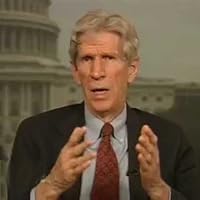
Gareth Porter
Gareth Porter is an American historian, media commentator and analyst who specialises in U.S. foreign policy & national security issues, particularly those relating to South-East Asia or the Middle East.
11 Books Written

A Peace Denied: The United States, Vietnam, and the Paris Agreement
by Gareth Porter
Rating: 4.0 ⭐
• 2 recommendations ❤️

In Manufactured Crisis, investigative reporter Gareth Porter shows how Israel and the George W. Bush administration successfully waged their campaign claiming that Iran was trying covertly to acquire a nuclear weapon. Porter shows in detail that most of the so-called evidence for such a weapons program was of dubious origin, including the documents that allegedly originated from the laptop of an Iranian nuclear scientist. As Iran and the United States have engaged in serious negotiations over Iran’s nuclear program, this book has provided crucial background material for those who want to make an independent assessment of the record, rather than relying on highly politicized allegations.

Perils of Dominance is the first completely new interpretation of how and why the United States went to war in Vietnam. It provides an authoritative challenge to the prevailing explanation that U.S. officials adhered blindly to a Cold War doctrine that loss of Vietnam would cause a "domino effect" leading to communist domination of the area. Gareth Porter presents compelling evidence that U.S. policy decisions on Vietnam from 1954 to mid-1965 were shaped by an overwhelming imbalance of military power favoring the United States over the Soviet Union and China. He demonstrates how the slide into war in Vietnam is relevant to understanding why the United States went to war in Iraq, and why such wars are likely as long as U.S. military power is overwhelmingly dominant in the world.Challenging conventional wisdom about the origins of the war, Porter argues that the main impetus for military intervention in Vietnam came not from presidents Kennedy and Johnson but from high-ranking national security officials in their administrations who were heavily influenced by U.S. dominance over its Cold War foes. Porter argues that presidents Eisenhower, Kennedy, and Johnson were all strongly opposed to sending combat forces to Vietnam, but that both Kennedy and Johnson were strongly pressured by their national security advisers to undertake military intervention. Porter reveals for the first time that Kennedy attempted to open a diplomatic track for peace negotiations with North Vietnam in 1962 but was frustrated by bureaucratic resistance. Significantly revising the historical account of a major turning point, Porter describes how Secretary of Defense Robert McNamara deliberately misled Johnson in the Gulf of Tonkin crisis, effectively taking the decision to bomb North Vietnam out of the president's hands.

When Global Environmental Politics was first published, the environment was just emerging as a pivotal issue in traditional international relations. Now the environment is a topic central to discussions of security politics and the relationship between foreign and domestic policy—and so much has changed that Gareth Porter and Janet Welsh Brown found themselves rewriting more than half of their original text. With new cases on biodiversity and desertification, this classic work is more complete and up-to-date than any survey of environmental politics on the market.In addition to providing a concise yet comprehensive overview of global environmental issues, the authors have worked to contextualize key topics such as the Rio conference, water security, the biodiversity treaty, and trade in toxics. Environmental concerns from global warming to the ozone layer to whaling are seen as challenges to transnational relations, with governments, NGOs, IGOs, and MNCs all facing the prospect of multilateral interaction to solve a growing global problem.

Here is the first scholarly book-length analysis of Communist Vietnam's political system. Taking advantage of the unprecedented wealth of revealing documentary material published in Vietnam since 1985, Gareth Porter offers new insights into the functioning of the Socialist Republic of Vietnam and its management of the Vietnamese economy and society. He examines the evolution of the system from the time the Democratic Republic of Vietnam was founded in 1945 through the 1986-1990 period of economic liberalization and cautious political reform by the successor regime, the SRV.

The Politics Of Counterinsurgency In The Philippines: Military And Political Options
by Gareth Porter
Rating: 5.0 ⭐

Resources, Population, and the Philippines Future: A Case Study
by Gareth Porter
Vietnam: The bloodbath argument
by Gareth Porter
Vietnam: The Definitive Documentation of Human Decisions
by Gareth Porter