
Gabriel Kolko
A historian specializing in 20th century Ameican politics and foreign policy, Gabriel Morris Kolko earned his BA in history from Kent State University in 1954, his MS from the University of Wisconsin in 1955, and his Ph.D. from Harvard University in 1962. He taught at the University of Pennsylvania and at SUNY-Buffalo before joining the history department of York University in Toronto in 1970.
19 Books Written
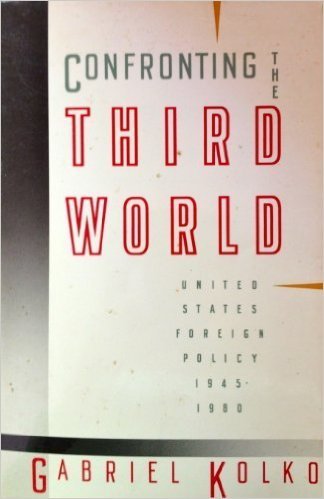
Confronting the Third World: United States Foreign Policy, 1945-1980
by Gabriel Kolko
Rating: 4.2 ⭐
• 2 recommendations ❤️
Analyzes U.S. foreign policy towards the Middle East and Latin America, and argues that the U.S. has often created political instability

The Triumph of Conservatism: A Reinterpretation of American History, 1900–1916
by Gabriel Kolko
Rating: 3.7 ⭐
A radically new interpretation of the Progressive Era which argues that business leaders, and not the reformers, inspired the era’s legislation regarding business.

Anatomy of a War: Vietnam, the United States, and the Modern Historical Experience
by Gabriel Kolko
Rating: 4.2 ⭐
Kolko's groundbreaking and widely cited study of the Vietnam War, with a new postscript by the author.

Another Century of War? is a candid and critical look at America's "new wars" by a brilliant and provocative analyst of its old ones. Gabriel Kolko's masterly studies of conflict have redefined our views of modern warfare and its effects; in this urgent and timely treatise, he turns his attention to our current crisis and the dark future it portends. Another Century of War? insists that the roots of terrorism lie in America's own cynical policies in the Middle East and Afghanistan, a half-century of realpolitik justified by crusades for oil and against communism. The latter threat has disappeared, but America has become even more ambitious in its imperialist adventures and, as the recent crisis proves, even less secure. America, Kolko contends, reacts to the complexity of world affairs with its advanced technology and superior firepower, not with realistic political response and negotiation. He offers a critical and well-informed assessment of whether such a policy offers any hope of attaining greater security for America. Raising the same hard-hitting questions that made his Century of War a "crucial" ( Globe and Mail ) assessment of our age of conflict, Kolko asks whether the wars of the future will end differently from those in our past.

Over the last three decades the historian Gabriel Kolko has redefined the way we look at modern warfare and its social and political effects. Century of War gives us a masterly synthesis of the effects of war on civilian populations and the political results of these traumatizing experiences in the twentieth century.

The Politics of War: Allied Diplomacy and the World Crisis of 1943-1945
by Gabriel Kolko
Rating: 4.4 ⭐
To what extent was the United States responsible for the Cold War? How far was its self-interest, determination, and ruthless ambition to supplant Britain in as many as possible of its traditional spheres of influence, responsible for creating the tensions of the post-war world situation?It is now becoming possible to glimpse the perspective and the realities of the international power struggle at the end of the war, the political strategies and manoevres of the Allies, their determination as they strove to reshape and influence the post-war world. Greece, where against the will of the population the Royal Family was placed on the throne and enforcedly kept there by British military intervention; the question of the future of Japan, shattered by its entry into war; the restoration of order in a disturbed post-Mussolini Italy; the question of a devastated Poland; the momentous summit conference at Yalta; the conditions of military strategy in the Far East - The Politics of War is universal in scope. It demonstrates how the aggressiveness of American foreign policy circumscribed British influence in the post-war world; how Churchill sought to restrict left-wing influence wherever he could in Europe; how Stalin fought to bring the communist parties of France, Italy, and Yugoslavia under Moscow's conservative control.By reassessing the actions and intentions of the Allies during the last two years of war, Gabriel Kolko in this most controversial book has shown how the balance of word power shifted and how the roots of the Cold War were planted.

Vietnam has experienced huge political and economic development since the war. In Anatomy of a Peace , Gabriel Kolko looks at the main economic phases the Communist Party has embarked upon since 1986 and outlines the transition to nascent capitalism. He also explores Vietnam's relations to its neighbours and the US in the light of social and psychological national features.Based on extensive research and over 30 years first hand experience, Anatomy of a Peace is a timely examination of recent history and developing economies in Asia. Gabriel Kolko argues that neither an intentional socialist or market strategy have determined recent Vietnamese history and, in fact, the Communist Party has little control over development during peace time.

This is a 1977 reprint of the original 1965 edition. From the author's "In the following pages I shall attempt critically to re-examine the relation of the railroads to federal regulation and the assumption that the national government consciously or in fact always acted in the manner that the majority of important railroad men considered fundamentally inimical to their interest. Rather, I will suggest that the intervention of the federal government not only failed to damage the interests of the railroads, but was positively welcomed by them since the railroads never really had the power over the economy, and their own industry, often ascribed to them." With extensive bibliography and index. 273 pages.

'Main Currents in Modern American History' is a reinterpretation of the United States' experience over the past century, focusing on the nature and purposes of power and its institutions in all of their changing dimensions during the nation's history as a modern industrial capitalist country. Gabriel Kolko reconsiders historically the economy, politics, and foreign policy, and the interactions between them that create additional strengths as well as new problems and dangers for American capitalism.

Book by Kolko, Gabriel

Wealth and Power in America: An Analysis of Social Class and Income Distribution
by Gabriel Kolko
Rating: 3.2 ⭐
In this economic analysis, Kolko demonstrates that the distribution of wealth in the United States remains what it was in 1939 or even 1910. Pointing to unequal tax burdens, hidden income, unemployment, and poverty, he predicts greater failure in economic democracy in the future.

World in Crisis is a new book from one of the world's leading scholars. Gabriel Kolko provides a panoramic overview of the problems facing the US and the world today. Each chapter covers a key topic, spanning a range of international issues including the current financial crisis, the limits of US foreign policy, the politicisation of intelligence, and why a war with Iran would be likely to culminate in disaster for the US. Kolko also outlines why changes in military technology make all wars, no matter who fights them, increasingly futile. At the heart of the book is the idea that the international system is in the grip of a great transition. Kolko shows how America is losing its dominance, and examines the profound changes we are experiencing as it is forced to accept the limits of its military power.
The Roots of American Foreign Policy: An Analysis of Power and Purpose.
by Gabriel Kolko
Rating: 3.3 ⭐
In "The Roots of American Foreign Policy," Gabriel Kolka, one of America's most perceptive young historians, makes clear that our foreign policy is the result of neither omission nor ignorance but rather of civilian authority and civilian-defined goals. An original and captivating book with a striking epilogue on reason and radicalism.

Does socialism have a future in the world of the twenty-first century? If not, what is the future for progressive politics? This is a major contribution to contemporary social and political thought written by one of the world's leading critical historians. Gabriel Kolko ask the difficult questions about where the left can go in a post-Cold War world where neoliberal policies appear to have triumphed in both the West and the former Soviet bloc. In trying to answer this, he interrogates both the origins and development of socialist ideas and the contemporary dynamics of the globalized economy dominated by American military, cultural and political might. While avoiding the temptations of either pessimism or utopianism, Kolko offers an original and practical solution about the way forward for a liberal politics.

The United States and world economic power
by Gabriel Kolko
The decline of American radicalism in the twentieth century
by Gabriel Kolko
The Bible is Human
by Gabriel Kolko
Wealth and Power in America
by Gabriel Kolko