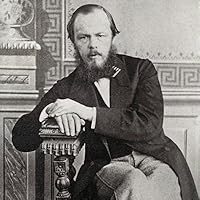
Fyodor Dostoevsky
Фёдор Михайлович Достоевский (Russian) Works, such as the novels Crime and Punishment (1866), The Idiot (1869), and The Brothers Karamazov (1880), of Russian writer Feodor Mikhailovich Dostoyevsky or Dostoevski combine religious mysticism with profound psychological insight. Very influential writings of Mikhail Mikhailovich Bakhtin included Problems of Dostoyevsky's Works (1929), Fyodor Mikhailovich Dostoevsky composed short stories, essays, and journals. His literature explores humans in the troubled political, social, and spiritual atmospheres of 19th-century and engages with a variety of philosophies and themes. People most acclaimed his Demons(1872) . Many literary critics rate him among the greatest authors of world literature and consider multiple books written by him to be highly influential masterpieces. They consider his Notes from Underground of the first existentialist literature. He is also well regarded as a philosopher and theologian. (Russian: Фёдор Михайлович Достоевский) (see also Fiodor Dostoïevski)
30 Books Written

Raskolnikov, a destitute and desperate former student, wanders through the slums of St Petersburg and commits a random murder without remorse or regret. He imagines himself to be a great man, a Napoleon: acting for a higher purpose beyond conventional moral law. But as he embarks on a dangerous game of cat and mouse with a suspicious police investigator, Raskolnikov is pursued by the growing voice of his conscience and finds the noose of his own guilt tightening around his neck. Only Sonya, a downtrodden prostitute, can offer the chance of redemption.This vivid translation by David McDuff has been acclaimed as the most accessible version of Dostoyevsky’s great novel, rendering its dialogue with a unique force and naturalism.

The murder of brutal landowner Fyodor Karamazov changes the lives of his sons irrevocably: Mitya, the sensualist, whose bitter rivalry with his father immediately places him under suspicion for parricide; Ivan the intellectual, whose mental tortures drive him to breakdown; the spiritual Alyosha, who tries to heal the family's rifts; and the shadowy figure of their bastard half-brother, Smerdyakov. As the ensuing investigation and trial reveal the true identity of the murder, Dostoyevsky's dark masterwork evokes a world where the lines between innocence and corruption, good and evil, blur, and everyone's faith in humanity is tested.This powerful translation of The Brothers Karamazov features an introduction highlighting Dostoyevsky's recurrent themes of guilt and salvation, with a new chronology and further reading.

Alternate cover here.Inspired by the true story of a political murder that horrified Russia in 1869, Fyodor Dostoevsky conceived of Demons as a "novel-pamphlet" in which he would say everything about the plague of materialist ideology that he saw infecting his native land. What emerged in 1872 was at once his darkest novel until The Brothers Karamazov and his most ferociously funny. For alongside its relentlessly escalating plot of conspiracy and assassination, Demons (which earlier translators erroneously translated as The Possessed) is a blistering comedy of ideas run amok. And like all of Dostoevsky's novels, it is also a riot of literary voices, whose profusion, energy and variety are rendered wonderfully in this new English version.--back cover

After his great portrayal of a guilty man in Crime and Punishment, Dostoevsky set out in The Idiot to portray a man of pure innocence. The twenty-six-year-old Prince Myshkin, following a stay of several years in a Swiss sanatorium, returns to Russia to collect an inheritance and “be among people.” Even before he reaches home he meets the dark Rogozhin, a rich merchant’s son whose obsession with the beautiful Nastasya Filippovna eventually draws all three of them into a tragic denouement. In Petersburg the prince finds himself a stranger in a society obsessed with money, power, and manipulation. Scandal escalates to murder as Dostoevsky traces the surprising effect of this “positively beautiful man” on the people around him, leading to a final scene that is one of the most powerful in all of world literature.Richard Pevear and Larissa Volokhonsky’s masterful translation of The Idiot is destined to stand with their versions of Crime and Punishment, The Brothers Karamazov, and Demons as the definitive Dostoevsky in English.
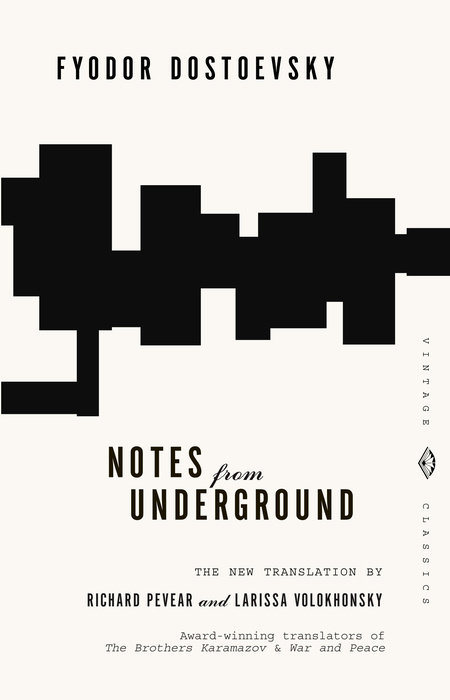
Dostoevsky’s most revolutionary novel, Notes from Underground marks the dividing line between nineteenth- and twentieth-century fiction, and between the visions of self each century embodied. One of the most remarkable characters in literature, the unnamed narrator is a former official who has defiantly withdrawn into an underground existence. In complete retreat from society, he scrawls a passionate, obsessive, self-contradictory narrative that serves as a devastating attack on social utopianism and an assertion of man’s essentially irrational nature.Richard Pevear and Larissa Volokhonsky, whose Dostoevsky translations have become the standard, give us a brilliantly faithful edition of this classic novel, conveying all the tragedy and tormented comedy of the original.

First published in 1862 after Dostoyevsky’s imprisonment in a Siberian labor camp, “The House of the Dead” is a collection of memoirs, related by themes, that portrays the horrific life of convicts. The author drew on his own experiences in prison to depict the squalor, destitution, and severity of a Siberian camp with remorseless detail. Dostoyevsky reveals the characters of many of the other convicts, which includes the depravity many have come to expect through their mental and physical suffering. The protagonist is Aleksandr Petrovich, a gentleman who additionally struggles with the malice of the largely peasant-populated prison. He gradually comes to accept his situation, experiencing a spiritual re-awakening in the unremitting strife of penal servitude. Though told with uncharacteristic detachment, “The House of the Dead” is a work of humanity, not without sympathy or admiration of those in Siberia, which proclaims the tragedy of those institutions, both for the inhabitants and for the country of Russia, and stands to this day as one of Dostoyevsky’s masterpieces. This edition is printed on premium acid-free paper.

White Nights is a short story by Fyodor Dostoevsky that was published in 1848. Set in St. Petersburg, it is the story of a young man fighting his inner restlessness. A light and tender narrative, it delves into the torment and guilt of unrequited love. Both protagonists suffer from a deep sense of alienation that initially brings them together. A blend of romanticism and realism, the story appeals gently to the senses and feelings.

In this dark and compelling short novel, Dostoevsky tells the story of Alexey Ivanovitch, a young tutor working in the household of an imperious Russian general. Alexey tries to break through the wall of the established order in Russia, but instead becomes mired in the endless downward spiral of betting and loss. His intense and inescapable addiction is accentuated by his affair with the General’s cruel yet seductively adept niece, Polina. In The Gambler, Dostoevsky reaches the heights of drama with this stunning psychological portrait.
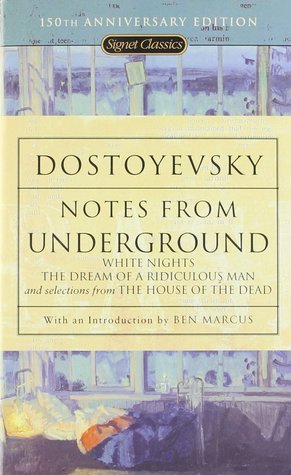
Notes from Underground, White Nights, The Dream of a Ridiculous Man, and Selections from The House of the Dead
by Fyodor Dostoevsky
Rating: 4.2 ⭐
A collection of powerful stories by one of the masters of Russian literature, illustrating the author's thoughts on political philosophy, religion and above all, humanity: Notes from Underground, White Nights, The Dream of a Ridiculous Man, and Selections from The House of the Dead (150th Anniversary Edition)The compelling works presented in this volume were written at distinct periods in Dostoyevsky's life, at decisive moments in his groping for a political philosophy and a religious answer. From the primitive peasant who kills without understanding that he is destroying life to the anxious antihero of Notes from Underground—who both craves and despises affection—the writer's often-tormented characters showcase his evolving outlook on our fate.Thomas Mann described Dostoyevsky as "an author whose Christian sympathy is ordinarily devoted to human misery, sin, vice, the depths of lust and crime, rather than to nobility of body and soul" and Notes from Underground as "an awe- and terror- inspiring example of this sympathy."

A short story by Fyodor Dostoyevsky written in 1877. It begins with a man walking St. Petersburg's streets while musing upon how ridiculous his life is, as well as its distinct lack of meaning or purpose. This train of thought leads him to the idea of suicide, which he resolves to commit using a previously-acquired gun. However, a chance encounter with a distressed little girl in the street derails his drastic plans.

While his literary reputation rests mainly on such celebrated novels as Crime and Punishment, The Brothers Karamazov, and The Idiot, Dostoyevsky also wrote much superb short fiction. The Double is one of the finest of his shorter works. It appeared in 1846 (his second published work) and is by far the most significant of his early stories, not least for its successful, straight-faced treatment of a hallucinatory theme.In The Double, the protagonist, Golyadkin senior, is persecuted by his double, Golyadkin junior, who resembles him closely in almost every detail. The latter abuses the former with mounting scorn and brutality as the tale proceeds toward its frightening denouement. Characteristic Dostoyevskyan themes of helplessness, victimization, and scandal are beautifully handled here with an artistry that qualifies the story as a small masterpiece.Students of literature, admirers of Dostoyevsky, and general readers will all be delighted to have this classic work available in this inexpensive but high-quality edition.

Poor Folk (Russian: Бедные люди, Bednye lyudi), sometimes translated as Poor People,[note] is the first novel by Fyodor Dostoevsky, written over the span of nine months between 1844 and 1845. Dostoevsky was in financial difficulty because of his extravagant lifestyle and his developing gambling addiction; although he had produced some translations of foreign novels, they had little success, and he decided to write a novel of his own to try to raise funds.Inspired by the works of Gogol, Pushkin, and Karamzin, as well as English and French authors, Poor Folk is written in the form of letters between the two main characters, Makar Devushkin and Varvara Dobroselova, who are poor third cousins twice removed. The novel showcases the life of poor people, their relationship with rich people, and poverty in general, all common themes of literary naturalism. A deep but odd friendship develops between them until Dobroselova loses her interest in literature, and later in communicating with Devushkin after a rich widower Mr. Bykov proposes to her. Devushkin, a prototype of the clerk found in many works of naturalistic literature at that time, retains his sentimental characteristics; Dobroselova abandons art, while Devushkin cannot live without literature.Contemporary critics lauded Poor Folk for its humanitarian themes. While Vissarion Belinsky dubbed the novel Russia's first "social novel" and Alexander Herzen called it a major socialist work, other critics detected parody and satire. The novel uses a complicated polyphony of voices from different perspectives and narrators. Initially offered by Dostoyevsky to the liberal-leaning magazine Fatherland Notes, the novel was published in the almanac, St. Petersburg Collection, on January 15, 1846. It became a huge success nationwide. Parts of it were translated into German by Wilhelm Wolfsohn and published in an 1846/1847 magazine. The first English translation was provided by Lena Milman in 1894, with an introduction by George Moore, cover art design by Aubrey Beardsley, and publication by London's Mathews and Lane.
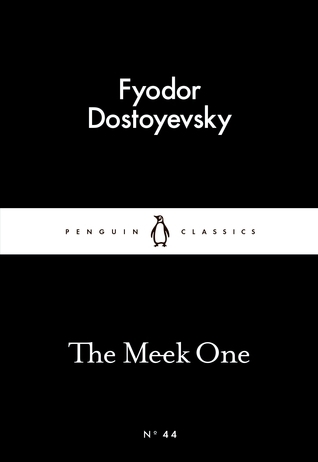
'I could see that she was still terribly afraid, but I didn't soften anything; instead, seeing that she was afraid I deliberately intensified it.' In this short story, Dostoyevsky masterfully depicts desperation, greed, manipulation and suicide. Introducing Little Black Classics: 80 books for Penguin's 80th birthday. Little Black Classics celebrate the huge range and diversity of Penguin Classics, with books from around the world and across many centuries. They take us from a balloon ride over Victorian London to a garden of blossom in Japan, from Tierra del Fuego to 16th-century California and the Russian steppe. Here are stories lyrical and savage; poems epic and intimate; essays satirical and inspirational; and ideas that have shaped the lives of millions. Fyodor Dostoyevsky (1821-1881).Dostoyevsky's works available in Penguin Classics are Crime and Punishment, The Idiot, The Double, The Gambler and Other Stories, The Grand Inquisitor, Notes From The Underground, Netochka Nezvanova, The House of The Dead, The Brothers Karamazov and The Village of Stepanchikovo.
Un giovane sognatore, nella magia vagamente inquieta delle nordiche notti bianche, incontra una misteriosa fanciulla e vive la sua “educazione sentimentale”, segnata da un brusco risveglio con conseguente ritorno alla realtà. Un Dostoevskij lirico, ispirato, comincia a riflettere sulle disillusioni dell’esistenza e dell’amore nell’ultima opera pubblicata prima dell’arresto e della deportazione, esperienze che modificheranno in maniera radicale e definitiva la sua concezione dell’uomo e dell’arte. In questa edizione, al celebre racconto viene affiancata la visione “diurna” di Pietroburgo contenuta nei feuilletons che compongono la Cronaca di Pietroburgo, vero e proprio laboratorio per la scrittura dostoevskiana. Lo stretto legame tra pubblicistica e letteratura, che accompagnerà Dostoevskij negli anni della maturità, viene così a manifestarsi fin quasi dal suo esordio. Il racconto Le notti bianche ha ispirato il film omonimo di Luchino Visconti (1957), con Marcello Mastroianni e Maria Schell, e il film Quattro notti di un sognatore di Robert Bresson (1971).

In this novel we see a young man madly in love with a girl from a moderately poor family. This girl falls in love with a very aristocratic prince—a man without principles, but charming in his childish egotism—extremely attractive by his sincerity, and with a full capacity for quite unconsciously committing the worst crimes toward those with whom life brings him into contact. The psychology of both the girl and the young aristocrat is very good, but where Dostoyevsky appears at his best is in representing how the other young man, rejected by the girl, devotes the whole existence to being her humble servant and again his own will become instrumental in throwing her into the hands of the aristocrat.

Crime e Castigo (em russo, Преступле́ние и наказа́ние, Prestuplênie i nakazánie) é um romance do escritor russo Fiódor Dostoiévski publicado em 1866. Narra a história de Rodion Românovitch Raskólnikov, um jovem estudante que comete um assassinato e se vê perseguido por sua incapacidade de continuar sua vida após o delito.O livro/romance se baseia numa visão sobre religião e existencialismo com um foco predominante no tema de atingir salvação por sofrimento, sem deixar de comentar algumas questões do socialismo e niilismo.Os personagens e as descrições de seus caracteres e personalidades, bem como outras obras maiores de Fiódor Dostoiévski, inspiraram pensamentos filosóficos,sociológicos e psicológicos da segunda metade do século XIX e também no século XX. Foram influenciados Nietzsche, Sartre, Freud, Orwell, Huxley, dentre outros.Os flagrantes traços autobiográficos, como a adoração pela mãe, o vício do jogo (O Jogador) e a fidelidade psicológica, bem como os traços estilísticos do autor, colocaram esta obra, entre as maiores da história da literatura universal e, certamente, junto com Os Irmãos Karamazov, garantiram a Fiódor Dostoiévski a posição de maior escritor russo da história em conjunto com Lev Tolstoy.

The most monstrous monster is the monster with noble feelings.This remarkably edgy and suspenseful tale shows that, despite being better known for his voluminous and sprawling novels, Fyodor Dostoevsky was a master of the more tightly-focused form of the novella.The Eternal Husband may, in fact, constitute his most classically-shaped composition, with his most devilish plot: a man answers a late-night knock on the door to find himself in a tense and puzzling confrontation with the husband of a former lover—but it isn’t clear if the husband knows about the affair. What follows is one of the most beautiful and piercing considerations ever written about the dualities of love: a dazzling psychological duel between the two men over knowledge they may or may not share, bringing them both to a shattering conclusion.The Art of The Novella SeriesToo short to be a novel, too long to be a short story, the novella is generally unrecognized by academics and publishers. Nonetheless, it is a form beloved and practiced by literature’s greatest writers. In the Art Of The Novella series, Melville House celebrates this renegade art form and its practitioners with titles that are, in many instances, presented in book form for the first time.

The narrator and protagonist of Dostoevsky’s novel The Adolescent (first published in English as A Raw Youth) is Arkady Dolgoruky, a naive 19-year-old boy bursting with ambition and opinions. The illegitimate son of a dissipated landowner, he is torn between his desire to expose his father’s wrongdoing and the desire to win his love. He travels to St. Petersburg to confront the father he barely knows, inspired by an inchoate dream of communion and armed with a mysterious document that he believes gives him power over others. This new English version by the most acclaimed of Dostoevsky’s translators is a masterpiece of pathos and high comedy.

This scarce antiquarian book is a facsimile reprint of the original. Due to its age, it may contain imperfections such as marks, notations, marginalia and flawed pages. Because we believe this work is culturally important, we have made it available as part of our commitment for protecting, preserving, and promoting the world's literature in affordable, high quality, modern editions that are true to the original work.

This work has been selected by scholars as being culturally important, and is part of the knowledge base of civilization as we know it. This work was reproduced from the original artifact, and remains as true to the original work as possible. Therefore, you will see the original copyright references, library stamps (as most of these works have been housed in our most important libraries around the world), and other notations in the work.This work is in the public domain in the United States of America, and possibly other nations. Within the United States, you may freely copy and distribute this work, as no entity (individual or corporate) has a copyright on the body of the work.As a reproduction of a historical artifact, this work may contain missing or blurred pages, poor pictures, errant marks, etc. Scholars believe, and we concur, that this work is important enough to be preserved, reproduced, and made generally available to the public. We appreciate your support of the preservation process, and thank you for being an important part of keeping this knowledge alive and relevant.

"Bobok" (Russian: Бобок, Bobok) is a short story by Fyodor Dostoyevsky that first appeared in 1873. The title can be translated from the Russian as meaning "little bean" and in the context of the story is taken to be synonymous with gibberish or nonsense.

‘It is best to do nothing! The best thing is conscious inertia! So long live the underground!’Alienated from society and paralysed by a sense of his own insignificance, the anonymous narrator of Dostoyevsky’s groundbreaking Notes from Underground tells the story of his tortured life. With bitter sarcasm, he describes his refusal to become a worker in the ‘ant-hill’ of society and his gradual withdrawal to an existence ‘underground’. The seemingly ordinary world of St Petersburg takes on a nightmarish quality in The Double when a government clerk encounters a man who exactly resembles him – his double perhaps, or possibly the darker side of his own personality. Like Notes from Underground, this is a masterly study of human consciousness.Jessie Coulson’s introduction discusses the stories’ critical reception and the themes they share with Dostoyevksy’s great novels.

Netochka Nezvanova - a 'Nameless Nobody' - tells the story of a childhood dominated by her stepfather, Efimov, a failed musician who believes he is a neglected genius. The young girl is strangely drawn to this drunken ruin of a man, who exploits her and drives the family to poverty. But when she is rescued by an aristocratic family, the abuse against Netochka's delicate psyche continues in a more subtle way, condemning her to remain an outsider - a solitary spectator of a glittering society. Conceived as part of a novel on a grand scale, Netochka Nezvanova remained incomplete after Dostoyevsky was exiled to Siberia for 'revolutionary activities' in 1849. With its depiction of the suffering, loneliness, madness and sin that affect both rich and poor in St Petersburg, it contains the great themes that were to dominate his later novels.
The Grand Inquisitor is a section from The Brothers Karamazov, which is a literary work by Russian author/philosopher Fyodor Dostoevsky. The central character in this work is a Grand Inquisitor who arrests Jesus. A Grand Inquisitor, or Inquisitor Generalis in German is the individual who leads an Inquisition, just like Spanish Dominican Tomas de Torquemada who was the official in charge of the Spanish Inquisition.

Usually interpreted as a diatribe against the Chernyshevsky generation, it is a work that is often referred to, but rarely read. Cioran's translation is not only readable, but is evocative of the wit and satire of the original; it is both accurate and fluid.

یک اتفاق مسخره در سال ۱۸۶۲ منتشر شد. این آخرین داستانی بود که داستایفسکی به تأثیر از نخستین استادش، گوگول، نوشت. داستان دربارهی صاحبمنصبی که به مراسم عروسی یکی از زیردستانش میرود تا همه بفهمند چه انسان فروتنی است و شعارهایی که در باب انسانیت سر میدهد توخالی نیست. اما آنچه در این ضیافت رقم میخورد بهکل چیز دیگری است. یک اتفاق مسخره همتراز شاهکارهایی چون «شنل» و «بلوار نفسکی» است و آنها که «همزاد» داستایفسکی و «یادداشتهای یک دیوانه»ی گوگول را خوانده و پسندیدهاند این کتاب کوچک را نیز دلپذیر خواهند یافت.

Главным героем повести «Слабое сердце» является Вася Шумков – петербургский мечтатель, который скрывается в несовершенном теле обыкновенного бедного молодого чиновника. Вася Шумков имеет преданного, любящего и верного друга Аркадия Ивановича Нефедевича, который является своеобразным ангелом-хранителем вечно мечтающего Васи. Аркадий Иванович – молодой сослуживец Васи, но отличается трезвостью ума, веселым живым нравом.Дебютная работа Николаева Матвея заслуживает внимания. Диктор профессионально передал атмосферу аудиокниги. Без лишнего трагизма, но с необходимыми акцентами Николаев Матвей повествует о судьбе Васи Шумкова. Приятный голос, грамотные паузы Николаева Матвея и гениальный слог Федора Михайловича Достоевского способны подарить истинное удовольствие от классического произведения «Слабое сердце».

Dostoyevsky said he wrote the Village of Stepanchikovo (1859) for the sheer pleasure of prolonging the adventures of my new hero and enjoying a good laugh at him. This hero is not unlike myself...Dostoyevsky's narrator has been summoned to his uncle Colonel Rostanev's remote country estate in the hope that he will act as decoy and rescue Rostanev's former ward, Nastenka Yezhevikin, from the tyranny of Opiskin, a despot and charlatan who has the whole household under his thumb. Forty-eight hours of explosive comic drama unfold, culminating in a violent confrontation between Opiskin and the ineffectual Rostanev.Dostoyevsky conveys a delight in life's absurdities to rival that of Gogol, yet at the same time in Opiskin, a comic monster of Russian literature, he creates an unflattering portrait of his mentor. Here we recognize the genesis of the characters and the revelatory dramatic scenes of and The Karamazov Brothers.The cover shows a detail from Spring by Konstantin Fedorovich Yuon reproduced by courtesy of the David King Collection.

Der ehrliche DiebEin schwaches HerzEin kleiner Held Das Krokodil BobokDie SanfteDer Traum eines lächerlichen Menschen

An entertaining parody of small-town manners and morals, this comic novella is a revelation When the aging Russian Prince, Prince K., arrives in the town of Mordasov, Marya Alexandrovna Moskaleva, a doyenne of local society life, takes him under her protection, with the aim of engineering his marriage with her 23 year old daughter Zina. Yet with many rivals for the hands of both parties, events are not guaranteed to run smoothly. The gossiping and rumor of the country village are deftly captured in Dostoevsky's mock-heroic tone. A rare foray into comedy by the giant of Russian literature, this tale nonetheless still possesses all the hallmarks of Dostoevsky's psychological and philosophical writing.