
Francis-Noel Thomas
4 Books Written
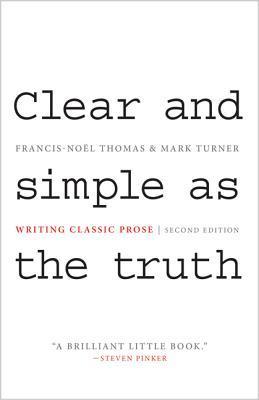
Clear and Simple as the Truth: Writing Classic Prose
by Francis-Noel Thomas
Rating: 4.3 ⭐
• 2 recommendations ❤️
For more than a decade, Clear and Simple as the Truth has guided readers to consider style not as an elegant accessory of effective prose but as its very heart. Francis-No�l Thomas and Mark Turner present writing as an intellectual activity, not a passive application of verbal skills. In classic style, the motive is truth, the purpose is presentation, the reader and writer are intellectual equals, and the occasion is informal. This general style of presentation is at home everywhere, from business memos to personal letters and from magazine articles to student essays. Everyone talks about style, but no one explains it. The authors of this book do; and in doing so, they provoke the reader to consider style, not as an elegant accessory of effective prose, but as its very heart.At a time when writing skills have virtually disappeared, what can be done? If only people learned the principles of verbal correctness, the essential rules, wouldn't good prose simply fall into place? Thomas and Turner say no. Attending to rules of grammar, sense, and sentence structure will no more lead to effective prose than knowing the mechanics of a golf swing will lead to a hole-in-one. Furthermore, ten-step programs to better writing exacerbate the problem by failing to recognize, as Thomas and Turner point out, that there are many styles with different standards.The book is divided into four parts. The first, Principles of Classic Style, defines the style and contrasts it with a number of others. The Museum is a guided tour through examples of writing, both exquisite and execrable. The Studio, new to this edition, presents a series of structured exercises. Finally, Further Readings in Classic Prose offers a list of additional examples drawn from a range of times, places, and subjects. A companion website, classicprose.com, offers supplementary examples, exhibits, and commentary, and features a selection of pieces written by students in courses that used Clear and Simple as the Truth as a textbook.

In an age of authorless, contextless, deconstructed texts, Francis-Noël Thomas argues that it is time to re-examine a fundamental but neglected concept of writing is an action whose agent is an individual. Addressing both general readers and scholars, Thomas offers two cases, Bernard Shaw's Saint Joan and Marcel Proust's A la recherche du temps perdu , read against the background of the authors' large, eccentric, and surprisingly similar claims about their texts as acts. He examines what happens when we take these claims seriously enough to find out why the authors made them in the first place and what bearing they have on the texts themselves.Originally published in 1993.The Princeton Legacy Library uses the latest print-on-demand technology to again make available previously out-of-print books from the distinguished backlist of Princeton University Press. These editions preserve the original texts of these important books while presenting them in durable paperback and hardcover editions. The goal of the Princeton Legacy Library is to vastly increase access to the rich scholarly heritage found in the thousands of books published by Princeton University Press since its founding in 1905.

Explanation: the fictional mode
by Francis-Noel Thomas

The Writer Writing by Francis-Noël Thomas
by Francis-Noel Thomas