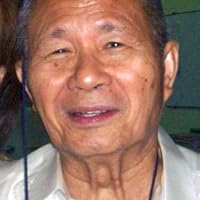
F. Landa Jocano
Felipe Landa Jocano was a Filipino anthropologist, educator, and author known for his works in Philippine Anthropology, in particular for documenting and translating the Hinilawod, a Western Visayan folk epic. Jocano served as Professor Emeritus at the Asian Center of the University of the Philippines and Executive Director of PUNLAD Research House, Inc. He has authored numerous books on various aspects of Filipino society and culture.
29 Books Written

This book is a collection of the various Philippine deities, pantheons, myths and tales of wonder grouped under a few large headings and strung together with a minimum of unobtrusive commentary by an outstanding Filipino scholar, Dr. F. Landa Jocano. This book is designed as an introduction to give a general understanding of this expansive and often confusing topic.The stories are drawn both from previously published materials and from Dr. Jocano’s own field research.

'This book is the revised and expanded version of Philippine Prehistory: An Anthropological Overview. Many new archaeological materials have been recovered since its publication in 1975, requiring changes in the earlier descriptions and interpretations of Philippine prehistoric society and culture." -- www.kabayancentral.com

This book is about the commonly shared and traditionally established system of values underlying Filipino behavior.

F. Landa Jocano combines the methods of sociology and anthropological analyses in this piercing record of a district of slum dwellers in Manila to draw out a full-fleshed portrait of life in the slum.

Filipino Social Organization: Traditional Kinship and Family Organization
by F. Landa Jocano
Rating: 3.9 ⭐
This book is about the study of traditional Filipino kinship and family organization. It puts together available ethnographic materials in an attempt at generalizing about this aspect of the Filipino social system. It is descriptive in approach.

Filipino Indigenous Ethnic Communities: Patterns, Variations, and Typologies
by F. Landa Jocano
Rating: 4.0 ⭐

This book is about the concept of worldview in Filipino culture. It describes worldview in the context of the local knowledge Filipinos, particularly the rural villagers from whom the ethnographic materials for this purpose were gathered, have of their surrounding world.

"This book is written with two purposes in mind. One is to present an ethnographic picture of folk medicine among Tagalog-speaking Filipino peasants in the municipality of Bay, Laguna Province, Philippines. The other is to provide health innovators with a case study on how peasants meet their medical needs." - from the Introduction

Management by Culture: Fine-Tuning Modern Management to Filipino Culture
by F. Landa Jocano
Rating: 4.3 ⭐

Towards Developing a Filipino Corporate Culture: Uses of Filipino Traditional Structures and Values in Modern Management
by F. Landa Jocano
Rating: 4.3 ⭐

Growing Up in a Philippine Barrion is a detailed ethnography of life in a barrio on the island of Panay, one of the Bisayas of the central Philippines. Written by a native of the Philippines, it is an analysis of education in the broadest sense - as socialization and enculturation rather than formal instruction in schools. The author also provides an analysis of kinship and of social relations in Malirbog, moving from family and household to the wider circle of kin and, finally, to the sanctions underlying he social order in the form of value orientations. The case study ends with analyses of the supernatural world and the treatment of death and burial, showing how they are aspects of culture learned by children who are present at all the important events and who are taught to fear supernatural beings as a means of social control.

Sulod Society: A Study in the Kinship System and Social Organization of a Mountain People of Central Panay
by F. Landa Jocano
Rating: 4.1 ⭐
This work offers a comprehensive description and analysis of the kinship system and social organization of the Sulod.

Philippine Prehistory: An Anthropological Overview of the Beginnings of Filipino Society and Culture
by F. Landa Jocano
Rating: 5.0 ⭐

Problems & Methods in the Study of Philippine Indigenous Ethnic Cultures: A Preliminary Overview
by F. Landa Jocano
Rating: 4.0 ⭐
The Philippines at Spanish Contact: Some Major Accounts of Early Filipino Society and Culture
by F. Landa Jocano
Rating: 4.0 ⭐
Social Work in the Philippines: A Historical Overview
by F. Landa Jocano
Our Living Past: The Philippines from 250,000 B.C. to 1521 A.D.
by F. Landa Jocano
Folk Christianity: A Preliminary Study of Conversion and Patterning of Christian Experience in the Philippines
by F. Landa Jocano

The Traditional World of Malitbog
by F. Landa Jocano
A Heritage to Be Proud Of
by F. Landa Jocano
Anthropology of the Filipino People
by F. Landa Jocano
Working with Filipinos: A cross-cultural encounter
by F. Landa Jocano
Book by Jocano, F. Landa
Philippines-USSR Relations: A Study in Foreign Policy Development
by F. Landa Jocano
The Hiligaynon [sic]: An Ethnography of Family and Community Life in Western Bisayas Region
by F. Landa Jocano
Tuburan: A Case Study of Adaptation and Peasant Life in a Bisayan Barrio
by F. Landa Jocano
The Ethnography of Tagalog Life Cycle: Some Preliminary Descriptions
by F. Landa Jocano
The Philippines at the Spanish contact, some major accounts of early Filipino society and culture
by F. Landa Jocano