
Eric A. Johnson
Eric Johnson joined the CMU faculty in 1976 after studying at Brown and Stockholm Universities and receiving his Ph.D. at the University of Pennsylvania. Over the years he has taught a wide array of courses, primarily focused on modern Europe, Germany, the Holocaust, and social science methods and approaches to historical study. He has held several visiting professorships of various lengths. As part of the CMU exchange with Strathclyde University he spent the 1988-1989 academic year teaching in Glasgow, Scotland. Between 1989 and 1995 he was a visiting professor at the Center for Historical Social Research at the University of Cologne, mostly leading a small research team working on terror in Nazi Germany. From 1995-1996 he was in residence writing and researching primarily at Princeton's Institute for Advanced Study, and he held a similar appointment at the Netherlands Institute for Advanced Study in 1998-1999. Professor Johnson's research interests dovetail considerably with his teaching. In the first years of his career he concentrated primarily on the history of crime and urbanization and justice. In the last couple of decades he has written primarily on Nazi Germany and the Holocaust. Presently he is working on American and Allied prisoners, especially pilots, in WWII and completing a personal account of the fall of the Berlin Wall and the re-unification of Germany.
12 Books Written

What We Knew: Terror, Mass Murder, and Everyday Life in Nazi Germany
by Eric A. Johnson
Rating: 4.0 ⭐
• 1 recommendation ❤️
The horrors of the Nazi regime and the Holocaust still present some of the most disturbing questions in modern history: Why did Hitler's party appeal to millions of Germans, and how entrenched was anti-Semitism among the population? How could anyone claim, after the war, that the genocide of Europe's Jews was a secret? Did ordinary non-Jewish Germans live in fear of the Nazi state? In this unprecedented firsthand analysis of daily life as experienced in the Third Reich, What We Knew offers answers to these most important questions. Combining the expertise of Eric A. Johnson, an American historian, and Karl-Heinz Reuband, a German sociologist, What We Knew is the most startling oral history yet of everyday life in theThird Reich.

Nazi Terror tackles the central aspect of the Nazi dictatorship head on by focusing on the roles of the individual and of society in making terror work. Based on years of research in Gestapo archives, on more than 1,100 Gestapo and "special court" case files, and on surveys and interviews with German perpetrators, Jewish victims and ordinary Germans who experienced the Third Reich firsthand, Johnson's book settles many nagging questions about who, exactly, was responsible for what, who knew what, and when they knew it. Nazi Terror is the most fine-grained portrait we may ever have of the mechanism of terror in a dictatorship.

This book contributes to modern German history and to the sociological understanding of crime in urban societies. Its central argument is that cities do not cause crime. It focuses on crime during Germany's period of most rapid growth. From 1871-1914, German cities, despite massive growth, socialist agitation, non-ethnic immigration, and the censure of conservative elites, were not particularly crime-infested. Nevertheless, governmental authorities often overreacted against city populations, helping to set Germany on a dangerous authoritarian course.

Der nationalsozialistische Terror. Gestapo, Juden und gewöhnliche Deutsche
by Eric A. Johnson
Rating: 5.0 ⭐

Fresh Oil: A Word for Dry and Difficult Days
by Eric A. Johnson
Fresh Oil lives up to its name. Dr. Eric A. Johnson speaks to our inner pains and struggles, and helps us see that blessing and healing are available. Just like fresh motor oil gives life for our cars, we all need the fresh oil of the Holy Spirit that recharges, resets and reinvigorates our lives. In these times of brokenness, uncertainty and trouble, Fresh Oil provides Biblical principles that refresh the soul.
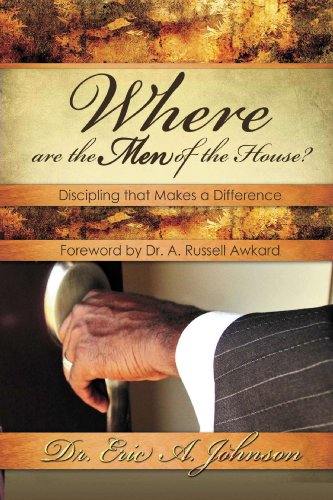
Where are the Men of the House? Discipling that Makes a Difference
by Eric A. Johnson
Dr. Eric Johnson’s new book reveals a clear and well-researched message about the problems and possibilities with men in today’s church. Drawing on the observations from ministerial leaders, past and present, he lays down the foundation stones for building strong Christian men. His academic research is backed up by the writer’s practical experience in his pastorate.Where are the men in the house? This piercing question tempts many pastors to be less than truthful. Like boasting about the size of church membership, and we have a tendency to blow-up the numbers of men who are active in the congregation. Dr. Johnson’s book exposes a flaw in contemporary church life, regardless of public perceptions about size and success.Church leaders must become tuned in to the unique needs of men. Men don’t have the same views about church that women seem to take for granted. The church must become more balanced in order to reach more men.Dr. Johnson’s publication builds a sound argument for reshaping the way we “do” church. The ideas that he shares from his own pastoral achievements and from a rich variety of other sources are doable. We may not be able to change everything all at once, but it’s time to make the church more welcoming, appealing and fulfilling to men.


Murder and Violence in Modern Latin America 1st edition by Johnson, Eric A. (2013) Paperback
by Eric A. Johnson

What We Knew: Terror, Mass Murder, and Everyday Life In Nazi Germany by Eric A. Johnson
by Eric A. Johnson
How to Grow the Wildflowers (Natural Garden) by Eric A. Johnson
by Eric A. Johnson
Ashtabula Firefighting (OH) (Images of America) by Eric A. Johnson
by Eric A. Johnson
The Nazi Terror: The Gestapo, Jews and Ordinary Germans
by Eric A. Johnson