
Elie Wiesel
Eliezer "Elie" Wiesel was a Romanian-born American writer, professor, political activist, Nobel laureate, and Holocaust survivor. He authored 57 books, written mostly in French and English, including Night, a work based on his experiences as a Jewish prisoner in the Auschwitz and Buchenwald concentration camps. In his political activities Wiesel became a regular speaker on the subject of the Holocaust and remained a strong defender of human rights during his lifetime. He also advocated for many other causes like the state of Israel and against Hamas and victims of oppression including Soviet and Ethiopian Jews, the apartheid in South Africa, the Bosnian genocide, Sudan, the Kurds and the Armenian genocide, Argentina's Desaparecidos or Nicaragua's Miskito people. He was a professor of the humanities at Boston University, which created the Elie Wiesel Center for Jewish Studies in his honor. He was involved with Jewish causes and human rights causes and helped establish the United States Holocaust Memorial Museum in Washington, D.C. Wiesel was awarded various prestigious awards including the Nobel Peace Prize in 1986. He was a founding board member of the New York Human Rights Foundation and remained active in it throughout his life.
30 Books Written
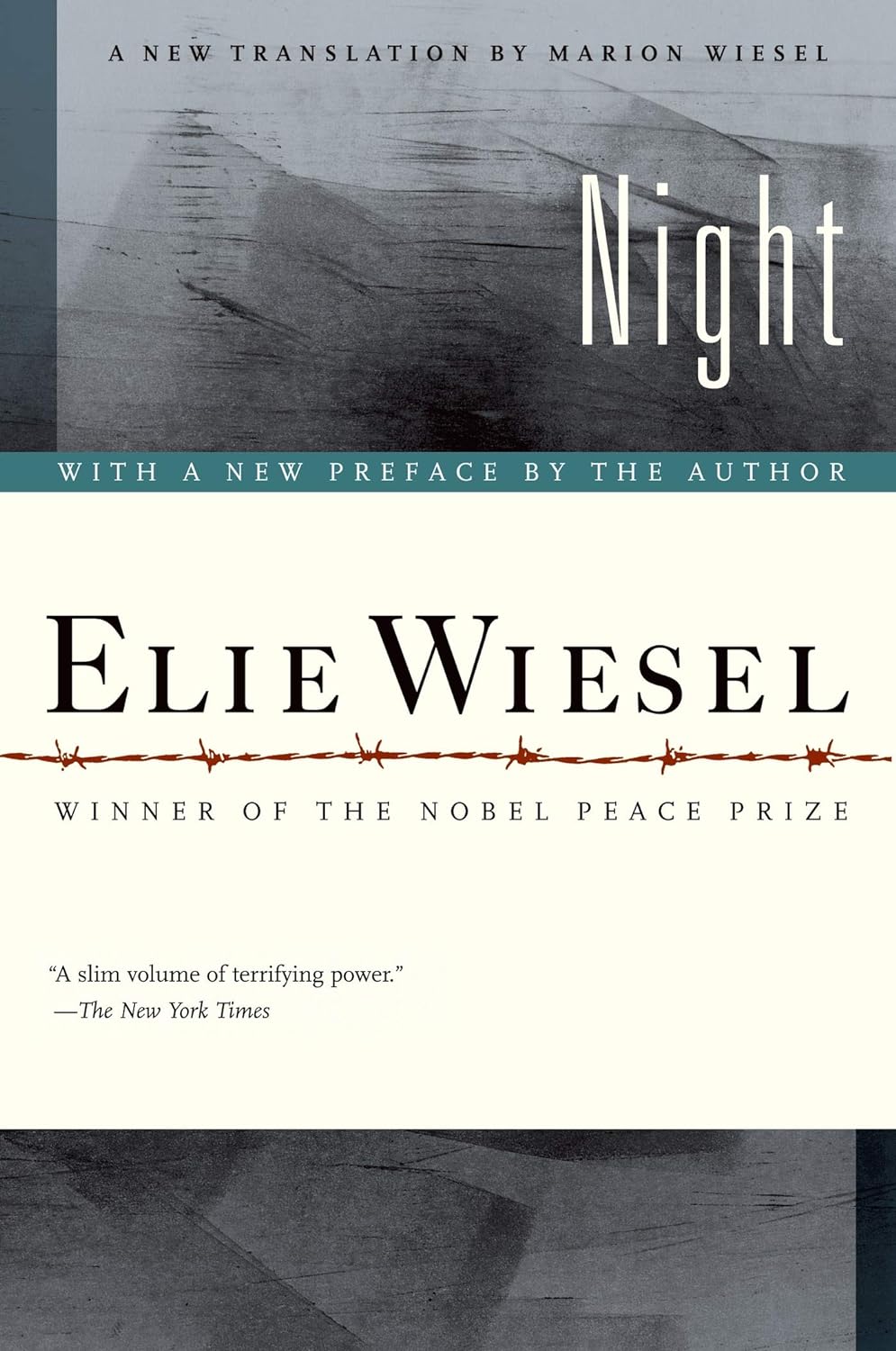
Born in the town of Sighet, Transylvania, Elie Wiesel was a teenager when he and his family were taken from their home in 1944 to Auschwitz concentration camp, and then to Buchenwald. Night is the terrifying record of Elie Wiesel's memories of the death of his family, the death of his own innocence, and his despair as a deeply observant Jew confronting the absolute evil of man. This new translation by his wife and most frequent translator, Marion Wiesel, corrects important details and presents the most accurate rendering in English of Elie Wiesel's testimony to what happened in the camps and of his unforgettable message that this horror must simply never be allowed to happen again.

Based on an actual event that occurred during World War II, this heartbreaking narrative poem about history, immortality, and the power of song is accompanied by magnificent full-color paintings by award-winning artist Mark Podwal. It is the evening before the holiday of Purim, and the Nazis have given the ghetto's leaders twenty-four hours to turn over ten Jews to be hung to "avenge" the deaths of the ten sons of Haman, the villain of the Purim story, which celebrates the triumph of the Jews of Persia over potential genocide some 2,400 years ago. If the leaders refuse, the entire ghetto will be liquidated. Terrified, they go to the ghetto's rabbi for advice; he tells them to return the next morning. Over the course of the night the rabbi calls up the spirits of rabbis from centuries past, but no one can give him a satisfactory answer; they've never encountered anything like this. The eighteenth century mystic and founder of Hasidism, the Ba'al Shem Tov, tries to intercede with God by singing a niggun, a wordless, joyful melody with the power to break the chains of evil, but his efforts end in failure. Heartbroken, the Ba'al Shem Tov teaches the niggun to the ghetto's rabbi, and vanishes. That evening, everyone in the ghetto is herded into the synagogue courtyard. When no one steps forward, they are informed that in an hour they will all be killed. How does one prepare to die? The question is laid before the ghetto rabbi, and he teaches his assembled community the song that the Ba'al Shem Tov taught him the night before. As their voices soar upward, they are joined by those of Jews from centuries past from all over the world, all singing the Ba'al Shem Tov's niggun as the massacre begins. And as the souls of these men, women, and children rise to the heavens, their song continues, uninterrupted, to the end of time and beyond.With an introduction by Elisha Wiesel

Elisha is a young Jewish man, a Holocaust survivor, and an Israeli freedom fighter in British-controlled Palestine; John Dawson is the captured English officer he will murder at dawn in retribution for the British execution of a fellow freedom fighter. The night-long wait for morning and death provides Dawn, Elie Wiesel's ever more timely novel, with its harrowingly taut, hour-by-hour narrative. Caught between the manifold horrors of the past and the troubling dilemmas of the present, Elisha wrestles with guilt, ghosts, and ultimately God, as he waits for the appointed hour and his act of assassination. Dawn is an eloquent meditation on the compromises, justifications, and sacrifices that human beings make when they murder other human beings.
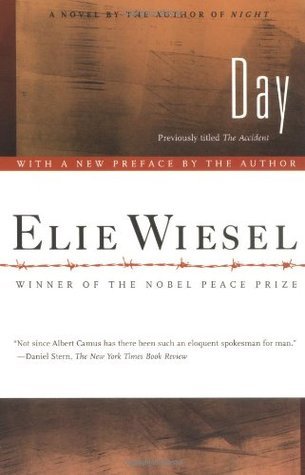
"Not since Albert Camus has there been such an eloquent spokesman for man." --The New York Times Book ReviewThe publication of Day restores Elie Wiesel's original title to the novel initially published in English as The Accident and clearly establishes it as the powerful conclusion to the author's classic trilogy of Holocaust literature, which includes his memoir Night and novel Dawn. "In Night it is the ‘I' who speaks," writes Wiesel. "In the other two, it is the ‘I' who listens and questions."In its opening paragraphs, a successful journalist and Holocaust survivor steps off a New York City curb and into the path of an oncoming taxi. Consequently, most of Wiesel's masterful portrayal of one man's exploration of the historical tragedy that befell him, his family, and his people transpires in the thoughts, daydreams, and memories of the novel's narrator. Torn between choosing life or death, Day again and again returns to the guiding questions that inform Wiesel's trilogy: the meaning and worth of surviving the annihilation of a race, the effects of the Holocaust upon the modern character of the Jewish people, and the loss of one's religious faith in the face of mass murder and human extermination.

The first three works by Elie Wiesel are here brought together in one volume, where the terrifying truth of their vision, the stunning simplicity of their art, and the power of their unity achieve epic dimensions.Night, first published in 1960, is Wiesel's true account of spiritual and national exile and one of the masterpieces of Holocaust literature. The adolescent Elie and his family, among hundreds of thousands of Jews from all parts of Eastern Europe, are cruelly deported from their hometown to the horrors of Auschwitz and Buchenwald. Wiesel writes of their battle for survival, and of his battle with God for a way to understand the wanton cruelty he witnesses each day.In the short novel Dawn (1961), Elisha - the sole survivor of his family, whose immolation he witnessed at Auschwitz - has survived the Second World War and settled in Palestine. Apprenticed to a Jewish terrorist gang, he is commanded to execute a British officer who has been taken hostage. During the lonely hours before dawn, he meditates on the act of murder he is waiting to commit.In The Accident, (1962), Wiesel's second novel, Elisha, now a journalist living in New York, is the victim of a nearly fatal automobile accident. This fiction questions the limits of the spirit and the self: Can Holocaust survivors forge a new life without the memories of the old? As the author writes in his introduction, "In Night it is the 'I' who speaks; in the other two [narratives], it is the 'I' who listens and questions." Wiesel's trilogy offers meditations on mankind's attraction to violence and on the temptation of self-destruction.

Translated by Marion WieselA profoundly and unexpectedly intimate, deeply affecting summing up of his life so far, from one of the most cherished moral voices of our time.Eighty-two years old, facing emergency heart surgery and his own mortality, Elie Wiesel reflects back on his life. Emotions, images, faces and questions flash through his mind. His family before and during the unspeakable Event. The gifts of marriage and children and grandchildren that followed. In his writing, in his teaching, in his public life, has he done enough for memory and the survivors? His ongoing questioning of God—where has it led? Is there hope for mankind? The world’s tireless ambassador of tolerance and justice has given us this luminous account of hope and despair, an exploration of the love, regrets and abiding faith of a remarkable man.

Where is God when innocent human beings suffer? This drama lays bare the most vexing questions confronting the moral imagination.Set in a Ukranian village in the year 1649, this haunting play takes place in the aftermath of a pogrom. Only two Jews, Berish the innkeeper and his daughter Hannah, have survived the brutal Cossack raids. When three itinerant actors arrive in town to perform a Purim play, Berish demands that they stage a mock trial of God instead, indicting Him for His silence in the face of evil. Berish, a latter-day Job, is ready to take on the role of prosecutor. But who will defend God? A mysterious stranger named Sam, who seems oddly familiar to everyone present, shows up just in time to volunteer. The idea for this play came from an event that Elie Wiesel witnessed as a boy in Auschwitz: "Three rabbis--all erudite and pious men--decided one evening to indict God for allowing His children to be massacred. I remember: I was there, and I felt like crying. But there nobody cried."Inspired and challenged by this play, Christian theologians Robert McAfee Brown and Matthew Fox, in a new Introduction and Afterword, join Elie Wiesel in the search for faith in a world where God is silent.

In this first volume of his two-volume autobiography, Wiesel takes us from his childhood memories of a traditional and loving Jewish family in the Romanian village of Sighet through the horrors of Auschwitz and Buchenwald and the years of spiritual struggle, to his emergence as a witness for the Holocaust's martyrs and survivors and for the State of Israel, and as a spokesman for humanity. With 16 pages of black-and-white photographs."From the abyss of the death camps Wiesel has come as a messenger to mankind--not with a message of hate and revenge, but with one of brotherhood and atonement."--From the citation for the 1986 Nobel Peace Prize

Raphael Lipkin is a man obsessed. He hears voices. He talks to ghosts. He is spending the summer at the Mountain Clinic, a psychiatric hospital in upstate New York—not as a patient, but as a visiting professional with a secret, personal quest. A professor of literature and a Holocaust survivor, Raphael, having rebuilt his life since the war, sees it on the verge of coming apart once more. He longs to talk to Pedro, the man who rescued him as a fifteen-year-old orphan from postwar Poland and brought him to Paris, becoming his friend, mentor, hero, and savior. But Pedro disappeared inside the prisons of Stalin’s Russia shortly after the war. Where is Pedro now, and how can Raphael discern what is true and what is false without him? A mysterious nighttime caller directs Raphael’s search to the Mountain Clinic, a unique asylum for patients whose delusions spring from the Bible. Amid patients calling themselves Adam, Cain, Abraham, Joseph, Jeremiah, and God, Raphael searches for Pedro’s truth and the meaning of his own survival in a novel that penetrated the mysteries of good, evil, and madness.

From Elie Wiesel, Nobel laureate and author of Night, a charged, deeply moving novel about the legacy of the Holocaust in today’s troubled world and the ongoing Israeli-Palestinian conflict. It’s 1975, and Shaltiel Feigenberg—professional storyteller, writer and beloved husband—has been taken hostage: abducted from his home in Brooklyn, blindfolded and tied to a chair in a dark basement. His captors, an Arab and an Italian, don’t explain why the innocent Shaltiel has been chosen, just that his life will be bartered for the freedom of three Palestinian prisoners. As his days of waiting commence, Shaltiel resorts to what he does best, telling stories—to himself and to the men who hold his fate in their hands. With beauty and sensitivity, Wiesel builds the world of Shaltiel’s memories, haunted by the Holocaust and a Europe in the midst of radical change. A Communist brother, a childhood spent hiding from the Nazis in a cellar, the kindness of liberating Russian soldiers, the unrest of the 1960s—these are the stories that unfold in Shaltiel’s captivity, as the outside world breathlessly follows his disappearance and the police move toward a final confrontation with his captors. Impassioned, provocative and insistently humane, Hostage is both a masterly thriller and a profoundly wise meditation on the power of memory to connect us to the past and our shared need for resolution.

From Elie Wiesel, a recipient of the Nobel Peace Prize and one of our fiercest moral voices, a provocative and deeply thoughtful new novel about a life shaped by the worst horrors of the twentieth century and one man’s attempt to reclaim happiness.Doriel, a European expatriate living in New York, suffers from a profound sense of desperation and loss. His mother, a member of the Resistance, survived World War II only to die in an accident, together with his father, soon after. Doriel was a child during the war, and his knowledge of the Holocaust is largely limited to what he finds in movies, newsreels, and books—but it is enough. Doriel’s parents and their secrets haunt him, leaving him filled with longing but unable to experience the most basic joys in life. He plunges into an intense study of Judaism, but instead of finding solace, he comes to believe that he is possessed by a dybbuk.Surrounded by ghosts, spurred on by demons, Doriel finally turns to Dr. Thérèse Goldschmidt, a psychoanalyst who finds herself particularly intrigued by her patient. The two enter into an uneasy relationship based on of dreams, histories, and secrets. Despite Doriel’s initial resistance, Dr. Goldschmidt helps to bring him to a crossroads—and to a shocking denouement.In Doriel’s journey into the darkest regions of the soul, Elie Wiesel has written one of his most profoundly moving works of fiction, grounded always by his unparalleled moral compass.

In Souls on Fire: Portraits and Legends of Hasidic Masters , Elie Wiesel re-enters, like an impassioned pilgrim, the universe of Hasidism.Souls on Fire is not a simple chronological history of Hasidism, nor is it a comprehensive book on its subject. Rather, Elie Wiesel has captured the essence of Hasidism through tales, legends, parables, sayings, and deeply personal reflections. His book is a testimony, not a study. Hasidism is revealed from within and not analyzed from the outside. "Listen attentively," Elie Wiesel's grandfather told him, "and above all, remember that true tales are meant to be transmitted—to keep them to oneself is to betray them." Wiesel does not merely tell us, but draws, with the hand of a master, the portraits of the leaders of the movement that created a revolution in the Jewish world. Souls on Fire is a loving, personal affirmation of Judaism, written with words and with silence. The author brings his profound knowledge of the Bible, the Talmud, Kabbala, and the Hasidic tale and song to this masterpiece, showing us that Elie Wiesel is perhaps our generation's most fervid "soul on fire."

A profoundly moving novel about a Holocaust survivor's struggle to remember both the heroic and the shameful events of his past, and about his American-born son's need to assimilate his father's life into his own. "A book of shattering force that offers a message of urgency to a world under the spell of trivia and the tyranny of amnesia."--Chicago Tribune Book World.

Gregor—a teenaged boy, the lone survivor of his family—is hiding from the Germans in the forest. He hides in a cave, where he meets a mysterious stranger who saves his life. He hides in the village, posing as a deaf-mute peasant boy. He hides among the partisans of the Jewish resistance. But where, he asks, is God hiding? And where can one find redemption in a world that God has abandoned? In a story punctuated by friendship and fear, sacrifice and betrayal, Gregor's wartime wanderings take us deep into the ghost-filled inner world of the survivor.

From the Nobel laureate and author of the masterly Night, a deeply felt, beautifully written novel of morality, guilt, and innocence.Despite personal success, Yedidyah—a theater critic in New York City, husband to a stage actress, father to two sons—finds himself increasingly drawn to the past. As he reflects on his life and the decisions he’s made, he longingly reminisces about the relationships he once had with the men in his family (his father, his uncle, his grandfather) and the questions that remain unanswered. It’s a feeling that is further complicated when Yedidyah is assigned to cover the murder trial of a German expatriate named Werner Sonderberg. Sonderberg returned alone from a walk in the Adirondacks with an elderly uncle, whose lifeless body was soon retrieved from the woods. His plea is enigmatic: “Guilty…and not guilty.”These words strike a chord in Yedidyah, plunging him into feelings that bring him harrowingly close to madness. As Sonderberg’s trial moves along a path of dizzying yet revelatory twists and turns, Yedidyah begins to understand his own family’s hidden past and finally liberates himself from the shadow it has cast over his life.With his signature elegance and thoughtfulness, Elie Wiesel has given us an enthralling psychological mystery, both vividly dramatic and profoundly emotional.

From Elie Wiesel, a gripping novel of guilt, innocence, and the perilousness of judging both.A plane en route from New York to Tel Aviv is forced down by bad weather. A nearby house provides refuge for five of its Claudia, who has left her husband and found new love; Razziel, a religious teacher who was once a political prisoner; Yoav, a terminally ill Israeli commando; George, an archivist who is hiding a Holocaust secret that could bring down a certain politician; and Bruce, a would-be priest turned philanderer.Their host—an enigmatic and disquieting man who calls himself simply the Judge—begins to interrogate them, forcing them to face the truth and meaning of their lives. Soon he announces that one of them—the least worthy—will die.The Judges is a powerful novel that reflects the philosophical, religious, and moral questions that are at the heart of Elie Wiesel’s work.

Reprint. Originally published: New York: Random House, c1976.

When the Six-Day War began, Elie Wiesel rushed to Israel. "I went to Jerusalem because I had to go somewhere, I had to leave the present and bring it back to the past. You see, the man who came to Jerusalem then came as a beggar, a madman, not believing his eyes and ears, and above all, his memory." This haunting novel takes place in the days following the Six-Day War. A Holocaust survivor visits the newly reunited city of Jerusalem. At the Western Wall he encounters the beggars and madmen who congregate there every evening, and who force him to confront the ghosts of his past and his ties to the present. Weaving together myth and mystery, parable and paradox, Wiesel bids the reader to join him on a spiritual journey back and forth in time, always returning to Jerusalem.

Story based on Wiesel's own life in which a young Holocaust survivor returns to his hometown, seeking to understand the mystery of those who stood by and watched.

Reuven Tamiroff, a Holocaust survivor, has never been able to speak about his past to his son, a young man who yearns to understand his father’s silence. As campuses burn amidst the unrest of the Sixties and his own generation rebels, the son is drawn to his father’s circle of wartime friends in search of clues to the past. Finally discovering that his brooding father has been haunted for years by his role in the murder of a brutal SS officer just after the war, young Tamiroff learns that the Nazi is still alive. Haunting, poetic, and very contemporary, The Fifth Son builds to an unforgettable climax as the son sets out to complete his father’s act of revenge.

When a Christian boy disappears in a fictional Eastern European town in the 1920s, the local Jews are quickly accused of ritual murder. There is tension in the air. A pogrom threatens to erupt. Suddenly, an extraordinary man—Moshe the dreamer, a madman and mystic—steps forward & confesses to a crime he didn't commit, in a vain attempt to save his people from certain death. The community gathers to hear his last words—a plea for silence—& everyone present takes an oath: whoever survives the impending tragedy must never speak of the town’s last days & nights of terror. For fifty years the sole survivor keeps his oath—until he meets a man whose life depends on hearing the story, & one man’s loyalty to the dead confronts head-on another’s reason to go on living. One of Wiesel’s strongest early novels, this timeless parable about the Jews & their enemies, about hate, family, friendship & silence, is as powerful, haunting & significant as it was when first published.

For Centuries, Jews have remembered the Golem, a creature of clay said to have been given life by the mystical incantations of the mysterious Maharal, Rabbi Yehuda Loew, leader of the Jewish community of 16-century Prague... In this beautiful book, Elie Wiesel has collected many of the legends associated with this enigmatic and eluisive figure and retold them as seen throughn the eyes of a wizened gravedigger who claims to have witnessed as a child the numerous miracles that legend attributes to the Golem...
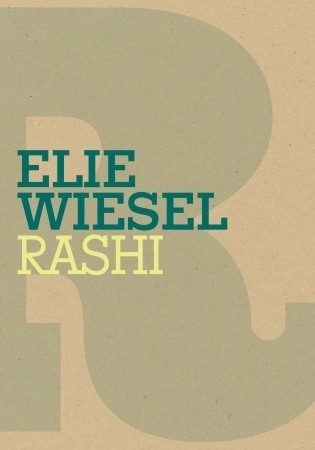
Part of the Jewish Encounter seriesFrom Elie Wiesel, winner of the Nobel Peace Prize, comes a magical book that introduces us to the towering figure of Rashi—Rabbi Shlomo Yitzchaki—the great biblical and Talmudic commentator of the Middle Ages.Wiesel brilliantly evokes the world of medieval European Jewry, a world of profound scholars and closed communities ravaged by outbursts of anti-Semitism and decimated by the Crusades. The incomparable scholar Rashi, whose phrase-by-phrase explication of the oral law has been included in every printing of the Talmud since the fifteenth century, was also a spiritual and religious His perspective, encompassing both the mundane and the profound, is timeless.Wiesel’s Rashi is a heartbroken witness to the suffering of his people, and through his responses to major religious questions of the day we see still another side of this greatest of all interpreters of the sacred writings.Both beginners and advanced students of the Bible rely on Rashi’s groundbreaking commentary for simple text explanations and Midrashic interpretations. Wiesel, a descendant of Rashi, proves an incomparable guide who enables us to appreciate both the lucidity of Rashi’s writings and the milieu in which they were formed.

On August 12, 1952, Russia's greatest Jewish writers were secretly executed by Stalin. In this remarkable blend of history and imagination, Paltiel Kossover meets the same fate but, unlike his real-life counterparts, he is permitted to leave a written testament. From a Jewish boyhood in pre-revolutionary Russia, Paltiel traveled down a road that embraced Communism, only to return to Russia and discover a Communist Party that had become his mortal enemy. Two decades later, Paltiel's son, Grisha, reads this precious record of his father's life and finds that it illuminates the shadowed planes of his own. Passionate and fierce, this story of a father's legacy to his son revisits some of the most dramatic events of our century, and confirms yet again Elie Wiesel's stature as "a writer of the highest moral imagination" ( San Francisco Chronicle ).

From Elie Wiesel, a profoundly moving novel about the healing power of compassion.Gamaliel Friedman is only a child when his family flees Czechoslovakia in 1939 for the relative safety of Hungary. For him, it will be the beginning of a life of rootlessness, disguise, and longing. Five years later, in desperation, Gamaliel’s parents entrust him to a young Christian cabaret singer named Ilonka. With his Jewish identity hidden, he survives the war, but in 1956, to escape the stranglehold of communism, he leaves Budapest after painfully parting with Ilonka.He settles in Vienna, then Paris, and finally, after a failed marriage, in New York, where he works as a ghostwriter, living through the lives of others. Eventually, he falls in with a group of a Spanish Civil War veteran, a survivor of the Warsaw ghetto, a victim of Stalinism, a former Israeli intelligence agent, and a rabbi—a mystic whose belief in the potential for grace in everyday life powerfully counters Gamaliel’s feelings of loss and dispossession. When Gamaliel is asked to help draw out an elderly, disfigured Hungarian woman who is barely able to communicate but who may be his beloved Ilonka, he begins to understand that a real life in the present is possible only if he will reconcile with his past.Aching, unsentimental, deeply affecting, and thought-provoking, The Time of the Uprooted is the work of a master.

As this concluding volume of his moving and revealing memoirs begins, Elie Wiesel is forty years old, a writer of international repute. Determined to speak out more actively for both Holocaust survivors and the disenfranchised everywhere, he sets himself a challenge: "I will become militant. I will teach, share, bear witness. I will reveal and try to mitigate the victims' solitude." He makes words his weapon, and in these pages we relive with him his unstinting battles. We see him meet with world leaders and travel to regions ruled by war, dictatorship, racism, and exclusion in order to engage the most pressing issues of the day. We see him in the Soviet Union defending persecuted Jews and dissidents; in South Africa battling apartheid and supporting Mandela's ascension; in Cambodia and in Bosnia, calling on the world to face the atrocities; in refugee camps in Albania and Macedonia as an emissary for President Clinton. He chastises Ronald Reagan for his visit to the German military cemetery at Bitburg. He supports Lech Walesa but challenges some of his views. He confronts Francois Mitterrand over the misrepresentation of his activities in Vichy France. He does battle with Holocaust deniers. He joins tens of thousands of young Austrians demonstrating against renascent fascism in their country. He receives the Nobel Peace Prize. Through it all, Wiesel remains deeply involved with his beloved Israel, its leaders and its people, and laments its internal conflicts. He recounts the behind-the-scenes events that led to the establishment of the Holocaust Museum in Washington, D.C. He shares the feelings evoked by his return to Auschwitz, by his recollections of Yitzhak Rabin, and by his memories of his own vanished family. This is the magnificent finale of a historic memoir.

A poignant, powerful distillation of the Holocaust experience from the internationally acclaimed writer and Nobel laureate.In his first book, Night , Elie Wiesel described his concentration camp experience, but he has rarely written directly about the Holocaust since then. Now, as the last generation of survivors is passing and a new generation must be introduced to mankind’s darkest hour, Wiesel sums up the most important aspects of Hitler’s years in power and provides a fitting memorial to those who suffered and perished. He writes about the creation of the Third Reich, Western acquiescence, the gas chambers, and memory. He criticizes Churchill and Roosevelt for what they knew and ignored, and he praises little-known Jewish heroes. Augmenting Wiesel’s text are testimonies from survivors, who recall, among other moments and the establishment of the Nurembourg Laws, Kristallnacht, transport to the camps, and liberation.With this book—richly illustrated with 45 photographs from the U.S. HolocaustMuseum—Wiesel proves once again the ineluctable importance of bearing witness.

In the fall of 1965 the I sraeli newspaper Haaretz sent a young journalist named Elie Wiesel to the Soviet Union to report on the lives of Jews trapped behind the Iron Curtain. “I would approach Jews who had never been placed in the Soviet show window by Soviet authorities,” wrote Wiesel. “They alone, in their anonymity, could describe the conditions under which they live; they alone could tell whether the reports I had heard were true or false—and whether their children and their grandchildren, despite everything, still wish to remain Jews. From them I would learn what we must do to help . . . or if they want our help at all.” What he discovered astonished him: Jewish men and women, young and old, in Moscow, Kiev, Leningrad, Vilna, Minsk, and Tbilisi, completely cut off from the outside world, overcoming their fear of the ever-present KGB to ask Wiesel about the lives of Jews in America, in Western Europe, and, most of all, in Israel. They have scant knowledge of Jewish history or current events; they celebrate Jewish holidays at considerable risk and with only the vaguest ideas of what these days commemorate. “Most of them come [to synagogue] not to pray,” Wiesel writes, “but out of a desire to identify with the Jewish people—about whom they know next to nothing.” Wiesel promises to bring the stories of these people to the outside world. And in the home of one dissident, he is given a gift—a Russian-language translation of Night, published illegally by the underground. “‘My God,’ I thought, ‘this man risked arrest and prison just to make my writing available to people here!’ I embraced him with tears in my eyes.”From the Trade Paperback edition.

As a child in Sighet, as a young boy in Auschwitz, as a teenage displaced person wandering through post-World War II Europe, as a young man at the beginning of his career as a writer, witness, and human-rights activist, Elie Wiesel had haunting, often surreal encounters with a wide range of people—sages, mystics, teachers, and dreamers. In Legends of Our Time, he shares with us some of their stories. On a Tel Aviv bus, Wiesel encounters a notorious Auschwitz barracks chief who forces him to confront past demons that he thought had long since been laid to rest. While traveling through Spain, he is approached by a young Catholic man holding an ancient family document in an unfamiliar language; written in Hebrew in 1492 by the man’s Marrano ancestor, it proudly proclaims to future generations the family’s Jewish origins. Twenty years after being deported from Sighet, Wiesel returns to discover that the only thing missing are the towns 10,000 Jews and the collective memory of their ever having existed. In a Moscow synagogue in the fall on 1967, Wiesel finds a sanctuary filled with young Jews who have miraculously educated themselves in their history and ancient language, who sing Hebrew songs in the street as KGB agents take down names. And from a rabbi in Auschwitz who fasted on Yom Kippur, Wiesel leans that there is more than one way to confront a God who seems to have abandoned His people.

Wise Men and Their Tales: Portraits of Biblical, Talmudic, and Hasidic Masters
by Elie Wiesel
Rating: 4.2 ⭐
In Wise Men and Their Tales , a master teacher gives us his fascinating insights into the lives of a wide range of biblical figures, Talmudic scholars, and Hasidic rabbis.The matriarch Sarah, fiercely guarding her son, Isaac, against the negative influence of his half-brother Ishmael; Samson, the solitary hero and protector of his people, whose singular weakness brought about his tragic end; Isaiah, caught in the middle of the struggle between God and man, his messages of anger and sorrow counterbalanced by his timeless, eloquent vision of a world at peace; the saintly Rabbi Yehoshua ben Levi, who by virtue of a lifetime of good deeds was permitted to enter heaven while still alive and who tried to ensure a similar fate for all humanity by stealing the sword of the Angel of Death.Elie Wiesel tells the stories of these and other men and women who have been sent by God to help us find the godliness within our own lives. And what interests him most about these people is their humanity, in all its glorious complexity. They get angry—at God for demanding so much, and at people, for doing so little. They make mistakes. They get frustrated. But through it all one constant remains—their love for the people they have been charged to teach and their devotion to the Supreme Being who has sent them. In these tales of battles won and lost, of exile and redemption, of despair and renewal, we learn not only by listening to what they have come to tell us, but by watching as they live lives that are both grounded in earthly reality and that soar upward to the heavens.