
Edward J. Watts
Edward Watts teaches history at the University of California, San Diego, He received his PhD in History from Yale University in 2002. His research interests center on the intellectual and religious history of the Roman Empire and the early Byzantine Empire.
8 Books Written

A new history of the Roman Republic and its collapse In Mortal Republic, prizewinning historian Edward J. Watts offers a new history of the fall of the Roman Republic that explains why Rome exchanged freedom for autocracy. For centuries, even as Rome grew into the Mediterranean's premier military and political power, its governing institutions, parliamentary rules, and political customs successfully fostered negotiation and compromise. By the 130s BC, however, Rome's leaders increasingly used these same tools to cynically pursue individual gain and obstruct their opponents. As the center decayed and dysfunction grew, arguments between politicians gave way to political violence in the streets. The stage was set for destructive civil wars--and ultimately the imperial reign of Augustus. The death of Rome's Republic was not inevitable. In Mortal Republic, Watts shows it died because it was allowed to, from thousands of small wounds inflicted by Romans who assumed that it would last forever.

Final Pagan Generation: Rome's Unexpected Path to Christianity (Transformation of the Classical Heritage)
by Edward J. Watts
Rating: 3.9 ⭐
The Final Pagan Generation recounts the fascinating story of the lives and fortunes of the last Romans born before the Emperor Constantine converted to Christianity. Edward J. Watts traces their experiences of living through the fourth century’s dramatic religious and political changes, when heated confrontations saw the Christian establishment legislate against pagan practices as mobs attacked pagan holy sites and temples. The emperors who issued these laws, the imperial officials charged with implementing them, and the Christian perpetrators of religious violence were almost exclusively young men whose attitudes and actions contrasted markedly with those of the earlier generation, who shared neither their juniors’ interest in creating sharply defined religious identities nor their propensity for violent conflict. Watts examines why the "final pagan generation"―born to the old ways and the old world in which it seemed to everyone that religious practices would continue as they had for the past two thousand years―proved both unable to anticipate the changes that imperially sponsored Christianity produced and unwilling to resist them. A compelling and provocative read, suitable for the general reader as well as students and scholars of the ancient world.

A philosopher, mathematician, and martyr, Hypatia is one of antiquity's best known female intellectuals. During the sixteen centuries following her murder, by a mob of Christians, Hypatia has been remembered in books, poems, plays, paintings, and films as a victim of religious intolerance whose death symbolized the end of the Classical world. But Hypatia was a person before she was a symbol. Her great skill in mathematics and philosophy redefined the intellectual life of her home city of Alexandria. Her talent as a teacher enabled her to assemble a circle of dedicated male students. Her devotion to public service made her a force for peace and good government in a city that struggled to maintain trust and cooperation between pagans and Christians.Despite these successes, Hypatia fought countless small battles to live the public and intellectual life that she wanted. This book rediscovers the life Hypatia led, the unique challenges she faced as a woman who succeeded spectacularly in a man's world, and the tragic story of the events that led to her tragic murder.
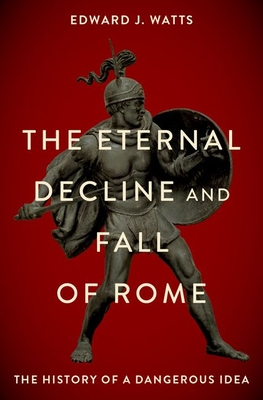
The Eternal Decline and Fall of Rome: The History of a Dangerous Idea
by Edward J. Watts
Rating: 3.6 ⭐
As this book intriguingly explores, for those who would make Rome great again and their victims, ideas of Roman decline and renewal have had a long and violent history.The decline of Rome has been a constant source of discussion for more than 2200 years. Everyone from American journalists in the twenty-first century AD to Roman politicians at the turn of the third century BC have used it as a tool to illustrate the negative consequences of changes in their world. Because Roman history is so long, it provides a buffet of ready-made stories of decline that can help develop the context around any snapshot. And Rome did, in fact, decline and, eventually, fall. An empire that once controlled all or part of more than 40 modern European, Asian, and African countries no longer exists. Roman prophets of decline were, ultimately, proven correct-a fact that makes their modern invocations all the more powerful. If it happened then, it could happen now.The Eternal Decline and Fall of Rome tells the stories of the people who built their political and literary careers around promises of Roman renewal as well as those of the victims they blamed for causing Rome's decline. Each chapter offers the historical context necessary to understand a moment or a series of moments in which Romans, aspiring Romans, and non--Romans used ideas of Roman decline and restoration to seize power and remake the world around them. The story begins during the Roman Republic just after 200 BC. It proceeds through the empire of Augustus and his successors, traces the Roman loss of much of western Europe in the fifth century AD, and then follows Roman history as it runs through the Eastern Roman Empire (Byzantium) until its fall in 1453. The final two chapters look at ideas of Roman decline and renewal from the fifteenth century until today. If Rome illustrates the profound danger of the rhetoric of decline, it also demonstrates the rehabilitative potential of arhetoric that focuses on collaborative restoration, a lesson of great relevance to our world today.

An acclaimed scholar tells the full, breathtaking history of Rome, from its emergence in the Iron Age to the capture of Constantinople in the thirteenth century When we think of “ancient Romans” today, many picture the toga-clad figures of Cicero and Caesar, presiding over a republic, and then an empire, before seeing their world collapse at the hands of barbarians in the fifth century AD. The Romans does away with this narrow vision by offering the first comprehensive account of ancient Rome over the course of two millennia. Prize-winning historian Edward J. Watts recounts the full sweep of Rome’s epic the Punic Wars, the fall of the republic, the coming of Christianity, Alaric’s sack of Rome, the rise of Islam, the Battle of Manzikert, and the onslaught of the Crusaders who would bring about the empire’s end. Watts shows that the source of Rome’s enduring strength was the diverse range of people who all called themselves Romans. This is the Rome of Augustus, Marcus Aurelius, and Constantine, but also Charlemagne, Justinian, and Manuel Comnenus—and countless other men and women who together made it the most resilient state the world has ever seen. An expansive, eye-opening portrait, The Romans is the definitive history of Rome and its citizens.

Riot in Alexandria: Tradition and Group Dynamics in Late Antique Pagan and Christian Communities
by Edward J. Watts
Rating: 3.8 ⭐
This innovative study uses one well-documented moment of violence as a starting point for a wide-ranging examination of the ideas and interactions of pagan philosophers, Christian ascetics, and bishops from the fourth to the early seventh century. Edward J. Watts reconstructs a riot that erupted in Alexandria in 486 when a group of students attacked a Christian adolescent who had publicly insulted the students' teachers. Pagan students, Christians affiliated with a local monastery, and the Alexandrian ecclesiastical leaders all cast the incident in a different light, and each group tried with that interpretation to influence subsequent events. Watts, drawing on Greek, Latin, Coptic, and Syriac sources, shows how historical traditions and notions of a shared past shaped the interactions and behavior of these high-profile communities. Connecting oral and written texts to the personal relationships that gave them meaning and to the actions that gave them form, Riot in Alexandria draws new attention to the understudied social and cultural history of the later fifth-century Roman world and at the same time opens a new window on late antique intellectual life.

Hypatia
by Edward J. Watts

La decadencia y caída de Roma
by Edward J. Watts
A lo largo de más de dos siglos, la caída de Roma ha sido una fuente constante de debate. Edward J. Watts construye un apasionante relato que se inicia en la República romana, inmediatamente después del año 200 a.C., y recorre el imperio de Augusto y sus sucesores, describe la pérdida de gran parte del territorio romano occidental durante el siglo V y el discurrir del Imperio romano de Oriente (Bizancio) hasta su caída en 1453, y, por último, la decadencia y la renovación de Roma desde el siglo XV hasta la actualidad.La caída del Imperio romano ha sido uno de los misterios más fascinantes de la historia. Su retórica de decadencia ha llegado hasta nuestros días y su alegato nos sirve de ejemplo para poder abordar los desafíos del futuro. Las profecías de la decadencia y las prescripciones para la restauración romanas quizá parezcan un discurso inútil, pero pueden provocar también cambios sustanciales en una sociedad y en su vida política. Watts ha escrito un libro apasionante que pone de manifiesto la vigencia de la decadencia y caída de Roma.Como señala el propio 'Yo tengo la esperanza de que podamos utilizar el ejemplo de Roma para elaborar un relato diferente que, más que sembrar la división, fomente la cohesión ante todos los graves desafíos sociales, económicos y personales que ahora tenemos por delante'.