
Edward Frenkel
Edward Frenkel (Russian: Эдвард Френкель, Edvard Frenkel'; born May 2, 1968) is a mathematician working in representation theory, algebraic geometry, and mathematical physics. He is a professor of mathematics at University of California, Berkeley. Frenkel grew up in Kolomna, Russia to a family of Russian Jews. As a high school student he studied higher mathematics privately with Evgeny Evgenievich Petrov, although his initial interest was in quantum physics rather than mathematics.[1] He was not admitted to Moscow State University because of discrimination against Jews and enrolled instead in the applied mathematics program at the Gubkin University of Oil and Gas. While a student there, he attended the seminar of Israel Gelfand and worked with Boris Feigin and Dmitry Fuchs. After receiving his college degree in 1989, he was first invited to Harvard University as a visiting professor, and a year later he enrolled as a graduate student at Harvard. He received his Ph.D. at Harvard University in 1991, after one year of study, under the direction of Joseph Bernstein. He was a Junior Fellow at the Harvard Society of Fellows from 1991 to 1994, and served as an associate professor at Harvard from 1994 to 1997. He has been a professor of mathematics at University of California, Berkeley since 1997. Jointly with Boris Feigin, Frenkel constructed the free field realizations of affine Kac–Moody algebras (these are also known as Wakimoto modules), defined the quantum Drinfeld-Sokolov reduction, and described the center of the universal enveloping algebra of an affine Kac–Moody algebra. The last result, often referred to as Feigin–Frenkel isomorphism, has been used by Alexander Beilinson and Vladimir Drinfeld in their work on the geometric Langlands correspondence. Together with Nicolai Reshetikhin, Frenkel introduced deformations of W-algebras and q-characters of representations of quantum affine algebras. Frenkel's recent work has focused on the Langlands program and its connections to representation theory, integrable systems, geometry, and physics. Together with Dennis Gaitsgory and Kari Vilonen, he has proved the geometric Langlands conjecture for GL(n). His joint work with Robert Langlands and Ngô Bảo Châu suggested a new approach to the functoriality of automorphic representations and trace formulas. He has also been investigating (in particular, in a joint work with Edward Witten) connections between the geometric Langlands correspondence and dualities in quantum field theory. Frenkel has co-produced, co-directed (with Reine Graves) and played the lead in a short film "Rites of Love and Math", a homage to the film "Rite of Love and Death" (also known as "Yûkoku") by the Japanese writer Yukio Mishima. The film premiered in Paris in April, 2010 and was in the official competition of the Sitges International Film Festival in October, 2010. The screening of "Rites of Love and Math" in Berkeley on December 1, 2010 caused some controversy. Frenkel's book Love and Math The Heart of Hidden Reality was published in October 2013.
3 Books Written

What if you had to take an art class in which you were only taught how to paint a fence? What if you were never shown the paintings of van Gogh and Picasso, weren’t even told they existed? Alas, this is how math is taught, and so for most of us it becomes the intellectual equivalent of watching paint dry.In Love and Math, renowned mathematician Edward Frenkel reveals a side of math we’ve never seen, suffused with all the beauty and elegance of a work of art. In this heartfelt and passionate book, Frenkel shows that mathematics, far from occupying a specialist niche, goes to the heart of all matter, uniting us across cultures, time, and space.Love and Math tells two intertwined stories: of the wonders of mathematics and of one young man’s journey learning and living it. Having braved a discriminatory educational system to become one of the twenty-first century’s leading mathematicians, Frenkel now works on one of the biggest ideas to come out of math in the last 50 years: the Langlands Program. Considered by many to be a Grand Unified Theory of mathematics, the Langlands Program enables researchers to translate findings from one field to another so that they can solve problems, such as Fermat’s last theorem, that had seemed intractable before.At its core, Love and Math is a story about accessing a new way of thinking, which can enrich our lives and empower us to better understand the world and our place in it. It is an invitation to discover the magic hidden universe of mathematics.
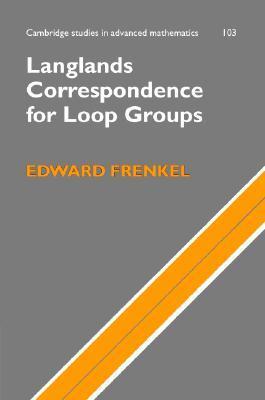
The Langlands Program was conceived initially as a bridge between Number Theory and Automorphic Representations, and has now expanded into such areas as Geometry and Quantum Field Theory, tying together seemingly unrelated disciplines into a web of tantalizing conjectures. A new chapter to this grand project is provided in this book. It develops the geometric Langlands Correspondence for Loop Groups, a new approach, from a unique perspective offered by affine Kac-Moody algebras. The theory offers fresh insights into the world of Langlands dualities, with many applications to Representation Theory of Infinite-dimensional Algebras, and Quantum Field Theory. This accessible text builds the theory from scratch, with all necessary concepts defined and the essential results proved along the way. Based on courses taught at Berkeley, the book provides many open problems which could form the basis for future research, and is accessible to advanced undergraduate students and beginning graduate students.

Vertex Algebras and Algebraic Curves (Mathematical Surveys and Monographs)
by Edward Frenkel
Rating: 5.0 ⭐
Vertex algebras are algebraic objects that encapsulate the concept of operator product expansion from two-dimensional conformal field theory. Vertex algebras are fast becoming ubiquitous in many areas of modern mathematics, with applications to representation theory, algebraic geometry, the theory of finite groups, modular functions, topology, integrable systems, and combinatorics. This book is an introduction to the theory of vertex algebras with a particular emphasis on the relationship with the geometry of algebraic curves. The notion of a vertex algebra is introduced in a coordinate-independent way, so that vertex operators become well defined on arbitrary smooth algebraic curves, possibly equipped with additional data, such as a vector bundle. Vertex algebras then appear as the algebraic objects encoding the geometric structure of various moduli spaces associated with algebraic curves. Therefore they may be used to give a geometric interpretation of various questions of representation theory. The book contains many original results, introduces important new concepts, and brings new insights into the theory of vertex algebras. The authors have made a great effort to make the book self-contained and accessible to readers of all backgrounds. Reviewers of the first edition anticipated that it would have a long-lasting influence on this exciting field of mathematics and would be very useful for graduate students and researchers interested in the subject. This second edition, substantially improved and expanded, includes several new topics, in particular an introduction to the Beilinson-Drinfeld theory of factorization algebras and the geometric Langlands correspondence. The book is suitable for graduate students and research mathematicians interested in representation theory, algebraic geometry, and mathematical physics.