
Edmund Morris
Librarian Note: There is more than one author in the Goodreads database with this name Edmund Morris was a writer best known for his biographies of United States presidents Theodore Roosevelt and Ronald Reagan. Morris received his early education in Kenya after which he attended Rhodes University in South Africa. He worked as an advertising copywriter in London before emigrating to the United States in 1968. His biography The Rise of Theodore Roosevelt won the Pulitzer Prize and National Book Award in 1980. After spending 14 years as President Reagan's authorized biographer, he published the national bestseller Dutch: A Memoir of Ronald Reagan in 1999. Morris's other books include Theodore Rex, the second in a projected three-volume chronicle of the life of Theodore Roosevelt, and Beethoven: The Universal Composer. Mr. Morris wrote extensively on travel and the arts for such publications as The New Yorker, the New York Times, and Harper's Magazine. Edmund Morris lived in New York City and Kent, Connecticut with his wife and fellow biographer, Sylvia Jukes Morris. Morris died on May 24, 2019 at a hospital in Kent, from a stroke at the age of 78.
8 Books Written

An alternative cover edition for this ISBN can be found hereThis classic biography is the story of seven men—a naturalist, a writer, a lover, a hunter, a ranchman, a soldier, and a politician—who merged at age forty-two to become the youngest President in history.The Rise of Theodore Roosevelt begins at the apex of his international prestige. That was on New Year’s Day, 1907, when TR, who had just won the Nobel Peace Prize, threw open the doors of the White House to the American people and shook 8,150 hands. One visitor remarked afterward, “You go to the White House, you shake hands with Roosevelt and hear him talk—and then you go home to wring the personality out of your clothes.”The rest of this book tells the story of TR’s irresistible rise to power. During the years 1858–1901, Theodore Roosevelt transformed himself from a frail, asthmatic boy into a full-blooded man. Fresh out of Harvard, he simultaneously published a distinguished work of naval history and became the fist-swinging leader of a Republican insurgency in the New York State Assembly. He chased thieves across the Badlands of North Dakota with a copy of Anna Karenina in one hand and a Winchester rifle in the other. Married to his childhood sweetheart in 1886, he became the country squire of Sagamore Hill on Long Island, a flamboyant civil service reformer in Washington, D.C., and a night-stalking police commissioner in New York City. As assistant secretary of the navy, he almost single-handedly brought about the Spanish-American War. After leading “Roosevelt’s Rough Riders” in the famous charge up San Juan Hill, Cuba, he returned home a military hero, and was rewarded with the governorship of New York. In what he called his “spare hours” he fathered six children and wrote fourteen books. By 1901, the man Senator Mark Hanna called “that damned cowboy” was vice president. Seven months later, an assassin’s bullet gave TR the national leadership he had always craved.His is a story so prodigal in its variety, so surprising in its turns of fate, that previous biographers have treated it as a series of haphazard episodes. This book, the only full study of TR’s pre-presidential years, shows that he was an inevitable chief executive. “It was as if he were subconsciously aware that he was a man of many selves,” the author writes, “and set about developing each one in turn, knowing that one day he would be President of all the people.”
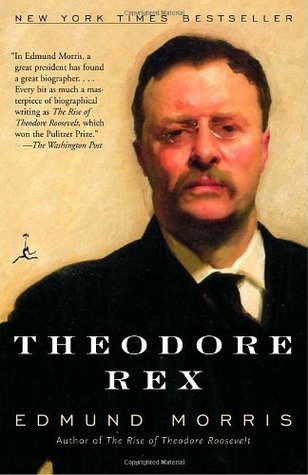
The most eagerly awaited presidential biography in years, Theodore Rex is a sequel to Edmund Morris’s classic bestseller The Rise of Theodore Roosevelt. It begins by following the new President (still the youngest in American history) as he comes down from Mount Marcy, New York, to take his emergency oath of office in Buffalo, one hundred years ago. A detailed prologue describes TR’s assumption of power and journey to Washington, with the assassinated President McKinley riding behind him like a ghost of the nineteenth century. (Trains rumble throughout this irresistibly moving narrative, as TR crosses and recrosses the nation.) Traveling south through a succession of haunting landscapes, TR encounters harbingers of all the major issues of the new century-Imperialism, Industrialism, Conservation, Immigration, Labor, Race-plus the overall challenge that intimidated McKinley: how to harness America’s new power as the world’s richest nation. Theodore Rex (the title is taken from a quip by Henry James) tells the story of the following seven and a half years-years in which TR entertains, infuriates, amuses, strong-arms, and seduces the body politic into a state of almost total subservience to his will. It is not always a pretty story: one of the revelations here is that TR was hated and feared by a substantial minority of his fellow citizens. Wall Street, the white South, Western lumber barons, even his own Republican leadership in Congress strive to harness his steadily increasing power.Within weeks of arrival in Washington, TR causes a nationwide sensation by becoming the first President to invite a black man to dinner in the White House. Next, he launches his famous prosecution of the Northern Securities Company, and follows up with landmark antitrust legislation. He liberates Cuba, determines the route of the Panama Canal, mediates the great Anthracite Strike, and resolves the Venezuela Crisis of 1902-1903 with such masterful secrecy that the world at large is unaware how near the United States and Germany have come to war.During an epic national tour in the spring of 1903, TR’s conservation philosophy (his single greatest gift to posterity) comes into full flower. He also bestows on countless Americans the richness of a personality without parallel-evangelical and passionate, yet lusty and funny; adroitly political, winningly natural, intellectually overwhelming. The most famous father of his time, he is adored by his six children (although beautiful, willful “Princess” Alice rebelled against him) and accepted as an honorary member of the White House Gang of seditious small boys. Theodore Rex, full of cinematic detail, moves with the exhilarating pace of a novel, yet it rides on a granite base of scholarship. TR’s own voice is constantly heard, as the President was a gifted letter writer and raconteur. Also heard are the many witticisms, sometimes mocking, yet always affectionate, of such Roosevelt intimates as Henry Adams, John Hay, and Elihu Root. (“Theodore is never sober,” said Adams, “only he is drunk with himself and not with rum.”)TR’s speed of thought and action, and his total command of all aspects of presidential leadership, from bureaucratic subterfuge to manipulation of the press, make him all but invincible in 1904, when he wins a second term by a historic landslide. Surprisingly, this victory transforms him from a patrician conservative to a progressive, responsible between 1905 and 1908 for a raft of enlightened legislation, including the Pure Food and Employer Liability acts. Even more surprising, to critics who have caricatured TR as a swinger of the Big Stick, is his emergence as a diplomat. He wins the Nobel Peace Prize for bringing about an end to the Russo-Japanese War in 1905. Interspersed with many stories of Rooseveltian triumphs are some bitter episodes-notably a devastating lynching-that remind us of America’s deep prejudices and fears. Theodore Rex does not attempt to justify TR’s notorious action following the Brownsville Incident of 1906-his worst mistake as President-but neither does this resolutely honest biography indulge in the easy wisdom of hindsight. It is written throughout in real time, reflecting the world as TR saw it. By the final chapter, as the great “Teddy” prepares to quit the White House in 1909, it will be a hard-hearted reader who does not share the sentiment of Henry Adams: “The old house will seem dull and sad when my Theodore has gone.”

Of all our great presidents, Theodore Roosevelt is the only one whose greatness increased out of office. What other president has written forty books, hunted lions, founded a third political party, survived an assassin’s bullet, and explored an unknown river longer than the Rhine?Packed with more adventure, variety, drama, humor, and tragedy than a big novel, yet documented down to the smallest fact, this masterwork recounts the last decade of perhaps the most amazing life in American history.

The definitive trilogy of biographies chronicling the storied life of the United States’ youngest President, Theodore Roosevelt—a consummate writer, soldier, naturalist, and politician—and his two world-changing terms in office.The Rise of Theodore RooseveltThe Rise of Theodore Roosevelt begins at the apex of his international prestige. That was on New Year’s Day, 1907, when TR, who had just won the Nobel Peace Prize, threw open the doors of the White House to the American people and shook 8,150 hands. One visitor remarked afterward, “You go to the White House, you shake hands with Roosevelt and hear him talk—and then you go home to wring the personality out of your clothes.”Theodore RexThe most eagerly awaited presidential biography in years, Theodore Rex is a sequel to Edmund Morris’s classic bestseller The Rise of Theodore Roosevelt. It begins by following the new President (still the youngest in American history) as he comes down from Mount Marcy, New York, to take his emergency oath of office in Buffalo, one hundred years ago. Colonel RooseveltThis biography by Edmund Morris, the Pulitzer Prize– and National Book Award–winning author of The Rise of Theodore Roosevelt and Theodore Rex, marks the completion of a trilogy sure to stand as definitive. Of all our great presidents, Theodore Roosevelt is the only one whose greatness increased out of office. What other president has written forty books, hunted lions, founded a third political party, survived an assassin’s bullet, and explored an unknown river longer than the Rhine? Packed with more adventure, variety, drama, humor, and tragedy than a big novel, yet documented down to the smallest fact, this masterwork recounts the last decade of perhaps the most amazing life in American history.

From Pulitzer Prize-winning author Edmund Morris comes a revelatory new biography of Thomas Alva Edison, the most prolific genius in American history.Although Thomas Alva Edison was the most famous American of his time, and remains an international name today, he is mostly remembered only for the gift of universal electric light. His invention of the first practical incandescent lamp 140 years ago so dazzled the world--already reeling from his invention of the phonograph and dozens of other revolutionary devices--that it cast a shadow over his later achievements. In all, this near-deaf genius ("I haven't heard a bird sing since I was twelve years old") patented 1,093 inventions, not including others, such as the X-ray fluoroscope, that he left unlicensed for the benefit of medicine.One of the achievements of this staggering new biography, the first major life of Edison in more than twenty years, is that it portrays the unknown Edison--the philosopher, the futurist, the chemist, the botanist, the wartime defense adviser, the founder of nearly 250 companies--as fully as it deconstructs the Edison of mythological memory. Edmund Morris, winner of the Pulitzer Prize and the National Book Award, brings to the task all the interpretive acuity and literary elegance that distinguished his previous biographies of Theodore Roosevelt, Ronald Reagan, and Ludwig van Beethoven. A trained musician, Morris is especially well equipped to recount Edison's fifty-year obsession with recording technology and his pioneering advances in the synchronization of movies and sound. Morris sweeps aside conspiratorial theories positing an enmity between Edison and Nikola Tesla and presents proof of their mutually admiring, if wary, relationship.Enlightened by seven years of research among the five million pages of original documents preserved in Edison's huge laboratory at West Orange, New Jersey, and privileged access to family papers still held in trust, Morris is also able to bring his subject to life on the page--the adored yet autocratic and often neglectful husband of two wives and father of six children. If the great man who emerges from it is less a sentimental hero than an overwhelming force of nature, driven onward by compulsive creativity, then Edison is at last getting his biographical due.

Edmund Morris has been absorbed in the life of Ronald Reagan for the last thirteen years, with unparalleled access to his papers, his friends, and his family. This audiobook will inform, engross, and even astonish those who believe they already know Ronald Reagan--as well as those who do not know him at all.When Ronald Reagan moved into the White House in 1981, one of his first literary guests was Edmund Morris, the Pulitzer-Prize winning biographer of Theodore Roosevelt. An extraordinary relationship--genial yet mysterious on the President's side, admiring yet unsentimental on Morris's--developed between the two men. Reagan granted Morris monthly interviews in the Oval Office, plus unrestricted access to his papers and family and friends.The result, after fourteen years of obsessive research, is a biography that is as much a memoir as narrative--a pilgrimage to the heart of Ronald Reagan's mystery. It begins with his birth in 1911 in the heart of rural Illinois (where he is still remembered as "Dutch"), and progresses through the way stations of an amazingly varied career: young lifeguard, aspirant writer, ace sportscaster, film star, soldier, union leader, corporate spokesman, Governor, and President.Here, recreated with participatory vividness (and some original historic audio clips) are the early achievements of the Reagan Era: a restoration of American optimism and patriotism, a re-powering of the national economy, and a massive arms buildup deliberately forcing the "Evil Empire" of Soviet Communism to come to terms. Here, too, is the septuagenarian President who came to grips with some of the most fundamental moral issues of the late twentieth century--at Bitburg and Bergen-Belsen, in Geneva and Reykjavik and Berlin. This audiobook closes with an achingly tender account of Reagan's post-presidential decline into dementia.

Pulitzer Prize-winning author Edmund Morris (The Rise of Theodore Roosevelt, Theodore Rex, Dutch) is one of America’s most distinguished biographers, known for his rich, compulsively readable prose style. His biography of Beethoven, one of the most admired composers in the history of music, is above all a study of genius in action, of one of the few giants of Western culture. Beethoven is another engaging entry in the HarperCollins’ “Eminent Lives” series of biographies by distinguished authors on canonical figures.

When the multitalented biographer Edmund Morris (who writes with equal virtuosity about Theodore Roosevelt, Ronald Reagan, Beethoven, and Thomas Edison) was a schoolboy in colonial Kenya, one of his teachers told him, “You have the most precious gift of all—originality.” That quality is abundantly evident in this selection of essays. They cover forty years in the life of a maverick intellectual who can be, at whim, astonishingly provocative, self-mockingly funny, and richly anecdotal. (The title essay, a tribute to Reagan in cognitive decline, is poignant in the extreme.) Whether Morris is analyzing images of Barack Obama or the prose style of President Clinton, or exploring the riches of the New York Public Library Dance Collection, or interviewing the novelist Nadine Gordimer, or proposing a hilarious “Diet for the Musically Obese,” a continuous cross-fertilization is going on in his mind. It mixes the cultural pollens of Africa, Britain, and the United States, and propogates hybrid flowers—some fragrant, some strange, some a shock to conventional sensibilities. Repeatedly in This Living Hand, Morris celebrates the physicality of artistic labor, and laments the glass screen that today’s e-devices interpose between inspiration and execution. No presidential biographer has ever had so literary a “take” on his he discerns powers of poetic perception even in the obsessively scientific Edison. Nor do most writers on music have the verbal facility to articulate, as Morris does, what it is about certain sounds that soothe the savage breast. His essay on the pathology of Beethoven’s deafness breaks new ground in suggesting that tinnitus may explain some of the weird aural effects in that composer’s works. Masterly monographs on the art of biography, South Africa in the last days of apartheid, the romance of the piano, and the role of imagination in nonfiction are juxtaposed with enchanting, almost unclassifiable pieces such as “The Lament for a Forgotten Fruit” (Morris suspects it may have grown in the Garden of Eden); “The Anticapitalist A Warning” (an assault on The Chicago Manual of Style ); “Nuages Colors in Music, Literature, and Art”; and the uproarious “Which Way Does Sir Dress?”, about ordering a suit from the most expensive tailor in London. Uniquely illustrated with images that the author describes as indispensable to his creative process, This Living Hand is packed with biographical insights into such famous personalities as Daniel Defoe, Henry Adams, Mark Twain, Evelyn Waugh, Truman Capote, Glenn Gould, Jasper Johns, W. G. Sebald, and Winnie the Pooh—not to mention a gallery of forgotten figures whom Morris lovingly restores to “life.” Among these are the pianist Ferruccio Busoni, the poet Edwin Arlington Robinson, the novelist James Gould Cozzens, and sixteen so-called “Undistinguished Americans,” contributors to an anthology of anonymous memoirs published in 1902. Reviewing that book for The New Yorker, Morris notes that even the most unlettered persons have, on occasion, “power to send forth surprise flashes, illuminating not only the dark around them but also more sophisticated shadows—for example, those cast by public figures who will not admit to private failings, or by philosophers too cerebral to state a plain truth.” The author of This Living Hand is not an ordinary person, but he too sends forth surprise flashes, never more dazzlingly than in his final essay, “The Ivo Pogorelich of Presidential Biography.”