
E.B. White
Elwyn Brooks White was a leading American essayist, author, humorist, poet and literary stylist and author of such beloved children's classics as Charlotte's Web, Stuart Little, and The Trumpet of the Swan. He graduated from Cornell University in 1921 and, five or six years later, joined the staff of The New Yorker magazine. He authored over seventeen books of prose and poetry and was elected to the American Academy of Arts and Letters in 1973. White always said that he found writing difficult and bad for one's disposition. Mr. White has won countless awards, including the 1971 National Medal for Literature and the Laura Ingalls Wilder Medal, which commended him for making “a substantial and lasting contribution to literature for children.”
30 Books Written

Don’t miss one of America’s top 100 most-loved novels, selected by PBS’s The Great American Read.This beloved book by E. B. White, author of Stuart Little and The Trumpet of the Swan, is a classic of children's literature that is "just about perfect." This paper-over-board edition includes a foreword by two-time Newbery winning author Kate DiCamillo. Some Pig. Humble. Radiant. These are the words in Charlotte's Web, high up in Zuckerman's barn. Charlotte's spiderweb tells of her feelings for a little pig named Wilbur, who simply wants a friend. They also express the love of a girl named Fern, who saved Wilbur's life when he was born the runt of his litter.E. B. White's Newbery Honor Book is a tender novel of friendship, love, life, and death that will continue to be enjoyed by generations to come. It contains illustrations by Garth Williams, the acclaimed illustrator of E. B. White's Stuart Little and Laura Ingalls Wilder's Little House series, among many other books.

Perceptive, funny, and nostalgic, E.B. White's stroll around Manhattan remains the quintessential love letter to the city, written by one of America's foremost literary figures. The New York Times has named Here is New York one of the ten best books ever written about the metropolis, and The New Yorker calls it "the wittiest essay, and one of the most perceptive, ever done on the city.

A selection of E.B. White's penetrating and thoughtful observations on the conditions of life

WONDERFUL TOWN
by E.B. White

E.B. White's classic novel tells the story of one small mouse on a very big adventure!Stuart Little is no ordinary mouse. Born into a family of humans, he lives in New York City with his parents, his older brother George, and Snowbell the cat. Though Stuart is shy and thoughtful, he's also a true lover of adventure.Stuart's greatest journey begins when his best friend, a beautiful little bird named Margalo, suddenly disappears from her nest. Determined to find her, Stuart sets off on an adventure away from home for the very first time in his life. Along the way, he encounters plenty of excitement—but will he be able to find his friend?

Generations have grown up with E. B. White's classic novels. One of his best-loved books, The Trumpet of the Swan, about a cygnet who finds his voice, is now a full-length animated film from Sony. Now younger readers can experience the joy of reading about Louie the trumpeter swan and his friends in these adorable readers with original full-color illustrations. Louie is very popular. Who wouldn't love a swan who can read, write, and play the trumpet? When Louie goes to camp, he meets a boy named A.G. who doesn't like birds, and since Louie is a bird, that means he doesn't like Louie. When A.G. pulls a dangerous stunt out on the lake, he realizes that Louie is a hero, after all.

For more than half a century, E. B. White's novel Charlotte's Web has charmed readers with its account of Charlotte, the resourceful spider, and the love and friendship she brings to her farmyard friends. Charlotte's Web and Other Illustrated Classics collects in a single volume all of E. B. White's classics for young readers, including Stuart Little, the story of an adventurous mouse boy born to human parents, and The Trumpet of the Swan, about Louis, the voiceless swan, who plays the trumpet to express himself. This volume features the classic illustrations of Garth Williams and Fred Marcelino. Charlotte's Web and Other Illustrated Classics is one of Barnes & Noble's leatherbound classic editions. Each volume features authoritative texts by the world's greatest authors, in exquistiely designed bonded-leather bindings with distinctive gilt edging and an attractive silk-ribbon bookmark. Decorative, durable, and collectible, these books offer hours of pleasure to readers young and old, and are an indispensible cornerstone for every home library.

This is the first children’s book by the distinguished author E. B. White. Stuart Little, the hero, is a mouse in the family of Frederick C. Little and is a debonair little character with a shy, engaging manner and a somewhat philosophical turn of mind. He is a great help around the house, and everybody except Snowbell the cat likes him a great deal. In spite of his small size, Stuart gets around in the world, riding a Fifth Avenue bus, racing (and winning in) a sailboat in Central Park, teaching school for a day, and so on. His size -- just over two inches -- does give him some trouble now and then, like the time he was rolled up in the window shade, or when he got dumped into a garbage scow. But on the whole his life is a happy one. His great adventure comes when, at the age of seven, he sets out in the world to seek his dearest friend, Margalo, a beautiful little bird who stayed for a few days in the Littles' Boston fern. It is on this search that we leave Stuart, going north in his little car, sure he is heading in the right direction. In this special gift-book edition of a beloved classic, renowned artist Rosemary Wells has lovingly added delicate watercolor to the original black-and-white drawings by Garth Williams. Stuart Little, small in size only, has the indomitable spirit of a heroic figure, and his story, funny and tender and exciting by turns, will be read, reread, and loved by young and old.

"Some of the finest examples of contemporary, genuinely American prose. White's style incorporates eloquence without affection, profundity without pomposity, and wit without frivolity or hostility. Like his predecessors Thoreau and Twain, White's creative, humane, and graceful perceptions are an education for the sensibilities." — Washington Post The classic collection by one of the greatest essayists of our time. Selected by E.B. White himself, the essays in this volume span a lifetime of writing and a body of work without peer. "I have chosen the ones that have amused me in the rereading," he writes in the Foreword, "alone with a few that seemed to have the odor of durability clinging to them." These essays are incomparable; this is a volume to treasure and savor at one's leisure.

Three Beloved Classics: Charlotte's Web/Stuart Little/The Trumpet of the Swan
by E.B. White
Rating: 4.2 ⭐
Contains E. B. White’s classic stories Charlotte’s Web, Stuart Little and The Trumpet of the Swan.

Too personal for an almanac, too sophisticated for a domestic history, and too funny and self-doubting for a literary journal, One Man's Meat can best be described as a primer of a countryman's lessons a timeless recounting of experience that will never go out of style.

Originally edited by Dorothy Lobrano Guth, and revised and updated by Martha WhiteForeword by John UpdikeThese letters are, of course, beautifully written but above all personal, precise, and honest. They evoke E.B. White's life in New York and in Maine at every stage of his life. They are full of memorable characters: White's family, the New Yorker staff and contributors, literary types and show business people, farmers from Maine and sophisticates from New York–Katherine S. White, Harold Ross, James Thurber, Alexander Woolcott, Groucho Marx, John Updike, and many, many more.Each decade has its own look and taste and feel. Places, too–from Belgrade (Maine) to Turtle Bay (NYC) to the S.S. Buford, Alaska–bound in 1923–are brought to life in White's descriptions. There is no other book of letters to compare with this; it is a book to treasure and savor at one's leisure.As White wrote in this book, "A man who publishes his letters becomes nudist–nothing shields him from the world's gaze except his bare skin....a man who has written a letter is stuck with it for all time."

Here are 161 wise, witty, and spirited short pieces and essays by the inimitable E. B. White. Written for the New Yorker over a span of forty-nine years, they show White’s changing concerns and development as a writer. In matchless style White writes about everything from cicadas to Khrushchev, from Thoreau to hyphens, from academic freedom to lipstick, from New York garbagemen to the sparrow, from Maine to the space age, from the Constitution to Harold Ross and even the common cold. White has been described by one critic as “our finest essayist,” and these short pieces and essays are classics to be read, savored, and read again. Also included are an Introduction and Selective Bibliography by Rebecca M. Dale.

E. B. White (1899-1985) is best known for his children's books, Charlotte's Web, Stuart Little, and The Trumpet of the Swan. Columnist for The New Yorker for over half a century and co-author of Strunk and White's The Elements of Style, White hit his stride as an American literary icon when he began publishing his "One Man's Meat" columns from his saltwater farm on the coast of Maine. In E. B. White on Dogs, his granddaughter and manager of his literary estate, Martha White, has compiled the best and funniest of his essays, poems, letters, and sketches depicting over a dozen of White's various canine companions. Featured here are favorite essays such as "Two Letters, Both Open," where White takes on the Internal Revenue Service, and also "Bedfellows," with its "fraudulent reports" from White's ignoble old dachshund, Fred. ("I just saw an eagle go by. It was carrying a baby.") From The New Yorker's "Talk of the Town" are some little-known "Notes and Comment" pieces.

A New York Times Book Review New & Noteworthy Title A collection of essays, letters and poems from E.B. White, “one of the country’s great literary treasures” ( New York Times) , centered on the subject of freedom and democracy in America. “I am a member of a party of one, and I live in an age of fear.” These words were written by E. B. White in 1947. Decades before our current political turmoil, White crafted eloquent yet practical political statements that continue to resonate. “There’s only one kind of press that’s any good—” he proclaimed, “a press free from any taint of the government.” He condemned the trend of defamation, arguing that “in doubtful, doubting days, national morality tends to slip and slide toward a condition in which the test of a man’s honor is his zeal for discovering dishonor in others.” And on the spread of fascism he lamented, “fascism enjoys at the moment an almost perfect climate for growth—a world of fear and hunger.” Anchored by an introduction by Pulitzer Prize-winning historian Jon Meacham, this concise collection of essays, letters, and poems from one of this country’s most eminent literary voices offers much-needed historical context for our current state of the nation—and hope for the future of our society. Speaking to Americans at a time of uncertainty, when democracy itself has come under threat, he reminds us, “As long as there is one upright man, as long as there is one compassionate woman . . . the scene is not desolate.”

E. B. White’s greatest stories, asides, essays, jokes, and tall tales about the city he arguably saw clearest, loved best, and skewered most mercilessly.Over more than fifty years at the New Yorker, E. B. White came to define a kind of ideal American clear, casual, democratic, and urbane. He also did more than any writer to define his favorite city. His classic Here Is New York captured a moment in the life of Manhattan with precision and love—but his was no fleeting infatuation. In New York Sketches, the first collection of his casual pieces about the city, White ranges at whim from the nesting habits of pigeons to the aisles of a calculator trade-show on Eighth Avenue, from the behavior of snails in aquariums to the ghosts of old romance that haunt a flower shop or a fire escape or an old hotel. These sketches, some less than a page long, many written for a laugh, or in response to the news of the day, show us White at his most playful and inventive. New York Sketches is a welcome diversion for every New Yorker—native, adoptive, or far from home—and a perfect introduction, not only to what White called “the inscrutable and lovely town,” but to the everyday enchantments of one of her fondest reporters.

Chickens, Gin, and a Maine Friendship: The Correspondence of E.B. White and Edmund Ware Smith
by E.B. White
Rating: 4.3 ⭐
During the 1950s and '60s, writers E.B. White and Edmund Ware Smith carried on a long correspondence by letter, despite living only a few miles apart on the coast of Maine. Often the letters were written from one or the other while they were traveling, but missing their homes and friends. The letters represent a witty and charming correspondence between two literary giants, their stories of Maine, the beauty of our region, and the trials and tribulations of living here.Introduced by White's granddaughter, Martha White, the letters show their first formal communications, their chummy middle years, right up to the death of Edmund Ware Smith. Throughout, there is a strong sense of place and community.

Fern loved Wilbur more than anything, and Wilbur loved her too. . . . Some Pig! introduces a new generation to Wilbur, the most lovable pig in children's literature. E. B. White's masterful text from the classic Charlotte's Web , combined with artist Maggie Kneen's finely detailed work, brings to life the enchanting friendship between Fern and Wilbur. This charming picture-book edition will capture the imagination and win the hearts of young readers everywhere.

Harper & Row, 1962. Hardcover. The essays which comprise this volume are from a period when White styled himself as a foreign correspondent - who didn't leave home. In the spirit of fashionable bylines from Paris or Beijing, his letters came from all points of the compass - that is, a compass aligned with his apartment in New York.

Elwyn Brooks White (1899 – 1985) was an American writer. He was a leading American essayist, author, humorist, poet and literary stylist and author of such beloved children's classics as Charlotte's Web (1952), Stuart Little (1945), and The Trumpet of the Swan (1970). He graduated from Cornell University in 1921 and, five or six years later, joined the staff of The New Yorker magazine. He authored over seventeen books of prose and poetry and was elected to the American Academy of Arts and Letters in 1973. This book offers a collection of approximately fifty poems and thirty-five sketches, stories, parodies, and commentary, selected by the author from his lifetime of writing.

Everything (he kept saying) is something it isn't. And everybody is always somewhere else.
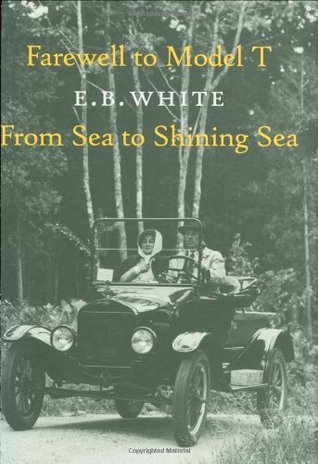
In 1922, just out of college and at loose ends, E.B. White set off across America in a Model T. He left his map at home, but packed his typewriter— his true destination, he tells us, was the world of letters. White wrote the richly humorous "Farewell to Model T" for The New Yorker in 1936; it was the first of his essays to bring him fame. In "From Sea to Shining Sea," White conjures the unspoiled America that remained his most enduring subject.The first essay of E. B. White's to become famous, "Farewell to Model T" originally appeared in 1936 in The New Yorker as "Farewell My Lovely." It is rich in comic descriptions of the eccentricities of the car, the demands it put on its devoted owners, and the hardware and decorative accessories—from 98-cent anti-rattlers to the "de-luxe flower vase of the cut-glass anti-splash type"—that kept them pouring over the Sears Roebuck catalog. If there was an owner's manual for the flivver, it didn't begin to divulge what the owner needed to know. That's where theory, speculation, superstition, and metaphysics came "I remember once spitting into a timer," White recalls, "not in anger, but in a spirit of research."It is published for the first time with "Sea to Shining Sea," in which White conjures the America that he had discovered as a 22-year old during a cross country trip in his Model T. (The year was 1922, the same the year that Fitzgerald and Hemingway went to Paris to find themselves.) In it he would "My own vision of the land—my own discovery of it—was shaped, more than by any other instrument, by a Model T Ford...a slow-motion roadster of miraculous design—strong, tremulous, and tireless, from sea to shining sea."

A collection of some of the best humor found in American literature including satires, fables, poems, and parodies

This beautifully packaged book with colorful illustrations provides a collection of humorous quotes and special descriptions from Charlotte's Web, in a collection for readers of all ages.

Famous for his essays and poems and immortalized through his classic children's books Charlotte's Web, Stuart Little, and The Trumpet of the Swan. (see p. S2, S5, S6) E.B. White and his way with words has become legendary.Read and personally introduced by E.B. White's son, Joel White (1931-1997), this unique recording includes Letter to the IRS, Once More to the Lake, The Ring of Time, The Sea and the Wind, excerpts from best-loved essays in One Man's Meat, and more. 2 hours.

"Run downhill!" suggested the cows."Run toward me!" yelled the gander."Run uphill!" cried the sheep."Turn and twist!" honked the goose."Jump and dance!" said the rooster. When Wilbur, the most lovable pig in children's literature, attempts to explore life beyond the boundaries of Zuckerman's farm, the other animals in the barnyard have lots of advice for him. It's only when Mr. Zuckerman uses the old pail trick and lures Wilbur back home with the irresistible aroma of warm slops that Wilbur decides to stay.

In the Words of E. B. White: Quotations from America's Most Companionable of Writers
by E.B. White
Rating: 4.4 ⭐
"The time not to become a father is eighteen years before a world war."--E. B. White on fatherhood"I was lucky to be born abnormal. It ran in the family."--on luck"I would really rather feel bad in Maine than feel good anywhere else." --on Maine"The English language is always sticking a foot out to trip a man."--on languageThe author of Charlotte's Web and One Man's Meat, coauthor of The Elements of Style, and columnist for The New Yorker for almost half a century, E. B. White (1899-1985) is an American literary icon. Over the course of his career, White inspired generations of writers and readers with his essays (both serious and humorous), children's literature, and stylistic guidance.In the Words of E. B. White offers readers a delightful selection of quotations, selected and annotated by his granddaughter and literary executor, Martha White. The quotations cover a wide range of subjects and situations, from Automobiles, Babies, Bees, City Life, and College to Spiders, Taxes, Weather, Work, and Worry. E. B. White comments on writing for children, how to tell a major poet from a minor one, and what to do when one becomes hopelessly mired in a sentence. White was apt to address the subject of security by speaking first about a Ferris wheel at the local county fair, or the subject of democracy from the perspective of roofing his barn and looking out across the bay--he had a gift for bringing the abstract firmly into the realm of the everyday. Included here are gems from White's books and essay collections, as well as bits from both published and unpublished letters and journals.This is a book for readers and writers, for those who know E. B. White from his "Notes and Comment" column in The New Yorker, have turned to The Elements of Style for help in crafting a polished sentence, or have loved a spider's assessment of Wilbur as "Some Pig." This distillation of the wit, style, and humanity of one of America's most distinguished essayists of the twentieth century will be a welcome addition to any reader's bookshelf.

Very RARE edition!! UNIQUE offer!! Don’t wait to be OWNER of this special piece of HISTORY!!!

Oracles move among us unnoticed, their plainspoken auguries hidden in the murmur of daily life, overlooked by all but the most astute of listeners. Over his many decades with The New Yorker, E. B. White became just such a listener as he wrote his incisive essays for the magazine’s Notes and Comment page. The essays in this collection first appeared in The New Yorker between 1937 and 1952, an interval framed by a waning Great Depression on one end and a waxing Cold War on the other. In between were the Holocaust, World War II, the atomic bomb, Walt Disney, the Iron Curtain, Chuck Yeager, television, the United Nations, and, barely noticed, the invention of the transistor and birth of the modern electronic age. Even when compared with events today, it was a period of unprecedented tumult and uncertainty. It was also a period when writers were not afraid to tackle the big issues head-on in print, as experts filled editorial pages and bookstores with their prescriptions for meeting the great challenges of the time. In contrast to these top-down explicators, White worked up from the specific in his understated way, leading the reader to a conclusion so self-evident by essay’s end that he barely needed to mention it. White writes about perennial human truths, but one must read these essays more than once to fully appreciate their timelessness. The first time through, the description of a modern pig nursery in “Remembrance of Things Past” is arresting for its mention of a long-obsolete piglet-comforting Victrola. But read again, the piece presages the issues surrounding humankind’s separation from nature and the safety of livestock antibiotics, issues that remain pressing concerns today. The Greeks revered their oracles because their utterances inevitably invited petitioners to look inside themselves for an answer. This is where White is at his very best, framing his essays in a way that all but compels introspection. . . 2007 Paul Saffo. From the foreword