
30 Books Written
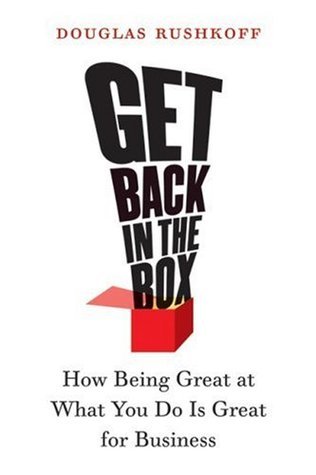
Get Back in the Box: How Being Great at What You Do Is Great for Business
by Douglas Rushkoff
Rating: 4.1 ⭐
• 4 recommendations ❤️
Douglas Rushkoff was one of the first social commentators to identify the new culture around the internet. He has spent nearly a decade advising companies on the ways they can re-orient their businesses to the transformations the internet has caused. Through his speaking and consulting, Rushkoff has discovered an important and unrecognized shift in American business. Too many companies are panicked and operating in survival mode when the worst of the crisis has already passed. Likening the internet transformation to the intellectual and technological ferment of the Enlightment, Rushkoff suggests we have a remarkable opportunity to re-integrate our new perspective with the work we actually do. Instead of running around trying to "think out of the box," Rushkoff demonstrates, now is the time to "get back in the box" and improve the way we do our jobs, run our operations and drive innovation from the ground up. Combining stories gleaned from his consulting with a thrilling tour of history's dramatic moments and clever readings of cultural shift we've just experienced, Rushkoff offers a compelling vision of the simple and effective ways businesses can re-invigorate themselves.

The tech elite have a plan to survive the apocalypse: they want to leave us all behind.Five mysterious billionaires summoned theorist Douglas Rushkoff to a desert resort for a private talk. The topic? How to survive the “Event”: the societal catastrophe they know is coming. Rushkoff came to understand that these men were under the influence of The Mindset, a Silicon Valley–style certainty that they and their cohort can break the laws of physics, economics, and morality to escape a disaster of their own making—as long as they have enough money and the right technology.In Survival of the Richest, Rushkoff traces the origins of The Mindset in science and technology through its current expression in missions to Mars, island bunkers, AI futurism, and the metaverse. In a dozen urgent, electrifying chapters, he confronts tech utopianism, the datafication of all human interaction, and the exploitation of that data by corporations. Through fascinating characters—master programmers who want to remake the world from scratch as if redesigning a video game and bankers who return from Burning Man convinced that incentivized capitalism is the solution to environmental disasters—Rushkoff explains why those with the most power to change our current trajectory have no interest in doing so. And he shows how recent forms of anti-mainstream rebellion—QAnon, for example, or meme stocks—reinforce the same destructive order.This mind-blowing work of social analysis shows us how to transcend the landscape The Mindset created—a world alive with algorithms and intelligences actively rewarding our most selfish tendencies—and rediscover community, mutual aid, and human interdependency. In a thundering conclusion, Survival of the Richest argues that the only way to survive the coming catastrophe is to ensure it doesn’t happen in the first place.

The debate over whether the Net is good or bad for us fills the airwaves and the blogosphere. But for all the heat of claim and counter-claim, the argument is essentially beside the point: it’s here; it’s everywhere. The real question is, do we direct technology, or do we let ourselves be directed by it and those who have mastered it? “Choose the former,” writes Rushkoff, “and you gain access to the control panel of civilization. Choose the latter, and it could be the last real choice you get to make.” In ten chapters, composed of ten “commands” accompanied by original illustrations from comic artist Leland Purvis, Rushkoff provides cyberenthusiasts and technophobes alike with the guidelines to navigate this new universe.In this spirited, accessible poetics of new media, Rushkoff picks up where Marshall McLuhan left off, helping readers come to recognize programming as the new literacy of the digital age––and as a template through which to see beyond social conventions and power structures that have vexed us for centuries. This is a friendly little book with a big and actionable message. World-renowned media theorist and counterculture figure Douglas Rushkoff is the originator of ideas such as “viral media,” “social currency” and “screenagers.” He has been at the forefront of digital society from its beginning, correctly predicting the rise of the net, the dotcom boom and bust, as well as the current financial crisis. He is a familiar voice on NPR, face on PBS, and writer in publications from Discover Magazine to the New York Times.“Douglas Rushkoff is one of the great thinkers––and writers––of our time.” —Timothy Leary“Rushkoff is damn smart. As someone who understood the digital revolution faster and better than almost anyone, he shows how the internet is a social transformer that should change the way your business culture operates." —Walter Isaacson

"If the end of the twentieth century can be characterized by futurism, the twenty-first can be defined by presentism." This is the moment we've been waiting for, explains award-winning media theorist Douglas Rushkoff, but we don't seem to have any time in which to live it. Instead we remain poised and frozen, overwhelmed by an always-on, live-streamed reality that our human bodies and minds can never truly inhabit. And our failure to do so has had wide-ranging effects on every aspect of our lives.People spent the twentieth century obsessed with the future. We created technologies that would help connect us faster, gather news, map the planet, compile knowledge, and connect with anyone, at anytime. We strove for an instantaneous network where time and space could be compressed.Well, the future's arrived. We live in a continuous now enabled by Twitter, email, and a so-called real-time technological shift. Yet this now is an elusive goal that we can never quite reach. And the dissonance between our digital selves and our analog bodies has thrown us into a new state of anxiety: present shock.Rushkoff weaves together seemingly disparate events and trends into a rich, nuanced portrait of how life in the eternal present has affected our biology, behavior, politics, and culture. He explains how the rise of zombie apocalypse fiction signals our intense desire for an ending; how the Tea Party and Occupy Wall Street form two sides of the same post-narrative coin; how corporate investing in the future has been replaced by futile efforts to game the stock market in real time; why social networks make people anxious and email can feel like an assault. He examines how the tragedy of 9/11 disconnected an entire generation from a sense of history, and delves into why conspiracy theories actually comfort us.As both individuals and communities, we have a choice. We can struggle through the onslaught of information and play an eternal game of catch-up. Or we can choose to live in the present: favor eye contact over texting; quality over speed; and human quirks over digital perfection. Rushkoff offers hope for anyone seeking to transcend the false now.Absorbing and thought-provoking, Present Shock is a wide-ranging, deeply thought meditation on what it means to be human in real-time.

Throwing Rocks at the Google Bus: How Growth Became the Enemy of Prosperity
by Douglas Rushkoff
Rating: 3.8 ⭐
Capital in the Twenty-First Century meets The Second Machine Age in this stunning and optimistic tour de force on the promise and peril of the digital economy, from one of the most brilliant social critics of our time. Digital technology was supposed to usher in a new age of endless prosperity, but so far it has been used to put industrial capitalism on steroids, making it harder for people and businesses to keep up. Social networks surrender their original missions to more immediately profitable data mining, while brokerage houses abandon value investing for algorithms that drain markets and our 401ks alike--all tactics driven by the need to stoke growth by any means necessary. Instead of taking this opportunity to reprogram our economy for sustainability, we have doubled down on growth as its core command. We have reached the limits of this approach. We must escape the growth trap, once and for all. Media scholar and technology author Douglas Rushkoff--one of today's most original and influential thinkers--argues for a new economic program that utilizes the unique distributive power of the internet while breaking free of the winner-take-all system the growth trap leaves in its wake. Drawing on sources both contemporary and historical, Rushkoff pioneers a new understanding of the old economic paradigm, from central currency to debt to corporations and labor.Most importantly, he offers a series of practical steps for businesses, consumers, investors, and policymakers to remake the economic operating system from the inside out--and prosper along the way. Instead of boycotting Wal-Mart or overtaxing the wealthy, we simply implement strategies that foster the creation of value by stakeholders other than just ourselves. From our currency to our labor to the corporation, every aspect of the economy can be reprogrammed with minimal disruption to create a more equitably distributed prosperity for all.Inspiring and challenging, Throwing Rocks at the Google Bus provides a pragmatic, optimistic, and human-centered model for economic progress in the digital age.
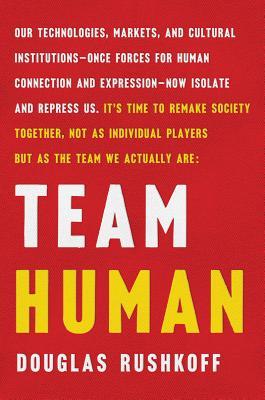
Porchlight’s Management and Workplace Culture Book of The Year"A provocative, exciting, and important rallying cry to reassert our human spirit of community and teamwork." ―Walter Isaacson Team Human is a manifesto―a fiery distillation of preeminent digital theorist Douglas Rushkoff’s most urgent thoughts on civilization and human nature. In one hundred lean and incisive statements, he argues that we are essentially social creatures, and that we achieve our greatest aspirations when we work together―not as individuals. Yet today society is threatened by a vast antihuman infrastructure that undermines our ability to connect. Money, once a means of exchange, is now a means of exploitation; education, conceived as way to elevate the working class, has become another assembly line; and the internet has only further divided us into increasingly atomized and radicalized groups. Team Human delivers a call to arms. If we are to resist and survive these destructive forces, we must recognize that being human is a team sport. In Rushkoff’s own words: “Being social may be the whole point.” Harnessing wide-ranging research on human evolution, biology, and psychology, Rushkoff shows that when we work together we realize greater happiness, productivity, and peace. If we can find the others who understand this fundamental truth and reassert our humanity―together―we can make the world a better place to be human.

Life Inc.: How the World Became a Corporation and How to Take it Back
by Douglas Rushkoff
Rating: 3.9 ⭐
This didn’t just happen.In Life Inc. , award-winning writer, documentary filmmaker, and scholar Douglas Rushkoff traces how corporations went from being convenient legal fictions to being the dominant fact of contemporary life. Indeed, as Rushkoff shows, most Americans have so willingly adopted the values of corporations that they’re no longer even aware of it.This fascinating journey, from the late Middle Ages to today, reveals the roots of our debacle. From the founding of the first chartered monopoly to the branding of the self; from the invention of central currency to the privatization of banking; from the birth of the modern, self-interested individual to his exploitation through the false ideal of the single-family home; from the Victorian Great Exhibition to the solipsism of MySpace–the corporation has infiltrated all aspects of our daily lives. Life Inc . exposes why we see our homes as investments rather than places to live, our 401(k) plans as the ultimate measure of success, and the Internet as just another place to do business.Most of all, Life Inc. shows how the current financial crisis is actually an opportunity to reverse this six-hundred-year-old trend and to begin to create, invest, and transact directly rather than outsource all this activity to institutions that exist solely for their own sakes.Corporatism didn’t evolve naturally. The landscape on which we are living–the operating system on which we are now running our social software–was invented by people, sold to us as a better way of life, supported by myths, and ultimately allowed to develop into a self-sustaining reality. It is a map that has replaced the territory.Rushkoff illuminates both how we’ve become disconnected from our world and how we can reconnect to our towns, to the value we can create, and, mostly, to one another. As the speculative economy collapses under its own weight, Life Inc. shows us how to build a real and human-scaled society to take its place.

Noted media pundit and author of Playing the Future Douglas Rushkoff gives a devastating critique of the influence techniques behind our culture of rampant consumerism. With a skilled analysis of how experts in the fields of marketing, advertising, retail atmospherics, and hand-selling attempt to take away our ability to make rational decisions, Rushkoff delivers a bracing account of media ecology today, consumerism in America, and why we buy what we buy, helping us recognize when we're being treated like consumers instead of human beings.

"A darkly comic contemporary a brave, very funny, very knowing trip through the neo-psychedelic substrate of the wired world." -- William Gibson , bestselling author of Neuromancer and Idoru Douglas Rushkoff--the foremost authority on cyberculture and author of Cyberia, Media Virus and Playing the Future --has penned the ultimate novel for our fast and furious times. A wired-in thrill ride into the here and now of tripping, raving, net-surfing...and beyond. "An eerie tale of 20-somethings caught up in an increasingly trippy world of homegrown religion. Set in an abandoned piano factory in Oakland, CA., Rushkoff's novel drops several characters--hackster, hipster, hustler, hippie--into a pop-culture Cuisinart along with a nice Jewish boy, and then spins them off into an intricate plot that leads to a showdown with the leader of a rival cultlike group." -- New York Times

This is an ideas-led, exuberant documentary about the converging strands of a new era, the empowerments of cyber-technology, and the precipitation of new ways of life. Originally written in 1994, it outlines the strands of the cyber subculture as it was emerging-- the favored drugs, the influential individuals, the hackers and their motivations, the science chaos and the complexity of fractuals. This book will endure as a reminder of how modern cyberculture came about--a note to the future form an individual perceptive enough to grasp the profound effects of the cyber revolution.

Media theorist and documentarian Douglas Rushkoff weaves a mind-bending tale of iconography and mysticism against the backdrop of a battle-torn Europe. In a story spanning generations, and featuring some of the most notable and notorious idealists of the 20th century, legendary occultist Aleister Crowley develops a powerful and dangerous new weapon to defend the world against Adolf Hitler's own war machine spawning an unconventional new form of warfare that is fought not with steel, but with symbols and ideas. Unfortunately, these intangible arsenals are much more insidious and perhaps much more dangerous than their creators could have ever conceived."Rushkoff is a cultural treasure and an eccentric author of big, strange ideas, never less than fascinating and always entertaining." -Warren Ellis, author of Gun Machine, Red, Trees, and Transmetropolitan"Douglas has been one of my personal heroes, and I've been a most attentive reader of anything he cares to put between covers, knowing that his combination of a cold eye and a warm heart is guaranteed to astonish and embolden my own thinking about what's possible in the world--about what's possible to enact in the space between one human being and another. He occupies the ground of our most immediate perplexities, and his reports of what he finds are breaking news." -Jonathan Lethem, author of The Best American Comics and The Fortress of Solitude

Bold, daring, and provocative, Media Virus! examines the intricate ways in which popular media both manipulate and are manipulated by those who know how to tap into their power. Douglas Rushkoff shows that where there's a wavelength, there's a way to "infect" those on it—from the subtly, but intentionally, subversive signals broadcast by shows like "The Simpsons," to the O.J. media frenzy surrounding the Nicole Brown Simpson murder case, chase, and trial. What does it all mean? Unless you've been living in a cave that isn't cable-ready, you're already infected with the media virus. But don't worry, it won't make you sick. It will make you think....

In a modern-day tale that reveals how the Bible's mythic tales are repeated today, Grad student Jake Stern leads an underground band of renegades to combat the frightening threats to freedom that permeate the world, employing technology, alchemy, media hacking, and mysticism to fight a modern threat that has its roots in ancient stories.

Acclaimed writer and thinker Douglas Rushkoff, author of Ecstasy Club and Coercion , has written perhaps the most important—and controversial—book on Judaism in a generation. As the religion stands on the brink of becoming irrelevant to the very people who look to it for answers, Nothing Sacred takes aim at its problems and offers startling and clearheaded solutions based on Judaism’s core values and teachings.Disaffected by their synagogues’ emphasis on self-preservation and obsession with intermarriage, most Jews looking for an intelligent inquiry into the nature of spirituality have turned elsewhere, or nowhere. Meanwhile, faced with the chaos of modern life, returnees run back to Judaism with a blind and desperate faith and are quickly absorbed by outreach organizations that—in return for money—offer compelling evidence that God exists, that the Jews are, indeed, the Lord’s “chosen people,” and that those who adhere to this righteous path will never have to ask themselves another difficult question again.Ironically, the texts and practices making up Judaism were designed to avoid just such a scenario. Jewish tradition stresses transparency, open-ended inquiry, assimilation of the foreign, and a commitment to conscious living. Judaism invites inquiry and change. It is an “open source” tradition—one born out of revolution, committed to evolution, and willing to undergo renaissance at a moment’s notice. But, unfortunately, some of the very institutions created to protect the religion and its people are now suffocating them.If the Jewish tradition is actually one of participation in the greater culture, a willingness to wrestle with sacred beliefs, and a refusal to submit blindly to icons that just don’t make sense to us, then the “lapsed” Jews may truly be our most promising members. Why won’t they engage with the synagogue, and how can they be made to feel more welcome?Nothing Sacred is a bold and brilliant book, attempting to do nothing less than tear down our often false preconceptions about Judaism and build in their place a religion made relevant for the future.From the Hardcover edition.

From the imagination of best-selling author Douglas Rushkoff, one of the most icono-clastic and acclaimed minds of our era, comes a graphic novel series that exposes the "real" Bible as it was actually written, and reveals how its mythic tales are repeated today.Young Alan Stern may have created life inside his laptop. Now, he's about to discover the terrible consequences of playing God.
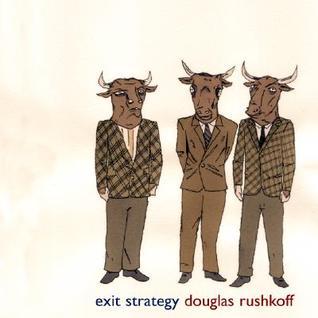
Set in the near-future (2008), Exit Strategy is a darkly comic send-up of the dot.com mania of the late 1990s and a modern-day retelling of the story of Joseph. Like Joseph, Jamie Cohen is betrayed by his compadres but unexpectedly finds himself at the right hand of power. He helps a huge venture capitalist build pyramids - except these are investment pyramids based on technology idols. An additional narrative conceit is this: 200 years later, anthropologists find the virtual manuscript of Exit Strategy and begin annotating the text. Hundreds of readers have already contributed footnotes for the book – they are charming, wacky, compelling and Rushkoff has selected one hundred of his favorites for inclusion.

The Adolescent Demo Division are the world's luckiest teen gamers. Raised from birth to test media, appear on reality TV and enjoy the fruits of corporate culture, the squad develop special abilities that make them the envy of the world--and a grave concern to their keepers.One by one, they "graduate" to new levels that are not what they seem. But their heightened abilities can only take them so far as the ultimate search for their birth families leads to an inconceivably harrowing discovery.Written by Douglas Rushkoff, world-renowned media theorist, Frontline TV correspondent and author (Ecstasy Club, Media Virus and Program or Be Programmed, TESTAMENT), with full color art by Goran Sudzuka and Jose Marzan Jr. (Y: THE LAST MAN).

From the imagination of best-selling author Douglas Rushkoff, one of the most iconoclastic and acclaimed minds of our era, comes a graphic novel series that exposes the "real" Bible as it was actually written, and reveals how its mythic tales are repeated today. Young Alan Stern may have created life--inside his laptop Now, he's about to discover the terrible consequences of playing God.


Arguing that media-saturated children have learned the necessary skills to survive and prosper in our digital age, the author uses everything from chaos theory, to Rodney King, to Star Wars to demonstrate that kids hold the key to the future. Reprint.

"Painful but Fabulous tells the story of Genesis P-Orridge, in his own words. A rare glimpse into the world of the icon and founder of Throbbing Gristle and psychic TV, "Painful but Fabulous is illustrated throughout with photos and graphics.

Douglas Rushkoff, author of eight books on media and culture, as well as the novels Ecstasy Club and Exit Strategy, marks his graphic novel debut with Club Zero-G. Teaming with Canadian independent comic artist Steph Dumais, Rushkoff has delivered America’s answer to Japan’s animé: a mind-altering journey into a universe where consensus reality is up for grabs.The story follows Zeke, a gangly, unpopular, 19-year-old college student—a townie who also happens to attend the elite college in his community—who has discovered a terrific new club where he is accepted and popular. There’s only one catch: everyone at the club is dreaming. It only exists in the shared dream consciousness of its participants. If at all.For there’s the rub: Zeke’s friends think he is simply going crazy. His girlfriend in the club won’t even acknowledge his existence in real life.As Zeke descends further into the Club Zero-G reality, he learns that this shared dream space is actually a psychic field created by four mutant children from the future—the last of their kind, conceived by human space travelers in zero gravity and exhibiting strange deformities and abilities. Living in a future where independent thinking is considered a threat to “consensus,” they are hunted by the authorities, and seek the help of teens from the 21st century who, they hope, can still alter the course of reality.But Zeke eventually learns this is all a setup, and he is being used by the militaries of the present and the future as a portal into the psychic field of the Zero-G kids, so they can be destroyed. Unless, of course, he is just going mad.The battle for Zeke’s mind becomes an interdimensional battle for reality itself, in this daring, adult, American, animé adventure.

Cursed by older generations, Generations X means a lot of things to a lot of people. They are a culture, a demographic, an outlook, a style, an economy, a scene, a literature, a political ideology, an aesthetic, an age, a decade, and a way of life.Here is a collage of the most revered voices of Generation X, demonstrating that while twentysomethings may, indeed, have dropped out of American culture (as it is traditionally defined), they also stand as a testament to American ingenuity, optimism, instinct, and intelligence.

This work argues that youth culture - from Power Rangers and Nintendo to the Internet and MTV - is equipping young people for life in the 20th-century, a chaotic realm in which the short attention span fostered by the soundbite and the remote control will be an asset rather than a disadvantage.

Open Source Democracy: How Online Communication Is Changing Offline Politics
by Douglas Rushkoff
Rating: 3.6 ⭐
An Excerpt from the book-Chapter 1 From Moses to modems: demystifying the storytelling and taking controlWe are living in a world of stories. We can't help but use narrativesto understand the events that occur around us. The unpredictability ofnature, emotions, social interactions and power relationships ledhuman beings from prehistoric times to develop narratives thatdescribed the patterns underlying the movements of these forces.Although we like to believe that primitive people actually believedthe myths they created about everything, from the weather to theafterlife, a growing camp of religious historians are concluding thatearly religions were understood much more metaphorically than weunderstand religion today. As Karen Armstrong explains in A History ofGod1, and countless other religious historians and philosophers fromMaimonides to Freud have begged us to understand, the ancients didn'tbelieve that the wind or rain were gods. They invented characterswhose personalities reflected the properties of these elements. Thecharacters and their stories served more as ways of remembering thatit would be cold for four months before spring returns than asgenuinely accepted explanations for nature's changes. The people wereactively, and quite self-consciously, anthropomorphizing the forces ofnature.

A deep dive into one of this century's most potent do we direct technology, or do we let ourselves be directed by it?This compact new edition of a paradigmatic text packs a big and actionable punch. Updated with a new section on the unique challenges posed by AI, Program or Be Programmed presents a spirited, accessible poetics of new media. On these pages (and screens), Rushkoff picks up where Marshall McLuhan left off, helping readers recognize programming as the new literacy of the digital age.The debate over whether the internet is good or bad for us fills the airwaves and the blogosphere. But for all the heat of claim and counter-claim, the argument is essentially beside the it’s here; it’s everywhere. The real question is, do we direct technology, or do we let ourselves be directed by it and those who have mastered it? “Choose the former,” writes Rushkoff, “and you gain access to the control panel of civilization. Choose the latter, and it could be the last real choice you get to make.” In eleven “commands,” Rushkoff provides cyberenthusiasts and technophobes alike with the guidelines to navigate this new universe.

This collection of provocations from the think tank Cybersalon brings together a blend of near-future speculative fiction and non-fiction commentary from leading experts in the fields of health, community, retail, and money. Together, they shine a light behind the cornerstones of our lives to reveal the unexpected and invite you to cast your critical eye on technology and its effect on society. Be prepared for warnings and inspirations from those who speculate about the future and those who make it a reality.

From the imagination of best-selling author Douglas Rushkoff, one of the most iconoclastic and acclaimed minds of our era, comes a graphic novel that exposes the “real” Bible as it was actually written, and reveals how its mythic tales are repeated today. Grad student Jake Stern leads an underground band of renegades that uses any means necessary to combat the frightening threats to freedom that permeate the world. They employ technology, alchemy, media hacking and mysticism to fight a modern threat that has its roots in ancient stories destined to recur in the modern age. This digital omnibus collects all four volumes of Douglas Rushkoff's Testament.

Covers visual highs, music, breathing, sex, meditation, skydiving, sports, brain machines, travel, massage, spas, math, science, mythology, reading, and visualization

The Tomorrow Project: Bestselling Authors Describe Daily Life in the Future
by Douglas Rushkoff
Rating: 3.3 ⭐