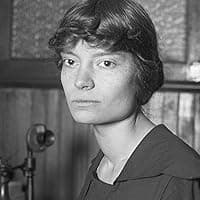
Dorothy Day
Dorothy Day was an American journalist, social activist and anarchist who, after a bohemian youth, became a Catholic Christian without in any way abandoning her social and anarchist activism. She was perhaps the best-known political radical in the American Catholic Church. In the 1930s, Day worked closely with fellow activist Peter Maurin to establish the Catholic Worker movement, a nonviolent, pacifist movement that continues to combine direct aid for the poor and homeless with nonviolent direct action on their behalf. A revered figure within the U.S. Catholic community, Day's cause for canonization was recently open by the Catholic Church.
20 Books Written

The Long Loneliness: The Autobiography of the Legendary Catholic Social Activist
by Dorothy Day
Rating: 4.0 ⭐
This inspiring and fascinating memoir, subtitled, “The Autobiography of the Legendary Catholic Social Activist,” The Long Loneliness is the late Dorothy Day’s compelling autobiographical testament to her life of social activism and her spiritual pilgrimage.A founder of the Catholic Worker Movement and longtime associate of Peter Maurin, Dorothy Day was eulogized in the New Yor

...the fruit of much research and study on Dorothy's part, captures the heart of the message of Saint Therese of Lisieux and reveals also the depth of Dorothy's own spirituality. At the time when Dorothy wrote about her, she was already known to the world as the Saint of the Little Way; in the April 1952 CW Dorothy also called her "the saint of the responsible." Dorothy reflected in her book that

In this early autobiographical work, Dorothy Day offers the first account of her dramatic conversion. This concise and passionate work gives an account of Day's former comrades in the radical movement of the steps that led to her to embrace Christ and the Catholic Church. From Union Square to Rome is an essential book for all those fascinated by Day's unique brand of holiness and activism.<b

These diary entries written by Dorothy Day in 1948 provide an intimate look into Day's personal life as well as essential background for understanding the Catholic Worker movement, which she founded. In this book, Day writes about all facets of her life. Yet whether describing her visits to her daughter's farm or the writings of the saints, a common theme emerges, namely, the gifts of God's love a

Dorothy Day has been described as the most significant, interesting, and influential person in the history of American Catholicism." Outside The Catholic Worker (which she edited from 1933 to her death), Day wrote for no other publication so often and over such an extended period - covering six decades - as the independent Catholic journal of opinion, Commonweal.Gathered

Dorothy Day provides the most complete intimate portrait of the man she called an Apostle to the world. Maurin emerges as a true saint and prophet who offers an instructive and healing challenge for our time.


Orginally New Harper & Row, 1963.

A twentieth-century Catholic activist, founder of the Catholic Worker movement and its newspaper, "The Catholic Worker," and candidate for sainthood are just a few descriptions of Dorothy Day. In this volume, Phyllis Zagano has compiled and arranged long and short selections from Dorothy Day's own writings which reflect her gospel-based spirituality. In addition, "Dorothy Day: In My Own Words" is

Dorothy Day, co-founder of the Catholic Worker movement, has been called the most significant, interesting, and influential person in the history of American Catholicism. For almost fifty years, through her tireless service to the poor and her courageous witness for peace, she offered an extraordinary example of the gospel in action. Now the publication of her diaries, previously sealed for twenty

“The publication of the letters of Dorothy Day is a significant event in the history of Christian spirituality.” —Jim Martin, SJ, author of My Life with the Saints Dorothy Day, cofounder of the Catholic Worker movement, has been called the most significant, interesting, and influential person in the history of American Catholicism. Now the publication of her letters, previously sealed

The rare first book (and only novel) by the radical pacifist and co-founder of the Catholic Worker Movement. It follows the protagonist, June Henreddy, through adolescence and college and on to her first job, on the staff of a socialist newspaper. She and the book's other characters are embroiled in the issues of the day (pacifism, birth control, free love, etc), and at one point her involvement w

Dorothy Day (1897–1980) was a well-known American journalist, activist, and Catholic convert whose cause for sainthood has been endorsed by the US bishops. She wrote numerous articles over a period of several decades for the prominent lay Catholic magazine Commonweal. Hold Nothing Back is gleaned from those writings. It includes reflections on her life as a single mother, her time in jail for civi

Reflections during Advent: Dorothy Day on Prayer, Poverty, Chastity and Obedience
by Dorothy Day
Rating: 3.8 ⭐
In his September 2015 speech to the United States Congress, Pope Francis credited American journalist Dorothy Day (1897-1980), cofounder of the Catholic Worker movement, for her deep faith and social activism. Day’s devotion to her Catholic faith and its traditions reverberated through a series of four reflections published during Advent 1966 in The Ave Maria magazine, a Catholic weekly founded in


In this guidebook Dorothy Day offers hard-earned wisdom and practical advice gained through decades of seeking to know Jesus and to follow his example and teachings in her own life. Unlike larger collections and biographies, which cover her radical views, exceptional deeds, and amazing life story, this book focuses on a more personal dimension of her life: Where did she receiv

Through Dorothy Day’s monthly “On Pilgrimage” columns from The Catholic Worker, this volume offers a unique chronicle on the 1960s--a tumultuous decade marked by the Cuban Revolution, Vatican II, the struggle for Civil Rights, Vietnam protests, the rise of the United Farmworkers, and dramatic cultural change which reverberates even today. Journalist Day surveyed these developments from the vantage

A collection of Dorothy Day’s “On Pilgrimage” columns from the 1970s. Travels around the world, including Tanzania and the Soviet Union; arrest with the farmworkers at age 75; a standoff with the IRS over refusal to pay federal income tax; the end of the Vietnam War; speaking at the Eucharistic Congress; opening a new house of hospitality for homeless women; and the slow, inexorable journey toward
Quarterly Catholic journal.

Dorothy Day (1897-1980), co-founder of the Catholic Worker movement, has recently been proposed for canonization. Through her houses of hospitality, the practice of the works of mercy, and her prophetic work for peace and justice, she offered a radical witness to the gospel in action. But it was as much in her everyday life as in her public activities that she expressed her spirituality and found