
Donald Sull
Donald Sull is a Senior Lecturer at the MIT Sloan School of Management. He is a global authority on managing in turbulent markets, and directs a week-long course on effectively executing strategy in volatile markets. He has been identified as a leading management thinker by The Economist, the Financial Times, and Fortune which named him among the ten new management gurus to know. The Economist listed his theory of active inertia among the ideas that shaped business management over the past century.Sull has published five books, including The Upside of Turbulence (2009). His book Made in China was namedone of the top eight business books of 2005 by the Financial Times and his book Why Good Companies Go Bad was a finalist for the Academy of Management’s Outstanding Management Book Award. Sull has also written more than 100 book chapters, case studies, and articles, including several best-selling Harvard Business Review articles.As a consultant and management educator, Sull has worked with companies including Mars, Oracle, PIMCO, Royal Bank of Canada, Standard Chartered Bank, Emirates Airline, Baker & McKenzie, Burberry, and Schneider Electric. He speaks regularly at leading management conferences, such as Microsoft’s CEO Summit and the McKinsey Strategy Summit.Prior to academia, he worked as a consultant with McKinsey & Company, and a management-investor with the leveraged buyout firm Clayton & Dubilier on the Uniroyal-Goodrich Tire Company deal. Sull received his AB, MBA, and doctorate from Harvard University, where he taught entrepreneurship at the Harvard Business School before rejoining the London Business School faculty as a professor of management practice in strategy and entrepreneurship. Sull has won teaching awards at both London Business School and Harvard University. He remains active in private equity as an investor and advisor to start-up companies.
1 Books Written
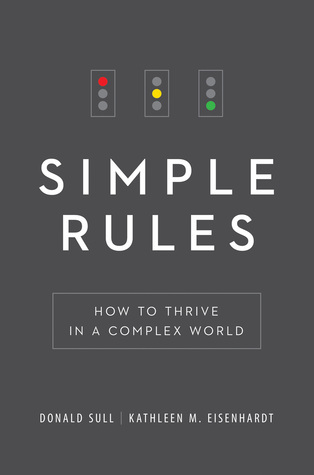
HOW SIMPLICITY TRUMPS COMPLEXITY IN NATURE, BUSINESS, AND LIFE Complexity surrounds us. We have too much email, juggle multiple remotes, and hack through thickets of regulations from phone contracts to health plans. But complexity isn’t destiny. Sull and Eisenhardt argue there’s a better way. By developing a few simple yet effective rules, people can best even the most complex problems. In Simple Rules, Sull and Eisenhardt masterfully challenge how we think about complexity and offer a new lens on how to cope. They take us on a surprising tour of what simple rules are, where they come from, and why they work. The authors illustrate the six kinds o f rules that really matter - for helping artists find creativity and the Federal Reserve set interest rates, for keeping birds on track and Zipcar members organized, and for how insomniacs can sleep and mountain climbers stay safe. Drawing on rigorous research and riveting stories, the authors ingeniously find insights in unexpected places, from the way Tina Fey codified her experience at Saturday Night Live into rules for producing 30 Rock (rule five: never tell a crazy person he’s crazy) to burglars’ rules for robbery (“avoid houses with a car parked outside”) to Japanese engineers mimicking the rules of slime molds to optimize Tokyo’s rail system. The authors offer fresh information and practical tips on fixing old rules and learning new ones. Whether you’re struggling with information overload, pursuing opportunities with limited resources, or just trying to change your bad habits, Simple Rules provides powerful insight into how and why simplicity tames complexity.