
Dennis C. Rasmussen
Dennis C. Rasmussen is a political theorist whose research focuses on the Enlightenment, the American founding, and the virtues and shortcomings of liberal democracy and market capitalism. He received his Ph.D. from Duke University in 2005 and his B.A. from Michigan State University’s James Madison College in 2000, and he has also held positions at Tufts University, the University of Houston, Brown University, and Bowdoin College
7 Books Written

The Infidel and the Professor: David Hume, Adam Smith, and the Friendship That Shaped Modern Thought
by Dennis C. Rasmussen
Rating: 4.0 ⭐
• 2 recommendations ❤️
The story of the greatest of all philosophical friendships―and how it influenced modern thoughtDavid Hume is arguably the most important philosopher ever to have written in English, but during his lifetime he was attacked as “the Great Infidel” for his religious skepticism and deemed unfit to teach the young. In contrast, Adam Smith, now hailed as the founding father of capitalism, was a revered professor of moral philosophy. Remarkably, Hume and Smith were best friends, sharing what Dennis Rasmussen calls the greatest of all philosophical friendships. The Infidel and the Professor tells the fascinating story of the close relationship between these towering Enlightenment thinkers―and how it influenced their world-changing ideas. It shows that Hume contributed more to economics―and Smith contributed more to philosophy―than is generally recognized. The result is a compelling account of a great friendship that had great consequences for modern thought.

Fears of a Setting Sun: The Disillusionment of America's Founders
by Dennis C. Rasmussen
Rating: 4.2 ⭐
The surprising story of how George Washington, Alexander Hamilton, John Adams, and Thomas Jefferson came to despair for the future of the nation they had createdAmericans seldom deify their Founding Fathers any longer, but they do still tend to venerate the Constitution and the republican government that the founders created. Strikingly, the founders themselves were far less confident in what they had wrought, particularly by the end of their lives. In fact, most of them--including George Washington, Alexander Hamilton, John Adams, and Thomas Jefferson--came to deem America's constitutional experiment an utter failure that was unlikely to last beyond their own generation. Fears of a Setting Sun is the first book to tell the fascinating and too-little-known story of the founders' disillusionment.As Dennis Rasmussen shows, the founders' pessimism had a variety of sources: Washington lost his faith in America's political system above all because of the rise of partisanship, Hamilton because he felt that the federal government was too weak, Adams because he believed that the people lacked civic virtue, and Jefferson because of sectional divisions laid bare by the spread of slavery. The one major founder who retained his faith in America's constitutional order to the end was James Madison, and the book also explores why he remained relatively optimistic when so many of his compatriots did not. As much as Americans today may worry about their country's future, Rasmussen reveals, the founders faced even graver problems and harbored even deeper misgivings.A vividly written account of a chapter of American history that has received too little attention, Fears of a Setting Sun will change the way that you look at the American founding, the Constitution, and indeed the United States itself.
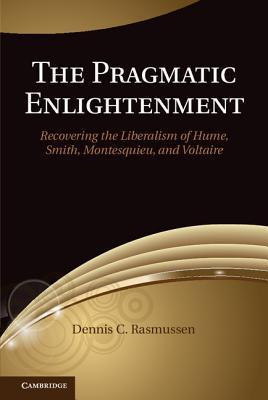
The Pragmatic Enlightenment: Recovering the Liberalism of Hume, Smith, Montesquieu, and Voltaire
by Dennis C. Rasmussen
Rating: 3.8 ⭐
This is a study of the political theory of the Enlightenment, focusing on four leading eighteenth-century David Hume, Adam Smith, Montesquieu, and Voltaire. Dennis C. Rasmussen calls attention to the particular strand of the Enlightenment these thinkers represent, which he terms the "pragmatic Enlightenment." He defends this strand of Enlightenment thought against both the Enlightenment’s critics and some of the more idealistic Enlightenment figures who tend to have more followers today, such as John Locke, Immanuel Kant, and Jeremy Bentham. Professor Rasmussen argues that Hume, Smith, Montesquieu, and Voltaire exemplify an especially attractive type of liberalism, one that is more realistic, moderate, flexible, and contextually sensitive than most other branches of this tradition.

The Constitution's Penman: Gouverneur Morris and the Creation of America's Basic Charter
by Dennis C. Rasmussen
Rating: 4.5 ⭐
Strikingly few Americans know who wrote the Constitution. Even fewer know that he was a peg-legged ladies' man with a wicked sense of humor, a staunch opponent of slavery, and an unabashed elitist. Gouverneur Morris, who has been described as "the most colorful man in North America" at the time of the founding, was a dominant figure at the Philadelphia Convention of 1787. In fact, he spoke more often, proposed more motions, and had more motions adopted than any other delegate. He also put the Constitution into its final form, choosing the arrangement and much of the wording of its provisions, not to mention composing the famous preamble ("We the people of the United States . . .") nearly from scratch. The Constitution's Penman is the first book to explore the constitutional vision of this fascinating, neglected, and influential American.As Dennis Rasmussen deftly shows, some aspects of Morris's political thought were intriguingly idiosyncratic, such as his argument that the Senate should be an aristocratic body whose members would serve life terms without pay. Other aspects of his vision for America's constitutional order, however, were astoundingly prescient. Morris saw as clearly as any of the framers the need for a powerful executive with a popular mandate, the central role that parties would play in American politics, and the unfathomable evils that slavery would visit on American life. Rasmussen demonstrates that it is impossible to fully understand the Constitution without appreciating the central role that Morris played in shaping it.

The Problems and Promise of Commercial Society: Adam Smith's Response to Rousseau
by Dennis C. Rasmussen
Rating: 2.0 ⭐
Adam Smith is popularly regarded as the ideological forefather of laissez-faire capitalism, while Rousseau is seen as the passionate advocate of the life of virtue in small, harmonious communities and as a sharp critic of the ills of commercial society. But, in fact, Smith had many of the same worries about commercial society that Rousseau did and was strongly influenced by his critique. In this first book-length comparative study of these leading eighteenth-century thinkers, Dennis Rasmussen highlights Smith’s sympathy with Rousseau’s concerns and analyzes in depth the ways in which Smith crafted his arguments to defend commercial society against these charges. These arguments, Rasmussen emphasizes, were pragmatic in nature, not it was Smith’s view that, all things considered, commercial society offered more benefits than the alternatives. Just because of this pragmatic orientation, Smith’s approach can be useful to us in assessing the pros and cons of commercial society today and thus contributes to a debate that is too much dominated by both dogmatic critics and doctrinaire champions of our modern commercial society.

Legacy of Sorrows: War in the Sun
by Dennis C. Rasmussen
Legacy of Sorrows comprises of two stories in one volume. The Witness focuses on the massacre of almost two thousand Italian civilians by the German SS during World War II. A thirteen-year-old boy sees his family killed and the mountain community he lived in eradicated in the most brutal fashion. As he grows into adulthood, he swears vengeance on the perpetrators of this atrocity. Long after the war, he discovers the whereabouts of the SS leaders who were involved. Now he must face a difficult choice. Should he carry out his vow of vengeance? Or should he let it go? The Devil’s Bridge is based on the true story of the friendship between Churchill and Mussolini. After the war, an Italian family living in the UK discovers the whereabouts of the letters that Churchill and Mussolini had once exchanged. Threatened by sinister forces, theyattempt to recover the letters and donate them to the Italian Government. But there are many people who don’t want these letters to surface, and who will do anything to keep them buried…

Atheist and Professor
by Dennis C. Rasmussen
Atheist and Professorb Two great Scottish enlightenment masters, David Hume and Adam Smith.The great philosophical friendship that has had a great influence on modern thought!This is because it deals with the “friendship” of two great thinkers. This is because friendships are much harder to reproduce than disagreements and fights. Conflict helps with dramatic drama, but not comradeship. So there are many books about philosophical conflict, but much less about philosophical friendship. Humes biographies also pay more attention to the brief clash with Rousseau than to his long friendship with Smith. Explore Adam Smiths longstanding friendship as the founder. From their first encounter in 1749 to Humes death in 1776, they follow the trend of friendship, examining both their personal interactions and their influence on each others worldview. Uncover how they commented on each others writings, how they supported their work and their literary ambitions, and how they advised each other on personal matters. As a member of the Scottish Enlightenment intellectual community, Hume and Smith made the same friends (and enemies), joined the same social group, and were interested in many of the same topics besides philosophy and economics. The book reveals that Smiths innate view of religion is much closer to Humes open view of religion than is commonly thought. It also shows that Hume contributed more to economics than many knew (and Smith contributed more to philosophy).