
David Sklansky
Sklansky was born and raised in Teaneck, New Jersey, where he graduated from Teaneck High School in 1966.[2] He attended the University of Pennsylvania, but left before graduation. He returned to Teaneck and passed multiple Society of Actuaries exams by the time he was 20, and worked for an actuarial firm.[3] Sklansky is generally considered[by whom?] a top authority on gambling. He has written many books on poker, blackjack, and general gambling. Sklansky has won three World Series of Poker bracelets, two in 1982 ($800 Mixed Doubles, and $1000 Draw Hi) and one in 1983 ($1000 Limit Omaha Hi). He also won the Poker By The Book invitational event on the 2004 World Poker Tour, outlasting Phil Hellmuth Jr, Mike Caro, T. J. Cloutier, and Mike Sexton, and then finally overcoming Doyle Brunson.[4] Sklansky attended the Wharton School of Business at the University of Pennsylvania for a year before leaving to become a professional gambler.[5] He briefly took on a job as an actuary before embarking into poker. While on the job he discovered a faster way to do some of the calculations and took that discovery to his boss. The boss told him he could go ahead and do it that way if he wanted but wouldn’t pass on the information to the other workers. "In other words, I knew something no one else knew, but I got no recognition for it," Sklansky is quoted as saying in Al Alvarez's The Biggest Game in Town. "In poker, if you're better than anyone else, you make immediate money. If there's something I know about the game that the other person doesn't, and if he's not willing to learn or can't understand, then I take his money." Sklansky resides in Henderson, Nevada.
30 Books Written

Texas Hold ’em is not an easy game to play well. To become an expert you must balance many concepts, some of which occasionally contradict each other. In 1988, the first edition appeared. Many ideas, which were only known to a small, select group of players, were made available to anyone who was striving to become an expert, and the hold ’em explosion had begun. It is now a new century, and the authors have again moved the state of the art forward by adding over 100 pages of new material, including extensive sections on "loose games," and "short-handed games." Anyone who studies this text, is well disciplined, and gets the proper experience should become a significant winner. Some of the other ideas discussed include play on the first two cards, semi-bluffing, the free card, inducing bluffs, staying with a draw, playing when a pair flops, playing trash hands, desperation bets, playing in wild games, reading hands, and psychology.

The Theory of Poker: A Professional Poker Player Teaches You How To Think Like One
by David Sklansky
Rating: 4.0 ⭐
Discusses theories and concepts applicable to nearly every variation of the game, including five-card draw (high), seven-card stud, hold 'em, lowball draw, and razz (seven-card lowball stud). This book introduces you to the Fundamental Theorem of Poker, its implications, and how it should affect your play. Other chapters discuss the value of deception, bluffing, raising, the slow-play, the value of position, psychology, heads-up play, game theory, implied odds, the free card, and semibluffing. Many of today's top poker players will tell you that this is the book that really made a difference in their play. That is, these are the ideas that separate the experts from the typical players. Those who read and study this book will literally leave behind those who don't, and most serious players wear the covers off their copies. This is the best book ever written on poker.

No limit hold em is exploding in popularity. Before 2000, it could be difficult to find a game. In 2006, it is played everywhere in casino cardrooms, in bar backrooms and homes, and on the Internet. Now anyone can find a game, but few know how to play well. Most players learn by watching television or by listening to dubious advice from their friends. While they may have picked up a valuable tidbit here or there, most players come to the table without a winning plan. These players have two wise up or go broke. The world s foremost poker theorist, David Sklansky, and noted poker authority, Ed Miller, will wise you up quickly. No Limit Hold Theory and Practice is the definitive work on this complex game. It provides you a window into the heads of experts, teaching you in straightforward and enjoyable terms the how s and why s of winning play. It covers critical concepts like manipulating the pot size, adjusting correctly to stack sizes, winning the battle of mistakes, reading hands, and manipulating opponents into playing badly. It teaches you about implied odds and how to size your bets and raises effectively. It even covers many principles of short stacked play that will give you a big edge in no limit hold em tournaments. Never before have so many people played no limit hold em, and never before has there been so much opportunity to win big. If you want your share of the spoils, read this book!

Tournament poker is different from standard ring game poker. From a distance, it may look like a typical poker game, but there are many factors that can lead to proper strategy that is very different than what most players, (including good poker players), are familiar with. Yet some people excel at tournament poker. This is not luck. These are players who have a good understanding of what the proper strategy adjustments are, and when they come into play. It is not a coincidence that the same players make it to the final table far more than their fair share. This text is the first book ever written that explains tournament strategies which only a small number of players have mastered. It assumes you already know how to play poker well, but aren’t knowledgeable of tournament concepts and when and where to use them. Some of the ideas discussed include the effect of going broke, The Gap Concept, how chips change value, adjusting strategy because the stakes rise, all-in strategy, the last table, making deals, The "System," and much more.

Is must reading for anyone planning to play hold 'em. It was the first definitive work on hold 'em poker and was originally published in 1976. Yet it is still one of the best-selling poker books available, and in 1997 it was expanded and updated to account for today's modern double blind structure. The text is designed for someone relatively new to the game, but it still contains much sophisticated material which all players should find beneficial. It is probably best known for the Sklansky Hand Rankings, which made the game much simpler to quantify and understand. Some of the topics include how Texas hold 'em is played, the importance of position, the first two cards, the key flops, strategy before the flop, semibluffing, the free card, slowplaying, check raising, heads-up on fifth street, and how to read hands.
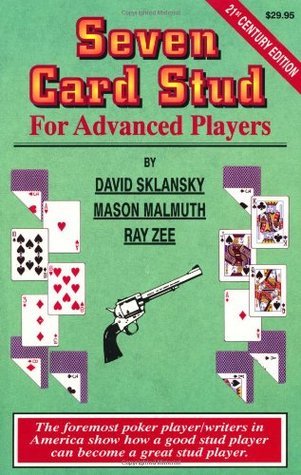
Seven-card stud is an extremely complex game. Deciding on exactly the right strategy in any particular situation can be very difficult. Perhaps this is why very few authors have attempted to analyze this game even though it is widely played. In 1989, the first edition of this text appeared. Many ideas, which were only known to a small, select group of players, were now made available to anyone who was striving to become an expert, and a major gap in the poker literature was closed. It is now a new century, and the authors have again moved the state of the art forward by adding over 100 pages of new material, including an extensive section on "loose games." Anyone who studies this text, is well disciplined, and gets the proper experience should become a significant winner. Some of the other ideas discussed in this 21st century edition include the cards that are out, the number of players in the pot, ante stealing, playing big pairs, playing little and medium pairs, playing three-flushes, playing three-straights, randomizing your play, fourth street, pairing your door card on fourth street, proper play on fifth, sixth, and seventh streets, defending against a possible ante steal, playing against a paired door card, scare card strategy, and buying a free card.
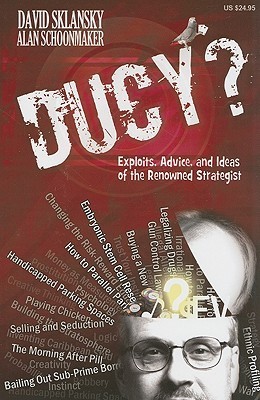
When Jim McManus, author of the New York Times best-seller, Positively Fifth Street, read our manuscript, he wrote, Whenever I read something by David, I never fail to learn new things about the world. The book is fantastically illuminating, well written, works as a kind of autobiography, and Al's input is effective as commentary. You will probably feel the same way by seeing how creatively combining math, logic, psychology, and probability theory can solve problems you might have previously regarded as unsolvable. Your ability to identify and even manipulate other people's thoughts and desires should improve, as well as your ability to understand and resist other experts who attempt to do the same thing. And this book will almost certainly put money in your pocket. The title, DUCY?, was taken from our forums at twoplustwo.com. To encourage people to think better, David would often ask, Do you see why? before fully explaining his conclusions or advice. Forum participants created the acronym and started using it themselves, and it became so popular that the following definition now appears in the Urban Abbreviated form of Do you see why? Commonly used on online forums; originated from the Two Plus Two Poker Community. We believe that the term does a good job of capturing the essence of this book.

Contains six sections discussing probability, poker, blackjack, other casino games, sports betting, and general gambling concepts. This book contains some of the most sophisticated gambling ideas that have ever been put into print. Included is perhaps the best discussion of the basic mathematics of gambling, yet it is written so that even the most non-mathematical of readers can understand it. Many of the ideas discussed are those that the author himself has successfully used during his career. Topics include expectation, combinations, Baye's Theorem, the eight mistakes in poker, checking in the dark, playing tight, The Key Card Concept, casinos and their mistakes, crapless craps, betting sports, hedging and middling, knowing what's important, the Law of Averages and Other Fallacies, and much more.

A combination of Sklansky on Razz and Essays on Poker, with new material added, including a special section on tournament play. The essays section contains chapters discussing such concepts as having a plan, choosing your game, playing according to your bankroll, the three levels of expert poker, middle-round strategy, what your opponent reads you for, the protected pot, saving the last bet, extra outs, how to play a tournament, and many others. The razz section will show you how the experts play this form of poker. Not only are the rules and structure of the game discussed, but advice is also given on how to play the first three cards, as well as all the other streets. In addition, a chapter of razz problems is provided, plus questions and answers to help keep your game sharp.

This volume is a collection of recent articles written by David Sklansky that have appeared in various publications including Card Player and Poker World magazines. A few have never before appeared in print. Most of the articles are about poker or gambling. However, David has recently branched out into other areas that lend themselves to his unique style of analysis and some of these essays are contained in this book. "Poker and gaming" topics include Being a Favorite, Are great Players Born? Talent Versus Discipline, Will Power, The Importance of Position, Never Go Broke, When Time is Not of the Essence, and Is Your Wallet Fat Enough? "Life" topics include What It Is that Makes an Issue Controversial, Coincidences, Some Thoughts on Dying, Legitimate Grievances, and Crime and Punishment. Though these essays vary greatly in content, you will find them very thought provoking. Thus Two Plus Two Publishing proudly brings you these latest examples of David Sklansky’s work.

Geeking, Grifting, and Gambling Through Las Vegas: Fifty Years of Exploits, Ideas, and Tell All Stories, From The Noted Poker Author
by David Sklansky
Rating: 3.5 ⭐
A semi autobiography that combines juicy anecdotes, sometimes about well known, (occasionally nasty) characters, gambling and other advice, and a psychological self profile of a "math nerd" who overcame mild autism by taking on Las Vegas.

The Theory of Poker by David Sklansky has long been recognized as the foundational book for all of poker no matter what the game, and at the time of this writing is still the best selling book in poker. But that book, while applicable to many aspects of no limit and pot limit poker was originally written mainly with limit games in mind. Now, the most popular form of poker is no-limit hold em. As a result, David felt it was time to write a new book that would methodically address each of the chapters in the original Theory of Poker, summarize them, and then go into lengthy detail as to how the ideas and concepts in those chapters need to be altered, when necessary, to best deal with no-limit and pot-limit games. There are also a number of new Bonus Chapters and Bonus Thoughts with new material specifically targeted toward those big bet games. There s an emphasis on no-limit hold em, (especially small to mid stakes), but the ideas almost always apply to pot-limit Omaha, no-limit single draw deuce-to-seven lowball as well as most other one winner big bet games. As with the original book, The Theory of Poker Applied to No-Limit is not a handbook that tells you how to play specific cards in various situations. (Except for example hands that are sometimes used to make ideas as clear as possible.) Rather it tells you what to think about before making your own decision. It shows your how to combine your knowledge of your opponents, your knowledge of poker math (including, where appropriate, the math known as game theory or GTO ), and astute logic to derive the best play (and its occasional alternatives). There are a few difficult sections that probably need to be read a few times. Most of the book, however, will be easily accessible to intermediate players, especially with the help of the Key Points at the end of most chapters. We at Two Plus Two Publishing LLC are proud to bring you this book, and expect it ll be quickly recognized as one of the most significant poker books in many years.

Is there really such a thing as a professional gambler? The answer is an unequivocal, "Yes!" This book's authors are but two examples. Many thousands of people around the country make a good living exclusively from gambling. It is not easy, but it can be done. The key is to understand which games are beatable and know how to beat them. David Sklansky and Mason Malmuth have spent many years writing about the finer points of poker, blackjack, and other beatable games. As you will see in the book, those other "games" are horses, sports, progressive slots and video poker, casino tournaments, and special promotions. They don't include craps, roulette, keno, or baccarat for reasons they'll explain. This book, was written for the not quite as experienced aspiring gambler. It shows you everything you need to learn and do if you want to gamble for a living from both the practical and the technical standpoints. The rest is up to you.

Blackjack is the one casino game where the player can easily get an edge over the house. In spite of this fact, only a handful of people are taking advantage of this edge. Why is that? David Sklansky believes that most people think expert blackjack play is too hard to learn. They browse through a book and are struck by the complex charts and tables. Sklansky realized that these charts were not really needed to show someone how to play an almost perfect game. As a renowned teacher, as well as a professional gambler, Sklansky has devised a technique that literally "talks" you through everything you need to know to truly beat this popular game.

Small Stakes No-Limit Hold 'em: Help Them Give You Their Money: Exploiting Weaknesses in Small Stakes No-Limit Hold 'em Games
by David Sklansky
Rating: 4.1 ⭐
Small stakes no-limit hold ’em games usually feature several players who play quite poorly. To achieve best possible results in these games it becomes necessary to exploit your opponents to the maximum, which is much different from the Game Theory Optimal (GTO) approach that is advocated by most players and poker instructors. This doesn’t mean that a GTO approach won’t win in today’s small stakes games, but it does mean that a highly exploitive player, providing he follows the right strategies, can do even better.Topics include “Making Them Play Bad,” “Smallish Stacks/Buy-Ins Are Often Best,” “Limping First-In,” “Rating Starting Hands,” “When They Don’t Bluff,” “The Power of Aces,” “Overcharging Drawing Hands,” “Pot Sweeteners On The Flop,” “Top Pair, Bad Kicker,” “Bet Sizing When First On the River,” “Betting Strategy When Someone is All-in,” and much more.

Is there really such a thing as a professional gambler?The answer is an unequivocal yes! The authors of this book are but twoexamples. The truth is that there are many thousands of people aroundthe country who make a good living exclusively from gambling. It isnot easy but it can be done. The key ideas are to understand whichgames are beatable and how to beat them.David Sklansky and Mason Malmuth have both spent many years writing about the finer points of poker, blackjack, and other beatable games. (As you will see in the book those other "games" are horses, sports, progressive slots and video poker, casino tournaments, and special promotions. They don?t include craps, roulette, keno, or baccarat for reasons explained herein.)This book, however, was written for the not-quite-as-experienced aspiring gambler. It shows you everything you need to learn and do if you want to gamble for a living both from the practical and the technical standpoint. The rest is up to you.


This volume is a collection of recent articles written by David Sklansky that have appeared in various publications including Card Player, Poker World and the Two Plus Two Poker Strategy Magazine. A few have never before appeared in print. Most of the articles are about poker or gambling. However, David has recently branched out into other areas that lend themselves to his unique style of analysis and some of these essays are contained in this book. From the original book, “Poker and Gaming”.Topics include Being a Favorite, Are Great Players Born? Talent Versus Discipline, The Importance of Position, Never Go Broke, When Time is Not of the Essence, and Is Your Wallet Fat Enough? “Life” topics include What It Is that Makes an Issue Controversial, Coincidences, Some Thoughts on Dying, Legitimate Grievances, and Crime and Punishment.This expanded addition also contains 32 additional essays, many of which address no-limit hold ’em. “Essays for the Expanded Edition” include Pros Versus Wannabes, Bluff Raising as the Big Blind, Evaluating Expected Value, and Expert Non-Optimum Random Strategy. Though these essays vary greatly in content, you will find them very thought provoking. Thus, Two Plus Two Publishing proudly brings you these latest examples of David Sklansky’s work.

Basics to winning at poker by one of the foremost authority on the subject

Poker and More: Unique Ideas and Concepts: Strategy. Game Theory. and Psychology from Two Renowned Gambling Experts
by David Sklansky
Rating: 3.0 ⭐
Topics include poker strategy, Game Theory, technical ideas, tournament strategy, psychology and other topics. Everything has been written for today's modern player.

Probability and Statistics: The Vegas Way : Unique, Easily Understood, Conversational Style for Students, Gamblers and Others Not Mathematically Inclined
by David Sklansky
Rating: 3.7 ⭐
Probability and The Vegas Way dispenses with everything you hate about math class, and brings you probability and statistics for the real world. And it does so in clear, plain-spoken language.The techniques and insights in the book were developed by renowned poker expert David Sklansky, author of The Theory of Poker, and political scientist Justin Conrad, author of Gambling and War. Sklansky used the insights in this book to win three World Series of Poker bracelets and Conrad uses them to analyze war and terrorism. The authors have taught these techniques to students with no background or interest in math. And they will teach them to you.Intentionally avoiding mathematical terms, equations, and symbols as much as possible, the book communicates the basic foundations of probability and statistics in an effective and accessible way. By the time you finish this book, you will be better prepared for the classroom, the poker room, and the boardroom.

Probability and Statistics for 12- Year-Olds (and Maybe You): Plain English Simply Explained, Lessons and Ideas for Students, Gamblers, and Decision Makers
by David Sklansky
Rating: 4.0 ⭐
I wasn’t just trying to be cute when titling this book Probability and Statistics for 12-Year-Olds (and Maybe You). That title was chosen because I know that those students who hate, or are weak at math, have probably learned that the self-help math books that purport to be easy, actually aren’t. But this book is different. It really is written simply enough, with the help of various tricks of my trade, so that even a moderately smart twelve year old (or his parents) can understand it.


Small Stakes No-Limit Hold 'em: Help Them Give You Their Money: Exploiting Weaknesses in Small Stakes No-Limit Hold 'em Games
by David Sklansky
Rating: 3.0 ⭐

Is there really such a thing as a professional gambler? The answer is an unequivocal, "Yes!" This book's authors are but two examples. Many thousands of people around the country make a good living exclusively from gambling. It is not easy, but it can be done. The key is to understand which games are beatable and know how to beat them. David Sklansky and Mason Malmuth have spent many years writing about the finer points of poker, blackjack, and other beatable games. As you will see in the book, those other "games" are horses, sports, progressive slots and video poker, casino tournaments, and special promotions. They don't include craps, roulette, keno, or baccarat for reasons they'll explain. This book, was written for the not quite as experienced aspiring gambler. It shows you everything you need to learn and do if you want to gamble for a living from both the practical and the technical standpoints. The rest is up to you.

Probability and Statistics for 12-Year-Olds (and Maybe You): Plain English Simply Explained, Lessons and Ideas for Students, Gamblers, and Decision Makers
by David Sklansky
Rating: 2.0 ⭐
I wasn’t just trying to be cute when titling this bookProbability and Statistics for 12-Year-Olds (and Maybe You).That title was chosen because I know that those students whohate, or are weak at math, have probably learned that the self-helpmath books that purport to be easy, actually aren’t. But this bookis different. It really is written simply enough, with the help ofvarious tricks of my trade, so that even a moderately smart twelveyear old (or his parents) can understand it.

Teoria del poker
by David Sklansky

Limit Hold 'em Poker for Advanced Players: 2023 Edition
by David Sklansky
This book replaces Hold 'em Poker for Advanced Players.Limit Texas Hold 'em is not an easy game to play well. To become an expert, you need to be able to balance many concepts, some of which occasionally contradict each other.In 1988, the first edition of this text appeared. Many ideas, which were only known to a small select group of players were now made available to anyone who was striving to achieve expert status,and the hold ’em explosion had begun.In 1999, this book went through a major expansion, called the 21st Century Edition, where an additional 100 pages were added which addressed many concepts and ideas which were not in the original edition including extensive sections on “loose” games and “short-handed” games. Topics included play on the first two cards, semi-bluffing, the free card, inducing bluffs, staying with a draw, playing when a pair flops, playing trash hands, desperation bets, playing in wild games, reading hands, psychology, and much more.Now, 23 years later, another edition is released that adds significant material to what was already written as well as some completely new chapters including “Identifying Highly Beatable Games,” “Playing Fast,” “Balancing Your Strategy,” Some Thoughts on Loose-Aggressive Games,” and “Playing in High Rake Games.”And as before, anyone who studies this text, is well disciplined, and gets the proper experience,should become a significant winner at limit hold ’em.

David Sklansky, uno de los mejores jugadores de poker del mundo -gran parte de sus ingresos provienen de su práctica en los casinos de Las Vegas y en diversos campeonatos-, ha escrito esta guía rigurosa y exhaustiva para los millones de aficionados al poker que ya conocen sus fundamentos, pero no entienden del todo la lógic

DUCY?; Exploits, Advice, and Ideas of the Renowned Strategist
by David Sklansky
When Jim McManus, author of the New York Times best-seller, Positively Fifth Street, read our manuscript, he wrote, Whenever I read something by David, I never fail to learn new things about the world. The book is fantastically illuminating, well written, works as a kind of autobiography, and Al's input is effective as commentary.You will probably feel the same way by seeing how creatively combining math, logic, psychology, and probability theory can solve problems you might have previously regarded as unsolvable. Your ability to identify and even manipulate other people's thoughts and desires should improve, as well as your ability to understand and resist other experts who attempt to do the same thing. And this book will almost certainly put money in your pocket.The title, DUCY?, was taken from our forums at twoplustwo.com. To encourage people to think better, David would often ask, Do you see why? before fully explaining his conclusions or advice. Forum participants created the acronym and started using it themselves, and it became so popular that the following definition now appears in the Urban Abbreviated form of Do you see why? Commonly used on online forums; originated from the Two Plus Two Poker Community.We believe that the term does a good job of capturing the essence of this book.