
Daniel T. Willingham
Daniel Willingham earned his B.A. from Duke University in 1983 and his Ph.D. in Cognitive Psychology from Harvard University in 1990. He is currently Professor of Psychology at the University of Virginia, where he has taught since 1992. Until about 2000, his research focused solely on the brain basis of learning and memory. Today, all of his research concerns the application of cognitive psychology to K-12 education. He writes the “Ask the Cognitive Scientist” column for American Educator magazine, and is an Associate Editor of Mind, Brain, and Education. He is also the author of Why Don't Students Like School? (Jossey-Bass) and When Can You Trust the Experts? (Jossey-Bass). His writing on education has been translated into ten languages. from http://www.danielwillingham.com/about...
18 Books Written

Why Don't Students Like School?: A Cognitive Scientist Answers Questions About How the Mind Works and What It Means for the Classroom
by Daniel T. Willingham
Rating: 4.0 ⭐
• 2 recommendations ❤️
Kids are naturally curious, but when it comes to school it seems like their minds are turned off. Why is it that they can remember the smallest details from their favorite television program, yet miss the most obvious questions on their history test?Cognitive scientist Dan Willingham has focused his acclaimed research on the biological and cognitive basis of learning and has a deep understanding of the daily challenges faced by classroom teachers. this book will help teachers improve their practice by explaining how they and their students think and learn—revealing the importance of story, emotion, memory, context, and routine in building knowledge and creating lasting learning experiences.In this breakthrough book, Willingham has distilled his knowledge of cognitive science into a set of nine principles that are easy to understand and have clear applications for the classroom. Some of examples of his surprising findings are:“Learning styles” don't exist The processes by which different children think and learn are more similar than different.Intelligence is malleable Intelligence contributes to school performance and children do differ, but intelligence can be increased through sustained hard work.You cannot develop “thinking skills” in the absence of facts We encourage students to think critically, not just memorize facts. However thinking skills depend on factual knowledge for their operation.Why Don't Students Like School is a basic primer for every teacher who wants to know how their brains and their students’ brains work and how that knowledge can help them hone their teaching skills.

Outsmart Your Brain: Why Learning is Hard and How You Can Make It Easy
by Daniel T. Willingham
Rating: 3.9 ⭐
In this revolutionary, comprehensive, and accessible guide on how the brain learns, discover how to study more efficiently and effectively, shrug away exam stress, and most of all, enjoy learning.When we study, we tend to focus on the tasks we can most easily control—such as highlighting and rereading—but these practices only give the illusion of mastery. As Dan Willingham, professor of psychology and bestselling author, explains, familiarity is not the same as comprehension.Perfect for teachers and students of all ages, Outsmart Your Brain provides real-world practices and the latest research on how to train your brain for better learning. Each chapter provides clear and specific strategies while also explaining why traditional study processes do not work. Grounded in scientifically backed practical advice, this is the ultimate guide to improving grades and better understanding the power of our own brains.

The Reading Mind: A Cognitive Approach to Understanding How the Mind Reads
by Daniel T. Willingham
Rating: 4.2 ⭐
Stop for a moment and wonder: what's happening in your brain right now—as you read this paragraph? How much do you know about the innumerable and amazing connections that your mind is making as you, in a flash, make sense of this request? Why does it matter?The Reading Mind is a brilliant, beautifully crafted, and accessible exploration of arguably life's most important skill: reading. Daniel T. Willingham, the bestselling author of Why Don't Students Like School?, offers a perspective that is rooted in contemporary cognitive research. He deftly describes the incredibly complex and nearly instantaneous series of events that occur from the moment a child sees a single letter to the time they finish reading. The Reading Mind explains the fascinating journey from seeing letters, then words, sentences, and so on, with the author highlighting each step along the way. This resource covers every aspect of reading, starting with two fundamental processes: reading by sight and reading by sound. It also addresses reading comprehension at all levels, from reading for understanding at early levels to inferring deeper meaning from texts and novels in high school. The author also considers the undeniable connection between reading and writing, as well as the important role of motivation as it relates to reading. Finally, as a cutting-edge researcher, Willingham tackles the intersection of our rapidly changing technology and its effects on learning to read and reading.Every teacher, reading specialist, literacy coach, and school administrator will find this book invaluable. Understanding the fascinating science behind the magic of reading is essential for every educator. Indeed, every "reader" will be captivated by the dynamic but invisible workings of their own minds.

How parents and educators can teach kids to love reading in the digital age Everyone agrees that reading is important, but kids today tend to lose interest in reading before adolescence. In Raising Kids Who Read , bestselling author and psychology professor Daniel T. Willingham explains this phenomenon and provides practical solutions for engendering a love of reading that lasts into adulthood. Like Willingham's much-lauded previous work, Why Don't Students Like School? , this new book combines evidence-based analysis with engaging, insightful recommendations for the future. Intellectually rich argumentation is woven seamlessly with entertaining current cultural references, examples, and steps for taking action to encourage reading. The three key elements for reading enthusiasm―decoding, comprehension, and motivation―are explained in depth in Raising Kids Who Read . Teachers and parents alike will appreciate the practical orientation toward supporting these three elements from birth through adolescence. Most books on the topic focus on early childhood, but Willingham understands that kids' needs change as they grow older, and the science-based approach in Raising Kids Who Read applies to kids of all ages. Debunking the myths about reading education, Raising Kids Who Read will empower you to share the joy of reading with kids from preschool through high school.
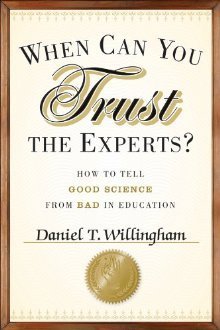
When Can You Trust the Experts?: How to Tell Good Science from Bad in Education
by Daniel T. Willingham
Rating: 3.9 ⭐
Clear, easy principles to spot what's nonsense and what's reliable Each year, teachers, administrators, and parents face a barrage of new education software, games, workbooks, and professional development programs purporting to be "based on the latest research." While some of these products are rooted in solid science, the research behind many others is grossly exaggerated. This new book, written by a top thought leader, helps everyday teachers, administrators, and family members―who don't have years of statistics courses under their belts―separate the wheat from the chaff and determine which new educational approaches are scientifically supported and worth adopting. In this insightful book, thought leader and bestselling author Dan Willingham offers an easy, reliable way to discern which programs are scientifically supported and which are the equivalent of "educational snake oil."
This highly readable book offers comprehensive coverage of classic cognitive psychology and uptotheminute coverage of controversies in the field in an interesting, lively manner that assumes no prior knowledge of cognitive psychology. The Approach of Cognitive Psychology. Visual Perception. Attention. Sensory Memory and Primary Memory. Memory Encoding, Retrieval, and Storage. Visual Imagery. Motor Control. Decision Making and Deductive Reasoning. Problem Solving. Language. For anyone interested in introductory cognitive psychology.

“O melhor livro sobre as táticas dos estudantes bem-sucedidos. Prático e baseado nos dados científicos mais recentes.” – Angela Duckworth, autora de Garra “O presente perfeito para quem se preocupa com suas notas ou – ainda melhor – para quem deseja aprender de verdade.” – Jonathan Haidt Saiba fazer provas e anotações vencer a procrastinação lidar com a ansiedade ler um livro difícil e muito mais! Você sabia que as estratégias de aprendizado mais comuns são as menos eficazes? Baseado nas pesquisas científicas mais recentes, Daniel Willingham criou 94 dicas práticas para aprimorar cada etapa do aprendizado, seja ler, ouvir ou fazer anotações. Um dos maiores especialistas da área, ele mostra também como lidar com a procrastinação, a ansiedade, a falta de concentração e outros desafios comuns à rotina de estudo. Perfeito para professores e qualquer estudante que queira melhorar seu desempenho, este é o guia definitivo para aprender mais rápido, melhorar as notas e, sobretudo, reter o conhecimento por muito mais tempo.

Why Don't Students Like School? (09) by Willingham, Daniel T [Paperback (2010)]

Fii mai destept decat creierul tau. De ce este greu sa inveti si cum poate deveni usor
by Daniel T. Willingham
Rating: 4.0 ⭐
In acest ghid revolutionar, complet si accesibil despre modul in care invata creierul, descoperi cum sa studiezi mai eficient, cum sa scapi de stresul examenelor si, mai mult decat orice, cum sa faci ca totul sa devina o placere. Cand invatam, avem tendinta sa ne concentram pe activitatile pe care le putem controla cel mai usor (precum evidentierea si recitirea), insa aceste practici doar ne dau iluzia invatarii. Dupa cum explica autorul, familiaritatea nu e acelasi lucru cu intelegerea. Perfect pentru profesori si elevi sau studenti de toate varstele, Fii mai destept decat creierul tau ofera exemple practice din lumea reala si vorbeste despre cele mai recente cercetari despre cum sa-ti antrenezi creierul ca sa inveti mai bine. Fiecare capitol contine strategii clare si specifice, explicand de ce nu functioneaza procesele de studiu traditionale. Pornind de la sfaturi practice fondate pe stiinta, acesta este ghidul absolut pentru a-ti imbunatati notele si a intelege puterea propriului creier. Pe scurt, este cea mai buna carte pe care am citit-o despre modul in care oricine poate invata tacticile celor mai buni studenti. Practica, dar sustinuta de cele mai recente cercetari stiintifice, Fii mai destept decat creierul tau este o rampa spre ciclul virtuos al interesului, al increderii si al realizarii. - Angela Duckworth, autoarea bestsellerului Grit

Seja Mais Esperto do Que o Seu Cérebro: A Chave Para Tornar a Aprendizagem Mais Fácil
by Daniel T. Willingham
Rating: 3.5 ⭐
Um guia revolucionário e acessível sobre como o cérebro aprendeEstudar é, para muitos, insistir em tarefas que se podem controlar, como sublinhar apontamentos e reler. No entanto, como nos revela o professor de Psicologia Daniel T. Willingham, esse método apenas dá a ilusão de domínio, e insistir nessa ilusão leva, muitas vezes, a consequências como o insucesso escolar ou a dificuldades acrescidas para captar a atenção de uma plateia de alunos.Perfeito tanto para professores como para alunos de todas as idades, Seja Mais Esperto do Que o Seu Cérebro traz-lhe as práticas do mundo real e revela-lhe as pesquisas mais recentes sobre como treinar o seu cérebro para aprender melhor, ao mesmo tempo que explica por que razão os processos de estudo tradicionais não funcionam.Este é o prático e definitivo guia para os professores, ajudando também os alunos a estudar de forma mais eficiente e eficaz, aliviando assim o stress da avaliação e, acima de tudo, desfrutando do maravilhoso processo de aprendizagem.Os elogios da crí"Numa frase, este é o melhor livro que já li sobre como qualquer pessoa pode aprender as técnicas dos estudantes mais bem-sucedidos. É uma rampa de lançamento para o círculo virtuoso do interesse, da confiança e da realização."Angela Duckworth, autora de O Poder da Paixão e da Perseverança"Se deixados por conta própria, os seres humanos habitualmente estudam mal. Felizmente, Daniel T. Willingham identificou todas as maneiras pelas quais podemos enganar o nosso cérebro e levá-lo a aprender (antes que ele nos engane primeiro). Um manual de utilizador para o cérebro do estudante."Amanda Ripley, autora de The Smartest Kids in the World, bestseller do jornal The New York Times"Dinâmico e interessante, este é um livro maravilhoso para os estudantes, com uma riqueza de conselhos práticos sobre diversos tópicos, distribuídos por capítulos do tipo "como fazer". Eu recomendaria também o livro para os professores e para todos os que estudam ao longo da vida - qualquer um interessado em aprender."Henry L. Roediger III, coautor de Make It The Science of Successful Learning"Daniel T. Willingham exerce uma função coloca o poder de aprender de volta onde deveria estar - nas mãos dos alunos; e, ao mesmo tempo, mostra aos professores como aproveitar os sistemas e as técnicas mais eficazes de modo a impulsionarem a aprendizagem. Uma ferramenta essencial para cada ano letivo, tão importante como uma calculadora, um punhado de lápis afiados e uma pilha de cadernos."Jessica Lahey, autora de The Gift of Failure

Leer beter leren. Minder stress, betere cijfers en meer plezier in studeren - dát is de belofte van dit boek. In Wees slimmer dan je brein laat psycholoog en bestsellerauteur Daniel Willingham zien hoe ons brein echt leert. Niet met markeren, samenvatten of eindeloos herlezen (die geven vooral een vals gevoel van beheersing), maar met bewezen effectieve strategieën die wél werken.Of je nu student bent, mentor, docent of dit boek staat vol concrete tips die direct toepasbaar zijn. Willingham legt helder uit waarom veelgebruikte studiemethoden niet helpen, en hoe je met kleine aanpassingen je leerresultaten flink kunt verbeteren.Gebaseerd op de nieuwste wetenschappelijke inzichten is Wees slimmer dan je brein dé praktische gids voor iedereen die wil begrijpen hoe leren werkt - en hoe je jouw brein daarbij te slim af kunt zijn.
![Cognition by Willingham, Daniel T.. (Pearson,2006) [Hardcover] 3rd EDITION](https://m.media-amazon.com/images/S/compressed.photo.goodreads.com/books/1697944154i/133019051.jpg)
Cognition by Willingham, Daniel T.. (Pearson,2006) [Hardcover] 3rd EDITION
by Daniel T. Willingham
Rating: 2.0 ⭐


Per què als nens no els agrada anar a l'escola?: Les respostes d'un neurocientífic al funcionament de la ment i les seves conseqüències a l'aula (Micro-macro Referències)
by Daniel T. Willingham
Com funciona el cervell d'un alumne? La ciència ha progressat enormement en els darrers trenta anys. Aquest llibre recull tot el que els científics han descobert al voltant del funcionament de la memòria i el cervell que pot i ha d'ajudar els mestres a arribar a conclusions pràctiques i directament aplicables a classe.

Jak przechytrzyć mózg. Czternaście praktycznych sposobów na skuteczną naukę
by Daniel T. Willingham
Jak skuteczniej i szybciej przyswajać wiedzę, pozbyć się stresu związanego z egzaminami, a przede wszystkim zacząć czerpać przyjemność z nauki Profesor psychologii Daniel T. Willingham w swojej przełomowej książce wyjaśnia, jak działa i z jakimi trudnościami musi się zmagać mózg w trakcie nauki. Pokazuje, dlaczego tradycyjne strategie uczenia się, takie jak wielokrotne powtarzanie czy zakreślanie ważnych informacji w notatkach, często dają tylko iluzję opanowania materiału. A przede wszystkim proponuje praktyczne strategie, które pomogą w pełni wykorzystać potencjał twojego umysłu. Dzięki nim dowiesz się między ·jak zrozumieć wykład ·jak sporządzać i porządkować notatki ·jak czytać trudne książki ·jak pokonać prokrastynację ·jak uczyć się do egzaminów. Ten przystępnie napisany poradnik przyda się zarówno uczniom, jak i nauczycielom. Sprawi, że przyswojona wiedza zostanie z tobą na dłużej, pomoże poprawić wyniki w nauce i wreszcie lepiej zrozumieć moc twojego mózgu. Tytuł Outsmart Your Brain Tł Filip Filipowski

Perché agli studenti NON PIACE LA SCUOLA?
by Daniel T. Willingham

Crianças que lêem: o que pais e professores podem fazer para ajudar
by Daniel T. Willingham
O objetivo deste livro é simples. Os pais querem que os filhos leiam. A maioria dos filhos não quer ler. O que os pais podem fazer a respeito?Crianças que lêem mostra como ajudar, a partir de dois princípios muito será divertido, e nós começaremos agora, não importa quanto tempo tenha sido perdido.No primeiro capítulo, você aprenderá um pouco sobre a ciência da leitura. — Como as crianças aprendem a decodificar? Que mecanismo elas utilizam para entender o que lêem?E por que algumas crianças se sentem motivadas a ler e outras não? — O restante do livro é dividido em três do nascimento até a pré-escola, do jardim-de-infância até a segunda série e da terceira série em diante.Em cada uma delas, capítulos separados abordam as melhores formas de trabalhar a decodificação, a compreensão e a motivação para a leitura em cada idade, mostrando não só o que os pais podem fazer em casa, mas também o que esperar que aconteça em sala de aula.• Traduçã Bruno Alexander• Título Raising Kids Who What Parents and Teachers Can Do

Waarom leren niet vanzelf gaat
by Daniel T. Willingham