
Daniel Quinn
I had and did the usual things -- childhood, schools, universities (St. Louis, Vienna, Loyola of Chicago), then embarked on a career in publishing in Chicago. Within a few years I was the head of the Biography & Fine Arts Department of the American Peoples Encyclopedia; when that was subsumed by a larger outfit and moved to New York, I stayed behind and moved into educational publishing, beginning at Science Research Associates (a division of IBM) and ending as Editorial Director of The Society for Vision Education (a division of the Singer Corporation). In 1977 I walked away from SVE and this very successful career when it became clear that I was not going to able to do there what I really wanted to do...which was not entirely clear. A few months later I set my feet on a path that would change my life completely. It was a path made up of books -- or rather versions of a book that, after twelve years, would turn out to be ISHMAEL. The first version, written in 1977-78, called MAN AND ALIEN, didn't turn out to be quite what I wanted, so wrote a second, called THE GENESIS TRANSCRIPT. Like the first version, this didn't satisfy me, so I wrote a third with the same title. THE BOOK OF NAHASH, abandoned unfinished, was the fourth version. When I started writing version five, THE BOOK OF THE DAMNED in 1981, I was sure I'd found the book I was born to write. The versions that came before had been like rainy days with moments of sunshine. THIS was a thunderstorm, and the lines crossed my pages like flashes of lightning. When, after a few thousand words I came to a clear climax, I said, "This MUST be seen," so I put Part One into print. Parts Two and Three followed, and I began searching for the switch that would turn on Part Four... but it just wasn't there. What I'd done was terrific -- and complete in its own way -- but at last I faced the fact that the whole thing just couldn't be done in lightning strikes. And so, on to versions six and seven (both called ANOTHER STORY TO BE IN). I knew I was close, and version eight was it -- the first and only version to be a novel and the first and only version inhabited by a telepathic gorilla named Ishmael. ISHMAEL was a life-changing book. It began by winning the Turner Tomorrow Award, the largest prize ever given to a single literary work. It would come to be read in some 25 languages and used in classrooms from mid-school to graduate school in courses as varied as history philosophy, geography, archaeology, religion, biology, zoology, ecology, anthropology, political science, economics, and sociology. But in 1992, when ISHMAEL was published, I had no idea what I might do next. My readers decided this for me. In letters that arrived by the bushel they demanded to know where this strange book came from, what "made" me write it. To answer these questions I wrote PROVIDENCE: THE STORY OF A FIFTY-YEAR VISION QUEST (1995). But there were even more urgently important questions to be answered, particularly this one: "With ISHMAEL you've undermined the religious beliefs of a lifetime. What am I supposed to replace them with?" I replied to this with THE STORY OF B (1996). The questions (and books) kept coming: Why did Ishmael have to die? This gave rise to MY ISHMAEL: A SEQUEL (1997), in which it's revealed that Ishmael was not only far from being dead but far from being finished with his work as a teacher. The question "Where do we go from here?" was the inspiration for BEYOND CIVILIZATION: HUMANITY'S NEXT GREAT ADVENTURE (1999), a very different kind of book. With these questions answered (and 500 more on my website), I felt I was fundamentally finished with what might be called my teachings and ready to move on. I had always taken as my guiding principle these words from André Gide: "What another would have done as well as you, do not do it. What another would have said as well as you, do not say it, written as well as you, do not write it.
29 Books Written

Librarian's note: An alternate cover edition can be found hereTEACHER SEEKS PUPIL.Must have an earnest desire tosave the world. Apply in person.It was just a three-line ad in the personals section, but it launched the adventure of a lifetime... So begins Ishmael, an utterly unique and captivating novel that has earned a large and passionate following among readers and critics alike—one of the most beloved and bestselling novels of spiritual adventure ever published.

An Adventure of the Mind and SpiritFather Jared Osborne has received an extraordinary assignment from his superiors: Investigate an itinerant preacher stirring up deep trouble in central Europe. His followers all him B, but his enemies say he’s something else: the Antichrist. However, the man Osborne tracks across a landscape of bars, cabarets, and seedy meeting halls is no blasphemous monster—though an earlier era would undoubtedly have rushed him to the burning stake. For B claims to be enunciating a gospel written not on any stone or parchment but in our very genes, opening up a spiritual direction for humanity that would have been unimaginable to any of the prophets or saviors of traditional religion. Pressed by his superiors for a judgment, Osborne is driven to penetrate B’s inner circle, where he soon finds himself an anguished collaborator in the dismantling of his own religious foundations. More than a masterful novel of adventure and suspense, The Story of B is a rich source of compelling ideas from an author who challenges us to rethink our most cherished beliefs.

An extraordinary and startlingly original sequel to Ishmael “Enthralling, shocking, hope-filled, and utterly fearless, Daniel Quinn leads us deeper and deeper into the human heart, history, and spirit. In My Ishmael , Quinn strikes out into entirely new territory, posing questions that will rock you on your heels, and providing tantalizing possibilities for a truly new world vision.”—Susan Chernak McElroy, author of Animals as Teachers & HealersWhen Ishmael places an advertisement for pupils with “an earnest desire to save the world,” he does not expect a child to answer him. But twelve-year-old Julie Gerchak is undaunted by Ishmael’s reluctance to teach someone so young, and convinces him to take her on as his next student. Ishmael knows he can't apply the same strategies with Julie that he used with his first pupil, Alan Lomax—nor can he hope for the same outcome. But young Julie proves that she is ready to forge her own spiritual path and arrive at her own destination. And when the time comes to choose a pupil to carry out his greatest mission yet, Ishmael makes a daring decision—a choice that just might change the world. Explore Daniel Quinn’s spiritual Ishmael trilogy: ISHMAEL • MY ISHMAEL • THE STORY OF B

In Beyond Civilization , Daniel Quinn thinks the unthinkable. We all know there's no one right way to build a bicycle, no one right way to design an automobile, no one right way to make a pair of shoes, but we're convinced that there must be only one right way to live -- and the one we have is it, no matter what.Beyond Civilization makes practical sense of the vision of Daniel Quinn's best-selling novel Ishmael . Examining ancient civilizations such as the Maya and the Olmec, as well as modern-day microcosms of alternative living like circus societies, Quinn guides us on a quest for a new model for society, one that is forward-thinking and encourages diversity instead of suppressing it. Beyond Civilization is not about a "New World Order" but a "New Personal World Order" that would allow people to assert control over their own destiny and grant them the freedom to create their own way of life right now -- not in some distant utopian future.

“A rare moral thriller in the tradition of Fahrenheit 451 ,” this stunning work from the author of Ishmael is set in a white-washed alternate world where Nazis won the war ( Village Voice ) Daniel Quinn, well known for Ishmael —a life-changing book for readers the world over—once again turns the tables and creates an otherworld that is very like our own, yet fascinating beyond words. Imagine that Nazi Germany was the first to develop an atomic bomb and the Allies surrendered. America was never bombed, occupied, or even invaded, but was nonetheless forced to recognize Nazi world dominance. The Nazis continued to press their campaign to rid the planet of “mongrel races” until eventually the world—from Capetown to Tokyo—was populated by only white faces. Two thousand years in the future, people don’t remember, or much care, about this distant past. The reality is that to be human is to be Caucasian, and what came before was literally ancient history having nothing to do with those then living. Now imagine that reincarnation is real, that souls migrate over time from one living creature to another, and that a soul that once animated an American black woman living at the time of World War II now animates an Aryan in Quinn’s new world—and that due to a traumatic accident, memories of this earlier incarnation assert themselves. Compared by readers and critics alike to 1984 and Brave New World, After Dachau is a new dystopian classic with much to say about our own time, and the dynamics of human history.

They knew us before we began to walk upright. Shamans called them guardians, mythmakers called them tricksters, pagans called them gods, churchmen called them demons, folklorists called them shape-shifters. They’ve obligingly taken any role we’ve assigned them, and, while needing nothing from us, have accepted whatever we thought was their due – love, hate, fear, worship, condemnation, neglect, oblivion. Even in modern times, when their existence is doubted or denied, they continue to extend invitations to those who would travel a different road, a road not found on any of our cultural maps. But now, perceiving us as a threat to life itself, they issue their invitations with a dark purpose of their own. In this dazzling metaphysical thriller, four who put themselves in the hands of these all-but-forgotten Others venture across a sinister American landscape hidden from normal view, finding their way to interlocking destinies of death, terror, transcendental rapture, and shattering enlightenment.

PROVIDENCE" is Quinn's fascinating memoir of hislife-long spiritual voyage. His journey takes him from a childhood dream inOmaha setting him on a search for fulfillment, to his time as a postulant inthe Trappist order under the guidance of eminent theologian Thomas Merton.Later, his quest took him through the deep self-discovery of psychoanalysis, through a failed marriage during the turbulent and exciting 60s, to findingfulfillment with his wife Rennie and a career as a writer. In PROVIDENCE Quinn also details his rejection of organized religion and his personalrediscovery of what he says is humankind's first and only universalreligion, the theology that forms the basis for "Ishmael."Cover Artist: Tom Hallman

Ever since the publication of Ishmael in 1992, readers have yearned for a glimpse into a dimension of spiritual revelation the author only hinted at in that and later books. Now at long last they have it in seven profound but delightfully simple tales that illuminate the world in which humans became humans. This is a world seen through animist as friendly to human life as it was to the life of gazelles, lions, lizards, mosquitos, jellyfish, and seals — not a world in which humans lived like trespassers who must conquer and subdue an alien territory. It's a world in which humans have a place in the community of life — not as rulers but as equals — with the paths of all held together in the hand of god.This is not an ancient world or a lost world. It exists as surely today as it ever did — for those who have eyes to see it. Tales of Adam, delightfully illustrated by Michael McCurdy, is a book that will come to be shelved alongside The Prophet , Jonathan Livingston Seagull, and The Alchemist .

In Ishmael , Daniel Quinn offered new ways of seeing and understanding human history, and our collective future. His message was transformative for millions of people, and Ishmael continues to attract tens of thousands of new readers each year. Subsequent works, such as The Story of B and My Ishmael , expanded upon his insights and teachings, but only now does he finally tackle the one question he has been asked hundreds of times but has never taken "How do you do what you do?" In If They Give You Lined Paper, Write Sideways Quinn elucidates for readers the methods behind his own thought processes, challenging and ultimately empowering them to view the world for themselves in creative, perhaps even revolutionary ways. If They Give You Lines Paper, Write Sideways also includes Quinn's never-before-published essays "The New Renaissance" and "Our Religions." There is a scientific consensus that global warming is approaching a tipping point beyond no return faster than had previously been predicted. Quinn has long portrayed humans as "a species of beings, which, while supposedly rational, are destroying the very planet they live on." So what are we to do? There has never been a plan for the future - and there never will be. But something extraordinary will happen in the next two or three decades; the people of our culture will learn to live sustainably - or not. Either way, it will be extraordinary. The sooner we understand this reality, the greater the chances that human society will transform itself so that the human race might have a future.

Daniel Quinn strikes again with this full-color, illustrated novel. What’s going to happen when the universe comes to the end of its string? Like a cosmic yo-yo, it’s going to start traveling back UP the string, to its beginning—and every life that has ever been lived will be lived in reverse. The strangest adventure to be found in this backward-running universe is that of Adam Taylor, whose epic quest through time cannot end until he finds his way into the womb that gave birth to us all.

Newcomer's Guide to the Afterlife: On the Other Side Known Commonly As "The Little Book"
by Daniel Quinn
Rating: 3.3 ⭐
The guide of choice for anyone who plans to die someday--are YOU ready for the AFTERLIFE?To find out, take this simple 1. Like Earth, the Afterlife has celebrities, outcasts, deadheads, losers, and busybodies. TrueFalse2. Is there an Afterlife after the Afterlife?YesNo3. When you first arrive on "the Other Side," you will be a) a set of wingsb) a toasterc) a copy of A Newcomer's Guide to the AfterlifeDon't worry if you're not sure how to respond. A Newcomer's Guide to the Afterlife has answers to these questions and more--and if you're lucky, some of them may turn out to be right!An irreverent, one-of-a-kind compendium from the award-winning author of Ishmael, A Newcomer's Guide to the Afterlife can be read as a parable, an allegory, a work of fiction--or exactly what it claims to a helpful handbook for the recently deceased. It is filled with uncommon wisdom, bizarre imaginings, uncanny perceptions, and unexpected humor. Is it fantastic escapism or a seminal event in human history? Read it and find out....Face it. The Afterlife is the ultimate test. You might as well study.

Things are looking great for Greg Donner, a Chicago freelance writer. He's got a terrific project, and he's met the woman of his dreams -- literally, his dreams (though they're rather odd ones). But then, one night, he falls asleep and awakes . . . to the beginning of a nightmare he just can't seem to wake up from. . . .

The book for which I'm best known, Ishmael, came into being over a twelve-year period, beginning in 1979. It wasn't work on a single book. Rather, it was work on different versions of what eventually became a single Ishmael, the eighth version and the only one in which the teacher Ishmael appears.When I started writing The Book of the Damned in 1981, I was sure I'd found the book I was born to write. The versions that came before had been like rainy days with moments of sunshine. THIS was a thunderstorm, and the lines crossed my pages like flashes of lightning. When, after a few thousand words I came to a clear climax, I said, "This MUST be seen," so I put Part One into print.Parts Two and Three followed, and I began searching for the switch that would turn on Part Four . . . but it just wasn't there. I clung to it for a long time after issuing the first three parts, desperately hoping to find a way to produce additional parts that would bring it to the conclusion I knew was "out there.” What I'd done was terrific—and complete in its own way—but at last I faced the fact that the whole thing just couldn't be done in lightning strikes . . . Another ten years passed before I found the way, a completely different way . . . in Ishmael, which was the embodiment of my message, providing the foundation for the clarifications, amplifications, and extensions still to come. But publishing The Book of the Damned had been no mistake. It deserved to be published, and it still does. Those lightning strikes illuminate an apocalyptic landscape never seen before—or after, in any of my later books (including Ishmael).
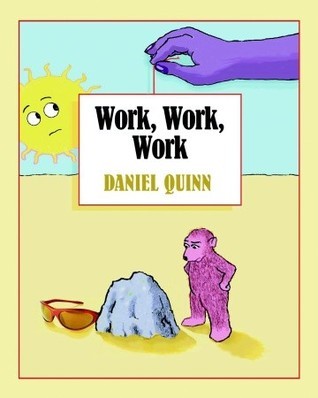
Work, Work, Work is the story of an industrious gopher whose lifework is to burrow from dawn to dusk under an enchanted land that he never sees. While he grumbles about his unceasing labors, the morning sky is spray-painted from a dirigible (and the sun gets a drop of blue in its eye), two UFOs from different planets meet for a strange exchange, an enormous octopus-like creature (who has just come from laying waste to Las Vegas) is subdued by a barrage of hats, hotdogs, and toasters, and, at the close of day, a window opens at the horizon so that a purple giant can hang the moon in the sky. Surfacing in the twilight, the gopher sighs, “Well, at least something happened. I ran into a rock!”Parents will find that Work, Work, Work , with its colorful and detailed illustrations, is something different from the usual. It’s a book that brings readers and read-to together in a highly interactive entertainment, with the child investigating and elucidating all the strange goings-on that occur above the gopher’s underground travels.
My novel Ishmael was a slow starter. In its early years it had only a few thousand readers. But those thousands told tens of thousands, the tens of thousands told hundreds of thousands, and the hundreds of thousands told millions.Ishmael was just the first course, however. The rest of the meal was still to come -- in Providence, The Story of B, My Ishmael, and Beyond Civilization. But, though I didn't stop with Ishmael, most of my readers did. Very few of them went on to sample any of the later courses. That's why I decided to put this book together. It's a collection of appetizers, generous samples of all the books that followed Ishmael -- and of the books that came BEFORE Ishmael. Reading here, you'll see that in earlier writings -- Tales of Adam and The Book of the Damned -- I accomplished some things that I never managed to surpass in any of the later books (including Ishmael).

Thirteen essays and speeches delivered (among others) at the University of Georgia Center for Humanities and Arts (Distinguished Lecturer Series); Sixth Annual Rice University Environmental Conference; the 2000 Houston Youth Environmental Leadership Conference (Keynote address); The 1997 Conference of the North American Association for Environmental Education; Earth Day 1998, Kent State University; Student Pugwash Technologies of Peace Conference, Carnegie Mellon University, 1997; The 2000 Fleming Lecture in Religion, Southwestern University, Georgetown, Texas.

At Woomeroo is a land . . . where mirrors wink in the sunlight as people signal one another from the hilltops . . . where a squirming pink infant, babbling with excitement, arrives by mail . . . where a man turns his kite over to his small son, who is borne off by it over the hill . . . where a rooster says,"Oh good. Wonderful fine beautiful good. Really. Because now I'm going to kill you" . . . where between Tiffany's and Ferragamo stands Tetwilder's, a boutique dealing in designer children . . . where a king struggles to evade an inescapable curse . . . where, with the addition of a girl's packing crate, the boy's refrigerator carton becomes a commodious two-room hovel . . . where a digger finds all sorts of things in the ground, including an attractive young woman . . . where a top court confirms: No Civil Rights for Stomachs . . . where it gets to be time for visits, and the children from the workhouse come, weeping in their rags and sooty shoes, and everyone begins to feel much better . . . where a girl standing in the boundless sea shakes her head and asks with perfect innocence: "What is land?" . . . where as a captive in Japan, a U.S. State Department courier hones his skills playing table tennis with the unacknowledged son of the Emperor Hirohito.

A two person panel discuss the issues surrounding our ability to produce enough to feed a growing world population. While interacting with the audience, Quinn and Thornhill describe their theories of the relationship between population and the ability of cultures to support that population.

Daniel Quinn Boxed Set: Ishmael: An Adventure of the Mind and Spirit, My Ishmael, the Story of B
by Daniel Quinn
Rating: 4.6 ⭐

A loving father, dedicated husband and industrious worker, Andy Matson leads an bucolic and fulfilling life that has been built from nothing more than resilience and hard work.But following the death of an old friend he begins to see just how cruel a mistress life can be as everything he has worked for slowly begins to deteriorate.Andy must fight against the very demons of mental health that killed his friend in order to persevere and claim back the life that was once his.'What is Happiness?' is the novel adaption of the Hip Hop album of the same name by Wee D and Steg G, Coming in the summer of 2017.

Sleepwalking thru a marriage is a story of how a wonderful marriage can go from wonderful to terrible. Not from abuse but from one partner losing passion for intimacy and abandoning the other. This story also has a bit of fiction in it to put the reader on a roller-coaster of "What If." I took a story of a marriage that went stagnant and added fiction to make it almost fantasy like to describe how the abandoned person felt when the passion and togetherness left the relationship. It is an endearing tale of love and love lost.
Jimmy is a strange boy likes tasting different things, and eats different parts of a public transport bus, until interrupted by the bus driver.
Experiencing Mass With Heart and Mind
by Daniel Quinn
Feelings and emotions are a vibrant part of our lives. They normally have a lot to do with how we live each day. Yet at Mass we often "turn off" our emotions and simply follow the routine.Knowing this, Daniel Quinn shows us how we can rise above seeing the Mass as a cold ritual of words and symbols. He helps us learn how each part of the Mass can guide us toward developing a more open and loving heart--and how, in turn, our heartfelt participation at Mass can enrich our spiritual life and our relationship with Jesus.


The fantasy room
by Daniel Quinn
This book is a journey through your mind about what if. A guy and his friends take a ride in a fantasy room created by one of them where you can live out whatever fantasy that you desire.

Reckless Challenge
by Daniel Quinn
Reckless ChallengeIt is a bold approach to the way of saving the world in relation to the dissolution of civilization. The reckless and enormous civilization experiments that humankind made against all things, including oneself, eventually broke down. The authors talk about the transition to a new way of thinking by making a commitment to an old way of thinking that believes that this crisis can be solved through social programs. The authors first set the title of the book as "The Manuel of Change" because of the authors intention to tell a new way to save the world. Ishmael, "a book about how to change things after recognizing what is wrong, is a book that tells a lot of people who are being swept away by the storm of globalization, This book, which presents the human New World order, will not be a utopia at all, but it will be the driving force of the change that creates the everyday lifestyle right now.
Welcome to the bigfoot fan club
by Daniel Quinn

Applied Research for Corn Production in Indiana, 2023
by Daniel Quinn