
Daniel Gross
30 Books Written

A Banker's Journey: How Edmond J Safra Built a Global Financial Empire
by Daniel Gross
Rating: 4.5 ⭐
• 1 recommendation ❤️
Who was Edmond J. Safra? “The greatest banker of his generation,” in the estimation of a former World Bank President. The founder of four massive financial institutions on three continents, and a proud child of Beirut’s Jewish quarter. An innovative avatar of financial globalization, and a faithful heir to a tradition of old-world banking. The leading champion and protector of the Sephardic diaspora. In A Banker’s Journey, financial journalist and historian Daniel Gross, who, like Safra, traces his heritage to Aleppo, Syria, reconstructs the public life of an intensely private man. With exclusive access to Safra’s personal archives, Gross tracks the banker’s remarkable journey from Beirut to Milan, São Paulo, Geneva, and New York—to the pinnacle of global finance.Edmond Safra was fifteen in 1947, when his father sent him to establish a presence in Milan, Italy. Fluent in six languages, and with an eye for value, managing risk, and personal potential, Safra was in perpetual motion until his tragic death in 1999. The modern, global financial empire he built was based on timeless principles: a banker must protect his depositors and avoid excessive leverage and risk. In an age of busts and bailouts, Safra posted remarkable returns while rarely suffering a credit loss.From a young age, Safra assumed the mantle of leadership in the Syrian-Lebanese Jewish community, providing personal aid, supporting the communities that formed in exile, and championing Sephardic religious and educational efforts in Israel and around the world. Edmond J. Safra’s life of achievement in the twentieth century offers enduring lessons for those seeking to make their way in the twenty-first century. He inspired generations to make the world a better place.

What do Bill Gates, Henry Ford, J. P. Morgan, Mary Kay Ash, and Walt Disney all have in common? Uncompromising vision, a willingness to take risks, and exceptional business acumen. Not only did these individuals amass great fortunes, they revolutionized the business world and helped shape society as we know it. Theirs are just a few of the stories collected in this anthology of commercial ingenuity.Drawing on a wealth of sources, this priceless collection brings to life extraordinary achievements, many of them forgotten or little known: how Robert Morris, the preeminent merchant of the eighteenth century, financed the American Revolution with his personal credit; how Ray Kroc used a shrewd real estate strategy to turn a faltering hamburger franchise operation into the McDonald's fast food empire; and how Mary Kay Ash built a billion-dollar direct sales cosmetics company by preaching a message of economic empowerment to women.Enlightening and fascinating, Forbes(r) Greatest Business Stories of All Time celebrates larger-than-life ambition, inspired leadership, wheeling and dealing, and hard work.Forbes is a registered trademark of Forbes Inc. Its use is pursuant to a license agreement with Forbes Inc.

Who was Edmond J. Safra? “The greatest banker of his generation,” in the estimation of a former World Bank President. The founder of four massive financial institutions on three continents, and a proud child of Beirut’s Jewish quarter. An innovative avatar of financial globalization, and a faithful heir to a tradition of old-world banking. The leading champion and protector of the Sephardic diaspora. In A Banker’s Journey, financial journalist and historian Daniel Gross, who, like Safra, traces his heritage to Aleppo, Syria, reconstructs the public life of an intensely private man. With exclusive access to Safra’s personal archives, Gross tracks the banker’s remarkable journey from Beirut to Milan, São Paulo, Geneva, and New York—to the pinnacle of global finance.Edmond Safra was fifteen in 1947, when his father sent him to establish a presence in Milan, Italy. Fluent in six languages, and with an eye for value, managing risk, and personal potential, Safra was in perpetual motion until his tragic death in 1999. The modern, global financial empire he built was based on timeless a banker must protect his depositors and avoid excessive leverage and risk. In an age of busts and bailouts, Safra posted remarkable returns while rarely suffering a credit loss.From a young age, Safra assumed the mantle of leadership in the Syrian-Lebanese Jewish community, providing personal aid, supporting the communities that formed in exile, and championing Sephardic religious and educational efforts in Israel and around the world. Edmond J. Safra’s life of achievement in the twentieth century offers enduring lessons for those seeking to make their way in the twenty-first century. He inspired generations to make the world a better place.

The financial crisis that has gripped this country since last September has had so many twists and turns, it would make for a great drama -- if it all were not so real and damaging. Companies are shutting down and laying off workers, 401ks are melting away, and the government is spending $700 billion dollars to bail out banks and financial institutions -- and that's only the beginning. The financial services industry, and the many industries that depend on it -- from housing to cars -- is in intensive care.So what happened? How did we get to this point of financial disaster? Is the economy just a huge, Madoff-esque Ponzi scheme? It is a complicated and confusing story -- but Daniel Gross of Newsweek has a special gift for making complicated matters easy to understand and even entertaining. In Dumb Money , he offers a guide to the debacle and to what the future may hold. This is not so much a book about who did what, though that's part of the story. Rather, it pieces together the building blocks of the debt-fueled economy, and distills the theory and personalities behind our late, lamented easy money culture. Dumb Money is a book that finally lays it all out in an engaging way, and might just help people invest their money smartly until the gloom passes.

A jornada de um banqueiro: Como Edmond J. Safra construiu um império financeiro global
by Daniel Gross
Rating: 4.2 ⭐
Quem foi Edmond J. Safra? Nesta biografia sobre o criador de um império financeiro mundial, Daniel Gross conta a história de um dos mais influentes e bem-sucedidos banqueiros do século XX. Edmond J. Safra foi "o maior banqueiro de sua geração", na avaliação de James Wolfensohn, ex-presidente do Banco Mundial. Nascido no bairro judeu de Beirute, descendente de uma das mais antigas comunidades judaicas do mundo, foi naturalizado cidadão do Brasil e, mais tarde, de Mônaco. Na construção de seu império financeiro, Edmond fundou quatro grandes instituições financeiras em três continentes, incluindo o Trade Development Bank (Genebra), o Republic National Bank (Nova York), o Safra Republic Holdings (Luxemburgo) e o que se tornou o Banco Safra (São Paulo), entre outras empresas e instituições. Em A jornada de um banqueiro, acompanhamos a vida e a carreira de Safra desde os seus 15 anos de idade até sua ascensão ao topo das finanças globais, além de desvendarmos as circunstâncias de sua precipitada morte.Figura central na globalização financeira, Edmond soube aliar as tradições do velho mundo bancário às necessidades da nova ordem econômica, entre elas a adaptação, o deslocamento e a constante reinvenção. No início dos anos 1950, os conflitos entre árabes e judeus causaram uma nova onda migratória, e foi no Brasil que a família Safra encontrou refúgio, cidadania e um lugar para criar raízes e desenvolver os negócios. Mais tarde, Edmond se casaria pela primeira e única vez, aos 43 anos, com a brasileira de ascendência anglo-judaica Lily Watkins. Em Mônaco, um incêndio criminoso acabou por encerrar, cedo demais, a jornada do criador do império bancário Safra.Em A jornada de um banqueiro, o historiador e jornalista financeiro Daniel Gross elabora uma fascinante combinação de biografia e história empresarial, ao reconstruir a vida pública e pessoal de um homem que assumiu não só o protagonismo na expansão dos negócios da família, mas também o papel de liderança na sua comunidade. Filantropo sem reservas e com profundo respeito à tradição, Edmond deixou um legado de lições empresariais e humanitárias.
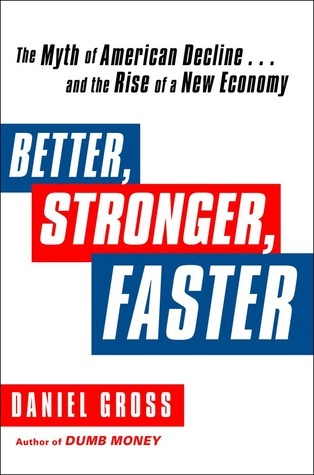
Better, Stronger, Faster: The Myth of American Decline . . . and the Rise of a New Economy
by Daniel Gross
Rating: 4.0 ⭐
Financial meltdown, a deep recession, and political polarization—combined with strong growth outside the United States—have led to a global bubble of pessimism surrounding America’s economic prospects. Bloated with debt, and outpaced by China and other emerging markets, the United States has been left for dead as an economic force. But in this time of grim predictions, Daniel Gross, Yahoo! financial columnist and author of Dumb Money, offers a refreshingly optimistic take on our nation’s economic prospects, examining the positive trends that point to a better, stronger future.Widely respected for his Newsweek and Slate coverage of the crash and the recovery, Daniel Gross shows that much of the talk about decline is misplaced. In the wake of the crash, rather than accept the inevitability of a Japan-style lost decade, America’s businesses and institutions tapped into the very strengths that built the nation’s economy into a global powerhouse in the first speed, ingenuity, adaptability, pragmatism, entrepreneurship, and, most significant, an ability to engage with the world. As the United States wallowed in self-pity, the world continued to see promise in what America has to offer—buying exports, investing in the United States, and adopting American companies and business models as their own. Global growth, it turns out, is not a zero-sum game.Better, Stronger, Faster is an account of the remarkable reconstruction and reorientation that started in March 2009, a period that Gross compares to March 1933—as both marked the start of unexpected recoveries. As the U.S. public sector undertook aggressive fiscal and monetary actions, the private sector sprang into action. Companies large and small restructured, tapped into long-dormant internal resources, and invested for growth, at home and abroad. Between 2009 and 2011, as Europe struggled with a cascade of crises, the U.S. got back on its feet—and began to run.Through stories of innovative solutions devised by policy makers, businesses, investors, and consumers, Gross explains how America has the potential to emerge from this period, not as the unrivaled ruler of the global economy but as a healthier leader and an enabler of sustainable growth.

Bubbles—from hot stocks in the 1920s to hot stocks in the 1990s—are much-lamented features of contemporary economic life. Time and again, American investors, seduced by the lures of quick money, new technologies, and excessive optimism, have shown a tendency to get carried away. Time and again, they have appeared foolish when the bubble burst. The history of finance is filled with tragic tales of shattered dreams, bankruptcies, and bitter recriminations.But what if the I-told-you-so lectures about bubbles tell only half the story? What if bubbles accomplish something that can only be seen in retrospect? What if the frenzy of irrational economic enthusiasm lays the groundwork for sober-minded opportunities, growth, and innovation? Could it be that bubbles wind up being a competitive advantage for the bubble-prone U.S. economy?In this entertaining and fast-paced book—you'll laugh as much as you cry—Daniel Gross convincingly argues that every bubble has a golden lining. From the 19th-century mania for the telegraph to the current craze in alternative energy, from railroads to real estate, Gross takes us on a whirlwind tour of reckless investors and pie-in-the-sky promoters, detailing the mania they created—but also the lasting good they left behind.In one of the great ironies of history, Gross shows how the bubbles once generally seen as disastrous have actually helped build the commercial infrastructures that have jump-started American growth. If there is a secret to the perennial resilience and exuberance of the American economy, Gross may just have found it in our peculiar capacity to blow financial bubbles—and successfully clean up the mess.

Legendary legal scholar Staughton Lynd teams up with influential labor organizer Daniel Gross in this exposition on solidarity unionism, the do-it-yourself workplace organizing system that is rapidly gaining prominence around the country and around the world. Lynd and Gross make the audacious argument that workers themselves on the shop floor, not outside union officials, are the real hope for labor's future. Utilizing the principles of solidarity unionism, any group of co-workers, like the workers at Starbucks, can start building an organization to win an independent voice at work without waiting for a traditional trade union to come and “organize” them. Indeed, in a leaked recording of a conference call, the nation's most prominent union-busting lobbyist coined a term, “the Starbucks problem,” as a warning to business executives about the risk of working people organizing themselves and taking direct action to improve issues at work. Combining history and theory with the groundbreaking practice of the model by Starbucks workers, Lynd and Gross make a compelling case for solidarity unionism as an effective, resilient, and deeply democratic approach to winning a voice on the job and in society.

Labor Law for the Rank & Filer: Building Solidarity While Staying Clear of the Law 2nd , Seco edition by Gross, Daniel, Lynd, Staughton (2011) Paperback
by Daniel Gross
Rating: 4.2 ⭐

Forbes - La Innovación como estrategia, cuando renovar y cambiar conducen al éxito.
by Daniel Gross
Rating: 4.5 ⭐
En el mundo de los negocios hay compañías que cambiaron la historia. Bajo la conducción de sus líderes no sólo revolucionaron el mercado en el que competían sino a la sociedad toda. Henry Ford, al mando de la automotriz que lleva su nombre; David Ogilvy, reconocido como el creador de la publicidad moderna, Ray Kroc, que tuvo la visión para construir y consolidar McDonald's; Sam Walton, fundador de Wal Mart y las tiendas de descuentos; y Jerome Kohlberg, Henry Kravis y George Roberts y la compra apalancada de empresas son los protagonistas de este libro. Conocer sus casos es imprescindible para llegar a la cima.

Bull Run Wall Street, The Democrats And The New Politics Of Personal Finance
by Daniel Gross
Rating: 4.0 ⭐
During the historic bull market of the last decade, a series of powerful tremor rocked the financial global economic crises; the Internet explosion and day trading craze; the 401k boom. Perhaps the most seismic shift of all was the "democratization" of the stock market, as middle class investors joined the party and the Democrats followed suit, effectively ending a century-old tradition in which Republicans, never Democrats, were the party most solidly aligned with Wall Street. These developments have defined the last decade and will help set the political agenda for the next. We are entering an era when the personal finance is the political. In Bull Run, journalist Daniel Gross outlines these important changes and explores their implications for our country, our pocketbooks, and our two major parties. His fresh take on Wall Street, his provocative opinions on the new relationship between politics and finance, and a wealth of enlightening stories and examples make this book is a must for Wall Streeters, business leaders, and anyone who wants to understand what's happening in the market-and what might happen next.

En la historia de los negocios hay nombres que perduran a través de los años, incluso muchos han llegado a convertirse en marcas así mismos. John D. Rockefeller, que pasó de liderar una pequeña refinería a adquirir y conducir un conglomerado de empresas; Walt Disney, que hace 50 años creó la primera corporación de empresas de entretenimientos; Mary Kay, que inventó una nueva cultura corporativa liderando a miles de mujeres; Bill Gates, el hombre que lleva adelante a Microsoft; y J.P. Morgan, que lideró al país en una de sus peores crisis financieras protagonizan este libro.


Barcelona. 23 cm. 286 p. il. Encuadernación en tapa blanda de editorial ilustrada. Traducción Forbes. Empresarios. Estados Unidos .. Este libro es de segunda mano y tiene o puede tener marcas y señales de su anterior propietario. 8480882662

Flatlanders from Kansas explore some of the best views to be found in the desert. Images taken while being led through the canyon help tell the story.A short story detailing the wonder and beauty that can be found in slot canyons. This story is specifically about a father and son's journey through Lower Antelope Canyon on the Navajo Reservation. It is located just outside Page, AZ.For an optimal experience read this story on a device with a color display. Turn the device to landscape mode when you come across a landscape image to view the image full-screen.
Discovering Anthropology introduces the subfields of anthropology (biological anthropology, archaeology, cultural anthropology, and linguistics) and examines both the theoretical and applied aspects of anthropology. The text focuses on how knowledge is acquired and how anthropologists use knowledge to effect change.

Historias de Forbes: 15 relatos de empresarios que cambiaron la manera como vivimos y hacemos negocios
by Daniel Gross
Rating: 4.0 ⭐

Quince historias fascinantes, en las que se descubren los personajes ocultos detras de las marcas mas reconocidas en la historia y las estrategias que utilizaron en sus inicios para llegar a la situacion que ostentan hoy.

Zustandsschätzung für eine aktive Verteilnetzführung unter Berücksichtigung einer defizitären Messinfrastruktur
by Daniel Gross
Diese Arbeit entwickelt ein praktikables und übertragbares Konzept einer Verteilnetz- Zustandsschätzung für den Einsatz in Mittel- und Niederspannungsnetzen. Die Erweiterung ausgewählter Zustandsschätzalgorithmen erfolgt dabei mit dem Fokus der Anwendung unter realen Rahmenbedingungen, als auch in Bezug auf eine spannungsebenenübergreifende Berechnung des Systemzustandes. Das entwickelte Verfahren zur Generierung anpassbarer Pseudomesswerte eignet sich sowohl für die Nachbildung einzelner als auch aggregierter Verbraucher und Erzeuger. Der Konzeptnachweis der vorgestellten Methode in Bezug auf die Bewertung der Schätzgüte, findet in zwei realen Mittelspannungsnetzen statt.

Google Analytics für Anfänger: Besucherverhalten analysieren, verstehen und optimieren. Eine Einführung in Google Analytics.
by Daniel Gross
Wie man mit Google Analytics seine Webseiten unter Beobachtung halten kann und somit Verbesserungen vornehmen kann. Holen Sie sich das Wissen über Google Analytica nach Hause – mit dem Ebook „Google Analystics für Anfänger“. Lernen Sie somit wie Sie auf Ihrer Website selbst kontrollieren können, wie sich die Besucher verhalten. In diesem Ebook hat Daniel Groß einen genauen Überblick über das Anwenden von Google Analystics aufgestellt. In diesem informativen Ebook erfahren Sie welche Begriffe es hier zu verstehen gibt und wie Sie Google Analytics praktisch anwenden können. Erfahren Sie Hintergrundinformationen was alles möglich ist, um seine Website vor dem Abstieg zu retten. Hier erklärt Daniel Groß wonach man die Ergebnisse auswerten lassen kann, wenn man Google Analytics verwendet. Eine sehr gute Erklärung wie genau man dies auf seiner Website einbringt ist hier vorhanden. Sie können damit die Daten unter folgenden Punkten auswerten Wenn Sie sich dieses Ebook durchgelesen haben, werden Sie verstehen, dass es sinnvoll ist Google Analytics anzuwenden.

At the southwest corner of Central Park lies one of Manhattan’s most trafficked intersections, and one of its greatest Columbus Circle, the only roundabout in a city of right angles. Since its construction in the 1850’s, the circle has become one of the borough’s most iconic landmarks, immediately recognizable since 1982 by the grand, pillared monument to Christopher Columbus that dominates its center. But just as iconic is the building that mirrors a two-towered amalgam of glass, steel, and concrete, unveiled in 2003 as Time Warner Center.

The Anteater Reader - Tenth Edition
by Daniel Gross

ニューズウィーク日本版ペーパーバックス 馬鹿(ダム)マネー
by Daniel Gross


Forbes. Die größten Erfolgsstories aller Zeiten.
by Daniel Gross

Die Hesse koche
by Daniel Gross

A Direct Electrical-Analog Method for Two-Dimensional Transient Heat Flow Analysis of Fire-Exposed Structures
by Daniel Gross
Excerpt from A Direct Electrical-Analog Method for Two-Dimensional Transient Heat Flow Analysis of Fire-Exposed StructuresThe results of the Bureau's research are published either in the Bureau's own series of publications or in the journals of professional and scientific societies. The Bureau itself publishes three periodicals avail able from the Government Printing The Journal of Research, published in four separate sections, presents complete scientific and technical papers; the Technical News Bulletin presents summary and pre liminary reports on work in progress; and Basic Radio Propagation Predictions provides data for determining the best frequencies to use for radio communications throughout the world. There are also five series of non periodical Monographs, Applied Mathematics Series, Handbooks, Miscellaneous Publications, and Technical Notes.About the PublisherForgotten Books publishes hundreds of thousands of rare and classic books. Find more at www.forgottenbooks.comThis book is a reproduction of an important historical work. Forgotten Books uses state-of-the-art technology to digitally reconstruct the work, preserving the original format whilst repairing imperfections present in the aged copy. In rare cases, an imperfection in the original, such as a blemish or missing page, may be replicated in our edition. We do, however, repair the vast majority of imperfections successfully; any imperfections that remain are intentionally left to preserve the state of such historical works.
Challenging the Myth of America's Decline
by Daniel Gross