
D.H. Lawrence
David Herbert Richards Lawrence was an English writer of the 20th century, whose prolific and diverse output included novels, short stories, poems, plays, essays, travel books, paintings, translations, literary criticism, and personal letters. His collected works represent an extended reflection upon the dehumanizing effects of modernity and industrialisation. In them, Lawrence confronts issues relating to emotional health and vitality, spontaneity, human sexuality and instinct. Lawrence's opinions earned him many enemies and he endured official persecution, censorship, and misrepresentation of his creative work throughout the second half of his life, much of which he spent in a voluntary exile he called his "savage pilgrimage." At the time of his death, his public reputation was that of a pornographer who had wasted his considerable talents. E. M. Forster, in an obituary notice, challenged this widely held view, describing him as "the greatest imaginative novelist of our generation." Later, the influential Cambridge critic F. R. Leavis championed both his artistic integrity and his moral seriousness, placing much of Lawrence's fiction within the canonical "great tradition" of the English novel. He is now generally valued as a visionary thinker and a significant representative of modernism in English literature. http://en.wikipedia.org/wiki/D.H._Law...
30 Books Written

2018 Reprint of 1928 Edition. Lyric and sensual, D.H. Lawrence's last novel is one of the major works of fiction of the twentieth century. Filled with scenes of intimate beauty, explores the emotions of a lonely woman trapped in a sterile marriage and her growing love for the robust gamekeeper of her husband's estate. The most controversial of Lawrence's books, Lady Chatterly's Lover joyously affirms the author's vision of individual regeneration through sexual love. The book's power, complexity, and psychological intricacy make this a completely original work—a triumph of passion, an erotic celebration of life.

The White Peacock is set in Nethermere (fictional name for real-life Eastwood) and is narrated by Cyril Beardsall, whose sister Laetitia is involved in a love triangle with two young men, George and Leslie Temple. She decides to marry Leslie, even though she feels sexually drawn to George. Spurned by Lettie, George marries the conventional Meg. Both his and Lettie's marriages end in unhappiness, as George slides into alcoholism. The novel involves themes such as the damage associated with mismatched marriages, and the border country between town and country
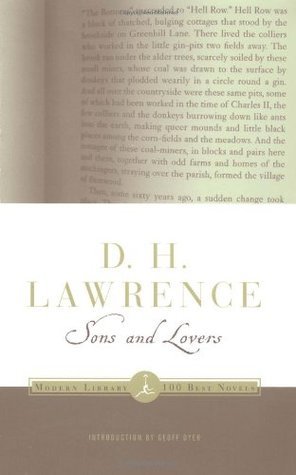
"She was a brazen hussy.""She wasn't. And she was pretty, wasn't she?""I didn't look ... And tell your girls, my son, that when they're running after you, they're not to come and ask your mother for you - tell them that - brazen baggages you meet at dancing classes"The marriage of Gertrude and Walter Morel has become a battleground. Repelled by her uneducated and sometimes violent husband, delicate Gertrude devotes her life to her children, especially to her sons, William and Paul - determined they will not follow their father into working down the coal mines. But conflict is evitable when Paul seeks to escape his mother's suffocating grasp through relationships with women his own age. Set in Lawrence's native Nottinghamshire, Sons and Lovers is a highly autobiographical and compelling portrayal of childhood, adolescence and the clash of generations.

Widely regarded as D. H. Lawrence's greatest novel, Women in Love is both a lucid account of English society before the First World War, and a brilliant evocation of the inexorable power of human desire. Women in Love continues where The Rainbow left off, with the third generation of Brangwens: Ursula Brangwen, now a teacher at Beldover, a mining town in the Midlands, and her sister Gudrun, who has returned from art school in London. The focus of the novel is primarily on their relationships, Ursula's with Rupert Birkin, a school inspector, and Gudrun's with industrialist Gerald Crich, and later with a sculptor, Loerke. Quintessentially modernist, Women in Love is one of Lawrence's most extraordinary, innovative and unsettling works.

D. H. Lawrence's controversial classic, The Rainbow, follows the lives and loves of three generations of the Brangwen family between 1840 and 1905. Their tempestuous relationships are played out against a backdrop of change as they witness the arrival of industrialization - the only constant being their unending attempts to grasp a higher form of existence symbolized by the persistent, unifying motif of the "rainbow". Lawrence's fourth novel, a prequel to Women in Love, is an invigorating, absorbing tale about the undying determination of the human soul.

An exemplar of Modernist fiction, "The Rocking-Horse Winner" tells the story of a young boy named Paul who learns to predict horse-race winners by frantically riding a rocking-horse until he enters a trance.

An electrifying short novel published posthumously set in a small village in the English countryside and tells the story of a sheltered rector's daughter whose life is changed when she is introduced to a world of unfettered passion. The Virgin and the Gipsy was discovered in France after D. H. Lawrence's death in 1930. Immediately recognized as a masterpiece in which Lawrence had distilled and purified his ideas about sexuality and morality, The Virgin and the Gipsy has become a classic and is one of Lawrence's most electrifying short novels.Set in a small village in the English countryside, this is the story of a secluded, sensitive rector's daughter who yearns for meaning beyond the life to which she seems doomed. When she meets a handsome young gipsy whose life appears different from hers in every way, she is immediately smitten and yet still paralyzed by her own fear and social convention. Not until a natural catastrophe suddenly, miraculously sweeps away the world as she knew it does a new world of passion open for her. Lawrence's spirit is infused by all his tenderness, passion, and knowledge of the human soul.

Sharply observed and expertly crafted, D.H. Lawrence’s The Fox is a captivating work exploring the dual themes of power and supremacy in the aftermath of the First World War. Banford and March live and work together on their meager farm, surviving hardship only by sheer determination and dedicated labor. The farm is their world, a place of safety—that is, until a young soldier walks in and upsets the women’s delicate status quo. None could have predicted the effect his presence would have on their lives.

With an Introduction and Notes by David Ellis, University of Kent at Canterbury.Lawrence's reputation as a novelist has often meant that his achievements in poetry have failed to receive the recognition they deserve. This edition brings together, in a form he himself sanctioned, his Collected Poems of 1928, the unexpurgated version of Pansies, and Nettles, adding to these volumes the contents of the two notebooks in which he was still writing poetry when he died in 1930.It therefore allows the reader to trace the development of Lawrence as a poet and appreciate the remarkable originality and distinctiveness of his achievement. Not all the poems reprinted here are masterpieces but there is more than enough quality to confirm Lawrence's status as one of the greatest English writers of the twentieth century.

'Was this what it all meant - utter, intact separateness, obscured by heat of living?' D. H. Lawrence's short stories portray complex, flawed interior lives, showing individuals facing momentous emotional events. In these two stories of fragile happiness and failed dreams, a tragedy forces a woman to acknowledge that she has never known her husband, and a man blinded in the First World War discovers an unexpected peace. This book includes "Odour of Chrysanthemums" and "The Blind Man".

From one of the greatest—and most controversial—writers of the 20th century comes a mesmerizing work of political imagination about a European woman's self-annihilating plunge into the intrigues, passions, and pagan rituals of Mexico.

With an Introduction and Notes by Jeff Wallace, University of Glamorgan.These stories of myth and resurrection, of uncanny events and violent impulse, were with one exception written and published in the latter half of the 1920s, coinciding with the composition of Lawrence's controversial masterpiece Lady Chatterley's Lover.At this time Lawrence declared himself to be 'really awful sick of writing'; yet here we find some of his most beautiful, hauntingly melancholy fictions. In struggling to escape from their thwarted lives and to achieve human 'tenderness', the characters embody and continue the major preoccupations of Lawrence's work as a whole.Love Among the Haystacks provides an early illustration of the intensity and innovation which made Lawrence one of the most distinctive and important of twentieth-century writers.

This selection of short stories has been made not only to offer a representative and wide-ranging selection of D. H. Lawrence's shorter fiction, but also to trace a pattern of development in the author's career. As Brian Finney writes in the Introduction: "To follow the development of his stories from the gauche anecdotes of his early twenties to the sophisticated parodies of the genre that he wrote in the last years of his life is like retracing the history of the genre from its pre-Chekhovian social realism and watching it read forward to the verbal play and self-conscious artificiality of postmodernist writers such as Borges and Beckett."The selection comprises fourteen short stories, including "Love Among the Haystacks," "The Prussian Officer," "Odour of Chrysanthemums," "The Border Line, and "The Woman Who Rode Away."

Brings together 175 poems that reveal Lawrence's virtuosity in this genre

In his last novel, published less than a year before his untimely death at the age of forty-five, D.H. Lawrence takes up the theme of Christ's resurrection and his final days on Earth. Lawrence recounts Christ's agonizing journey from death back to life with an alarmingly proffane realism, depicting the tale from teh moment of his initial painful awakening to his eventual redemptive sexual relationship with the priestess of the pagan goddess Isis.The story expands beyond its Christian roots to explore and embrace Lawrence's abiding faith in the life-force apparent in every aspect of the natural world. For his final work, Lawrence has encapsulated a lifetime of extraordinary vision into one profound and exquisite parable.

A classic Lawrence novel of sensual awakening and the yearning for freedom, and winner of the 1920 James Tait Black Memorial Prize.The daughter of well-to-do trades people in the fictional mining town of Woodhouse, Alvina Houghton struggles to find excitement in her provincial surroundings and worries that she is condemned to become an old maid. After plans to elope with her lover to Australia and train as a nurse in London lead to nothing, she joins a traveling theater group and succumbs to the charms of the dark, passionate Italian Ciccio.This edition also contains pictures, personal notes, and other critical primary source material.

These two brilliant novels are deservedly among Lawrence's most popular works. Both are at the same time exciting narratives and striking expressions of Lawrence's philosophy. St. Mawr is the story of a splendid stallion in whose vitality the heroine finds the quality that is lacking in the men she knows. It is also the first of Lawrence's writing to be partially set in America, on a ranch in Arizona. The Man Who Died, originally published in Paris as "The Escaped Cock" and later retitled and revised, has as its main character Christ, who does not die on the cross but escapes to wander through the country seeking the meaning of human existence, which he finally discovers in a temple of Isis by the waters of Lebanon.

A collection of three novellas that display D. H. Lawrence's brilliant and insightful evocation of human relationships - both tender and cruel - and the devastating results of war In The Fox , two young women living on a small farm during the First World War find their solitary life interrupted. As a fox preys on their poultry, a human predator has the women in his sights. The Captain's Doll explores the complex relationship between a German countess and a married Scottish soldier in occupied Germany, while in The Ladybird a wounded prisoner of war has a disturbing influence on the Englishwoman who visits him in hospital.For more than seventy years, Penguin has been the leading publisher of classic literature in the English-speaking world. With more than 1,700 titles, Penguin Classics represents a global bookshelf of the best works throughout history and across genres and disciplines. Readers trust the series to provide authoritative texts enhanced by introductions and notes by distinguished scholars and contemporary authors, as well as up-to-date translations by award-winning translators.

Lawrence asserted that 'the proper function of a critic is to save the tale from the artist who created it'. In these highly individual, penetrating essays he has exposed 'the American whole soul' within some of that continent's major works of literature. In seeking to establish the status of writings by such authors as Poe, Melville, Fenimore Cooper and Whitman, Lawrence himself has created a classic work. Studies in Classic American Literature is valuable not only for the light it sheds on eighteenth- and nineteenth-century American consciousness, telling 'the truth of the day', but also as a prime example of Lawrence's learning, passion and integrity of judgement.

Written after the First World War when he was living in Sicily, Sea and Sardinia records Lawrence's journey to Sardinia and back in January 1921. It reveals his response to a new landscape and people and his ability to transmute the spirit of place into literary art. Like his other travel writings the book is also a shrewd inquiry into the political and social values of an era which saw the rise of communism and fascism. On one level an indictment of contemporary materialism, Sea and Sardinia is nevertheless an optimistic book, celebrating the creativity of the human spirit and seeking in the fundamental laws which governed human nature in the past fresh inspiration for the present. This 1997 edition restores censored passages and corrects corrupt textual readings to reveal for the first time the book Lawrence himself called 'a marvel of veracity'.

Written in the years following World War I and set in postwar England and Italy, Aaron's Rod questions many of the accepted social and political institutions of Lawrence's generation, and raises issues as valid for our own time as they were for his. The novel's hero is an Everyman who flees the destruction in England and his failing marriage and who, like Lawrence himself, becomes absorbed in discovering and understanding the nature of the political and religious ideologies that shaped western civilization. Aaron's Rod was completed in 1921 and was censored by both Lawrence's American and English publishers. The Cambridge Edition, based on the only authoritative, surviving typescript, restores these cut passages and eliminates the errors and house-styling of previous editions.The volume contains an introduction that describes the novel's genesis, its transmission, publication history, and reception. Extensive explanatory notes and textual apparatus are also included.

D.H. Lawrence's 'The Horse Dealer's Daughter' could be described as a story in which boy meets girl. Its plot, on the surface, resembles that of any number of traditionally romantic pastorals: a country boy saves a country girl from drowning, sees something in her that he never saw before, and, at the end of the story, proposes marriage. But, as we soon see, there is nothing typical about Lawrence's story, because the psychological workings of its characters, particularly that of the rescuer, defy all our expectations of how such a story should work. Lawrence cuts through the romanticism inherent in such a plot line to reflect the dark and conflicting feelings of the so-called lovers.

This book was converted from its physical edition to the digital format by a community of volunteers. You may find it for free on the web. Purchase of the Kindle edition includes wireless delivery.

Kangaroo is D. H. Lawrence's eighth novel, set in Australia. He wrote the first draft in just forty-five days while living south of Sydney, in 1922, and revised it three months later in New Mexico. The descriptions of the country are vivid and sympathetic and the book fuses lightly disguised autobiography with an exploration of political ideas at an immensely personal level. Based on a collation of the manuscript, typescripts and first editions, this text of Kangaroo is closest to what Lawrence would have expected to see in print. There is a full textual apparatus of variants, a comprehensive introduction giving the background and history of composition and publication and a summary of contemporary reviewers' opinions. Explanatory notes elucidate the many geographical, political and literary allusions in the text; there are three maps and an appendix detailing Australian locations.

This a collection of some of Lawrence's short stories, which were first published around the time of his death in 1930. They include "Love Among the Haystacks", "A Prelude", "A Lesson on a Tortoise", "Lessford's Rabbits", "A Modern Lover", and "The Fly in the Ointment".

"even islands like to keep each other company"The Man Who Loved Islands is a haunting story of a man who tries to control his life by making his world ever smaller by moving to increasingly smaller islands. Each one proves to be beyond his ability to control either other people or his sexual desire and finally the last island conquers him. The story can even be seen as a metaphor of man's inexorable march to death when we are all finally alone.The story is said to have been inspired by the life of Compton Mackenzie.

His first published collection, these twelve stories were written between 1907 and 1914, during a crucial period of development for Lawrence from which he emerged a leading figure of the modernist movement. Reaching new levels of feeling and experience, these stories range from the tale of a Prussian officer who drives his orderly towards a bloody reckoning, to the strangely exotic elements of "A Fragment of Stained Glass", and the divisions within society and conflicts of the heart that form the central themes of "Daughters of a Vicar". Interweaving individual lives, their happiness, failures and defeats, with the profound forces of nature, Lawrence has created stories of remarkable power and sensitivity. This Penguin edition reproduces the newly established Cambridge text, which is based on Lawrence's manuscripts, typescripts and corrected proofs.

This is a pre-1923 historical reproduction that was curated for quality. Quality assurance was conducted on each of these books in an attempt to remove books with imperfections introduced by the digitization process. Though we have made best efforts - the books may have occasional errors that do not impede the reading experience. We believe this work is culturally important and have elected to bring the book back into print as part of our continuing commitment to the preservation of printed works worldwide.

Includes Blind Man; England, My England; Fanny and Annie; Horse Dealer's Daughter; Monkey Nuts; Primrose Path; Samson and Delilah; Tickets, Please; Wintry Peacock; You Touched Me England, My England is a collection of stories by published by D.H. Lawrence in 1922. Most of the stories were written against the backdrop of the World War I. Taking war and its destruction as its main concern, the collection contains stories like, The Blind Man, The Horse-Dealer's Daughter, which is the story of young doctor who rescues a girl from drowning, and England, My England, in which Egbert, an effete aristocrat who, in his effort to reassert his masculinity, is killed in the war.

The 13 stories collected here, written between 1924 and 1928, draw on D.H. Lawrence's experiences in New Mexico, Mexico, Italy, Germany, and England, and feature thinly disguised, often malicious, portraits of friends and acquaintances. The title story recounts the flight of a woman from her home to seek a more spiritual existence. These stories demonstrate the extraordinary range of Lawrence's style.