
Craig Shirley
Craigan Paul Shirley is an American political consultant and author of several books on Ronald Reagan.
15 Books Written

December 1941: 31 Days that Changed America and Saved the World
by Craig Shirley
Rating: 4.6 ⭐
• 1 recommendation ❤️
In the days before the attack on Pearl Harbor, America was largely focused on the war in Europe, but when planes dropped out of a clear blue sky and bombed the American naval base and aerial targets in Hawaii, everything changed in an instant. December 1941 takes you into the moment-by-moment ordeal of a nation waking to war. In December 1941 , bestselling author Craig Shirley celebrates the American spirit while reconstructing the events that called it to shine with rare and piercing light. Shirley puts readers on the ground and the thick of the action. Relying on daily news reports from around the country and recently declassified government papers, Shirley sheds light on the crucial diplomatic exchanges leading up to the attack, the policies on the internment of Japanese people living in the U.S. after the assault, and the near-total overhaul of the U.S. economy to prepare for war. Shirley paints a compelling portrait of pre-war American culture--from the fashion and the celebrities to common pastimes. His portrait of America at war is just as vivid, Featuring colorful personalities including Franklin Roosevelt, Winston Churchill, U.S. Secretary of State Cordell Hull, and General Douglas MacArthur, December 1941 highlights a period of profound change in American government, foreign and domestic policy, law, economics, and business, chronicling the developments day by day through that singular and momentous month. December 1941 features surprising revelations, amusing anecdotes, and heart-wrenching stories, and also explores the unique religious and spiritual dimension of a culture under assault on the eve of Christmas. Before the attack on Pearl Harbor, the closest thing to war for the Americans was uncoordinated, mediocre war games in South Carolina. Less than thirty days later, by the end of December 1941, the nation was involved in a battle for the preservation of its very way of life--a battle that would forever change the nation and the world.

The Mother of the Father of our Country. Mary Ball Washington was an unlikely candidate to be the mother of history’s most famous revolutionary. In fact, George Washington’s first fight for independence was from his controlling, singular mother. Stubborn, aristocratic Mary Ball Washington was entrenched in the Old World ways of her ancestors, dismissing the American experiment even as her son led the successful rebellion against the crown. During his youth, ambitious George dove into the hard-scrabble work of a surveyor and rose through the ranks of the fledgling colonial army, even as his overprotective mother tried to discourage these efforts.Mary’s influence on George was twofold. Though she raised her eldest son to become one of the world’s greatest leaders, Mary also tried many times to hold him back. While she passed down her strength and individuality to George, she also sought to protect him from the risks he needed to take to become a daring general and president. But it was this resistance itself which fanned the spark of George’s independence into a flame. The constant tug of war between the two throughout the early years helped define George’s character.In Mary Ball Washington, New York Times bestselling author Craig Shirley uncovers startling details about the inner workings of the Washington family. He vividly brings to life a resilient widow who singlehandedly raised six children and ran a large farm at a time when most women’s duties were relegated to household matters. Throughout, Shirley compares and contrasts mother and son, illuminating the qualities they shared and the differences that divided them. A significant contribution to American history, Mary Ball Washington is the definitive take on the relationship between George and Mary Washington, offering fresh insight into this extraordinary figure who would shape our nation—and the woman who shaped him.

Rendezvous with Destiny: Ronald Reagan and the Campaign That Changed America
by Craig Shirley
Rating: 4.3 ⭐
As late as Election Day, headlines across the country blared that the race was “too close to call.” Even on the verge of his historic triumph in the 1980 presidential election, political observers continued to underestimate Ronald Wilson Reagan. In Rendezvous with Destiny , the long-awaited follow-up to his widely praised account of Reagan’s insurgent 1976 presidential campaign, Craig Shirley tells the incredible behind-the-scenes story of Reagan’s improbable run to the White House in 1980—of how the “too close to call” election became a landslide victory over incumbent Jimmy Carter and independent candidate John Anderson. And this, Shirley shows, was no ordinary election. It dramatically altered the course of American—and world—history. Reagan’s victory gave rise to a new generation of conservatism, ended liberalism’s half-century reign of dominance, reversed the second-worst economic crisis in American history, and led to the demise of the mighty Soviet Union. To write Rendezvous with Destiny , Shirley gained unprecedented access to 1980 campaign files and interviewed more than 150 insiders—from Reagan’s closest advisers and family members to Jimmy Carter himself. The result is the first comprehensive history of the hard-fought 1980 campaign, a gripping account that follows Reagan’s unlikely path from his bitter defeat on the floor of the 1976 Republican convention, through his underreported “wilderness years,” through grueling primary fights in which he knocked out several Republican heavyweights, through an often-nasty general election campaign complicated by the presence of a third-party candidate (not to mention the looming shadow of Ted Kennedy), to Reagan’s astounding victory on Election Night in 1980. Shirley’s years of intensive research have enabled him to relate countless untold stories—including, at long last, the solution to one of the most enduring mysteries in politics: just how Reagan’s campaign got hold of Carter’s debate briefing books. Rendezvous with Destiny reveals how Reagan successfully battled the headwinds of the national media, the Republican Party establishment, and even his own campaign team to become one of America’s greatest chief executives.

Reagan's Revolution: The Untold Story of the Campaign That Started It All
by Craig Shirley
Rating: 4.2 ⭐
Today's political scene looks nothing like it did thirty years ago, and that is due mostly to Reagan's monumental reshaping of the Republican party. What few people realize, however, is that Reagan's revolution did not begin when he took office in 1980, but in his failed presidential challenge to Gerald Ford in 1975-1976. This is the remarkable story of that historic campaign-one that, as Reagan put it, turned a party of "pale pastels" into a national party of "bold colors." Featuring interviews with a myriad of politicos, journalists, insiders, and observers, Craig Shirley relays intriguing, never-before-told anecdotes about Reagan, his staff, the campaign, the media, and the national parties and shows how Reagan, instead of following the lead of the ever-weakening Republican party, brought the party to him and almost single-handedly revived it.

Acclaimed historian and New York Times bestselling author Craig Shirley delivers a compelling account of 1945, particularly the watershed events in the month of April, that details how America emerged from World War II as a leading superpower. In the long-awaited follow-up to the widely praised December 1941 ,Craig Shirley's April 1945 paints a vivid portrait of America--her people, faith, economy, government, and culture. The year of 1945 bought a series of watershed events that transformed the country into an arsenal of democracy, one that no longer armed the world by necessity but henceforth protected the world by need. At the start of 1945, America and the rest of the world were grieving millions of lives lost in the global conflict. As President Roosevelt was sworn into his fourth term, optimism over an end to the bloody war had grown--then, in April, several events collided that changed the face of the world the sudden death of President Roosevelt followed by Harry S. Truman's rise to office; Adolph Hitler's suicide; and the horrific discoveries of Dachau and Auschwitz. Americans doubled down on their completion of the atomic bomb and their plans to drop them on Hiroshima and Nagasaki, the destruction ultimately leading the Japanese Empire to surrender on V-J day and ending World War II for good. Combining engaging anecdotes with deft research and details that are both diminutive and grand, April 1945 gives readers a front-row seat to the American stage at the birth of a brand-new world .

His name in American politics is more cited than any other president. Both the Republican and Democratic parties are radically different today, mainly as a result of Ronald Reagan and the force of his ideas. No twentieth century president shaped the American political landscape so profoundly.Craig Shirley’s Last Act is the important final chapter in the life of Reagan that no one has thus far covered. It’s the kind of book that widens our understanding of American history and of the presidency and the men who occupied it. To tell Reagan’s story, Craig has secured the complete, exclusive, and enthusiastic support of the Reagan Foundation and Library and spent considerable time there reviewing sealed files and confidential information.Cast in a grand and compelling narrative style, Last Act contains interesting and heretofore untold anecdotes about Reagan, Mrs. Reagan, their pleasure at retirement, the onslaught of the awful Alzheimer’s and how he and Mrs. Reagan dealt with the diagnosis, the slow demise, the extensive plans for a state funeral, the outpouring from the nation, which stunned the political establishment, the Reagan legacy, and how his shadow looms more and more over the Republican Party, Washington, the culture of America, and the world.

With a Foreword by Jon MeachamNew York Times bestselling biographer Craig Shirley charts Ronald Reagan’s astonishing rise from the ashes of his lost 1976 presidential bid to overwhelming victory in 1980. American conservatism—and the nation itself—would never be the same.In 1976, when Ronald Reagan lost his second bid for the GOP presidential nomination (the first was in 1968), most observers believed his political career was over. Yet one year later, at the annual Conservative Political Action Conference, Reagan sounded like a new man. He introduced conservatives to a "New Republican Party"—one that looked beyond the traditional country club and corporate boardroom base to embrace "the man and woman in the factories . . . the farmer . . . the cop on the beat. Our party," Reagan said, "must be the party of the individual. It must not sell out the individual to cater to the group."Reagan’s movement quickly spread, championed by emerging conservative leaders and influential think tanks. Meanwhile, for the first time in modern history, Reagan also began drawing young people to American conservatism.But it was not only the former governor's political philosophy that was changing. A new man was emerging as well: The angry anticommunist was evolving into a more reflective, thoughtful, hopeful, and more spiritual leader. Championing the individual at home, rejecting containment and détente abroad, and advocating for the defeat of Soviet communism, his appeal crossed party lines.At a time when conservatives are seeking to redefine their identity in light of the Donald Trump phenomenon, Reagan Rising offers insight into the development of Reagan’s optimistic and unifying philosophy, and offers lessons for both established Republican leaders as well as emerging hopefuls.

The Search for Reagan: The Appealing Intellectual Conservatism of Ronald Reagan
by Craig Shirley
Rating: 3.5 ⭐
Never before has anyone explored the mind, soul, and heart of Ronald Reagan. The Search for Reaga n explores the challenges and controversies in Reagan’s life and how he successfully dealt with each, depicting a man who was never as conservative as some conservatives wanted him to be, but rather as conservative as he was comfortable being—a man who wanted to win on his own terms and integrity.Ronald Reagan was a singularly unique man and conservative who championed a wildly successful revolution—leading to more freedom and less government for the American people and to the fall of communism, while boosting American morale, which had been his three big goals. He was the first president in many years who believed optimism from the Oval Office had a direct bearing on the affairs of the nation. As a consequence, he left office more popular than when he entered with a whopping 73 percent approval. He is beloved even today as his presidential library is visited far more than any other presidential library, by more than five million people each year. He understood that American conservatism was based upon the individual and not the group. He is still regarded as one of the most admired men in America. The range of Reagan scholarship by virtue of books sold about him continues to grow. In his presidency, he solved the mystery of high inflation that had bedeviled his predecessor, high interest rates, and high gas prices. He created over twenty million new jobs, and the number of American millionaires grew from 4,414 to 34,944. He quite literally changed our world for the better and is considered by most historians to be one of our four greatest presidents, alone with George Washington, Abraham Lincoln, and Franklin Roosevelt.
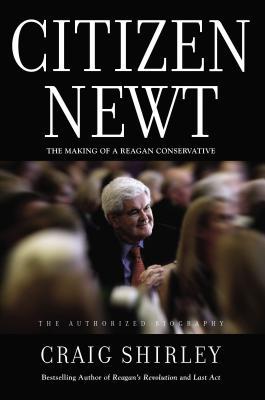
In one way or another Newt Gingrich has been leading a revolution for most of his life. Citizen Newt is the definitive account of that struggle. Writing with the full cooperation of Speaker Gingrich and the players around him, New York Times bestselling author Craig Shirley captures the events, ideas, failures, and successes of Newton Leroy Gingrich-one of the most complex, influential, and durable political figures of our time. Returning to Gingrich's childhood in Pennsylvania and his formative years as a young history professor, Citizen Newt moves through Gingrich's first forays into politics and takes listeners behind the scenes of the congressman's crucial role in the Reagan Revolution, his battles with George H. W. Bush and Bill Clinton, and his masterly orchestration of 1994's "Gingrich Revolution" and the Contract with America, which catapulted him to national prominence and forever changed congressional and national politics. Drawing upon untold stories from Gingrich and those who know him best-political allies and opponents, Washington insiders and political iconoclasts, Capitol Hill staffers and colleagues-Shirley has crafted a fascinating, humorous, humanizing, and insightful account of a true American original.


Reagan's Revolution: The Untold Story of the Campaign That Started It All Library Edition
by Craig Shirley
Today's political scene looks nothing like it did thirty years ago, and that is due mostly to Reagan's monumental reshaping of the Republican party. What few people realize, however, is that Reagan's revolution did not begin when he took office in 1980, but in his failed presidential challenge to Gerald Ford in 1975-1976. This is the remarkable story of that historic campaign-one that, as Reagan put it, turned a party of "pale pastels" into a national party of "bold colors." Featuring interviews with a myriad of politicos, journalists, insiders, and observers, Craig Shirley relays intriguing, never-before-told anecdotes about Reagan, his staff, the campaign, the media, and the national parties and shows how Reagan, instead of following the lead of the ever-weakening Republican party, brought the party to him and almost single-handedly revived it. Photos are included in the audiobook companion PDF download.

Today's political scene looks nothing like it did thirty years ago, and that is due mostly to Reagan's monumental reshaping of the Republican party. What few people realize, however, is that Reagan's revolution did not begin when he took office in 1980, but in his failed presidential challenge to Gerald Ford in 1975-1976. This is the remarkable story of that historic campaign-one that, as Reagan put it, turned a party of "pale pastels" into a national party of "bold colors." Featuring interviews with a myriad of politicos, journalists, insiders, and observers, Craig Shirley relays intriguing, never-before-told anecdotes about Reagan, his staff, the campaign, the media, and the national parties and shows how Reagan, instead of following the lead of the ever-weakening Republican party, brought the party to him and almost single-handedly revived it. Photos are included in the audiobook companion PDF download.

Today's political scene looks nothing like it did thirty years ago, and that is due mostly to Reagan's monumental reshaping of the Republican party. What few people realize, however, is that Reagan's revolution did not begin when he took office in 1980, but in his failed presidential challenge to Gerald Ford in 1975-1976. This is the remarkable story of that historic campaign-one that, as Reagan put it, turned a party of "pale pastels" into a national party of "bold colors." Featuring interviews with a myriad of politicos, journalists, insiders, and observers, Craig Shirley relays intriguing, never-before-told anecdotes about Reagan, his staff, the campaign, the media, and the national parties and shows how Reagan, instead of following the lead of the ever-weakening Republican party, brought the party to him and almost single-handedly revived it. Photos are included in the audiobook companion PDF download.
The Search for Reagan: The Appealing Intellectual Conservatism of Ronald Reagan - Library Edition
by Craig Shirley

Upheaval: A Clash of Cultures: The Untold Story of One of The Most Consequential Campaigns in American History
by Craig Shirley