
Clayton E. Cramer
9 Books Written

My Brother Ron: A Personal and Social History of the Deinstitutionalization of the Mentally Ill
by Clayton E. Cramer
Rating: 4.0 ⭐
• 2 recommendations ❤️
America started a grand experiment in the 1960 deinstitutionalization of the mentally ill. The consequences were very homelessness; a degradation of urban life; increases in violent crime rates; increasing death rates for the mentally ill. My Brother Ron tells the story of deinstitutionalization from two points of what happened to the author's older brother, part of the first generation of those who became mentally ill after deinstitutionalization, and a detailed history of how and why America went down this path. My Brother Ron examines the multiple strands that came together to create the perfect storm that was a well-meaning concern about the poor conditions of many state mental hospitals; a giddy optimism by the psychiatric profession in the ability of new drugs to cure the mentally ill; a rigid ideological approach to due process that ignored that the beneficiaries would end up starving to death or dying of exposure.

Armed America: The Remarkable Story of How And Why Guns Became As American As Apple Pie
by Clayton E. Cramer
Rating: 3.9 ⭐
In this true story of our nation's love affair with firearms, Clayton E. Cramer debunks the myths and takes readers along a winding historical trail full of surprising revelations and riveting anecdotes, explaining the roots of America's gun culture.

This special publication uses an extensive collection of news reports from over an eight-year period to survey the circumstances and outcomes of defensive gun uses in America. Federal and state lawmakers often oppose repealing or amending laws governing the ownership or carrying of guns. That opposition is often based on assumptions that the average citizen is incapable of successfully employing a gun in self-defense or that possession of a gun in public will tempt people to violence in contentious situations.Those assumptions, illustrated in this report, are false. Such cases are an exceedingly small minority of gun uses by otherwise law-abiding citizens and a great number of tragedies-murders, rapes, assaults, robberies-have been thwarted by self-defense gun uses. The vast majority of gun owners are ethical and competent - and thousands of crimes are prevented each year by ordinary citizens with guns.This report's analysis begins with an overview of the academic studies that have tried to estimate the frequency of defensive gun uses. It then examines recent legal issues and trends surrounding the law of self defense, and then explores the manner and circumstances in which people use guns against criminals.This paper also examines instances of gun use in self-defense in order to provide a better understanding of their character. When ordinary Americans use guns in self defense, what is the nature of that use? How frequently do these events occur and what are the consequences? Finally, a lengthy Appendix provides scores of documented examples in which ordinary people have used guns to defend themselves.

Concealed Weapon Laws of the Early Republic: Dueling, Southern Violence, and Moral Reform
by Clayton E. Cramer
Rating: 3.8 ⭐
Cramer's work examines the motivations and legislative history behind the nation's first laws regulating the carrying of concealed deadly weapons and establishes a previously unexplored link between these laws and efforts to suppress dueling in the southern back country. Earlier attempts to analyze these laws focused upon efforts to maintain slavery by severely restricting the rights of free if free blacks could not possess arms and lacked other basic rights, slaves would be less inclined to seek their freedom. Cramer rejects such thinking by demonstrating that the concealed weapon laws of the early republic were not racially-motivated. He further supports the work of other scholars who have lately examined the role of Scots-Irish immigrants in creating a distinctive southern back-country culture of honor violence including dueling and brawling. It was the attempt to control such violence, Cramer argues, that led to the concealed weapons laws. Thus, rather than considering gun control laws primarily as legal or constitutional history, this study starts from a cultural and historical viewpoint.Southern state legislatures sought to improve the morals of their back-country population through increasingly severe punishments for dueling. When judges and juries regularly refused to convict duelists, these legislatures created extrajudicial punishments by requiring elected and appointed officials, as well as lawyers, to swear oaths of non-participation in dueling. Young men, obsessed with honor and reluctant to perjure themselves for fear of damaging their public reputation, soon took to carrying Bowie knives and handguns with which to kill those who insulted them―a perfectly honorable action to much of the population. The state legislatures then severely regulated carrying of concealed deadly weapons in the hope of suppressing the bloody results of what had been, until then, an accepted practice.
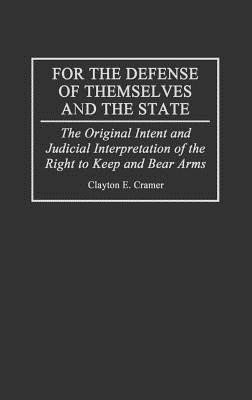
For the Defense of Themselves and the State: The Original Intent and Judicial Interpretation of the Right to Keep and Bear Arms
by Clayton E. Cramer
Rating: 4.0 ⭐
[This book] provides the kind of scholarly resource that educated citizens need to think for themselves, a rich digest of primary sources documenting--in their own words--the views, motives, and intentions of the Framers, historic commentators, legislators, and judiciary who have debated the right to keep and bear arms from the origins of our republic. Preston K. Covey, Carnegie Mellon UniversityBeginning with its origins in the English Civil War, Clayton Cramer traces the development in the United States of the right to keep and bear arms--through the Constitutional Convention, the ratification debates that followed, its inclusion by Congress in the Bill of Rights, to the present controversy over gun control. This book provides important background, analysis, documentation, and perspective for the ongoing national debate over arms.

An excellent resource on the changing population distribution of antebellum Black Americans, this book covers census data by region and state. Two-thirds of the book consists of tables and graphs providing dimensional representations of black populations, both free and slave, in pre-Civil War America. The book opens with a discussion of the limitations of the census data, then goes on to provide an overview of the progress of manumission, abolition, and restrictions on black migration. The book also examines the 1840 census controversy. It will be a particularly useful resource for scholars concerned with changes in the black population.

Firing Back: A Clear, Simple Guide to Defending Your Constitutional Right to Bear Arms
by Clayton E. Cramer
Are you concerned about the efforts (and legislative triumphs) of gun-control advocates? Are you confused by the "facts" and "statistics" being purveyed by the media? Finally, here's your ammunition to confront the swell of gun control laws in America. Now you can arm yourself with the facts and arguments that challenge the gun-control philosophy. As an average citizen, author Clayton E. Cramer teaches you the skills to effectively confront gun control advocates. "Firing Back" is the strongest ammunition you can carry in today's conflict over the Second Amendment.

Concealed Weapon Laws of the Early Republic
by Clayton E. Cramer
Cramer's work examines the motivations and legislative history behind the nation's first laws regulating the carrying of concealed deadly weapons and establishes a previously unexplored link between these laws and efforts to suppress dueling in the southern back country. Earlier attempts to analyze these laws focused upon efforts to maintain slavery by severely restricting the rights of free blacks: if free blacks could not possess arms and lacked other basic rights, slaves would be less inclined to seek their freedom. Cramer rejects such thinking by demonstrating that the concealed weapon laws of the early republic were not racially-motivated. He further supports the work of other scholars who have lately examined the role of Scots-Irish immigrants in creating a distinctive southern back-country culture of honor violence including dueling and brawling. It was the attempt to control such violence, Cramer argues, that led to the concealed weapons laws. Thus, rather than considering gun control laws primarily as legal or constitutional history, this study starts from a cultural and historical viewpoint.Southern state legislatures sought to improve the morals of their back-country population through increasingly severe punishments for dueling. When judges and juries regularly refused to convict duelists, these legislatures created extrajudicial punishments by requiring elected and appointed officials, as well as lawyers, to swear oaths of non-participation in dueling. Young men, obsessed with honor and reluctant to perjure themselves for fear of damaging their public reputation, soon took to carrying Bowie knives and handguns with which to kill those who insulted themNa perfectly honorable action to much of the population. The state legislatures then severely regulated carrying of concealed deadly weapons in the hope of suppressing the bloody results of what had been, until then, an accepted practice."
Apple Pie
by Clayton E. Cramer