
Claudia Rankine
Claudia Rankine is an American poet and playwright born in 1963 and raised in Kingston, Jamaica and New York City. Rankine is the author of five collections of poetry, including "Citizen: An American Lyric" and "Don’t Let Me Be Lonely"; two plays including "The White Card," which premiered in February 2018 (ArtsEmerson and American Repertory Theater) and will be published with Graywolf Press in 2019, and "Provenance of Beauty: A South Bronx Travelogue"; as well as numerous video collaborations. She is also the editor of several anthologies including "The Racial Imaginary: Writers on Race in the Life of the Mind." In 2016, she cofounded The Racial Imaginary Institute. Among her numerous awards and honors, Rankine is the recipient of the Bobbitt National Prize for Poetry and the Poets & Writers’ Jackson Poetry Prize as well as fellowships from the Guggenheim Foundation, the Lannan Foundation, the MacArthur Foundation, United States Artists and the National Endowment of the Arts. She is a chancellor of the Academy of American Poets and teaches at Yale University as the Frederick Iseman Professor of Poetry. She lives in New Haven, Connecticut. (source: Arizona State University)
22 Books Written

A provocative meditation on race, Claudia Rankine's long-awaited follow up to her groundbreaking book Don't Let Me Be Lonely: An American Lyric.Claudia Rankine's bold new book recounts mounting racial aggressions in ongoing encounters in twenty-first-century daily life and in the media. Some of these encounters are slights, seeming slips of the tongue, and some are intentional offensives in the classroom, at the supermarket, at home, on the tennis court with Serena Williams and the soccer field with Zinedine Zidane, online, on TV-everywhere, all the time. The accumulative stresses come to bear on a person's ability to speak, perform, and stay alive. Our addressability is tied to the state of our belonging, Rankine argues, as are our assumptions and expectations of citizenship. In essay, image, and poetry, Citizen is a powerful testament to the individual and collective effects of racism in our contemporary, often named "post-race" society.
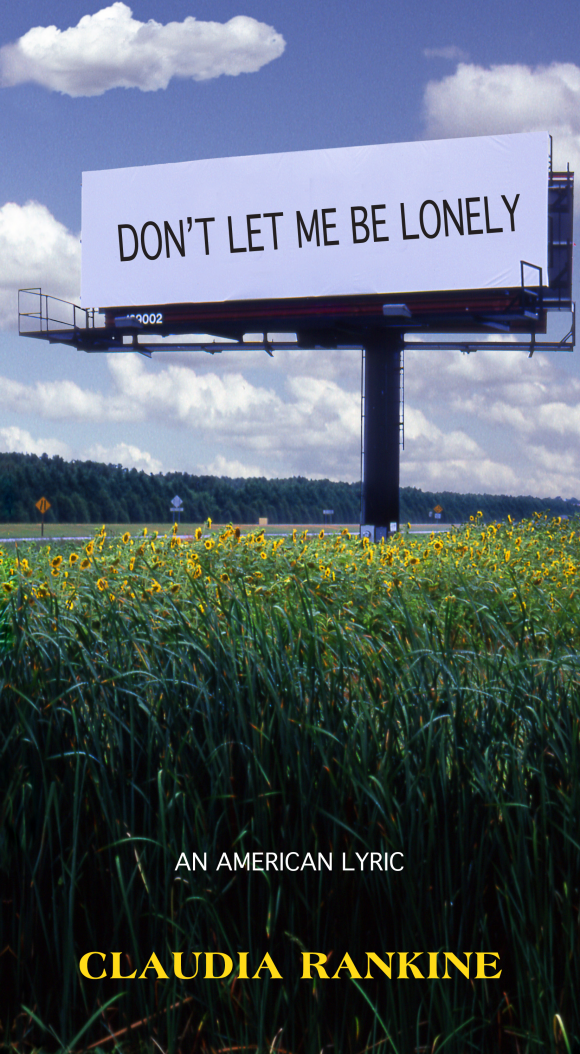
In this powerful sequence of TV images and essay, Claudia Rankine explores the personal and political unrest of our volatile new century. I forget things too. It makes me sad. Or it makes me the saddest. The sadness is not really about George W. or our American optimism; the sadness lives in the recognition that a life cannot matter.The award-winning poet Claudia Rankine, well known for her experimental multigenre writing, fuses the lyric, the essay, and the visual in this politically and morally fierce examination of solitude in the rapacious and media-driven assault on selfhood that is contemporary America. With wit and intelligence, Rankine strives toward an unprecedented clarity-of thought, imagination, and sentence-making-while arguing that recognition of others is the only salvation for ourselves, our art, and our government.Don't Let Me Be Lonely is an important new confrontation with our culture, with a voice at its heart bewildered by its inadequacy in the face of race riots, terrorist attacks, medicated depression, and the antagonism of the television that won't leave us alone.

Claudia Rankine's Citizen changed the conversation--Just Us urges all of us into itAs everyday white supremacy becomes increasingly vocalized with no clear answers at hand, how best might we approach one another? Claudia Rankine, without telling us what to do, urges us to begin the discussions that might open pathways through this divisive and stuck moment in American history.Just Us is an invitation to discover what it takes to stay in the room together, even and especially in breaching the silence, guilt, and violence that follow direct addresses of whiteness. Rankine's questions disrupt the false comfort of our culture's liminal and private spaces--the airport, the theater, the dinner party, the voting booth--where neutrality and politeness live on the surface of differing commitments, beliefs, and prejudices as our public and private lives intersect.This brilliant arrangement of essays, poems, and images includes the voices and rebuttals of others: white men in first class responding to, and with, their white male privilege; a friend's explanation of her infuriating behavior at a play; and women confronting the political currency of dying their hair blond, all running alongside fact-checked notes and commentary that complements Rankine's own text, complicating notions of authority and who gets the last word.Sometimes wry, often vulnerable, and always prescient, Just Us is Rankine's most intimate work, less interested in being right than in being true, being together.

A play about the imagined fault line between black and white lives by Claudia Rankine, the author of CitizenThe White Card stages a conversation that is both informed and derailed by the black/white American drama. The scenes in this one-act play, for all the characters’ disagreements, stalemates, and seeming impasses, explore what happens if one is willing to stay in the room when it is painful to bear the pressure to listen and the obligation to respond.―from the introduction by Claudia RankineClaudia Rankine’s first published play, The White Card , poses the essential Can American society progress if whiteness remains invisible?Composed of two scenes, the play opens with a dinner party thrown by Virginia and Charles, an influential Manhattan couple, for the up-and-coming artist Charlotte. Their conversation about art and representations of race spirals toward the devastation of Virginia and Charles’s intentions. One year later, the second scene brings Charlotte and Charles into the artist’s studio, and their confrontation raises both the stakes and the questions of what―and who―is actually on display.Rankine’s The White Card is a moving and revelatory distillation of racial divisions as experienced in the white spaces of the living room, the art gallery, the theater, and the imagination itself.

Born in Jamaica and now making her home in the United States, Claudia Rankine writes poems that draw breath from alienation -- from her home, her body, her mind. Hailed by Robert Hass as "a fiercely gifted young poet," Claudia Rankine has welded the cerebral and the spiritual, the sensual and the grotesque. With a fierce intelligence and daunting honesty, Rankine writes about her vulnerability by looking at those closest to her. Whether writing about the man she fell in love with, or the country she's come to that is not her home, what remains long after, in searing echo, is her voice -- its beguiling cadence and vivid physicality.

In her third collection of poems, Claudia Rankine creates a profoundly daring, ingeniously experimental examination of pregnancy, childbirth, and artistic expression. Liv, an expectant mother, and her husband, Erland, are at an impasse from her reluctance to bring new life into a bewildering world. The couple's journey is charted through conversations, dreams, memories, and meditations, expanding and exploding the emotive capabilities of language and form. A text like no other, it crosses genres, combining verse, prose, and dialogue to achieve an unparalleled understanding of creation and existence.

Citizen: An American Lyric / Natives / Why I'm No Longer Talking To White People About Race
by Claudia Rankine
Rating: 4.2 ⭐
Please Note That The Following Individual Books As Per Original ISBN and Cover Image In this Listing shall be Dispatched Collectively: Citizen An American Lyric, Natives, Why Im No Longer Talking To White People About Race 3 Books Collection Set: Citizen An American Lyric: In this moving, critical and fiercely intelligent collection of prose poems, Claudia Rankine examines the experience of race and racism in Western society through sharp vignettes of everyday discrimination and prejudice, and longer meditations on the violence - whether linguistic or physical - which has impacted the lives of Serena Williams, Zinedine Zidane, Mark Duggan and others. Natives: From the first time he was stopped and searched as a child, to the day he realised his mum was white, to his first encounters with racist teachers - race and class have shaped Akala's life and outlook. In this unique book he takes his own experiences and widens them out to look at the social, historical and political factors that have left us where we are today. Why I'm No Longer Talking to White People About Race: The book that sparked a national conversation. Exploring everything from eradicated black history to the inextricable link between class and race, Why I'm No Longer Talking to White People About Race is the essential handbook for anyone who wants to understand race relations in Britain today.

The Penguin Modern Poets are succinct, collectible, lovingly-assembled guides to the richness and diversity of contemporary poetry, from the UK, America and beyond. Every volume brings together representative selections from the work of three poets now writing, allowing the seasoned poetry lover and the curious reader alike to encounter our most exciting new voices. Volume 6, Die Deeper into Life , features the work of Maggie Nelson and Claudia Rankine, the two American poets who, in hybrid books bridging the divide between poetry, lyric prose, life-writing and theory such as Bluets , The Argonauts , Don't Let Me Be Lonely and Citizen , have transformed the literary landscape over the last 15 years, alongside that of Denise Riley, who for decades has been exploring closely related concerns - motherhood; identity and oppression; loss; the language and words that build, or assault, our selves - as one of the best-kept secrets of British poetry, now fittingly recognized by a string of shortlistings and awards. These are writers who combine deep thought with deep feeling to illuminate our world, how we suffer in it, how we resist it, and how we can live with and love it.

Poetry. African American Studies. "Claudia Rankine is a fiercely gifted young poet. Intelligence, a curiosity and hunger for understanding like some worrying, interior, physical pain, a gift for being alert in the world. She knows when to bless and to curse, to wonder and to judge, and she doesn't flinch. NOTHING IN NATURE IS PRIVATE is an arrival. It's the kind of book that makes you hopeful for American poetry." Robert Hass"I am excited by Claudia Rankine's poems, their elegance, their emotional force, their scrupulous intimation of multiple identities. Representing brilliantly the prismatic vision of a Jamaican, middle class, intellectual black woman living in America, they address the widest constituency of readers. This is a richly rewarding collection." Mervyn Morris"

MoMA PS1 presents the fourth iteration of Greater New York. Recurring every five years, the exhibition has traditionally showcased the work of emerging artists living and working in the New York metropolitan area. Considering the “greater” aspect of its title in terms of both geography and time, Greater New York. begins roughly with the moment when MoMA PS1 was founded in 1976 as an alternative venue that took advantage of disused real estate, reaching back to artists who engaged the margins of the city.In conjunction with the exhibition, MoMA PS1 is publishing a series of readers that will be released throughout the run of the exhibition. These short volumes revisit older histories of New York while also inviting speculation about its future, highlighting certain works in the exhibition and engaging a range of subjects including disco, performance anxiety, real estate and newly unearthed historical documents. The series features contributions from Fia Backström, Mark Beasley, Gregg Bordowitz, Susan Cianciolo, Douglas Crimp, Catherine Damman, David Grubbs, Angie Keefer, Aidan Koch, Glenn Ligon, Gordon Matta-Clark, Claudia Rankine, Collier Schorr, and Sukhdev Sandhu, concluding with a round-table conversation with exhibition curators Peter Eleey, Douglas Crimp, Thomas J. Lax and Mia Locks. The series is edited by Jocelyn Miller, Curatorial Associate, MoMA PS1.

MoMA PS1 presents the fourth iteration of Greater New York . Recurring every five years, the exhibition has traditionally showcased the work of emerging artists living and working in the New York metropolitan area. Considering the “greater” aspect of its title in terms of both geography and time, Greater New York . begins roughly with the moment when MoMA PS1 was founded in 1976 as an alternative venue that took advantage of disused real estate, reaching back to artists who engaged the margins of the city.In conjunction with the exhibition, MoMA PS1 is publishing a series of readers that will be released throughout the run of the exhibition. These short volumes revisit older histories of New York while also inviting speculation about its future, highlighting certain works in the exhibition and engaging a range of subjects including disco, performance anxiety, real estate and newly unearthed historical documents. The series features contributions from Fia Backström, Mark Beasley, Gregg Bordowitz, Susan Cianciolo, Douglas Crimp, Catherine Damman, David Grubbs, Angie Keefer, Aidan Koch, Glenn Ligon, Gordon Matta-Clark, Claudia Rankine, Collier Schorr, and Sukhdev Sandhu, concluding with a round-table conversation with exhibition curators Peter Eleey, Douglas Crimp, Thomas J. Lax and Mia Locks. The series is edited by Jocelyn Miller, Curatorial Associate, MoMA PS1.

Schreiben als Sehen | Writing as Seeing (Berliner Rede zur Poesie 10)
by Claudia Rankine
Rating: 3.0 ⭐
Die Berliner Rede zur Poesie wird am 3. Juni 2025 von der US-amerikanischen Schriftstellerin Claudia Rankine gehalten.Achille Mbembe behauptet, dass vor dem Wort das Bild stand. Die Rolle des Wortes war es, dieses Bild widerzuspiegeln. In einer postfaktischen, »vernunftfeindlichen« Welt, um es mit Mbembes Worten zu sagen, in der die Rechtsstaatlichkeit von den Gesetzlosen angegriffen wird, sollte das Gesehene die neue Poetik sein. In dem Kampf, durch die Sprache zu dem zu gelangen, was gesehen wird, kämpfen wir jetzt gegen das Verbot von Wörtern und die Überwachung und Zensur sowohl des Denkens als auch der Bewegung. Und trotz der Tatsache, dass Körper von Natur aus mit Bewegung verbunden sind, scheint es, während sich unsere Länder nach rechts bewegen und versuchen, Ressourcen und Reichtum für eine westliche weiße Bevölkerung zu sichern, ein globales Beharren unserer Regierungsorgane auf Nicht-Kohabitation zu geben, so dass sogar die Staatsbürgerschaft ein anfechtbarer Status geworden ist. Dies ermöglicht die Abschiebung von legalen und undokumentierten Personen, deren Geschichten ein umfassenderes Bild der Gegenwart ergeben. Claudia Rankines Berliner Rede zur Poesie befasst sich mit der Art und Weise, wie die unvermeidliche Beziehung des Bildes zur Sprache eine unserer größten Ressourcen bleibt. Wenn die Beziehung zwischen Bild und Text trotz der neuen Regime des 21. Jahrhunderts weiterhin das widerspiegelt, was um uns herum geschieht, dann wird das zum Schweigen Gebrachte und Ausgelöschte auf zufällige und unerwartete Weise präsent bleiben. Mbembe versteht das Geschichtenerzählen so, dass es die Kräfte übersteigt, die es einschränken wollen.

Eleven More American Women Poets in the 21st Century: Poetics Across North America
by Claudia Rankine

Rashid Johnson
by Claudia Rankine
‘Johnson is a leading voice of his generation.’ – New York Times The most comprehensive publication to date on widely celebrated artist Rashid Johnson Working with a variety of media that includes painting, sculpture, photography, video, and performance, Rashid Johnson has created a nuanced and iconographic body of work that connects literature, music, and art. Personal references and pervasive cultural narratives are interweaved with the legacy of modernist abstraction, producing what critics have labelled ‘conceptual post-black art’. A precocious talent (his work was included in the seminal ‘Freestyle’ exhibition in New York in 2001), Johnson received the High Museum of Art’s David C. Driskell Prize, which honours contributions in the field of African-American art.

The End of the Alphabet
by Claudia Rankine

Poetry: March 2014, Volume 203, Number 6
by Claudia Rankine
March 2014, Volume 203, Number 6 (Featuring Claudia Rankine, Tim Seibles, and Nikky Finney), edited by Don Share. 2014 paperback published by the Poetry Foundation. Various contributors. Cover art by Lorna Simpson.
Eleven More American Women Poets in the 21st Century
by Claudia Rankine
Citizen: An American Lyric
by Claudia Rankine
Just Us: An American Conversation
by Claudia Rankine
Claudia Rankine's Citizen changed the conversation--Just Us urges all of us into itAs everyday white supremacy becomes increasingly vocalized with no clear answers at hand, how best might we approach one another? Claudia Rankine, without telling us what to do, urges us to begin the discussions that might open pathways through this divisive and stuck moment in American history.Just Us is an invitation to discover what it takes to stay in the room together, even and especially in breaching the silence, guilt, and violence that follow direct addresses of whiteness. Rankine's questions disrupt the false comfort of our culture's liminal and private spaces--the airport, the theater, the dinner party, the voting booth--where neutrality and politeness live on the surface of differing commitments, beliefs, and prejudices as our public and private lives intersect.This brilliant arrangement of essays, poems, and images includes the voices and rebuttals of others: white men in first class responding to, and with, their white male privilege; a friend's explanation of her infuriating behavior at a play; and women confronting the political currency of dying their hair blond, all running alongside fact-checked notes and commentary that complements Rankine's own text, complicating notions of authority and who gets the last word.Sometimes wry, often vulnerable, and always prescient, Just Us is Rankine's most intimate work, less interested in being right than in being true, being together.
The End of the Alphabet
by Claudia Rankine
THE END OF THE ALPHABET.
by Claudia Rankine
Triage
by Claudia Rankine
A groundbreaking new direction for Claudia Rankine, the best-selling author of Citizen and Just UsClaudia Rankine has widened contemporary literature with her consciousness-raising, genre-defying works. In her first book after her celebrated American trilogy, presented with full-color visuals, Rankine shifts into sustained narrative, memory, criticism, and essay to offer her most personal and emotionally resonant writing yet.Triage follows the turbulent friendship between two composite characters, the narrator and the theorist, self-identified sisters struggling to define their wounded histories and their shared but separate lives. During college, they invent a game of Every time they see each other, they have to stop and fall to the ground. As their kinship continues off and on for decades, “collapse” takes on new meanings that are seen and felt in the violence of their pasts, artworks depicting couches where someone might ease their exhaustion, the ongoing devastation in Gaza, and the antagonism of their conversation and their love for each other.Triage is an argument for the necessity of grieving and the demand for action in our time of relentless loss. “No matter our posture,” Rankine writes, “we are all among the rubble.” This is a book for those complicated but beautiful friendships that we come to rely on to unsettle us, to make us better.