
Chip Conley
At the age of 26, Chip Conley started his own hospitality company, Joie de Vivre (JDV), and, as CEO for two-dozen years, expanded it into a collection of over 35 award-winning hotels, restaurants and spas – the second largest boutique hotel company in the U.S. The bestselling author of PEAK, Chip is a veteran practitioner of emotional intelligence in business and in his latest book, EMOTIONAL EQUATIONS, he takes us from emotional intelligence to emotional fluency. The preeminent thought leader at the intersection of psychology and business, Chip speaks around the world on finding meaning at work, is a regular blogger on The Huffington Post and his own blog at http://www.emotionalequations.com . Chip has been honored with the highest accolade in the American hospitality industry, the coveted ISHC Pioneer award, and was named the Most Innovative CEO – and JDV the "2nd Best Place to Work" – in the entire Bay Area by The San Francisco Business Times. He received his BA and MBA from Stanford University, and holds an Honorary Doctorate in Psychology from Saybrook Graduate School & Research Center, where he is the school’s 2012 Scholar-Practitioner in residence.
12 Books Written

When he was 26, Chip Conley broke the two cardinal rules of starting a he invested in an industry about which he knew nothing and he ignored the mantra "location, location, location." He bought a notorious "pay-by-the-hour" motel in a seedy San Francisco neighborhood.A dozen years later, Chip is the "boy wonder" of the American travel industry, famous for his entrepreneurial genius, creativity, and sense of fun.In The Rebel Rules, Conley shares his success secrets. He focuses on the primary traits -- vision, passion, instinct, and agility -- that characterize today's fast company leaders. His guidebook doubles as a toolbox for anyone -- whether a virgin entrepreneur or a corporate manager -- who wants to walk in step with today's business innovators.The Rebel Rules will show you how

Experience is making a comeback. Learn how to repurpose your wisdom.At age 52, after selling the company he founded and ran as CEO for 24 years, rebel boutique hotelier Chip Conley was looking at an open horizon in midlife. Then he received a call from the young founders of Airbnb, asking him to help grow their disruptive start-up into a global hospitality giant. He had the industry experience, but Conley was lacking in the digital fluency of his 20-something colleagues. He didn't write code, or have an Uber or Lyft app on his phone, was twice the age of the average Airbnb employee, and would be reporting to a CEO young enough to be his son. Conley quickly discovered that while he'd been hired as a teacher and mentor, he was also in many ways a student and intern. What emerged is the secret to thriving as a mid-life worker: learning to marry wisdom and experience with curiosity, a beginner's mind, and a willingness to evolve, all hallmarks of the "Modern Elder."In a world that venerates the new, bright, and shiny, many of us are left feeling invisible, undervalued, and threatened by the "digital natives" nipping at our heels. But Conley argues that experience is on the brink of a comeback. Because at a time when power is shifting younger, companies are finally waking up to the value of the humility, emotional intelligence, and wisdom that come with age. And while digital skills might have only the shelf life of the latest fad or gadget, the human skills that mid-career workers possess--like good judgment, specialized knowledge, and the ability to collaborate and coach - never expire.Part manifesto and part playbook, Wisdom@Work ignites an urgent conversation about ageism in the workplace, calling on us to treat age as we would other type of diversity. In the process, Conley liberates the term "elder" from the stigma of "elderly," and inspires us to embrace wisdom as a path to growing whole, not old. Whether you've been forced to make a mid-career change, are choosing to work past retirement age, or are struggling to keep up with the millennials rising up the ranks, Wisdom@Work will help you write your next chapter.

After fifteen years of rising to the pinnacle of the hospitality industry, Chip Conley's company was suddenly undercapitalized and overexposed in the post-dot.com, post-9/11 economy. For relief and inspiration, Conley, the CEO and founder of Joie de Vivre Hospitality, turned to psychologist Abraham Maslow's iconic Hierarchy of Needs. This book explores how Conley's company "the second largest boutique hotelier in the world" overcame the storm that hit the travel industry by applying Maslow's theory to what Conley identifies as the key Relationship Truths in business with Employees, Customers and Investors. Part memoir, part theory, and part application, the book tells of Joie de Vivre's remarkable transformation while providing real world examples from other companies and showing how readers can bring about similar changes in their work and personal lives. Conley explains how to understand the motivations of employees, customers, bosses, and investors, and use that understanding to foster better relationships and build an enduring and profitable corporate culture.
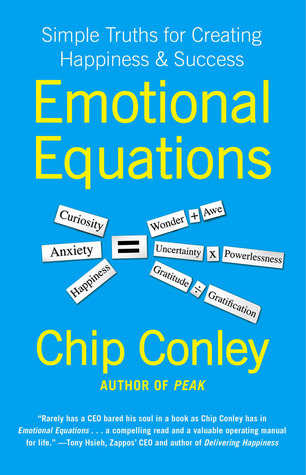
TONY HSIEH on Emotional Equations: "Rarely has a CEO bared his soul in a book as Chip Conley has in Emotional Equations. This powerfully authentic story makes for a compelling read and an invaluable operating manual for life. Chip’s stories are used to create emotional building blocks that define how we can understand and navigate our internal weather and emotions.In business and in life, we tend to gravitate toward people who inspire trust and create positive emotional connections. Yet, we learn very little about emotional intelligence in formal education. That’s what makes reading Emotional Equations so enjoyable -- it’s like taking a fun college course in understanding Curiosity, Jealousy, Despair, Authenticity, Wisdom, and nearly twenty different emotions or emotional states that regularly show up in our lives. Emotional Equations illustrates that the more unpredictable the world is, the more important it is to master our emotions in such a way that our internal world doesn’t mirror the chaos of the external world. Chip’s book amplifies the importance of creating that emotional space in our lives such that we don’t unconsciously react to everything.Chip’s goal is to take the idea of emotional intelligence and transform it into emotional fluency. It’s one thing to study a foreign language in theory, but quite another to try to use it in our daily lives. Emotional Equations provides the tools for doing both.Chip not only provides a comprehensive list of emotional equations that he’s derived, he also shows how to create your own emotional equations by encouraging readers to rethink their relationships with their own emotions and asking the question, “What is this emotion trying to tell me right now, and how can it serve me?” Emotional Equationsis one of those rare books that combine research and theory with actual practice. If you’re interested in learning how to understand and manage emotions both in work and in life, this book will definitely provide some new perspectives and plenty of food for thought."

Marketing That Matters: 10 Practices to Profit Your Business and Change the World
by Chip Conley
Rating: 3.9 ⭐
Whether you're an entrepreneur building a new enterprise, the leader of an established socially responsible business, or a marketing professional at a Fortune 500 company who wants to make a difference, this "in-the-trenches" guide provides action steps for creating marketing programs that benefit your company and the world.Using real-life examples from Patagonia, General Mills, Clif Bar, and many other companies, Marketing That Matters shows how to define your company's mission, goals, and potential audience in ways that are flexible, creative, and true to your organization's core values. They offer ten practices to engage customers using innovative marketing techniques--from discovering how customers make decisions to building committed communities of customers, employees, and strategic partners who will spread the word about your company--and potentially change the world. Marketing that Matters is the definitive handbook to help you incorporate social responsibility as a core element in your company's marketing strategy.

New York Times bestselling author and co-founder/CEO of The Modern Elder Academy “reminds us all to savor the wisdom, self-knowledge, and joy that accompanies [the middle decades] of our lives” (Father Richard Rohr) and “provides a clear blueprint for creating the lives we want” (Gretchen Rubin)The midlife crisis is the butt of so many jokes, but this long-derided life stage has an upside. What if we could reframe our thinking about the natural transition of midlife not as a crisis, but as a chrysalis—a time when something profound awakens in us, as we shed our skin, spread our wings, and pollinate our wisdom to the world?In Learning to Love Midlife , Chip Conley offers an alternative narrative to the way we commonly think of our 40s, 50s and 60s. Drawing on the latest social science research, inspiring stories, and timeless wisdom, he reveals 12 reasons why life gets better with age. They No matter where you are in your midlife journey, this perspective‑shifting guide will inspire you to find joy, purpose and success in the years that lie ahead—and how those years can be your best ones yet.


12 razones por las que la vida mejora a partir de los 40Por mucho tiempo nos han hecho creer que cumplir 40 es el comienzo de la decadencia, pero nada más distante de la realidad. A medida que envejecemos, la inteligencia emocional crece, tenemos mayor libertad financiera y las opiniones ajenas nos importan menos. Lejos de ser una crisis, esta etapa puede ser una oportunidad para reinventarte y empezar la mejor fase de tu vida.Chip Conley, CEO de la Academia de Adultos Mayores Modernos, te muestra cómo dejar atrás esas creencias antiguas y con ello aprovechar al máximo esta edad. A través de cinco pilares clave —físico, emocional, mental, espiritual y vocacional—, descubrirás que entrar a los 40 (y más) es una oportunidad para aprender de nuevo, reflexionar sobre quién eres y, lo más importante, entender que el secreto de la vida no es acumular años, sino evolucionar y crecer por dentro.

Entrepreneurship: Make more money as an entrepreneur
by Chip Conley

La edad dorada: 12 razones por las que la vida mejora a partir de los 40 / Learning to Love Midlife
by Chip Conley
Por mucho tiempo nos han hecho creer que cumplir 40 es el comienzo de la decadencia, pero nada más distante de la realidad. A medida que envejecemos, la inteligencia emocional crece, tenemos mayor libertad financiera y las opiniones ajenas nos importan menos. Lejos de ser una crisis, esta etapa puede ser una oportunidad para reinventarte y empezar la mejor fase de tu vida. Chip Conley, CEO de la Academia de Adultos Mayores Modernos, te muestra cómo dejar atrás esas creencias antiguas y con ello aprovechar al máximo esta edad. A través de cinco pilares clave —físico, emocional, mental, espiritual y vocacional—, descubrirás que entrar a los 40 (y más) es una oportunidad para aprender de nuevo, reflexionar sobre quién eres y, lo más importante, entender que el secreto de la vida no es acumular años, sino evolucionar y crecer por dentro.

The Midlife Manifesto
by Chip Conley