
Chet Richards
Chet Richards was a close associate of the late US Air Force Colonel John R. Boyd from the mid-1970s until Boyd s death in 1997. Boyd had asked him to review the mathematical portions of his first civilian paper, Destruction and Creation, and this led to a collaboration that eventually included applications to the business world. Chet Richards career began at the Pentagon in 1971, and has included employment with Northrop, the professional services company CACI in Washington DC, and Lockheed. A consultant since 1999, he maintains his practice in strategy for business, marketing, and communications through Tarkenton & Addams, Inc., a public relations firm in Atlanta, GA. Chet is the author of several publications all involving applications of Boyd s strategies. His most recent, A Swift, Elusive Sword, addresses how we can re-fashion the US Defense Department to defend ourselves against the types of non-traditional enemies we will likely face in the 21st Century. It was published by the Centers for Defense Information shortly before 9/11, has been translated into Russian, and is now in its second printing. He has lectured on this subject to commercial organizations in the US and abroad, including the US Army Command and Staff College and the Air War College, and is the only person to have delivered Boyd s Patterns of Conflict since Boyd s death. Chet is also a retired colonel in the US Air Force Reserve, where he served for many years as the Reserve Air Attaché to Saudi Arabia. Prior to that, he was a reservist on the Air Staff in Washington, where he built computer models of fighter aircraft effectiveness. He was commissioned in 1969 through the Army ROTC program at the University of Mississippi. Chet and his wife, Ginger, live in Atlanta, where, in addition to their work with Tarkenton & Addams, they build custom web sites to support the marketing communications needs of their clients. They also own and operate two sites devoted to John Boyd s strategic legacy, Defense and the National Interest (http://www.d-n-i.net) and Belisarius.com (http://www.belisarius.com.) They have two daughters who, as this is written, are both in graduate school in Georgia, and one very overweight cat. (Barnes and Noble)
5 Books Written

Certain to Win: The Strategy of John Boyd, Applied to Business
by Chet Richards
Rating: 4.1 ⭐
• 2 recommendations ❤️
Certain to Win [Sun Tzu's prognosis for generals who follow his advice] develops the strategy of the late US Air Force Colonel John R. Boyd for the world of business.The success of Robert Coram's monumental biography, Boyd, the Fighter Pilot Who Changed the Art of War, rekindled interest in this obscure pilot and documented his influence on military matters ranging from his early work on fighter tactics to the USMC's maneuver warfare doctrine to the planning for Operation Desert Storm. Unfortunately Boyd's written legacy, consisting of a single paper and a four-set cycle of briefings, addresses strategy only in war. Boyd and BusinessBoyd did study business. He read everything he could find on the Toyota Production System and came to consider it as an implementation of ideas similar to his own. He took business into account when he formulated the final version of his OODA loop and in his last major briefing, Conceptual Spiral, on science and technology. He read and commented on early versions of this manuscript, but he never wrote on how business could operate more profitably by using his ideas.Other writers and business strategists have taken up the challenge, introducing Boyd's concepts and suggesting applications to business. Keith Hammonds, in the magazine Fast Company, George Stalk and Tom Hout in Competing Against Time, and Tom Peters most recently in Re-imagine! have described the OODA loop and its effects on competitors.They made significant contributions. Successful businesses, though, don t concentrate on affecting competitors but on enticing customers. You could apply Boyd all you wanted to competitors, but unless this somehow caused customers to buy your products and services, you ve wasted time and money. If this were all there were to Boyd, he would rate at most a sidebar in business strategy.Business is not WarPart of the problem has been Boyd's focus on war, where affecting competitors is the whole idea. Armed conflict was Boyd's life for nearly 50 years, first as a fighter pilot, then as a tactician and an instructor of fighter pilots, and after his retirement, as a military philosopher. Coram describes (and I know from personal experience) how his quest consumed Boyd virtually every waking hour.It was not a monastic existence, though, since John was above everything else a competitor and loved to argue over beer and cigars far into the night. During most of the 1970s and 80s he worked at the Pentagon, where he could share ideas and debate with other strategists and practitioners of the art of war. The result was the remarkable synthesis we know as Patterns of Conflict. Discussions about generals and campaigns, however, did not give Boyd much insight into competition in other areas, like businessNow you might expect, at first glance, that business is so much like war that lifting concepts from one and applying them to the other would be straightforward. But think about that for a minute. Even in its simplest description, business doesn't really look much like war. For one thing, there are always three sides to business you, customers, and competitors. Often it is vastly more complex, with a multitude of competitors who are customers of each other as well. In business, unlike war, it may even be desirable to be conquered by a competitor in a lucrative merger or acquisition. Finally, and most important, it is rarely possible to defeat the other player in the triangle, that is, to compel an unwilling customer to buy. Attempts to pressure customers into paying too much or into buying more than they need often open a window for competitors (as the US airline industry is belatedly discovering.) Generally all we can do is attract offer products and services to potential customers, whose decisions determine who wins and who loses.What this means is that the strategies and tactics of war, Boyd's included, are destructive in nature and so never apply to business. Expressions like Attack enemy weaknesses have no meaning, except as metaphors and analogies. Across different domains, such literary devices are as likely to be misleading as helpful.Boyd's Strategy Still AppliesBusiness is not war, but it is a form of conflict, a situation where one group can win only if another group loses. If you dig beneath Boyd's war-centered tactics you find a general strategy for ensuring that in most any type of conflict your group will be the one that wins.Although Boyd made a number of new and fundamental contributions, his is an ancient school, extending back in written form 2,500 years. It is built around two primary A focus on time (not speed) and specifically, using dislocations in time to shape the competitive situation. These effects, by the way, are quite different in business than they are in war.A culture with attributes that enable even impel organizations to exploit time for competitive advantage. W...

A Swift, Elusive Sword: What if Sun Tzu and John Boyd Did a National Defense Review?
by Chet Richards
Rating: 4.0 ⭐
A study of national security and military strategy by Col. Chester Richards (USAF Ret.), suggests that ancient strategic wisdom may help solve the dilemma confronting the U.S. spending on defense exceeds that of any combination of potential adversaries, but the services still face cancellation of weapon systems and lack of funds for training, spares, and care and feeding of the troops. Richards suggests U.S. military leaders can break out of the "dollars equals defense" mindset, and create more effective forces. The second edition contains a new forward written in response to the effects that the September 11, 2001 terrorist attacks against the United States have engendered in the U.S. military.

From the author's executive Events since Sept. 11, 2001, have introduced the world to a new type of threat, one not tied to a particular country and one that doesn’t field conventional armies to challenge us on the battlefield. Al-Qaida and its kin have taken the techniques of guerrilla warfare, added new technologies such as the Internet, and brought war to the homelands of the United States and Western Europe. Despite spending on defense that equals the rest of the world, combined, and initiating a war in Iraq that will likely surpass Vietnam in cost, the United States has yet either to destroy al-Qaida or to defeat a group of ragtag insurgents concentrated in the areas around Baghdad. The U.S. Department of Defense (DoD), designed to defeat the Soviet Union, is not only unsuited for this new form of conflict, it cannot be transformed into an organization that is. It is time for DoD to be abolished to make way for new approaches.Among these would be a restructuring of the Armed Services to eliminate not only our large, heavy formations but the mindsets that accompany them. In their place, we should consider forces that blur the boundary between "civilian" and "military" as well as between government and private industry. We can be sure that our opponents have not ruled out any form of organization, and if we are to win, we must be at least as creative.Forces, even radically re-created ones, can be effective only as part of a coherent national strategy. There are two generic approaches for building such a rollback, where we intervene to eliminate regimes that harbor or might harbor terrorists, and containment, where we take measures to protect ourselves from attack, but otherwise limit involvement to intelligence, police, and diplomatic measures. This book sympathizes with the goal of rollback, but considering its costs and lack of success in places like Iraq, recommends containment as the strategy most likely to protect against terrorists acts, while not making life in the developing world more dangerous than it already is.
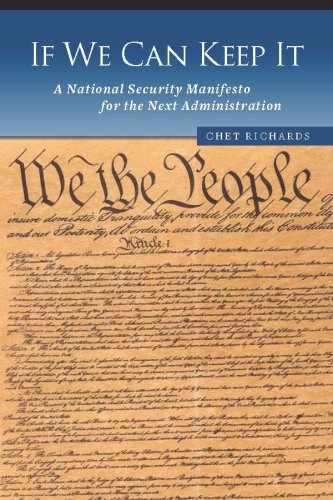
If We Can Keep It: A National Security Manifesto for the Next Administration
by Chet Richards
Rating: 3.8 ⭐
If We Can Keep It is the latest in the series of monographs sponsored by the Straus Military Reform Project of the World Security Institute's Center for Defense Information. Unlike other publications now coming out on the Iraq War and the counterinsurgency campaign there, retired Air Force Col. Chet Richards rejects the notion that policy-makers can predict how well any such effort will work. The track record of military occupations in culturally and religiously alien lands in modern times is not good in terms of the end result for the occupier, the effects on the indigenous population, and the standing of the occupying nation and army in the eyes of the rest of the world. The next U.S. administration, whether Republican or Democrat, should not think that we have discovered, with the Pentagon's counterinsurgency doctrine, an effective policy tool for reshaping the world, or even the rogue nations in it. Richards explores alternatives to the invade-occupy-fight paradigm and draws some surprising, important and instructive conclusions about what future forces and weapons should look like if America is to survive on its own terms in the world.

This Book Doesn't Just Talk About Leadership. Instead It Offers A Robust, Systematic Framework To Achieve It. Certain To Win Develops The Strategy Of The Late Us Air Force Colonel John R. Boyd As A Manual For Success. Leadership, Personality Development, Business, Management, Defence Strategy