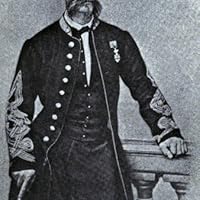
Charles Jean Jacques Joseph Ardant du Picq
Charles Jean Jacques Joseph Ardant du Picq was a French Army officer and military theorist of the mid-nineteenth century whose writings, as they were later interpreted by other theorists, had a great effect on French military theory and doctrine.
7 Books Written

Battle Studies: Ancient and Modern Battle
by Charles Jean Jacques Joseph Ardant du Picq
Rating: 3.5 ⭐
• 2 recommendations ❤️
BATTLE STUDIES: ANCIENT AND MODERN BATTLE By Colonel Ardant du Picq Excerpt from Preface In presenting to the American reading public a translation of a volume written by an obscure French colonel, belonging to a defeated army, who fell on the eve of a battle which not alone gave France over to the enemy but disclosed a leadership so inapt as to awaken the suspicion of treason, one is faced by the inevitable interrogation - "Why?" Yet the answer is simple. The value of the book of Ardant du Picq lies precisely in the fact that it contains not alone the unmistakable forecast of the defeat, itself, but a luminous statement of those fundamental principles, the neglect of which led to Gravelotte and Sedan. Napoleon has said that in war the moral element is to all others as three is to one. Moreover, as du Picq impressively demonstrates, while all other circumstances change with time, the human element remains the same, capable of just so much endurance, sacrifice, effort, and no more. Thus, from Caesar to Foch, the essential factor in war endures unmodified. . . Contents Frontispiece - Portrait of Colonel Ardant du Picq Foreword Preface Translator's Note Introduction A Military Thinker Record of Military Service of Colonel Ardant du Picq Extract from the History of the 10th Infantry Regiment PART ONE: ANCIENT BATTLE Introduction I. Man in Primitive and Ancient Combat II. Knowledge of Man Made Roman Tactics; the Successes of Hannibal; Those of Caesar III. Analysis of the Battle of Cannae IV. Analysis of the Battle of Pharsalus and Some Characteristic Examples V. Morale in Ancient Battle VI. How Real Combatants Are Obtained and How the Fighting of To-Day Requires Them to Be More Dependable Than in Ancient Battle VII. Purpose of This Study and What Is Necessary to Complete It PART TWO: MODERN BATTLE I. General Discussion 1. Ancient and Modern Battle 2. Moral Elements in Battle 3. Material and Moral Effect 4. The Theory of Strong Battalions 5. Combat Methods II. Infantry 1. Masses - Deep Columns 2. Skirmishers - Supports - Reserves - Squares 3. Firing 4. Marches - Camps - Night Attacks III. Cavalry 1. Cavalry and Modern Appliances 2. Cavalry Against Cavalry 3. Cavalry Against Infantry 4. Armor and Armament IV. Artillery V. Command, General Staff and Administration VI. Social and Military Institutions; National Characteristics ------------------------------------------------------------------------------------------------------------------------------------------ Windham Press is committed to bringing the lost cultural heritage of ages past into the 21st century through high-quality reproductions of original, classic printed works at affordable prices. This book has been carefully crafted to utilize the original images of antique books rather than error-prone OCR text. This also preserves the work of the original typesetters of these classics, unknown craftsmen who laid out the text, often by hand, of each and every page you will read. Their subtle art involving judgment and interaction with the text is in many ways superior and more human than the mechanical methods utilized today, and gave each book a unique, hand-crafted feel in its text that connected the reader organically to the art of bindery and book-making. We think these benefits are worth the occasional imperfection resulting from the age of these books at the time of scanning, and their vintage feel provides a connection to the past that goes beyond the mere words of the text.

Battle is the final objective of armies and man is the fundamental instrument in battle. Nothing can wisely be prescribed in an army—its personnel, organization, discipline and tactics, things which are connected like the fingers of a hand—without exact knowledge of the fundamental instrument, man, and his state of mind, his morale, at the instant of combat. It often happens that those who discuss war, taking the weapon for the starting point, assume unhesitatingly that the man called to serve it will always use it as contemplated and ordered by the regulations. But such a being, throwing off his variable nature to become an impassive pawn, an abstract unit in the combinations of battle, is a creature born of the musings of the library, and not a real man. Man is flesh and blood; he is body and soul. And, strong as the soul often is, it can not dominate the body to the point where there will not be a revolt of the flesh and mental perturbation in the face of destruction. The human heart, to quote Marshal de Saxe, is then the starting point in all matters pertaining to war. Let us study the heart, not in modern battle, complicated and not readily grasped, but in ancient battle. For, although nowhere explained in detail, ancient battle was simple and clear. Centuries have not changed human nature. Passions, instincts, among them the most powerful one of self-preservation, may be manifested in various ways according to the time, the place, the character and temperament of the race. Thus in our times we can admire, under the same conditions of danger, emotion and anguish, the calmness of the English, the dash of the French, and that inertia of the Russians which is called tenacity. But at bottom there is always found the same man. It is this man that we see disposed of by the experts, by the masters, when they organize and discipline, when they order detailed combat methods and take general dispositions for action. The best masters are those who know man best, the man of today and the man of history. This knowledge naturally comes from a study of formations and achievements in ancient war. The development of this work leads us to make such an analysis, and from a study of combat we may learn to know man. Let us go even back of ancient battle, to primeval struggle. In progressing from the savage to our times we shall get a better grasp of life. And shall we then know as much as the masters? No more than one is a painter by having seen the methods of painting. But we shall better understand these able men and the great examples they have left behind them. We shall learn from them to distrust mathematics and material dynamics as applied to battle principles. We shall learn to beware of the illusions drawn from the range and the maneuver field. There, experience is with the calm, settled, unfatigued, attentive, obedient soldier, with an intelligent and tractable man-instrument in short, and not with the nervous, easily swayed, moved, troubled, distrait, excited, restless being, not even under self-control, who is the fighting man from general to private. There are strong men, exceptions, but they are rare. These illusions, nevertheless, stubborn and persistent, always repair the very next day the most damaging injuries inflicted on them by experience. Their least dangerous effect is to lead to prescribing the impractical, as if ordering the impractical were not really an attack on discipline, and did not result in disconcerting officers and men by the unexpected and by surprise at the contrast between battle and the theories of peacetime training. Battle, of course, always furnishes surprises. But it furnishes less in proportion as good sense and the recognition of truth have had their effect on the training of the fighting man, and are disseminated in the ranks.

Une peuplade malgache les tanala de l'Ikongo
by Charles Jean Jacques Joseph Ardant du Picq
-Bibliographie - ses principales œuvres - plusieurs aspects de la culture et de la civilisation des Tanala de l'Ikongo, dans le sud-est de Madagascar. Dans l'essai ethnographique que nous publions, paru dans Le Tour du Monde, il fait un portrait à grands traits de cette ethnie et de la région où elle vit.
![Étude du combat d'après l'antique / par C. Ardant du Picq 1868 [Leather Bound]](https://m.media-amazon.com/images/S/compressed.photo.goodreads.com/books/1694950306i/147400459.jpg)
Étude du combat d'après l'antique / par C. Ardant du Picq 1868 [Leather Bound]
by Charles Jean Jacques Joseph Ardant du Picq
Leather Binding on Spine and Corners with Golden Leaf Printing on round Spine (extra customization on request like complete leather, Golden Screen printing in Front, Color Leather, Colored book etc.) Reprinted in 2022 with the help of original edition published long back [1868]. This book is printed in black & white, sewing binding for longer life, Printed on high quality Paper, re-sized as per Current standards, professionally processed without changing its contents. As these are old books, we processed each page manually and make them readable but in some cases some pages which are blur or missing or black spots. If it is multi volume set, then it is only single volume, if you wish to order a specific or all the volumes you may contact us. We expect that you will understand our compulsion in these books. We found this book important for the readers who want to know more about our old treasure so we brought it back to the shelves. Hope you will like it and give your comments and suggestions. Pages 83. EXTRA 10 DAYS APART FROM THE NORMAL SHIPPING PERIOD WILL BE REQUIRED FOR LEATHER BOUND BOOKS. COMPLETE LEATHER WILL COST YOU EXTRA US$ 25 APART FROM THE LEATHER BOUND BOOKS. {FOLIO EDITION IS ALSO AVAILABLE.} Complete Étude du combat d'après l'antique / par C. Ardant du Picq 1868 Ardant Du Picq, Charles (-).

Battle studies: Ancient and modern battle
by Charles Jean Jacques Joseph Ardant du Picq
Etudes Sur Le Combat 1880 [Leather Bound]
by Charles Jean Jacques Joseph Ardant du Picq
Leather Binding on Spine and Corners with Golden leaf printing on spine. This book is printed in black & white, Sewing binding for longer life, where the book block is actually sewn (smythe sewn/section sewn) with thread before binding which results in a more durable type of binding. Reprinted in 2022 with the help of original edition published long back 1880. As this book is reprinted from a very old book, there could be some missing or flawed pages. If it is multi vo Resized as per current standards. We expect that you will understand our compulsion with such books. 316 Etudes sur le combat 1880 Charles Jean Jacques Joseph Ardant du Picq
Battle Studies; Ancient and Modern Battle, by Colonel Ardant Du Picq. Tr. from the 8Th Ed. in the French by Colonel John N. Greely and Major Robert C. Cotton. 1921 [Leather Bound]
by Charles Jean Jacques Joseph Ardant du Picq
Leather Binding on Spine and Corners with Golden leaf printing on spine. This book is printed in black & white, Sewing binding for longer life, where the book block is actually sewn (smythe sewn/section sewn) with thread before binding which results in a more durable type of binding. Reprinted in 2022 with the help of original edition published long back 1921. As this book is reprinted from a very old book, there could be some missing or flawed pages. If it is multi vo Resized as per current standards. We expect that you will understand our compulsion with such books. 306 Battle studies; ancient and modern battle, by Colonel Ardant du Picq. Tr. from the 8th ed. in the French by Colonel John N. Greely and Major Robert C. Cotton. 1921 Charles Jean Jacques Joseph Ardant du Picq