
Charles C. Mann
Charles C. Mann is a correspondent for Science and The Atlantic Monthly, and has cowritten four previous books including Noah’s Choice: The Future of Endangered Species and The Second Creation . A three-time National Magazine Award finalist, he has won awards from the American Bar Association, the Margaret Sanger Foundation, the American Institute of Physics, and the Alfred P. Sloan Foundation, among others. His writing was selected for The Best American Science Writing 2003 and The Best American Science and Nature Writing 2003. He lives with his wife and their children in Amherst, Massachusetts.
17 Books Written

1491: New Revelations of the Americas Before Columbus
by Charles C. Mann
Rating: 4.2 ⭐
• 4 recommendations ❤️
A groundbreaking study that radically alters our understanding of the Americas before the arrival of the Europeans in 1492.Traditionally, Americans learned in school that the ancestors of the people who inhabited the Western Hemisphere at the time of Columbus’s landing had crossed the Bering Strait twelve thousand years ago; existed mainly in small, nomadic bands; and lived so lightly on the land that the Americas was, for all practical purposes, still a vast wilderness. But as Charles C. Mann now makes clear, archaeologists and anthropologists have spent the last thirty years proving these and many other long-held assumptions wrong.In a book that startles and persuades, Mann reveals how a new generation of researchers equipped with novel scientific techniques came to previously unheard-of conclusions. Among them:• In 1491 there were probably more people living in the Americas than in Europe.• Certain cities–such as Tenochtitlán, the Aztec capital–were far greater in population than any contemporary European city. Furthermore, Tenochtitlán, unlike any capital in Europe at that time, had running water, beautiful botanical gardens, and immaculately clean streets.• The earliest cities in the Western Hemisphere were thriving before the Egyptians built the great pyramids.• Pre-Columbian Indians in Mexico developed corn by a breeding process so sophisticated that the journal Science recently described it as “man’s first, and perhaps the greatest, feat of genetic engineering.”• Amazonian Indians learned how to farm the rain forest without destroying it–a process scientists are studying today in the hope of regaining this lost knowledge.• Native Americans transformed their land so completely that Europeans arrived in a hemisphere already massively “landscaped” by human beings.Mann sheds clarifying light on the methods used to arrive at these new visions of the pre-Columbian Americas and how they have affected our understanding of our history and our thinking about the environment. His book is an exciting and learned account of scientific inquiry and revelation.

The Wizard and the Prophet: Two Remarkable Scientists and Their Dueling Visions to Shape Tomorrow's World
by Charles C. Mann
Rating: 4.3 ⭐
• 2 recommendations ❤️
From the best-selling, award-winning author of 1491 and 1493--an incisive portrait of the two little-known twentieth-century scientists, Norman Borlaug and William Vogt, whose diametrically opposed views shaped our ideas about the environment, laying the groundwork for how people in the twenty-first century will choose to live in tomorrow's world.In forty years, Earth's population will reach ten billion. Can our world support that? What kind of world will it be? Those answering these questions generally fall into two deeply divided groups--Wizards and Prophets, as Charles Mann calls them in this balanced, authoritative, nonpolemical new book. The Prophets, he explains, follow William Vogt, a founding environmentalist who believed that in using more than our planet has to give, our prosperity will lead us to ruin. Cut back! was his mantra. Otherwise everyone will lose! The Wizards are the heirs of Norman Borlaug, whose research, in effect, wrangled the world in service to our species to produce modern high-yield crops that then saved millions from starvation. Innovate! was Borlaug's cry. Only in that way can everyone win! Mann delves into these diverging viewpoints to assess the four great challenges humanity faces--food, water, energy, climate change--grounding each in historical context and weighing the options for the future. With our civilization on the line, the author's insightful analysis is an essential addition to the urgent conversation about how our children will fare on an increasingly crowded Earth.

1493: Uncovering the New World Columbus Created
by Charles C. Mann
Rating: 4.2 ⭐
• 2 recommendations ❤️
NATIONAL BESTSELLER • A deeply engaging history of how European settlements in the post-Colombian Americas shaped the world—from the highly acclaimed author of 1491 . • "Fascinating...Lively...A convincing explanation of why our world is the way it is." — The New York Times Book ReviewPresenting the latest research by biologists, anthropologists, archaeologists, and historians, Mann shows how the post-Columbian network of ecological and economic exchange fostered the rise of Europe, devastated imperial China, convulsed Africa, and for two centuries made Mexico City—where Asia, Europe, and the new frontier of the Americas dynamically interacted—the center of the world. In this history, Mann uncovers the germ of today's fiercest political disputes, from immigration to trade policy to culture wars. In 1493 , Mann has again given readers an eye-opening scientific interpretation of our past, unequaled in its authority and fascination.

A companion book for young readers based on 1491: New Revelations of the Americas Before Columbus, the groundbreaking bestseller by Charles C. Mann.

In the Sans Bois Mountains of Oklahoma, a lustrous orange and mahogany beetle drags a tiny carcass across a patch of ground shaken by bulldozers clearing the way for a new highway that threatens the beetle's existence. Workers at a housing development near Austin, Texas, cut a swath through a tangle of young oaks and sumacs, once home to a colony of rare, olive-winged birds. On a sand dune bordering a shopping center in Albany, New York, a security guard patrols a chain-link fence, keeping curious shoppers out of an area reserved for several hundred little blue butterflies. These are scenes emblematic of America's fractious and expensive battle to save its natural heritage. To report on this battle, Charles C. Mann and Mark L. Plummer traveled throughout the United States; they discovered a nation struggling to balance the protection of its troubled ecosystems with the ordinary needs of its human inhabitants - a nation that is increasingly racked by conflict and confusion over endangered species and the law intended to protect them, the Endangered Species Act. Noah's Choice illuminates the essential questions that now confront environmentalists, developers, ecologists, and, indeed, all Americans. Why do some species face extinction, and why should we care? How serious is the problem, and how much will fixing it cost? Can we save all of nature and still have all the material things we want? And if we cannot, how should we choose which species to bring aboard our ark - and which to leave behind? Gracefully written, thoroughly researched, deeply felt, and unfailingly honest, Noah's Choice provides a haven from the storm of polemic that surrounds this issue. The authors suggest newprinciples for striking a desperately important balance between the needs of human beings and the rest of the world, and provide an invaluable blueprint to guide us in discharging the awesome responsibility of choosing among species.

No drug in the world outsells aspirin. With billions of dollars at stake, and no medically significant differences among the hundreds of brands around the globe, rival drug makers have been driven to the extremes of corporate warfare. Authors Mann and Plummer look inside this world of relentless competition to show the ploys, the battles, the bursts of extraordinary marketing, advertising and litigation that have resulted - and relate the unique and little-known medical history of the drug itself. "The Aspirin Wars" penetrates the wilder shores of capitalism to reveal the essence of business competition at its canniest.

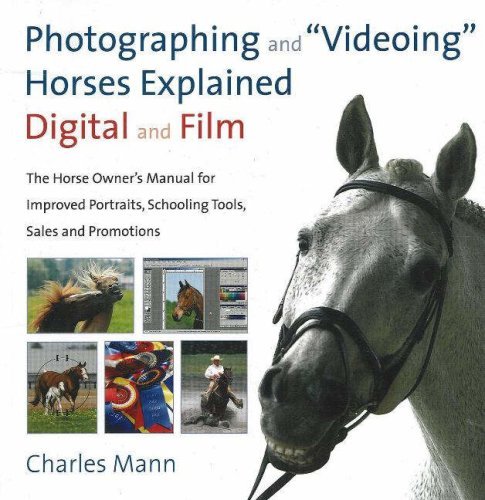
Photographing and Videoing Horses Explained: Digital and Film: The Horse Owner's Manual for Improved Portraits, Schooling Tools, Sales and Promotions
by Charles C. Mann
Rating: 4.0 ⭐
The perfect practical introduction to photographing and "videoing" horses and a valuable money-earning reference book.

Kolumbus' Erbe: Wie Menschen, Tiere, Pflanzen die Ozeane überquerten und die Welt von heute schufen
by Charles C. Mann
Rating: 4.6 ⭐
«Das beste Sachbuch des Jahres.» TIMEDie Entdeckung Amerikas war für das Leben auf unserem Planeten das folgenreichste Ereignis seit dem Aussterben der Dinosaurier. Millionen Jahre waren die Hemisphären weitgehend voneinander isoliert gewesen. Mit Kolumbus traten sie in einen Austausch. Menschen und Pflanzen, Tiere und Krankheiten gelangten per Schiff in neue Lebensräume und schufen eine Welt, in der nichts blieb, wie es einmal gewesen war. Das hatte auch gravierende politische Der «kolumbische Austausch» trug mehr als alles andere dazu bei, dass Europa zur Weltmacht aufstieg und China verdrängte. Charles C. Mann zeichnet ein spannendes Panorama dieser Vorgänge, das Kontinente und Jahrhunderte umfasst. Ein großartiges Lesevergnügen für alle Wissensdurstigen!«Herausragend.» The New York Times«Ein faszinierendes und vielschichtiges Buch, das auf vorbildliche Weise sprechende Fakten mit gutem Geschichtenerzählen vereint.» The Washington Post

Ocho décadas después de Colón, un español llamado Legazpi triunfó donde Colón había fracasado. Navegó hacia el oeste para establecer un comercio continuo con China, entonces el país más rico y poderoso del mundo. En Manila, ciudad fundada por Legazpi, la plata de América extraída por esclavos africanos e indios, se vendía a los asiáticos a cambio de seda para los europeos. Fue la primera vez que bienes y personas de todos los rincones del mundo estaban conectados en un único intercambio mundial. Así como Colón creó un nuevo mundo biológicamente, Legazpi y el imperio español al que sirvió crearon un nuevo mundo económicamente.En esta historia Mann descubre el germen de las disputas políticas más feroces de la actualidad, desde la inmigración hasta la política comercial y las guerras culturales. En 1493, Mann ha vuelto a ofrecer a los lectores una interpretación científica reveladora de nuestro pasado sin igual en su autoridad y fascinación


The teaching of physics for purposes of general education
by Charles C. Mann
The teaching of physics for purposes of general education 342 Pages.

Tales from the Rails: and Other Stories from my Life
by Charles C. Mann
My dad, Charles William Mann, was born in 1927 in Prescott, a small town in rural Arkansas. He left home at seventeen to work in the Houston shipyards. He then joined the Merchant Marines and sailed around the world at the end of WW II. His odyssey continued when he returned to Arkansas and married Mary Frances Ward. After holding jobs as a route salesman for the El Dorado Coffee Company, running a paint-manufacturing plant and selling life insurance, Charles went to work in the train yards of the Cotton Belt Railroad as a painter in 1964 in Pine Bluff, Arkansas. That new beginning led to a position as a union labor representative with the Brotherhood of Railway Carmen, a role which would ultimately carry him all the way to the national offices in Washington D.C. This miscellaneous collection of stories spans the breadth of his life from his childhood in Prescott to white collar Washington D.C. and back again. Much has been omitted or lost, but I hope that all who stop to visit the journey he took will discover something, not just about the nature of the times in which he lived, but about the special nature of the man.

I Like to Live the Love Sheet Music
by Charles C. Mann
Digital Sheet Music of I Like to Live the Love Composed Charles Mann;Dave Crawford

LA MONTEE DES EAUX
by Charles C. Mann
Ce qui est problématique pour l’humanité n’est pas forcément mauvais pour les affaires.
NATIVE AMERICANS ARE RECLAIMING THEIR LAND
by Charles C. Mann
The journalist's dilemma.(GEOGRAPHICAL REVIEW FORUM: REFLECTIONS ON CHARLES C. MANN'S 1491*): An article from: The Geographical Review
by Charles C. Mann