
Chögyam Trungpa
Vidyadhara Chögyam Trungpa Rinpoche (Tibetan: ཆོས་ རྒྱམ་ དྲུང་པ་ Wylie: Chos rgyam Drung pa; also known as Dorje Dradul of Mukpo, Surmang Trungpa, after his monastery, or Chökyi Gyatso, of which Chögyam is an abbreviation) was a Buddhist meditation master, scholar, teacher, poet, and artist. He was the 11th descendent in the line of Trungpa tulkus of the Kagyü school of Tibetan Buddhism. He was also trained in the Nyingma tradition, the oldest of the four schools, and was an adherent of the rimay or "non-sectarian" movement within Tibetan Buddhism, which aspired to bring together and make available all the valuable teachings of the different schools, free of sectarian rivalry. Trungpa was a significant figure in the dissemination of Tibetan Buddhism to the West, founding Naropa University and establishing the Shambhala Training method, a presentation of the Buddhadharma largely devoid of ethnic trappings. In 1963, he moved to England to study comparative religion, philosophy, and fine arts at Oxford University. During this time, he also studied Japanese flower arranging and received an instructors degree from the Sogetsu school of ikebana. In 1967, he moved to Scotland, where he founded the Samye Ling meditation centre. Shortly thereafter, a variety of experiences—including a car accident that left him partially paralyzed on the left side of his body—led him to give up his monastic vows and work as a lay teacher. In 1969, he published Meditation in Action , the first of fourteen books on the spiritual path published during his lifetime. The following year he married Diana Pybus and moved to the United States, where he established his first North American meditation centre, Tail of the Tiger (now known as Karmê-Chöling) in Barnet, Vermont. In 1986, he moved to Nova Scotia, Canada, where hundreds of his students had settled. That Autumn, after years of heavy alcohol use, he had a cardiac arrest, and he died of heart failure the following Spring. His legacy is carried on by his son, Sakyong Mipham Rinpoche, under the banner of Shambhala International and the Nalanda Translation Committee.
30 Books Written

In this modern spiritual classic, the Tibetan meditation master Chögyam Trungpa highlights the commonest pitfall to which every aspirant on the spiritual path falls prey: what he calls spiritual materialism. The universal tendency, he shows, is to see spirituality as a process of self-improvement—the impulse to develop and refine the ego when the ego is, by nature, essentially empty. "The problem is that ego can convert anything to its own use," he said, "even spirituality." His incisive, compassionate teachings serve to wake us up from this trick we all play on ourselves, and to offer us a far brighter reality: the true and joyous liberation that inevitably involves letting go of the self rather than working to improve it. It is a message that has resonated with students for nearly thirty years, and remains fresh as ever today. This new edition includes a foreword by Chögyam Trungpa's son and lineage holder, Sakyong Mipham.

In this practical guide to enlightened living, Chögyam Trungpa offers an inspiring vision for our time, based on the figure of the sacred warrior. In ancient times, the warrior learned to master the challenges of life, both on and off the battlefield. He acquired a sense of personal freedom and power—not through violence or aggression, but through gentleness, courage, and self-knowledge. The Japanese samurai, the warrior-kings of Tibet, the knights of medieval Europe, and the warriors of the Native American tribes are a few examples of this universal tradition of wisdom. With this book the warrior's path is opened to contemporary men and women in search of self-mastery and greater fulfillment. Interpreting the warrior's journey in modern terms, Trungpa discusses such skills as synchronizing mind and body, overcoming habitual behaviors, relaxing within discipline, facing the world with openness and fearlessness, and finding the sacred dimension of everyday life. Above all, Trungpa shows that in discovering the basic goodness or human life, the warrior learns to radiate that goodness out into the world for the peace and sanity of others. The Shambhala teachings—named for a legendary Himalayan kingdom where prosperity and happiness reign—thus point to the potential for enlightened conduct that exists within every human being. "The basic wisdom of Shambhala," Trungpa writes, "is that in this world, as it is, we can find a good and meaningful human life that will also serve others. That is our true richness."

Using this book could be hazardous to your ego! The slogans it contains are designed to awaken the heart and cultivate love and kindness toward others. They are revolutionary in that practicing them fosters abandonment of personal territory in relating to others and in understanding the world as it is.The fifty-nine provocative slogans presented here—each with a commentary by the Tibetan meditation master Chögyam Trungpa—have been used by Tibetan Buddhists for eight centuries to help meditation students remember and focus on important principles and practices of mind training. They emphasize meeting the ordinary situations of life with intelligence and compassion under all circumstances. Slogans include, "Don't be swayed by external circumstances," "Be grateful to everyone," and "Always maintain only a joyful mind."This edition contains a new foreword by Pema Chödrön.

Freedom is generally thought of as the ability to achieve goals and satisfy desires. But what are the sources of these goals and desires? If they arise from ignorance, habitual patterns, and negative emotions, is the freedom to pursue these goals true freedom—or is it just a myth? In this book, Chögyam Trungpa explores the meaning of freedom in the profound context of Tibetan Buddhism. He shows how our attitudes, preconceptions, and even our spiritual practices can become chains that bind us to repetitive patterns of frustration and despair. He also explains how meditation can bring into focus the causes of frustration, and how these negative forces can aid us in advancing toward true freedom. Trungpa's unique ability to express the essence of Buddhist teachings in the language and imagery of contemporary American culture makes this book one of the best sources of the Buddhist doctrine ever written. This edition also contains a foreword by Pema Chödrön, a close student of Chögyam Trungpa and the best-selling author of When Things Fall Apart.

Many of us, without even realizing it, are dominated by fear. We might be aware of some of our fears—perhaps we are afraid of public speaking, financial hardship, or losing a loved one. But in this book meditation master Chögyam Trungpa shows us that most of us suffer from a far more pervasive form of fear: the fear of ourselves. We feel ashamed and embarrassed to look at our feelings or acknowledge our styles of thinking and behaving; we don’t want to face the reality of our moment-to-moment experience. It is this fear that keeps us trapped in cycles of suffering, despair, and distress. Chögyam Trungpa offers us a vision of moving beyond fear to discover the innate bravery, trust, and delight in life that lies at the core of our being. Drawing on the Shambhala tradition and on Buddhist teachings, he explains how we can each become a spiritual warrior: a person who faces each moment of life with openness and fearlessness. “The ultimate definition of bravery is not being afraid of who you are,” writes Chögyam Trungpa. In language that is fresh, accessible, and startlingly direct, this book explains: • how the practice of sitting meditation can help us to uncover our inherent confidence and bravery, • how fear and embarrassment about ourselves keep us trapped in cycles of suffering, • the wisdom of loving-kindness and nonaggression, • how true invincibility depends on becoming more open and vulnerable. Here are the essential insights and strategies that will allow us to finally claim victory over fear.

This classic teaching by a Tibetan master continues to inspire both beginners and long-time practitioners of Buddhist meditation. Chögyam Trungpa Rinpoche shows that meditation extends beyond the formal practice of sitting to build the foundation for compassion, awareness, and creativity in all aspects of life.He explores the six activities associated with meditation in action—generosity, discipline, patience, energy, clarity, and wisdom—revealing that through simple, direct experience, one can attain real the ability to see clearly into situations and deal with them skillfully, without the self-consciousness connected with ego.

The revered Buddhist teacher examines the life of Guru Rinpoche and the awakened state of mind known as "crazy wisdom"Chögyam Trungpa describes "crazy wisdom" as an innocent state of mind that has the quality of early morning—fresh, sparkling, and completely awake. This fascinating book examines the life of Padmasambhava, or Guru Rinpoche—the revered Indian teacher who brought Buddhism to Tibet—to illustrate the principle of crazy wisdom. From this profound point of view, spiritual practice does not provide comfortable answers to pain or confusion. On the contrary, painful emotions can be appreciated as a challenging opportunity for new discovery. In particular, the author discusses meditation as a practical way to uncover one's own innate wisdom.

According to the Buddha, no one can attain basic sanity or enlightenment without practicing meditation. The teachings given here on the outlook and technique of meditation provide the foundation that every practitioner needs to awaken as the Buddha did. Trungpa teaches us to let go of the urge to make meditation serve our ambition; thus we can relax into openness. We are shown how the deliberate practice of mindfulness develops into contrived awareness, and we discover the world of insight that awareness reveals. We learn of a subtle psychological stage set that we carry with us everywhere and unwittingly use to structure all our experience—and we find that meditation gradually carries us beyond this and beyond ego altogether to the experience of unconditioned freedom.
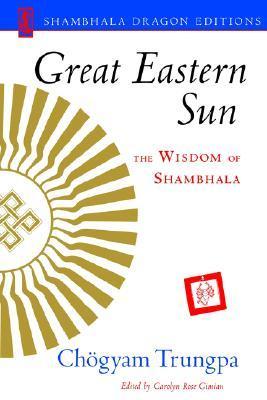
Chögyam Trungpa had a vision of a society of enlightened people, or at least of people on the path to enlightenment. These are the Shambhala warriors, people "brave enough not to give in to the aggression and contradictions that exist in society." A companion volume to Trungpa's classic Shambhala: The Sacred Path of the Warrior, Great Eastern Sun is an invitation for all people to discover their own goodness, which is always there, just as the sun is always rising. Trungpa had an uncanny grasp of the hang-ups and excuses that keep Westerners in their safe ego cocoons, and in Great Eastern Sun he entices us all out, to express our goodness and live a life on the edge of insecurity. The mindful life turns out to be one of detached but sacred existence, floating with the power of compassionate awareness. A genuine life is what Trungpa propels us to, and Great Eastern Sun is his lantern for guiding us down the path of genuine living. --Brian Bruya

Insightful teachings on bringing mindfulness and awareness—the fruits of a steady meditation practice—to the key aspects of daily lifeEach day we deal with the challenges of ordinary a series of mundane experiences that could be summarized by the title of this book, Work, Sex, Money . We all hope that these aspects of our life will be a source of fulfillment and pleasure, and they often are. Yet they are also always sources of problems for which we seek practical advice and solutions. The best prescription, according to Chögyam Trungpa, is a dose of reality and also a dose of respect for ourselves and our world. His profound teachings on work, sex, and money celebrate the sacredness of life and our ability to cope with its twists and turns with dignity, humor, and even joy.He begins by breaking down the barrier between the spiritual and the mundane, showing that work, sex, and money are just as much a part of our spiritual life as they are a part of our everyday existence. He then discusses these subjects in relation to ego and self-image, karma, mindfulness, and meditation. “Work” includes general principles of mindfulness and awareness in how we conduct everyday life as well as discussion of ethics in business and the workplace. “Sex” is about relationships and communication as a whole. “Money” looks at how we view the economics of livelihood and money as “green energy” that affects our lives. The result is an inclusive vision of life, one that encompasses the biggest issues and the smallest details of every day.There are, in fact, few definitive answers in these pages. There is, however, authentic wisdom providing us with tools we need to work with the toughest stuff in our lives.
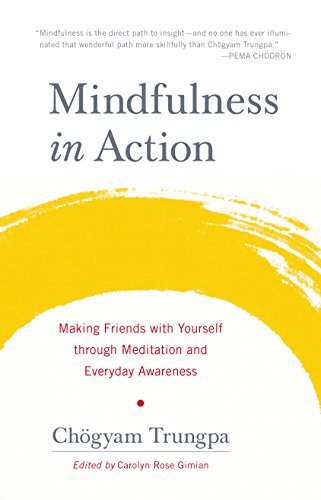
Mindfulness in Action: Making Friends with Yourself through Meditation and Everyday Awareness
by Chögyam Trungpa
Rating: 4.1 ⭐
“One of the great spiritual leaders of all times” offers mindfulness meditations and guidance on how to bring awareness into everyday life with “an illuminating wisdom that dances through every page” (Tara Brach, PhD, author of Radical Acceptance) The rewards of mindfulness practice are well reduced stress, improved concentration, and an overall sense of well-being. But those benefits are just the beginning. Mindfulness in action—mindfulness applied throughout life—can help us work more effectively with life’s challenges, expanding our appreciation and potential for creative engagement. This guide to mindful awareness through meditation provides all the basics to get you started, but also goes deeper to address the questions that naturally arise as your practice matures and further insight arises. A distillation of teachings on the subject by one of the great meditation masters of our time, this book serves as an introduction to the practice as well as a guide to the ongoing mindful journey. “Mindfulness is the direct path to insight—and no one has ever illuminated that wonderful path more skillfully than Chögyam Trungpa.” —Pema Chödrön

The first volume of this landmark series presents the teachings of the hinayana. The hinayana introduces core Buddhist teachings on the nature of mind, the practice of meditation, the reality of suffering, and the possibility of liberation. It examines the nature of suffering, impermanence, and egolessness, with an emphasis on personal development through meditative discipline and study. The formal entry into the hinayana and the Buddhist path altogether is the refuge vow, in which a student goes for refuge to the Buddha, or the teacher; the dharma, or the teachings; and the sangha, or the community. The hinayana path is based on training in mindfulness and awareness, cultivating virtue, and cutting grasping. Topics covered in detail in this volume include the four noble truths, karma, the four foundations of mindfulness, meditation practice, the refuge vows, the three jewels, the five skandhas, the five precepts, twofold egolessness, and more.The Profound Treasury of the Ocean of Dharma represents meditation master Chögyam Trungpa’s greatest contribution to Western Buddhism. This three-volume collection presents in lively, relevant language the comprehensive teachings of the Tibetan Buddhist path of the hinayana, mahayana, and vajrayana. This work will resonate with new students of Buddhism as well as the most senior students.

This compelling collection of essays, talks, and seminars by Chögyam Trungpa presents the basic teachings of Buddhism as they relate to everyday life. The book is divided into three parts. In "Personal Journey," the author discusses the qualities of openness, inquisitiveness, and good humor that characterize the enlightened Buddha-nature in everyone. In "Stages on the Path," he presents the three vehicles—Hinayana, Mahayana, and Vajrayana—that carry the Buddhist practitioner toward enlightenment. In "Working with Others," he describes the direct application of Buddhist teachings in such areas as relationships, children, and money. Chögyam Trungpa's great appreciation of Western culture combined with his deep understanding of the Tibetan tradition makes these teachings uniquely accessible to Western readers.

More and more mental health professionals are discovering the rich tradition of Buddhist psychology and integrating its insights into their work with clients. Buddhist tradition teaches that all of us are born with what Chögyam Trungpa terms "basic sanity," or inherent goodness, health, and clear perception. Helping ourselves and others to connect with this intrinsic ground of sanity and health is the subject of this collection of teachings, which the author gave to Western psychologists, psychotherapists, and students of Buddhist meditation over a number of years. The Sanity We Are Born With describes how anyone can strengthen their mental health, and it also addresses the specific problems and needs of people in profound psychological distress. Additionally, the author speaks to the concerns of psychotherapists and any health care professionals who work with their patients' states of mind. The collection includes teachings on: • Buddhist concepts of mind, ego, and intelligence, and how these ideas can be employed in working on oneself and with others • meditation as a way of training the mind and cultivating mindfulness • nurturing our intrinsic health and basic sanity • guidance for psychotherapists and health professionals

Chögyam Trungpa—meditation master, scholar, and artist—was identified at the age of only thirteen months as a major tulku , or reincarnation of an enlightened teacher. As the eleventh in the teaching lineage known as the Trungpa tulkus, he underwent a period of intensive training in meditation, philosophy, and fine arts, receiving full ordination as a monk in 1958 at the age of eighteen. The following year, the Chinese Communists invaded Tibet, and the young Trungpa spent many harrowing months trekking over the Himalayas, narrowly escaping capture.Trungpa's account of his experiences as a young monk, his duties as the abbot and spiritual head of a great monastery, and his moving relationships with his teachers offers a rare and intimate glimpse into the life of a Tibetan lama. The memoir concludes with his daring escape from Tibet to India. In an epilogue, he describes his emigration to the West, where he encountered many people eager to learn about the ancient wisdom of Tibetan Buddhism.

The truth of life has never been better or more succinctly articulated than in the Buddha's teaching on suffering, its cause, and its cessation—the famous formulation known as the Four Noble Truths. This concise handful of words is in fact the foundation from which all subsequent Buddhist teachings grow, and upon which all of them rely. Their wisdom is as pertinent to the scholar of Buddhist philosophy as it is to the ordinary practitioner, as it is indeed to anyone, anywhere, who aspires to liberation.Chögyam Trungpa's in-depth exploration of the Four Noble Truths reveals the subtlety and sophistication that lie beneath these deceptively simple teachings. He emphasizes their profound relevance not just as an inspiration when we set out on the path but at every other moment of our lives as well, showing how we can join view (intellectual understanding) of the teaching with practical application in order to interrupt suffering before it arises.His teaching is, as always, refreshingly direct and profoundly inspiring. The Truth of Suffering is an ideal introduction to the Four Noble Truths for the beginner as well as for the experienced practitioner in search of deeper understanding.

Based on the author's talks at Naropa University, this volume introduces the reader to the principles of tantra, based on the practice of meditation, which leads to the discovery of egolessness. Trungpa Rinpoche provides a direct and experiential picture of the tantric world, explaining the importance of self-existing energy, the mandala principle, the difference between Buddhist and Hindu tantra—stressing the nontheistic foundation of Buddhism. The role of the teacher and the meaning of tantric transmission are also presented. Written for the student of Buddhism rather than the scholar, Journey without Goal demystifies the vajrayana and at the same time affirms the power and sacredness of its ancient teaching.

The Abhidharma is a collection of Buddhist scriptures that investigate the workings of the mind and the states of human consciousness. In this book, Chögyam Trungpa shows how an examination of the formation of the ego provides us with an opportunity to develop real intelligence. Trungpa also presents the practice of meditation as the means that enables us to see our psychological situation clearly and directly.

Genuine art has the power to awaken and liberate. The renowned meditation master and artist Chögyam Trungpa called this type of art “dharma art”—any creative work that springs from an awakened state of mind, characterized by directness, unselfconsciousness, and nonaggression. Dharma art provides a vehicle to appreciate the nature of things as they are and express it without any struggle or desire to achieve. A work of dharma art brings out the goodness and dignity of the situation it reflects—dignity that comes from the artist’s interest in the details of life and sense of appreciation for experience. Trungpa shows how the principles of dharma art extend to everyday any activity can provide an opportunity to relax and open our senses to the phenomenal world.An expanded edition of Trungpa's Dharma Art (1996), this book includes a new introduction and essay.

Based on a series of talks given by Chögyam Trungpa during the first session of what was to become Naropa University, Cynicism and Magic introduces key Tibetan Buddhist concepts, including karma, the structure of ego, the paramitas, and the bodhisattva. Employing a unique and intimate teaching style, Trungpa Rinpoche presents these concepts in a larger framework of questions we all have: What is authentic spirituality? Can I find enlightenment and freedom? How should I approach life, death, suffering, and boredom? How can I develop some discipline, patience, and sanity? Whether you are new to Buddhism or returning to the fundamentals of your practice, this book will guide you toward experiencing a living dharma intelligently, with a sense of openness and wonder.

The second volume in this landmark series presents the bodhisattva teachings of the mahayana. At this point, having trained and seen the benefits of looking within, the student begins to shift their focus outward to the broader world. Formal entry into the mahayana occurs with taking the bodhisattva vow. Mahayana practitioners dedicate themselves to the service of all sentient beings, aspiring to save them from sorrow and confusion, and vowing to bring them to perfect liberation. This stage of the path emphasizes the cultivation of wisdom through the view and experience of emptiness, or shunyata , in which all phenomena are seen to be unbounded, completely open, ungraspable, and profound. From the ground of shunyata, compassionate activity is said to arise naturally and spontaneously. In addition to mindfulness and awareness, the mahayanist practices lojong , or “mind training,” based on the cultivation of the paramitas , or “transcendent virtues”: generosity, discipline, patience, exertion, meditation, and prajna, or “knowledge.” As a component of lojong, tonglen , or “sending and taking,” is practiced in order to increase maitri , or loving-kindness. Other topics covered in detail in this volume include bodhichitta , skillful means, Buddha nature and basic goodness, Madhyamaka, the ten bhumis , the three kayas , and more.The Profound Treasury of the Ocean of Dharma represents meditation master Chögyam Trungpa’s greatest contribution to Western Buddhism. This three-volume collection presents in lively, relevant language the comprehensive teachings of the Tibetan Buddhist path of the hinayana, mahayana, and vajrayana. This work will resonate with new students of Buddhism as well as the most senior students.

A pocket-sized treasury of short teachings on living life with courage and compassion—from one of the most influential Buddhist teachers of our timeChögyam Trungpa (1940–1987), one of the most influential Tibetan meditation masters to practice and teach in the West, used to say that wisdom can be taught only in the form of a hint —a hint that inclines us to recognize the wisdom in us all along. Here are 108 marvelous hints from the renowned teacher so supremely skilled at dropping them. The Pocket Chögyam Trungpa will serve as a compact introduction to his teachings for those not yet familiar with him—and as a wonderful source of daily inspiration for those who are.The Shambhala Pocket Library is a collection of short, portable teachings from notable figures across religious traditions and classic texts. The covers in this series are rendered by Colorado artist Robert Spellman. The books in this collection distill the wisdom and heart of the work Shambhala Publications has published over 50 years into a compact format that is collectible, reader-friendly, and applicable to everyday life.

The Tibetan word bardo is usually associated with life after death. Here, Chögyam Trungpa discusses bardo in a very different as the peak experience of any given moment. Our experience of the present moment is always colored by one of six psychological the god realm (bliss), the jealous god realm (jealousy and lust for entertainment), the human realm (passion and desire), the animal realm (ignorance), the hungry ghost realm (poverty and possessiveness), and the hell realm (aggression and hatred). In relating these realms to the six traditional Buddhist bardo experiences, Trungpa provides an insightful look at the "madness" of our familiar psychological patterns and shows how they present an opportunity to transmute daily experience into freedom.

According to the mandala principle, a prominent feature of tantric Buddhism, all phenomena are part of one reality. Whether good or bad, happy or sad, clear or obscure, everything is interrelated and reflects a single totality. As Chögyam Trungpa explains in this work, from the perspective of the mandala principle, existence is orderly chaos. There is chaos and confusion because everything happens by itself, without any external ordering principle. At the same time, whatever happens expresses order and intelligence, wakeful energy and precision. Through meditative practices associated with the mandala principle, the opposites of experience—confusion and enlightenment, chaos and order, pain and pleasure—are revealed as inseparable parts of a total vision of reality.

In what he calls a "200 percent potent" teaching, Chögyam Trungpa reveals how the spiritual path is a raw and rugged "unlearning" process that draws us away from the comfort of conventional expectations and conceptual attitudes toward a naked encounter with reality. The tantric paradigm for this process is the story of the Indian master Naropa (1016–1100), who is among the enlightened teachers of the Kagyu lineage of the Tibetan Buddhism. Naropa was the leading scholar at Nalanda, the Buddhist monastic university, when he embarked upon the lonely and arduous path to enlightenment. After a series of daunting trials, he was prepared to receive the direct transmission of the awakened state of mind from his guru, Tilopa. Teachings that he received, including those known as the six doctrines of Naropa, have been passed down in the lineages of Tibetan Buddhism for a millennium. Trungpa's commentary shows the relevance of Naropa's extraordinary journey for today's practitioners who seek to follow the spiritual path. Naropa's story makes it possible to delineate in very concrete terms the various levels of spiritual development that lead to the student's readiness to meet the teacher's mind. Trungpa thus opens to Western students of Buddhism the path of devotion and surrender to the guru as the embodiment and representative of reality.

Transcripts of two seminars given during the 1970s introduce the tantric teachings of Tibetan Buddhism to western audiences

Chögyam Trungpa wrote more than two dozen books on Buddhism and the Shambhala path of warriorship. The Essential Chögyam Trungpa blends excerpts from bestsellers like The Sacred Path of the Warrior, Cutting Through Spiritual Materialism, Meditation in Action, and other titles into a concise overview of Trungpa's teachings. Forty selections from fourteen different books articulate the secular path of the Shambhala warrior as well as the Buddhist path of meditation and awakening. This "new classic" vividly demonstrates Trungpa's great appreciation of Western culture which, combined with his deep understanding of the Tibetan tradition, makes these teachings uniquely accessible to contemporary readers. It will appeal to beginning students of meditation as well as seasoned readers of Eastern religion.

The Collected Works, Vol. 3: Cutting Through Spiritual Materialism / The Myth of Freedom / The Heart of the Buddha / Selected Writings
by Chögyam Trungpa
Rating: 4.6 ⭐
The Collected Works of Chögyam Trungpa brings together in eight volumes the writings of the first and most influential and inspirational Tibetan teacher to present Buddhism in the West. Organized by theme, the collection includes full-length books as well as articles, seminar transcripts, poems, plays, and interviews, many of which have never before been available in book form. From memoirs of his escape from Chinese-occupied Tibet to insightful discussions of psychology, mind, and meditation; from original verse and calligraphy to the esoteric lore of tantric Buddhism—the impressive range of Trungpa's vision, talents, and teachings is showcased in this landmark series. Volume Three captures the distinctive voice that Chögyam Trungpa developed in North America in the 1970s and reflects the preoccupations among Western students of that era. It includes Cutting Through Spiritual Materialism and The Myth of Freedom, the two books that put Chögyam Trungpa on the map of the American spiritual scene. The Heart of the Buddha and sixteen articles and forewords complete this volume.

"Dharma art" refers to creative works that spring from the awakened meditative state, characterized by directness, unselfconsciousness, and nonaggression. Trungpa Rinpoche shows that dharma art provides a vehicle to appreciate the nature of things as they are and express it without any struggle or desire to achieve.

Chögyam Trungpa explores the the vajrayana teachings of the tantric path in this final volume of his masterpiece on Tibetan Buddhism This three-volume collection presents in lively, relevant language the comprehensive teachings of the Tibetan Buddhist path of the hinayana, mahayana, and vajrayana. Considered Chögyam Trungpa’s magnum opus, The Profound Treasury of the Ocean of Dharma will resonate with new and senior students of Buddhism. In this third and final volume, Chögyam Trungpa’s examines the vajrayana teachings of the tantric path. The vajrayana, or "diamond vehicle," also referred to as tantra, draws upon and extends the teachings of the hinayana and mahayana. As with the hinayana and the mahayana, the formal acceptance into the vajrayana is marked by a vow, in this case the samaya vow. There is an emphasis at this stage on the student-teacher relationship and on the quality of devotion. Generally, students must complete preliminary practices, called ngöndro , to prepare themselves for initiation into the vajrayana path before going further. Having done so, they then receive the appropriate empowerments to begin tantric practices. There are empowerment ceremonies of many kinds, called abhishekas . The vajrayana includes both form practices, such as visualizations and sadhanas (ritual liturgies), and formless practices based on allowing the mind to rest naturally in its inherent clarity and emptiness. Although on the surface, there is much greater complexity in tantric practices, the principles of mindfulness and awareness and the cultivation of compassion and skillful action continue to be of central importance. The tantric path requires complete engagement and fierce dedication. It is said to be a more rapid path, but it is also more dangerous. There is a quality of directness, abruptness, and wholeheartedness. Tantrikas , or vajrayana practitioners, recognize that the most challenging aspects of life, the energies and play of confused emotions and frightening obstacles, can be worked with as gateways to freedom and realization. Other topics covered in detail in this volume include the four reminders, the mandala principle, mahamudra, atiyoga, and more.