Cesar A. Hidalgo
2 Books Written

What is economic growth? And why, historically, has it occurred in only a few places? Previous efforts to answer these questions have focused on institutions, geography, finances, and psychology. But according to MIT's antidisciplinarian César Hidalgo, understanding the nature of economic growth demands transcending the social sciences and including the natural sciences of information, networks, and complexity. To understand the growth of economies, Hidalgo argues, we first need to understand the growth of order.At first glance, the universe seems hostile to order. Thermodynamics dictates that over time, order-or information-disappears. Whispers vanish in the wind just like the beauty of swirling cigarette smoke collapses into disorderly clouds. But thermodynamics also has loopholes that promote the growth of information in pockets. Although cities are all pockets where information grows, they are not all the same. For every Silicon Valley, Tokyo, and Paris, there are dozens of places with economies that accomplish little more than pulling rocks out of the ground. So, why does the US economy outstrip Brazil's, and Brazil's that of Chad? Why did the technology corridor along Boston's Route 128 languish while Silicon Valley blossomed? In each case, the key is how people, firms, and the networks they form make use of information.Seen from Hidalgo's vantage, economies become distributed computers, made of networks of people, and the problem of economic development becomes the problem of making these computers more powerful. By uncovering the mechanisms that enable the growth of information in nature and society, Why Information Grows lays bear the origins of physical order and economic growth. Situated at the nexus of information theory, physics, sociology, and economics, this book propounds a new theory of how economies can do not just more things, but more interesting things.
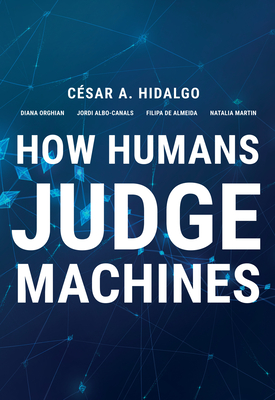
A detailed examination of people's reactions to machine actions as compared to human actions. Through dozens of experiments, this book explores when and why people judge humans and machines differently. How would you feel about losing your job to a machine? How about a tsunami alert system that fails? Would you react differently to acts of discrimination depending on whether they were carried out by a machine or by a human? What about public surveillance?How Humans Judge Machines compares people's reactions to actions performed by humans and machines. Using data collected in dozens of experiments, this book reveals the biases that permeate human-machine interactions.Are there conditions in which we judge machines unfairly? Is our judgment of machines affected by the moral dimensions of a scenario? Is our judgment of machine correlated with demographic factors such as education or gender?César Hidalgo and colleagues use hard science to take on these pressing technological questions. Using randomized experiments, they create revealing counterfactuals and build statistical models to explain how people judge artificial intelligence and whether they do it fairly. Through original research, How Humans Judge Machines bring us one step closer tounderstanding the ethical consequences of AI.