
Cass R. Sunstein
Cass R. Sunstein is an American legal scholar, particularly in the fields of constitutional law, administrative law, environmental law, and law and behavioral economics, who currently is the Administrator of the White House Office of Information and Regulatory Affairs in the Obama administration. For 27 years, Sunstein taught at the University of Chicago Law School, where he continues to teach as the Harry Kalven Visiting Professor. Sunstein is currently Professor of Law at Harvard Law School, where he is on leave while working in the Obama administration.
31 Books Written

Nudge, édition mise à jour et augmentée: Édition ultime du best-seller du prix Nobel d’économie
by Cass R. Sunstein
Rating: 4.0 ⭐
• 1 recommendation ❤️
La nouvelle édition du livre fondateur sur le nudge : le livre de référence sur l'économie comportementale.Richard Thaler, spécialiste de l’économie comportementale, prix Nobel d’économie, et Cass Sunstein, l’un des plus grands juristes américains, nous invitent à expérimenter le nudge. Le nudge, c’est le monde des incitations douces, à l’image des parents éléphants qui donnent un léger coup de trompe à leurs petits pour leur permettre d’aller dans la bonne direction. Ce livre, à l’origine du phénomène Nudge, s’appuie sur les recherches comportementales les plus poussées pour prendre de meilleures décisions. Il engage le lecteur à changer fondamentalement sa façon de penser, tout en préservant sa liberté de choix. Mise à jour, enrichie et augmentée, cette édition analyse les effets du nudge et expose notamment les critiques formulées à son encontre. Elle intègre également de nouveaux thèmes majeurs : la Covid-19, la transparence de l’information, le sludge... Enfin, elle traite avec un regard neuf des questions telles que le changement climatique, le don d’organe, les finances personnelles… Cette approche originale de l’économie comportementale nous donne un gentil coup de pouce (« Nudge » en anglais) pour aborder facilement des questions sérieuses.
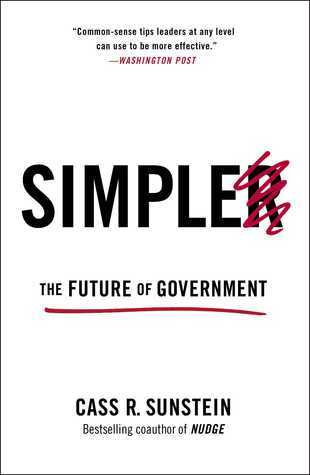
For nearly four years, Cass R. Sunstein, bestselling author and President Obama’s “Regulatory Czar,” helped to oversee a revolution in better government. He explains how and why—and what comes next.The future of government arrived four years ago. Government became simpler, it became smarter, and Cass Sunstein was at the center of it all. Drawing on state-of-the-art work in behavioral psychology and economics, Sunstein, as administrator of the powerful White House Office of Information and Regulatory Affairs (OIRA), quietly helped save the nation billions of dollars while preventing thousands of deaths and countless illnesses and accidents. All this was accomplished in part through the extraordinary power of nudges—low-cost, seemingly modest policies that preserve freedom of choice. In combination with smart, disciplined cost-benefit analysis, nudges are simplifying government and making it far more effective.Twenty-first century insights now inform simplified mortgage and student loan applications, the labeling of food and energy-efficient cars, financial reform, and health care reform. New principles—democratizing data, presenting individuals and businesses with the most salient information, ensuring that the better outcome is the automatic outcome—are transforming government. Countless regulations are being streamlined or eliminated. Transparent review of which rules are working, and which aren’t, is becoming the norm. Citing numerous examples from his years in the first term of the Obama Administration, and projecting forward into a data-driven future, Simpler provides a new understanding of how government can work.

There’s Santa Claus, Shakespeare, Mickey Mouse, the Bible, and then there’s Star Wars. Nothing quite compares to sitting down with a young child and hearing the sound of John Williams’s score as those beloved golden letters fill the screen. In this fun, erudite, and often moving book, Cass R. Sunstein explores the lessons of Star Wars as they relate to childhood, fathers, the Dark Side, rebellion, and redemption. As it turns out, Star Wars also has a lot to teach us about constitutional law, economics, and political uprisings.In rich detail, Sunstein tells the story of the films’ wildly unanticipated success and explores why some things succeed while others fail. Ultimately, Sunstein argues, Star Wars is about freedom of choice and our never-ending ability to make the right decision when the chips are down. Written with buoyant prose and considerable heart, The World According to Star Wars shines a bright new light on the most beloved story of our time.

An essential guide to the impeachment process that rises above politics and goes beyond punditry, from one of America's foremost legal experts, including analysis of the Mueller Report.As Benjamin Franklin famously put it, Americans have a republic, if we can keep it. Preserving the Constitution and the democratic system it supports is the public's responsibility. One route the Constitution provides for discharging that duty--a route rarely traveled--is impeachment.Harvard Law professor Cass R. Sunstein provides a succinct citizen's guide to this essential tool of self-government. Taking us deeper than mere partisan politics, he illuminates the constitutional design behind impeachment and emphasizes the people's role in holding presidents accountable. In spite of the loud national debate between pundits and politicians alike over whether or not to impeach Trump, impeachment remains widely misunderstood. Sunstein identifies and corrects a number of common misconceptions. For example, he shows how the Constitution, not the House of Representatives, establishes grounds for impeachment, and that the president can be impeached for abuses of power that do not violate the law. Even neglect of duty counts among the "high crimes and misdemeanors" delineated in the republic's foundational document. Sunstein describes how impeachment helps make sense of our constitutional order, particularly the framers' controversial decision to install an empowered executive in a nation deeply fearful of kings.With an eye toward the past and the future, Impeachment: A Citizen's Guide considers a host of actual and imaginable arguments for a president's removal, explaining why some cases are easy and others hard, why some arguments for impeachment have been judicious and others not. And with an appendix on the Mueller report, it puts the current national debate in its proper historical context. In direct and approachable terms, it dispels the fog surrounding impeachment so that Americans of all political convictions may use their ultimate civic authority wisely.
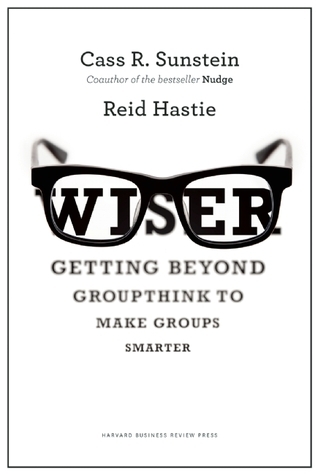
Why are group decisions so hard? Since the beginning of human history, people have made decisions in groups―first in families and villages, and now as part of companies, governments, school boards, religious organizations, or any one of countless other groups. And having more than one person to help decide is good because the group benefits from the collective knowledge of all of its members, and this results in better decisions. Right? Back to reality. We’ve all been involved in group decisions―and they’re hard. And they often turn out badly. Why? Many blame bad decisions on “groupthink” without a clear idea of what that term really means. Now, Nudge coauthor Cass Sunstein and leading decision-making scholar Reid Hastie shed light on the specifics of why and how group decisions go wrong―and offer tactics and lessons to help leaders avoid the pitfalls and reach better outcomes. In the first part of the book, they explain in clear and fascinating detail the distinct problems groups run into:

"What makes Trump immune is that he is not a president within the context of a healthy Republican government. He is a cult leader of a movement that has taken over a political party - and he specifically campaigned on a platform of one-man rule. This fact permeates "Can It Happen Here? . . . which concludes, if you read between the lines, that "it" already has." - New York Times Book ReviewSeveral of the contributors...agree that American politics is susceptible to creeping authoritarianism and provide the intellectual underpinning. - Washington PostWith the election of Donald J. Trump, many people on both the left and right feared that America's 240-year-old grand experiment in democracy was coming to an end, and that Sinclair Lewis' satirical novel, It Can't Happen Here, written during the dark days of the 1930s, could finally be coming true. Is the democratic freedom that the United States symbolizes really secure? Can authoritarianism happen in America?Acclaimed legal scholar, Harvard Professor, and New York Times bestselling author Cass R. Sunstein queried a number of the nation's leading thinkers. In this thought-provoking collection of essays, these distinguished thinkers and theorists explore the lessons of history, how democracies crumble, how propaganda works, and the role of the media, courts, elections, and fake news in the modern political landscape--and what the future of the United States may hold.Contributors include:Martha Minow, dean of Harvard Law SchoolEric Posner, law professor at the University of Chicago Law SchoolTyler Cowen, economics professor at George Mason UniversityTimur Kuran, economics and political science professor at Duke UniversityNoah Feldman, professor of law at Harvard Law SchoolJonathan Haidt, social psychologist and Professor of Ethical Leadership at New York University's Stern School of BusinessJack Goldsmith, Professor at Harvard Law School, Senior Fellow at the Hoover Institution, and co-founder of LawfareStephen Holmes, Professor of Law at New York UniversityJon Elster, Professor of the Social Sciences at Columbia UniversityThomas Ginsburg, Professor of International Law and Professor of Political Science at the University of Chicago and a member of the American Academy of Arts and SciencesCass R. Sunstein, Robert Walmsley University Professor, Harvard UniversityDuncan Watts, sociologist and principal researcher at Microsoft Research

Bestselling author Cass R. Sunstein reveals the appeal and the danger of conformityWe live in an era of tribalism, polarization, and intense social division--separating people along lines of religion, political conviction, race, ethnicity, and sometimes gender. How did this happen? In Conformity, Cass R. Sunstein argues that the key to making sense of living in this fractured world lies in understanding the idea of conformity--what it is and how it works--as well as the countervailing force of dissent.An understanding of conformity sheds new light on many issues confronting us today: the role of social media, the rise of fake news, the growth of authoritarianism, the success of Donald Trump, the functions of free speech, debates over immigration and the Supreme Court, and much more.Lacking information of our own and seeking the good opinion of others, we often follow the crowd, but Sunstein shows that when individuals suppress their own instincts about what is true and what is right, it can lead to significant social harm. While dissenters tend to be seen as selfish individualists, dissent is actually an important means of correcting the natural human tendency toward conformity and has enormous social benefits in reducing extremism, encouraging critical thinking, and protecting freedom itself.Sunstein concludes that while much of the time it is in the individual's interest to follow the crowd, it is in the social interest for individuals to say and do what they think is best. A well-functioning democracy depends on it.

The rise of the "information society" offers not only considerable peril but also great promise. Beset from all sides by a never-ending barrage of media, how can we ensure that the most accurate information emerges and is heeded? In this book, Cass R. Sunstein develops a deeply optimistic understanding of the human potential to pool information, and to use that knowledge to improve our lives.In an age of information overload, it is easy to fall back on our own prejudices and insulate ourselves with comforting opinions that reaffirm our core beliefs. Crowds quickly become mobs. The justification for the Iraq war, the collapse of Enron, the explosion of the space shuttle Columbia--all of these resulted from decisions made by leaders and groups trapped in "information cocoons," shielded from information at odds with their preconceptions. How can leaders and ordinary people challenge insular decision making and gain access to the sum of human knowledge?Stunning new ways to share and aggregate information, many Internet-based, are helping companies, schools, governments, and individuals not only to acquire, but also to create, ever-growing bodies of accurate knowledge. Through a ceaseless flurry of self-correcting exchanges, wikis, covering everything from politics and business plans to sports and science fiction subcultures, amass--and refine--information. Open-source software enables large numbers of people to participate in technological development. Prediction markets aggregate information in a way that allows companies, ranging from computer manufacturers to Hollywood studios, to make better decisions about product launches and office openings. Sunstein shows how people can assimilate aggregated information without succumbing to the dangers of the herd mentality--and when and why the new aggregation techniques are so astoundingly accurate.In a world where opinion and anecdote increasingly compete on equal footing with hard evidence, the on-line effort of many minds coming together might well provide the best path to infotopia.

Sludge: What Stops Us from Getting Things Done and What to Do about It
by Cass R. Sunstein
Rating: 3.3 ⭐
The New York Times –bestselling author of Nudge reveals h ow we became so burdened by red tape and unnecessary paperwork—and why we must do better.“If nudges have a mortal enemy, or perhaps the equivalent of antimatter to matter, it’s ‘sludge’.” — ForbesWe’ve all had to fight our way through administrative sludge—filling out complicated online forms, mailing in paperwork, standing in line at the motor vehicle registry. This kind of red tape is a nuisance, but, as Cass Sunstein shows in Sludge , it can also impair health, reduce growth, entrench poverty, and exacerbate inequality. Confronted by sludge, people just give up—and lose a promised a visa, a job, a permit, an educational opportunity, necessary medical help. In this lively and entertaining look at the terribleness of sludge, Sunstein explains what we can do to reduce it.Because of sludge, Sunstein, explains, too many people don't receive benefits to which they are entitled. Sludge even prevents many people from exercising their constitutional rights—when, for example, barriers to voting in an election are too high. (A Sludge Reduction Act would be a Voting Rights Act.) Sunstein takes readers on a tour of the not-so-wonderful world of sludge, describes justifications for certain kinds of sludge, and proposes “Sludge Audits” as a way to measure the effects of sludge. On balance, Sunstein argues, sludge infringes on human dignity, making people feel that their time and even their lives don't matter. We must do better.

As the Internet grows more sophisticated, it is creating new threats to democracy. Social media companies such as Facebook can sort us ever more efficiently into groups of the like-minded, creating echo chambers that amplify our views. It's no accident that on some occasions, people of different political views cannot even understand each other. It's also no surprise that terrorist groups have been able to exploit social media to deadly effect.Welcome to the age of #Republic.In this revealing book, Cass Sunstein, the New York Times bestselling author of Nudge and The World According to Star Wars, shows how today's Internet is driving political fragmentation, polarization, and even extremism--and what can be done about it.Thoroughly rethinking the critical relationship between democracy and the Internet, Sunstein describes how the online world creates "cybercascades," exploits "confirmation bias," and assists "polarization entrepreneurs." And he explains why online fragmentation endangers the shared conversations, experiences, and understandings that are the lifeblood of democracy.In response, Sunstein proposes practical and legal changes to make the Internet friendlier to democratic deliberation. These changes would get us out of our information cocoons by increasing the frequency of unchosen, unplanned encounters and exposing us to people, places, things, and ideas that we would never have picked for our Twitter feed.#Republic need not be an ironic term. As Sunstein shows, it can be a rallying cry for the kind of democracy that citizens of diverse societies most need.

On Rumors: How Falsehoods Spread, Why We Believe Them, What Can Be Done
by Cass R. Sunstein
Rating: 3.3 ⭐
Book by Sunstein, Cass R.

The bestselling author of Simpler offers a powerful, provocative, and convincing argument for protecting people from their own mistakes Based on a series of pathbreaking lectures given at Yale University in 2012, this powerful, thought-provoking work by national best-selling author Cass R. Sunstein combines legal theory with behavioral economics to make a fresh argument about the legitimate scope of government, bearing on obesity, smoking, distracted driving, health care, food safety, and other highly volatile, high-profile public issues. Behavioral economists have established that people often make decisions that run counter to their best interests—producing what Sunstein describes as “behavioral market failures.” Sometimes we disregard the long term; sometimes we are unrealistically optimistic; sometimes we do not see what is in front of us. With this evidence in mind, Sunstein argues for a new form of paternalism, one that protects people against serious errors but also recognizes the risk of government overreaching and usually preserves freedom of choice. Against those who reject paternalism of any kind, Sunstein shows that “choice architecture”—government-imposed structures that affect our choices—is inevitable, and hence that a form of paternalism cannot be avoided. He urges that there are profoundly moral reasons to ensure that choice architecture is helpful rather than harmful—and that it makes people’s lives better and longer.

From New York Times bestselling author Cass Sunstein, a brisk, provocative book that shows what freedom really means―and requires―todayIn this pathbreaking book, New York Times bestselling author Cass Sunstein asks us to rethink freedom. He shows that freedom of choice isn’t nearly enough. To be free, we must also be able to navigate life. People often need something like a GPS device to help them get where they want to go―whether the issue involves health, money, jobs, children, or relationships.In both rich and poor countries, citizens often have no idea how to get to their desired destination. That is why they are unfree. People also face serious problems of self-control, as many of them make decisions today that can make their lives worse tomorrow. And in some cases, we would be just as happy with other choices, whether a different partner, career, or place to live―which raises the difficult question of which outcome best promotes our well-being.Accessible and lively, and drawing on perspectives from the humanities, religion, and the arts, as well as social science and the law, On Freedom explores a crucial dimension of the human condition that philosophers and economists have long missed―and shows what it would take to make freedom real.
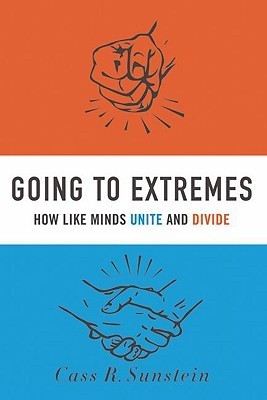
Why do people become extremists? What makes people become so dismissive of opposing views? Why is political and cultural polarization so pervasive in America?In Going to Extremes, renowned legal scholar and best-selling author Cass R. Sunstein offers startling insights into why and when people gravitate toward extremism. Sunstein marshals a wealth of evidence that shows that when like-minded people gather in groups, they tend to become more extreme in their views than they were before. Thus when liberals group get together to debate climate change, they end up more alarmed about climate change, while conservatives brought together to discuss same-sex unions become more set against same-sex unions. In courtrooms, radio stations, and chatrooms, enclaves of like-minded people are breeding ground for extreme movements. Indeed, Sunstein shows that a good way to create an extremist group, or a cult of any kind, is to separate members from the rest of society, either physically or psychologically. Sunstein's findings help to explain such diverse phenomena as political outrage on the Internet, unanticipated "blockbusters" in the film and music industry, the success of the disability rights movement, ethnic conflict in Iraq and former Yugoslavia, and Islamic terrorism. Providing a wealth of real-world examplessometimes entertaining, sometimes alarmingSunstein offers a fresh explanation of why partisanship has become so bitter and debate so rancorous in America and abroad. Praise for the hardcover: "A path-breaking exploration of the perils and possibilities created by polarization among the like-minded."Kathleen Hall Jamieson, co-author of unSpun and Echo Chamber"Poses a powerful challenge to anyone concerned with the future of our democracy. He reveals the dark side to our cherished freedoms of thought, expression and participation. Initiates an urgent dialogue which any thoughtful citizen should be interested in." James S. Fishkin, author of When the People Speak

The Second Bill of Rights: FDR's Unfinished Revolution and Why We Need It More Than Ever
by Cass R. Sunstein
Rating: 3.8 ⭐
In 1944, Franklin Delano Roosevelt gave a State of the Union Address that was arguably the greatest political speech of the twentieth century. In it, Roosevelt grappled with the definition of security in a democracy, concluding that "unless there is security here at home, there cannot be lasting peace in the world." To help ensure that security, he proposed a "Second Bill of Rights" -- economic rights that he saw as necessary to political freedom. Many of the great legislative achievements of the past sixty years stem from Roosevelt's vision. Using this speech as a launching point, Cass R. Sunstein shows how these rights are vital to the continuing security of our nation. This is an ambitious, sweeping book that argues for a new vision of FDR, of constitutional history, and our current political scene.

How much information is too much? Do we need to know how many calories are in the giant vat of popcorn that we bought on our way into the movie theater? Do we want to know if we are genetically predisposed to a certain disease? In Too Much Information, Cass Sunstein examines the effects of information on our lives. Sunstein argues that government should require companies, employers, hospitals, and others to disclose information not because of a general "right to know" but when the information in question would significantly improve people's lives.

The different ways that social change happens, from unleashing to nudging to social cascades.How does social change happen? When do social movements take off? Sexual harassment was once something that women had to endure; now a movement has risen up against it. White nationalist sentiments, on the other hand, were largely kept out of mainstream discourse; now there is no shortage of media outlets for them. In this book, with the help of behavioral economics, psychology, and other fields, Cass Sunstein casts a bright new light on how change happens.Sunstein focuses on the crucial role of social norms--and on their frequent collapse. When norms lead people to silence themselves, even an unpopular status quo can persist. Then one day, someone challenges the norm--a child who exclaims that the emperor has no clothes; a woman who says "me too." Sometimes suppressed outrage is unleashed, and long-standing practices fall.Sometimes change is more gradual, as "nudges" help produce new and different decisions--apps that count calories; texted reminders of deadlines; automatic enrollment in green energy or pension plans. Sunstein explores what kinds of nudges are effective and shows why nudges sometimes give way to bans and mandates. Finally, he considers social divisions, social cascades, and "partyism," when identification with a political party creates a strong bias against all members of an opposing party--which can both fuel and block social change.

The most controversial essays from the bestselling author once called the most dangerous man in America—collected for the first time.The nation’s most-cited legal scholar who for decades has been at the forefront of applied behavioral economics, and the bestselling author of Nudge and Simpler , Cass Sunstein is one of the world’s most innovative thinkers in the academy and the world of practical politics. In the years leading up to his confirmation as the administrator of the White House Office of Information and Regulatory Affairs (OIRA), Sunstein published hundreds of articles on everything from same-sex marriage to cost-benefit analysis. Conspiracy Theories and Other Dangerous Ideas is a collection of his most famous, insightful, relevant, and inflammatory pieces. Within these pages you will • Why perfectly rational people sometimes believe crazy conspiracy theories• What wealthy countries should and should not do about climate change• Why governments should allow same-sex marriage, and what the “right to marry” is all about• Why animals have rights (and what that means)• Why we “misfear,” meaning get scared when we should be unconcerned and are unconcerned when we should get scared• What kinds of losses make us miserable, and what kinds of losses are absolutely fine• How to find the balance between religious freedom and gender equality• And much more . . .Cass Sunstein is a unique, controversial, and exciting voice in the political world. A man who cuts through the fog of left vs. right arguments and offers logical, evidence-based, and often surprising solutions to today’s most challenging questions.

Winner of the 2021 Scribes Book AwardFrom two legal luminaries, a highly original framework for restoring confidence in a government bureaucracy increasingly derided as “the deep state.”Is the modern administrative state illegitimate? Unconstitutional? Unaccountable? Dangerous? Intolerable? American public law has long been riven by a persistent, serious conflict, a kind of low-grade cold war, over these questions.Cass Sunstein and Adrian Vermeule argue that the administrative state can be redeemed, as long as public officials are constrained by what they call the morality of administrative law. Law and Leviathan elaborates a number of principles that underlie this moral regime. Officials who respect that morality never fail to make rules in the first place. They ensure transparency, so that people are made aware of the rules with which they must comply. They never abuse retroactivity, so that people can rely on current rules, which are not under constant threat of change. They make rules that are understandable and avoid issuing rules that contradict each other.These principles may seem simple, but they have a great deal of power. Already, without explicit enunciation, they limit the activities of administrative agencies every day. But we can aspire for better. In more robust form, these principles could address many of the concerns that have critics of the administrative state mourning what they see as the demise of the rule of law. The bureaucratic Leviathan may be an inescapable reality of complex modern democracies, but Sunstein and Vermeule show how we can at last make peace between those who accept its necessity and those who yearn for its downfall.

A powerful analysis of why lies and falsehoods spread so rapidly now, and how we can reform our laws and policies regarding speech to alleviate the problem.Lying has been with us from time immemorial. Yet today is different-and in many respects worse. All over the world, people are circulating damaging lies, and these falsehoods are amplified as never before through powerful social media platforms that reach billions. Liars are saying that COVID-19 is a hoax. They are claiming that vaccines cause autism. They are lying about public officials and about people who aspire to high office. They are lying about their friends and neighbors. They are trying to sell products on the basis of untruths. Unfriendly governments, including Russia, are circulating lies in order to destabilize other nations, including the United Kingdom and the United States. In the face of those problems, the renowned legal scholar Cass Sunstein probes the fundamental question of how we can deter lies while also protecting freedom of speech.To be sure, we cannot eliminate lying, nor should we try to do so. Sunstein shows why free societies must generally allow falsehoods and lies, which cannot and should not be excised from democratic debate. A main reason is that we cannot trust governments to make unbiased judgments about what counts as "fake news." However, governments should have the power to regulate specific kinds of those that genuinely endanger health, safety, and the capacity of the public to govern itself. Sunstein also suggests that private institutions, such as Facebook and Twitter, have a great deal of room to stop the spread of falsehoods, and they should be exercising their authority far more than they are now doing. As Sunstein contends, we are allowing far too many lies, including those that both threaten public health and undermine the foundations of democracy itself.

Why policies should be based on careful consideration of their costs and benefits rather than on intuition, popular opinion, interest groups, and anecdotes. Opinions on government policies vary widely. Some people feel passionately about the child obesity epidemic and support government regulation of sugary drinks. Others argue that people should be able to eat and drink whatever they like. Some people are alarmed about climate change and favor aggressive government intervention. Others don't feel the need for any sort of climate regulation. In The Cost-Benefit Revolution , Cass Sunstein argues our major disagreements really involve facts, not values. It follows that government policy should not be based on public opinion, intuitions, or pressure from interest groups, but on numbers—meaning careful consideration of costs and benefits. Will a policy save one life, or one thousand lives? Will it impose costs on consumers, and if so, will the costs be high or negligible? Will it hurt workers and small businesses, and, if so, precisely how much? As the Obama administration's “regulatory czar,” Sunstein knows his subject in both theory and practice. Drawing on behavioral economics and his well-known emphasis on “nudging,” he celebrates the cost-benefit revolution in policy making, tracing its defining moments in the Reagan, Clinton, and Obama administrations (and pondering its uncertain future in the Trump administration). He acknowledges that public officials often lack information about costs and benefits, and outlines state-of-the-art techniques for acquiring that information. Policies should make people's lives better. Quantitative cost-benefit analysis, Sunstein argues, is the best available method for making this happen—even if, in the future, new measures of human well-being, also explored in this book, may be better still.

How to Become Famous: Lost Einsteins, Forgotten Superstars, and How the Beatles Came to Be
by Cass R. Sunstein
Rating: 3.5 ⭐
Fame. It's like a series of lotteries in life—will you draw a winning ticket? A lot depends on luck, but this book shows it's possible to increase one's chances . . . Consider the most famous music group in history. What would the world be like if the Beatles never existed? This was the question posed by the playful, thought-provoking 2019 film Yesterday , in which a young, completely unknown singer starts performing Beatles hits to a world that has never heard them. Would the Fab Four's songs be as phenomenally popular as they are in our own Beatle-infused world? The movie asserts that they would, but is that true? Was the success of the Beatles essentially inevitable due to their amazing, matchless talent? Maybe. It's hard to imagine our world without its stars and celebrity geniuses—they become a part of our culture and history, seeming permanent and preordained. But as Harvard law professor (and passionate Beatles fan) Cass Sunstein shows in this startling book, that is far from the case. Focusing on both famous and forgotten (or simply overlooked) artists and luminaries in music, literature, business, science, politics, and other fields, he explores why some individuals become famous and others don't and offers a new understanding of the role of greatness, luck, and contingency in the achievement of fame. First, Sunstein examines recent research—on informational cascades, power laws, network effects, and group polarization—to probe the question of how people become famous. He explores what ends up in the history books, in the great religious texts, and in the literary canon—and how that changes radically over time. He delves into the rich and entertaining stories of a diverse cast of famous characters, from John Keats, William Blake, and Jane Austen to Bob Dylan, Ayn Rand, and Stan Lee—as well as John, Paul, George, and Ringo. How to Become Famous takes you on a fun, captivating, and at times profound journey that will forever change your perspective on the latest celebrity's "fifteen minutes," the nature of memory, success and failure in business, and our enduring fascination with fame.

How our shifting sense of "what's normal" defines the character of democracy"A provocative examination of social constructs and those who would alternately undo or improve them."— Kirkus ReviewsThis sharp and engaging book by leading governmental scholar Cass R. Sunstein examines dramatically shifting understandings of what’s normal—and how those shifts account for the feminist movement, the civil rights movement, the rise of Adolf Hitler, the founding itself, political correctness, the rise of gun rights, the response to COVID-19, and changing understandings of liberty. Prevailing norms include the principle of equal dignity, the idea of not treating the press as an enemy of the people, and the social unacceptability of open expressions of racial discrimination. But norms can turn upside-down in a hurry. What people tolerate, and what they abhor, depends on what else they are seeing. Exploring Nazism, #MeToo, the work of Alexander Hamilton and James Madison, constitutional amendments, pandemics, and the influence of Ayn Rand, Sunstein reveals how norms change, and ultimately determine the shape of society and government in the United States, Europe, and elsewhere.

The Ethics of Influence: Government in the Age of Behavioral Science
by Cass R. Sunstein
Rating: 3.6 ⭐
In recent years, 'Nudge Units' or 'Behavioral Insights Teams' have been created in the United States, the United Kingdom, Germany, and other nations. All over the world, public officials are using the behavioral sciences to protect the environment, promote employment and economic growth, reduce poverty, and increase national security. In this book, Cass R. Sunstein, the eminent legal scholar and best-selling co-author of Nudge, breaks new ground with a deep yet highly readable investigation into the ethical issues surrounding nudges, choice architecture, and mandates, addressing such issues as welfare, autonomy, self-government, dignity, manipulation, and the constraints and responsibilities of an ethical state. Complementing the ethical discussion, The Ethics of Influence: Government in the Age of Behavioral Science contains a wealth of new data on people's attitudes towards a broad range of nudges, choice architecture, and mandates.

See only what you want to see, hear only what you want to hear, read only what you want to read. In cyberspace, we already have the ability to filter out everything but what we wish to see, hear, and read. Tomorrow, our power to filter promises to increase exponentially. With the advent of the Daily Me, you see only the sports highlights that concern your teams, read about only the issues that interest you, encounter in the op-ed pages only the opinions with which you agree. In all of the applause for this remarkable ascendance of personalized information, Cass Sunstein asks the questions, Is it good for democracy? Is it healthy for the republic? What does this mean for freedom of speech?Republic.com exposes the drawbacks of egocentric Internet use, while showing us how to approach the Internet as responsible citizens, not just concerned consumers. Democracy, Sunstein maintains, depends on shared experiences and requires citizens to be exposed to topics and ideas that they would not have chosen in advance. Newspapers and broadcasters helped create a shared culture, but as their role diminishes and the customization of our communications universe increases, society is in danger of fragmenting, shared communities in danger of dissolving. In their place will arise only louder and ever more extreme echoes of our own voices, our own opinions.In evaluating the consequences of new communications technologies for democracy and free speech, Sunstein argues the question is not whether to regulate the Net (it's already regulated), but how; proves that freedom of speech is not an absolute; and underscores the enormous potential of the Internet to promote freedom as well as its potential to promote "cybercascades" of like-minded opinions that foster and enflame hate groups. The book ends by suggesting a range of potential reforms to correct current misconceptions and to improve deliberative democracy and the health of the American republic.Chat with Cass Sunstein in a Message Forum hosted beginning April 1, 2001.
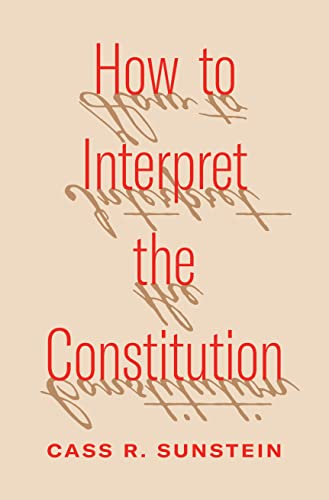
From New York Times bestselling author Cass Sunstein, a timely and powerful argument for rethinking how the U.S. Constitution is interpretedThe U.S. Supreme Court has eliminated the right to abortion and is revisiting other fundamental questions today—about voting rights, affirmative action, gun laws, and much more. Once-arcane theories of constitutional interpretation are profoundly affecting the lives of all Americans. In this brief and urgent book, Harvard Law School professor Cass Sunstein provides a lively introduction to competing approaches to interpreting the Constitution—and argues that the only way to choose one is to ask whether it would change American life for the better or worse. If a method of interpretation would eliminate the right of privacy, allow racial segregation, or obliterate free speech, it would be unacceptable for that reason.But some Supreme Court justices are committed to “originalism,” arguing that the meaning of the Constitution is settled by how it was publicly understood when it was ratified. Originalists insist that their approach is dictated by the Constitution. That, Sunstein argues, is a big mistake. The Constitution doesn’t contain instructions for its own interpretation. Any approach to constitutional interpretation needs to be defended in terms of its broad effects—what it does to our rights and our institutions. It must respect those rights and institutions—and safeguard the conditions for democracy itself.Passionate and compelling, How to Interpret the Constitution is essential reading for anyone who is concerned about how the Supreme Court is changing the rights and lives of Americans today.

What happens to democracy and free speech if people use the Internet to listen and speak only to the like-minded? What is the benefit of the Internet's unlimited choices if citizens narrowly filter the information they receive? Cass Sunstein first asked these questions in 2001's Republic.com . Now, in Republic.com 2.0 , Sunstein thoroughly rethinks the critical relationship between democracy and the Internet in a world where partisan Weblogs have emerged as a significant political force. Republic.com 2.0 highlights new research on how people are using the Internet, especially the blogosphere. Sunstein warns against "information cocoons" and "echo chambers," wherein people avoid the news and opinions that they don't want to hear. He also demonstrates the need to regulate the innumerable choices made possible by technology. His proposed remedies and reforms emphasize what consumers and producers can do to help avoid the perils, and realize the promise, of the Internet.
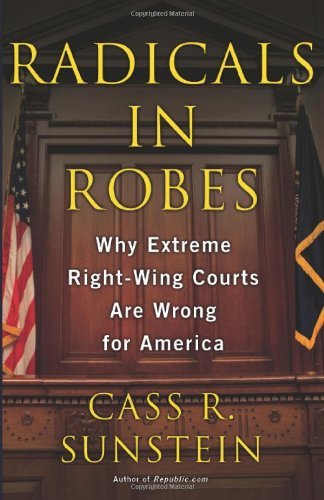
Radicals in Robes: Why Extreme Right-Wing Courts Are Wrong for America
by Cass R. Sunstein
Rating: 3.5 ⭐
Most people think that the Supreme Court has a rough balance between left and right. This is a myth; in fact the justices once considered right-wing have now taken the mantle of the Court's moderates, and the liberal element has all but disappeared. Most people also think that judicial activism is solely a liberal movement. This is also a myth; since William Rehnquist was confirmed as Chief Justice in 1986, the Supreme Court has engaged in an unprecedented record of judicial activism. These two factors are feeding a movement to restore what many conservatives call "The Constitution in Exile," by which they mean the Constitution as it existed before the Roosevelt administration. Radicals in Robes explains what the restoration of this constitutional vision would mean. It would mean the end of the FCC, the SEC, the EPA, and every other federal agency that enacts regulations that have the force of law. It would mean that the clause of the First Amendment that says that Congress may make no law "respecting an establishment of religion" would be turned on its head. Marriage laws and many other familiar areas of modern life are all in the sights of this conservative movement. Radicals in Robes takes judicial philosophy out of the law schools and shows what it means when it intersects partisan politics. It pulls away the veil of rhetoric from a dangerous and radical right-wing movement and issues a strong and passionate warning about what conservatives really intend. One of the most respected legal theorists in the country, Cass R. Sunstein here issues a warning of compelling concern to us all.

In How to Humble a Wingnut, leading constitutional scholar, behavioral economist, and former Administrator of the White House Office of Information and Regulatory Affairs Cass R. Sunstein examines the unconventional impetuses behind human decision-making. Why it is that people often choose to behave so strangely? Sunstein’s incisive commentaries point to recent empirical findings to demonstrate how and why people convince themselves they are right despite evidence to the contrary; fear dangers they are unlikely to encounter; and ignore real risks. Mining developments in recent behavioral studies for tips on everything from holiday shopping and political biases to staying healthy and clear thinking in general, Sunstein nudges his reader towards that rarest of grounds—understanding.
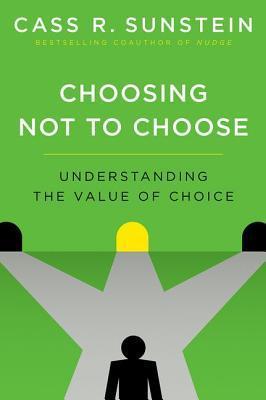
Our ability to make choices is fundamental to our sense of ourselves as human beings, and essential to the political values of freedom-protecting nations. Whom we love; where we work; how we spend our time; what we buy; such choices define us in the eyes of ourselves and others, and much blood and ink has been spilt to establish and protect our rights to make them freely.Choice can also be a burden. Our cognitive capacity to research and make the best decisions is limited, so every active choice comes at a cost. In modern life the requirement to make active choices can often be overwhelming. So, across broad areas of our lives, from health plans to energy suppliers, many of us choose not to choose. By following our default options, we save ourselves the costs of making active choices. By setting those options, governments and corporations dictate the outcomes for when we decide by default. This is among the most significant ways in which they effect social change, yet we are just beginning to understand the power and impact of default rules. Many central questions remain unanswered: When should governments set such defaults, and when should they insist on active choices? How should such defaults be made? What makes some defaults successful while others fail?Cass R. Sunstein has long been at the forefront of developing public policy and regulation to use government power to encourage people to make better decisions. In this major new book, Choosing Not to Choose, he presents his most complete argument yet for how we should understand the value of choice, and when and how we should enable people to choose not to choose.The onset of big data gives corporations and governments the power to make ever more sophisticated decisions on our behalf, defaulting us to buy the goods we predictably want, or vote for the parties and policies we predictably support. As consumers we are starting to embrace the benefits this can bring. But should we? What will be the long-term effects of limiting our active choices on our agency? And can such personalized defaults be imported from the marketplace to politics and the law? Confronting the challenging future of data-driven decision-making, Sunstein presents a manifesto for how personalized defaults should be used to enhance, rather than restrict, our freedom and well-being.
