
Carl R. Rogers
"Experience is, for me, the highest authority. The touchstone of validity is my own experience. No other person's ideas, and none of my own ideas, are as authoritative as my experience. It is to experience that I must return again and again, to discover a closer approximation to truth as it is in the process of becoming in me." -Carl Rogers, On Becoming a Person DEVELOPED THEORIES - THERAPIES Person-Centered; Humanistic; Client-Centered; Student-Centered TIMELINE 1902 - Carl Rogers was born in Oak Park, Illinois. 1919 - Enrolled at University of Wisconsin. 1924 - Graduated from University of Wisconsin and enrolled at Union Theological Seminary. 1926 - Transferred to Columbia. 1931- Earned Ph.D. from Columbia. 1940 - Began teaching at University of Ohio. 1946 - Elected president of American Psychological Association (APA). 1951 - Published Client-centered Therapy. 1961 - Published On Becoming A Person.
30 Books Written

A profound and deeply personal collection of essays by renowned psychologist Carl RogersThe late Carl Rogers, founder of the humanistic psychology movement and father of client-centered therapy, based his life's work on his fundamental belief in the human potential for growth. A Way of Being was written in the early 1980s, near the end of Carl Rogers's career, and serves as a coda to his classic On Becoming a Person. More philosophical than his earlier writings, it traces his professional and personal development and ends with a prophetic call for a more humane future.

On Becoming a Person: A Therapist's View of Psychotherapy
by Carl R. Rogers
Rating: 4.2 ⭐
• 2 recommendations ❤️
The late Carl Rogers, founder of the humanistic psychology movement, revolutionized psychotherapy with his concept of "client-centered therapy." His influence has spanned decades, but that influence has become so much a part of mainstream psychology that the ingenious nature of his work has almost been forgotten. A new introduction by Peter Kramer sheds light on the significance of Dr. Rogers's work today. New discoveries in the field of psychopharmacology, especially that of the antidepressant Prozac, have spawned a quick-fix drug revolution that has obscured the psychotherapeutic relationship. As the pendulum slowly swings back toward an appreciation of the therapeutic encounter, Dr. Rogers's "client-centered therapy" becomes particularly timely and important.
Client-Centered Therapy: Its Current Practice, Implications and Theory
by Carl R. Rogers
Rating: 4.2 ⭐
Presenting the non-directive and related points of view in counselling and therapy, Rogers gives a clear exposition of procedures by which individuals who are being counselled may be assisted in achieving for themselves new and more effective personality adjustments.

This remarkable collection provides a personal look at Rogers' youth, marriage, and aging, and also addresses personal growth, education, and "client-centered therapy."

2015 Reprint of 1957 Edition. Full facsimile of the original edition. Not reproduced with Optical Recognition Software. "Active Listening," first developed by Rogers and Farson, is a therapeutic technique designed to promote positive change in the client. Active listening is a communication technique used in counselling, training and conflict resolution, which requires the listener to feed back what they hear to the speaker, by way of re-stating or paraphrasing what they have heard in their own words, to confirm what they have heard and moreover, to confirm the understanding of both parties. It continues to have a lasting influence to this day.

This is the text that championed a revolutionary approach to education that changed the way we teach our children. Now, in the Third Edition, its challenging the status quo with twenty years of evidence that defies current thinking. Five exciting new chapters focus on issues of importance now and in the future - learning from children who love school; researching person-centered issues in education; developing the administrators role as a facilitator; building discipline and classroom management with the learner; and person-centered views of transforming schools. Freedom to Learn, Third Edition is written in the first person, with two goals in mind - to aid the development of the minds of children and young persons, and to encourage the kinds of adventurous enterprises being carried out daily by dedicated, caring teachers in creative classrooms and supportive schools throughout the nation. *Use of a first-person narrative-a technique pioneered by Carl Rogers in the first edition of Freedom to Learn-personalizes text coverage, and gives prospective teachers a real feel of communicating with an expert about what is really needed in the classroom. *Case studies and interviews illumina

Explores the origins, techniques, and applications of client-centered psychotherapy based on direct knowledge of and interaction with individual schizophrenics

Carl Rogers coined the term, ‘The Basic Encounter Group’ to identify encounter groups that operated on the principles of the person-centered approach. It is the contention that the person-centered Basic Encounter Group is quite unique and, in fact, offers a different paradigm for group therapy. Indeed, the application of the premises of the person-centered approach in group therapy requires a re-examination of many of the usual presuppositions about group function. This includes presuppositions about leader target population, size of group, establishment of goals and ground rules, and facilitator behavior. This contention is contrary to the conclusion that the client-centered basic encounter group ‘ . . . is in the mainstream of approaches for working with groups because of its eclectic nature and its lack of distinguishing features to set it apart from other process models (Boy, 1985, p. 210).

A classic from the pioneering and influential therapist Carl Rogers. To anyone interested in psychology or sociology or politics or morality, Rogers will give a new dimension of awareness. The Month

Psychology/sociology"Becoming Partners is a popularly written book about marriage and its alternatives. Using interviews in the partner's own words, the author gives the reader a series of slices, pictures, perceptions – of relationships, breakdowns, restructurings – in a wide variety of partnerships. These are followed by his own incisive commentary and summation. The interviews span a variety of relationships, among others the author's own marriage, convention, long-lived and successful; commune group marriags; a triangle; a quartet; a racially mixed marriage. And at no time does Dr. Rogers attempt to pass judgment on whether the unions are good or they simply exist, and that is enough." (back cover text)

Widely regarded as one of the most influential psychologists of all time, Carl Rogers was a towering figure within the humanistic movement towards person centered theory and non-directive psychotherapy. Originally published in 1946 his classic article Significant Aspects of Client-Centered Therapy is essential reading for anybody interested in psychotherapy and counseling. In this landmark publication Carl Rogers outlines the origins of client-centered therapy, the process of client-centered therapy, the discovery and capacity of the client and the client-centered nature of the therapeutic relationship.

Binding Unknown, Date not stated

Offers a brief profile of Rogers, and shares his discussions with theologians and psychologists issues in psychotherapy

Libro usado en buenas condiciones, por su antiguedad podria contener señales normales de uso

1D Pamphlet in very good condition. Some aging, light fading & light shelf wear. Buy with confidence...we're a professional bookstore with the highest standards for integrity and customer service.

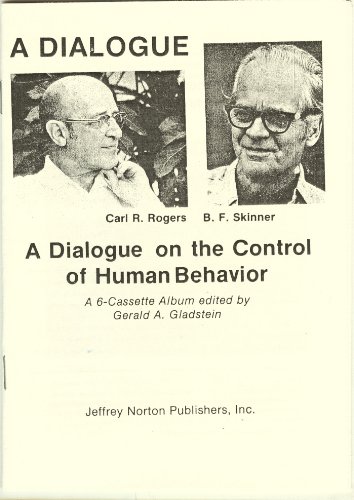
The control of human behavior is both an exciting and threatening prospect. Whether we like it or not, the prospect is close to reality, according to Carl Rogers and B. F. Skinner. These leading authorities debated in 1962 how the control of human behavior can and should come about. The debate has been reproduced on 6 CDs accompanied by a booklet containing background information, a summary of each topic, and a bibliography. Released on CD in 2006. Product No. S29244D.

First published in American Psychologist and originally presented as an address of the retiring President of the American Psychological Association. In this classic text, Rogers presents his observations on the organization of personality around a number of key themes; Characteristics of the Observational Material.The Relation of the Organized Perceptual Field to Behavior.The Relation of the Perception of the Self to Adjustment.The Conditions of Change of Self Perception.Relationship to Current Psychological Thinking.Some Observations on the Organization of Personality (Kindle Edition) forms part of an initiative to make important, insightful and engaging psychology publications widely available.

Carl R. Rogers (1902-1987), a founder of the humanistic psychology movement, is one of the most influential psychologists of the twentieth century. His impact on education, counseling, psychotherapy, conflict resolution, and peace is unparalleled. He has enriched the world through his empathic presence, his rigorous research, and his authorship of more than two hundred articles and sixteen books. On Becoming a Person is one of the classics in psychological literature. Dr. Rogers created a profound and fundamental shift in the fields of psychology and human relations. His deep belief that each person has worth, dignity, and the capacity for self-direction was counter to the pervading thought of his day. In order to fully understand and appreciate his impact, it is important to know what experiences shaped his life and what influences directed his thinking. Carl The Quiet Revolutionary is a unique kind of autobiography, or oral history, that explores all these aspects of his life, and more, through a series of interviews. The result is a lively account in Rogers' own words of the peaks and valleys of both his professional and personal life. In it he describes his early life, his family, his schooling, and his intellectual development, and it includes the early development of person-centered therapy, his disillusionment with academia, "The Therapeutic Hour" (including his thoughts on training the therapist, on supervision, and on research in psychotherapy), and his extensive efforts to reduce international tension through his work in northern Ireland, South Africa, and Central America ("The Peace Project").

Entwicklung der Persönlichkeit (Konzepte der Humanwissenschaften): Psychotherapie aus der Sicht eines Therapeuten
by Carl R. Rogers
Rating: 4.8 ⭐
Libro usado en buenas condiciones, por su antiguedad podria contener señales normales de uso

Psychotherapy Classics: Landmark Articles in the History of Psychotherapy and Counseling
by Carl R. Rogers
Rating: 4.2 ⭐
Psychotherapy Classics Featuring contributions from some of the most influential and enigmatic thinkers of the 20th century, Psychotherapy Landmark Articles in the History of Psychotherapy and Counseling is essential reading for anybody with an interest in this area. Significant Aspects of Client-Centered Therapy By Carl Rogers In this landmark publication Carl Rogers outlines the origins of client-centered therapy, the process of client-centered therapy, the discovery and capacity of the client and the client-centered nature of the therapeutic relationship. The Problem of Psychotherapy by Laurance Shaffer Originally presented as the address of the President of the Division of Clinical and Abnormal Psychology, American Psychological Association; this landmark paper draws attention to issues relating to the nature of the therapeutic process within psychotherapy which are just as relevant How can we understand what takes place in the therapeutic interview? Why does it readjust the distressed person? Under what conditions is psychotherapy applicable? What techniques, applied in appropriately selected circumstances will produce predictable and effective results? Shaffer's central argument is that the psychologist's major problem with respect to therapy is not that of the professional conditions of practice, but is the problem of understanding what therapy is and does. Psychotherapy And The Placebo Effect by David Rosenthal & Jerome D. Frank Describes the placebo effect, discusses some of its implications for the evaluation of psychotherapy, and makes recommendations concerning research design in psychotherapy based on these considerations. Rational Psychotherapy and Individual Psychology by Albert Ellis One of the first published accounts of rational psychotherapy; a theory of personality and a system of therapeutic technique that would eventually develop into what is now known as rational emotive behavior therapy. In the course of this landmark paper Ellis introduces and expands upon his hypothesis that thinking represents the most important way in which human emotion is caused and controlled. He then goes on to outline the main points of agreement and disagreement between rational therapy and the individual Psychology of Alfred Adler. Recollections of A Psychoanalytic The Case of "Prisoner K" by Thomas-Szasz Fascinating account of "psychoanalytic psychotherapy" conducted by Thomas Szasz; who was soon to elevated into a position of international renown and controversy following the publication of his classic text "The Myth of Mental Illness." Psychotherapy As A Learning Process by Albert Bandura In this classic paper eminent psychologist Albert Bandura explores systematic attempts to apply principles of learning to the area of psychotherapy. Bandura begins this exploration by asking whether human behavior can be modified through psychological means and if so, what are the learning mechanisms that mediate behavior change? He then sets about discussing some of these learning mechanisms in turn i.e., counterconditioning, extinction, discrimination learning, methods of reward, punishment and social imitation. Psychotherapy Landmark Articles in the History of Psychotherapy and Counseling has been produced as part of an initiative by the website www.all-about-psychology.com to make historically important psychology publications widely available.

Book in good condition. No dust cover. Fast shipping direct from Amazon. Eligible for Amazon Prime and Super Saver shipping.

This classic debate between Skinner and Rogers took the form of three papers originally published in 1956. The papers were based on material presented by the authors in a symposium held at the annual meeting of the American Psychological Association. The first paper is by Skinner, the second paper by Rogers and the third paper (a rebuttal of the second) was again by Skinner. This compelling debate not only offers a fascinating insight into the thinking of two of the most influential psychologists of the 20th Century but it also provides a wonderful historical snapshot of the theoretical and ideological battles going on within psychology at the time. Some Issues Concerning The Control of Human Behavior (Kindle edition) forms part of an initiative to make important, insightful and engaging psychology publications widely available.

On Becoming an Effective Teacher: Person-centered Teaching, Psychology, Philosophy and Dialogues
by Carl R. Rogers
Rating: 4.4 ⭐
On Becoming an Effective Teacher describes exemplary practices like Teach For America, which highlight the power of person-centered teaching to bring about higher student achievement and emotional intelligence. Lyon situates the classic with the cutting-edge, integrating wisdom with research, anecdote with practical advice, to find truths that reveal paths toward effective teaching. Jeffrey Cornelius-White, Psy.D., LPC, Professor of Counseling, Missouri State University, USA, Author of Learner Centered Instruction: Building Relationships for Student SuccessThis fascinating book reveals through current research and contemporary applications that Carl Rogers' pioneering and radical approach to education is as relevant today as it was in the 1970s and '80s. Brian Thorne, University of East Anglia, UKCarl Rogers is one of the most influential psychologists of the twentieth century. His influence is similarly outstanding in the fields of education, counselling, psychotherapy, conflict resolution, and peace. On Becoming an Effective Teacher presents the final unpublished writings of Rogers and as such has, not only unique historical value, but also a vital message for today's educational crises, and can be read as a prescription against violence in our schools. It documents the research results of four highly relevant, related but independent studies which comprise the biggest collection of data ever accumulated to test a person-centred theory in the field of education. This body of comprehensive research on effective teaching was accomplished over a twenty-year period in 42 U.S. States and in six other countries including the UK, Germany, Brazil, Canada, Israel, and Mexico and is highly relevant to the concerns of teachers, psychologists, students, and parents.The principal findings of the research in this book show that teachers and schools can significantly improve their effectiveness through programs focusing on facilitative interpersonal relationships. Teachers who either naturally have, or are trained to have empathy, genuineness (congruence), and who prize their students (positive regard) create an important level of trust in the classroom and exert significant positive effects on student outcomes including achievement scores, interpersonal functioning, self-concept, attendance, and violence.The dialogues between Rogers and Lyon offer a unique and timeless perspective on teaching, counselling and learning. The work of Reinhard Tausch on person-centered teaching for counselors, parents, athletics, and even textbook materials, and the empathic interactions of teachers and students, is among the most thorough and rigorous research ever accomplished on the significance and potential of a person-centered approach to teaching and learning.This pioneering textbook is highly relevant to educational psychologists and researchers, as well as those in undergraduate and graduate university courses in education, teacher training, counseling, psychology and educational psychology.

Dr. Rogers offers the individual guidelines for becoming in touch with himself, freeing himself for growth and development, and removing obstacles to the constructive expression of feelings

Classic article from 1940 in which Carl Rogers outlines the conditions for successful psychotherapy. Namely; rapport, free expression of feeling on the part of the client, recognition and acceptance by the client of his spontaneous self, responsible choices, the gaining of insight through assimilated interpretation and independence with support.The Processes of Therapy (Kindle edition) forms part of an initiative by the website www.all-about-psychology.com to make important, insightful and engaging psychology publications widely available.


Le but de cet ouvrage est de synthétiser et présenter les théories de Carl Rogers basées sur ses pratiques thérapeutiques. Sa conception d'une psychologie humaniste, qui s'est développée dans les années 1950, représente véritablement la troisième force de la psychothérapie, aux côtés de la psychanalyse et des thérapies comportementales. La pensée de Rogers est plus que jamais dans l'air du temps puisqu'on s'aperçoit, en fat, que nombreuses pratiques ou techniques d'aujourd'hui sont issues de ses travaux (CNV, coaching, cellules de crise prychologique, questionnaires d'enquêtes...). La notion rogérienne de l'écoute a influencé et précédé de plusieurs décennies les récentes découvertes de la psychologie dans ce domaine. Le lecteur trouvera dans ce livre d'une part, les aspects théoriques de l'approche de la thérapie de Carl Rogers, thérapie centrée sur la personne (appelée également non directive). D'autre part, sont aussi présentées dans cet ouvrage les bases de la pensée de l'auteur se fondant sur une théorie de la personnalité et de la dynamique du comportement humain, ainsi qu'une vision des relations humaines et ses réflexions sur un fonctionnement optimal de la personnalité.


Psychothérapie et relations humaines: Théorie et pratique de la thérapie non-directive - Volume 1, Exposé général
by Carl R. Rogers
Rating: 5.0 ⭐
Primeiro volume do manual com os conceitos da ACP em português.