
C.P. Snow
Known British scientist Charles Percy Snow, baron Snow of Leicester, wrote especially his 11-volume series Strangers and Brothers (1940-1970). See https://en.wikipedia.org/wiki/C._P._Snow
30 Books Written

2013 Reprint of 1959 Edition. Exact facsimile of the original edition, not reproduced with Optical Recognition Software. This is the publication of the influential 1959 Rede Lecture by British scientist and novelist C. P. Snow. Its thesis was that "the intellectual life of the whole of western society" was split into the titular two cultures - namely the sciences and the humanities - and that this was a major hindrance to solving the world's problems. Published in book form, Snow's lecture was widely read and discussed on both sides of the Atlantic, leading him to write a 1963 follow-up, "The Two Cultures: And a Second Look: An Expanded Version of The Two Cultures and the Scientific Revolution."

Winner of 1954 James Tait Black Memorial Prize for Fiction. Widely regarded as C. P. Snow's masterpiece, this lucid and compelling story of the contest for the Mastership of a Cambridge college is the fifth novel in C. P. Snow's magnificent Strangers and Brothers sequence. As the old Master slowly dies of cancer, his colleagues and peers jostle for power. Two candidates come to the foreground; Paul Jago - warm and sympathetic, but given to extravagant moods and hindered by an unsuitable wife - and Crawford, a shrewd, cautious and reliable man who lacks any of Jago's human gifts. For Lewis Eliot, through whose eyes the narrative unfurls, the choice is clear, but politics and egos soon cloud the debate and the College is torn in two. Depicting power in a confined setting with clarity and humanity, The Masters remains unsurpassed in its quiet, authoritative insight into the politics of academia. A meticulous study of the public issues and private problems of post-war Britain, C. P. Snow's Strangers and Brothers sequence is a towering achievement that stands alongside Anthony Powell's A Dance to the Music of Time as one of the great romans-fleuves of the twentieth century.

The life of Lewis Eliot - documented across eleven novels with C. P. Snow's distinctive blend of precision and compassion - begins in Time of Hope.The novel opens in the summer of 1914 when nine-year-old Lewis hears the news of his father's bankruptcy, and closes in 1933, when, although hindered in his promising career as a lawyer by the neuroses of his wife, he realises that he cannot bear to leave her. In the course of this ambitious but ultimately unremarkable man's early life rage the great questions of the age - questions of class, of gender, of ideology and of war - asked and answered with wisdom and tolerance.A meticulous study of the public issues and private problems of post-war Britain, C. P. Snow's Strangers and Brothers sequence is a towering achievement that stands alongside Anthony Powell's A Dance to the Music of Time as one of the great romans-fleuves of the twentieth century.

The corridors and committee rooms of Whitehall are the setting for the ninth in the 'Strangers and Brothers' series. They are also home to the manipulation of political power. Roger Quaife wages his ban-the-bomb campaign from his seat in the Cabinet and his office at the Ministry. The stakes are high as he employs his persuasiveness.

It is the onset of World War II in the fifth in the Strangers and Brothers series. A group of Cambridge scientists are working on atomic fission. But there are consequences for the men who are affected by it. Hiroshima also causes mixed personal reactions.

The Light and the Dark is the fourth in time sequence of narrative (although published as the second of the series) in the 'Strangers and Brothers' series. The story is set in Cambridge, but the plot also moves to Monte Carlo, Berlin and Switzerland. Lewis Eliot narrates the career of a childhood friend. Roy Calvert is a brilliant but controversial linguist who is about to be elected to a fellowship.

In the second of the 'Strangers and Brothers' series Lewis Eliot tells the story of George Passant, a Midland solicitor's managing clerk and idealist who tries to bring freedom to a group of people in the years 1925 to 1933. Ten other novels follow this one, but 'Time of Hope' published later in 1949 is set in time before this title and therefore becomes number one in the series.

Seventh in the Strangers and Brothers series, this is a novel of conflict exploring the world of the great Anglo-Jewish banking families between the two World Wars. Charles March is heir to one of these families and is beginning to make a name for himself at the Bar. When he wishes to change his way of life and do something useful he is forced into a quarrel with his father, his family and his religion.

Roger Mills, a Harley Street specialist, is taking a sailing holiday on the Norfolk Broads. When his six guests find him at the tiller of his yacht with a smile on his face and a gunshot through his heart, all six fall under suspicion in this, C P Snow's first novel.
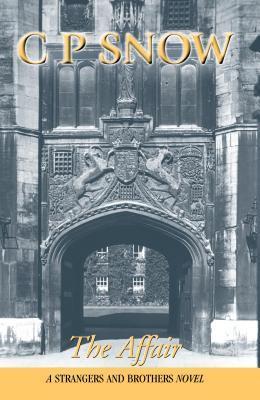
In the eighth in the 'Strangers and Brothers' series Donald Howard, a young science Fellow is charged with scientific fraud and dismissed from his college. This novel, which became a successful West End play, describes a miscarriage of justice in the same Cambridge college which served as a setting for 'The Masters'.

'Homecomings' is the seventh in the 'Strangers and Brothers' series and sequel to 'Time of Hope'. This complete story in its own right follows Lewis Eliot's life through World War II. After his first wife's death his work at the Ministry assumes a larger role. It is not until his second marriage that Eliot is able to commit himself emotionally.

The penultimate novel in the 'Strangers and Brothers' series takes Goya's theme of monsters that appear in our sleep. The sleep of reason here is embodied in the ghastly murders of children that involve torture and sadism.

The last in the Strangers and Brothers series has Sir Lewis Eliot’s heart stop briefly during an operation. During recovery he passes judgement on his achievements and dreams. Concerns fall from him leaving only ironic tolerance. His son Charles takes up his father’s burdens and like his father, he is involved in the struggles of class and wealth, but he challenges the Establishment, risking his future in political activities.

Humphrey Leigh, retired resident of Belgravia, pays a social visit to an old friend, Lady Ashbrook. She is waiting for her test results, fearing cancer. When Lady Ashbrook gets the all clear she has ten days to enjoy her new lease of life. And then she is found murdered.

This story told in the first person starts with a child’s interest in the night sky. A telescope starts a lifetime’s interest in science. The narrator goes up to King’s College, London to study. As a fellow at Cambridge he embarks on love affairs and searches for love at the same time as career success. Finally, contentment in love exhausts his passion for research.


Economic storm clouds gather as bad political weather is forecast for the nation. Three elderly peers look on from the sidelines of the House of Lords and wonder if it will mean the end of a certain way of life. Against this background is set a court struggle over a disputed will that escalates into an almighty battle.

Brothers and Strangers, Volume 1 contains the first 4 books of C.P. Snow's incredible 11 book series. Volume 1 'Time of Hope', 'George Passant', "The Conscience of the Rich', and 'The Light and the Dark' (1071 pages)
Sir Charles tells the story, hitherto unpublished, of the bitter and damaging wartime enmity between two eminent British scientists both powerful in government. These men were Sir Henry Tizard, who saw to it that England led the world in the development of radar, and his unrelenting opponent F.A. Lindemann (Lord Cherwell), Winston Churchill's scientific advisor.

C P Snow's sketches of famous physicists & explanation of how atomic weapons were developed gives an overview of science often lacking. This study provides us with hope for the future as well as anecdotes from history.

The Masters/The New Men/Homecomings/The Affair

In this engrossing book C.P. Snow, one of the foremost living English novelists and public servants, writes about a great nineteenth-century English novelist who also was a man of affairs. Anthony Trollope wrote forty-seven novels, including the famous Barsetshire and Palliser series; he was widely read in his time, and his work was admired by Tolstoy and Henry James. Since his death in 1882 he has always had a loyal following, but now, finally, he is becoming recognized as a major figure in English literature.After a painful childhood and youth – “more loving than loved” – Trollope found his way in his twenties and went on to become a man of consequence in the British civil service. In his official role he travelled the world – coming to understand the United States better than most of his contemporaries. C.P. Snow’s brilliant portrait gives us the robust and gregarious Trollope, successful and happily married, and underneath a sensitive, complex man.Trollope’s miserable childhood surely helped to shape the novelist who, according to C.P. Snow, was the finest natural psychologist in nineteenth-century English fiction. The author breaks with the traditional view of Trollope as merely a social historian. He had the rare gift of percipience, Lord Snow says in his fascinating examination of Trollope’s art. Large in his achievement was the remarkable understanding of women he brought to his novels.This sumptuously illustrated book, written with such penetrating intelligence, verve and wit, will delight Trollope fans and create new ones. As absorbing as a good novel Trollope is the finest sort of tribute one novelist could pay another.
Brothers and Strangers, Volume 3 contains the last 3 books of C.P. Snow's incredible 11 book series. Volume 3 'The Corridors of Power', 'The Sleep of Reason' and 'Last Things' (921 pages)

First U.S. edition bound in white cloth. A near fine copy in a very good dust jacket. Dust soiling to the edges of the book's upper page block. The dust jacket has rubs to its spine tips. Dust soiling to its panels.
The Realists: Eight Portraits: Stendhal, Balzac, Dickens, Dostoevsky, Tolstoy, Galdos, Henry James, Proust
by C.P. Snow
Rating: 3.9 ⭐
In this series of portraits of Stendhal, Balzac, Dickens, Dostoevsky, Tolstoy, Galdos, James, and Proust, Snow assesses the influences of personality and experiences on their choice of subjects and literary style

"Смерть под парусом" Ч.Сноу, "Ведомство страха" Гр.Грина, "Фаворит" Д.Френсиса - три романа, представляющие в настоящем сборнике три лица английского детектива, отличаются друг от друга и индивидуальным стилем повествования и конкретным жизненным материалом, положенным в основу сюжета. Эти произведения, написанные добротно, уверенно и интересно, дают в совокупности нравов в довольно широком временном спектре. Вступительная статья В.Скороденко.

First edition. Good+. Book is very good with no notable flaw. Generally sharp, well-preserved jacket has a few smudges/marks on the front and light rubbing on both sides.
