
C.L.R. James
C. L. R. James (1901–1989), a Trinidadian historian, political activist, and writer, is the author of The Black Jacobins, an influential study of the Haitian Revolution and the classic book on sport and culture, Beyond a Boundary. His play Toussaint Louverture: The Story of the Only Successful Slave Revolt in History was recently discovered in the archives and published Duke University Press.
30 Books Written

The Black Jacobins: Toussaint L'Ouverture and the San Domingo Revolution
by C.L.R. James
Rating: 4.4 ⭐
• 4 recommendations ❤️
A powerful and impassioned historical account of the largest successful revolt by enslaved people in the Haitian Revolution of 1791–1803“One of the seminal texts about the history of slavery and abolition.... Provocative and empowering.” — The New York Times Book ReviewThe Black Jacobins, by Trinidadian historian C. L. R. James, was the first major analysis of the uprising that began in the wake of the storming of the Bastille in France and became the model for liberation movements from Africa to Cuba. It is the story of the French colony of San Domingo, a place where the brutality of plantation owners toward enslaved people was horrifyingly severe.And it is the story of a charismatic and barely literate enslaved person named Toussaint L’Ouverture, who successfully led the Black people of San Domingo against successive invasions by overwhelming French, Spanish, and English forces—and in the process helped form the first independent post-colonial nation in the Caribbean.With a new introduction (2023) by Professor David Scott.

This new edition of C. L. R. James's classic Beyond a Boundary celebrates the fiftieth anniversary of one of the greatest books on sport and culture ever written.Named one of the Top 50 Sports Books of All Time by Sports Illustrated"Beyond a Boundary . . . should find its place on the team with Izaak Walton, Ivan Turgenev, A. J. Liebling, and Ernest Hemingway."—Derek Walcott, The New York Times Book Review"As a player, James the writer was able to see in cricket a metaphor for art and politics, the collective experience providing a focus for group effort and individual performance. . . . [In] his scintillating memoir of his life in cricket, Beyond a Boundary (1963), James devoted some of his finest pages to this theme."—Edward Said, The Washington Post"A work of double reverence—for the resilient, elegant ritualism of cricket and for the black people of the world."—Whitney Balliett, The New Yorker"Beyond a Boundary is a book of remarkable richness and force, which vastly expands our understanding of sports as an element of popular culture in the Western and colonial world."—Mark Naison, The Nation"Everything James has done has had the mark of originality, of his own flexible, sensitive, and deeply cultured intelligence. He conveys not a rigid doctrine but a delight and curiosity in all the manifestations of life, and the clue to everything lies in his proper appreciation of the game of cricket."—E. P. Thompson, author of The Making of the English Working Class"Beyond a Boundary is . . . first and foremost an autobiography of a living legend—probably the greatest social theorist of our times."—Manning Marable, Journal of Sport & Social Issues"The great triumph of Beyond a Boundary is its ability to rise above genre and in its very form explore the complex nature of colonial West Indian society."—Caryl Phillips, The New Republic

First published in London in 1939, Minty Alley is now available to American readers. In the pages of this work, C. L. R. James is both an imaginative political theorist and a sensitive commentator on the West Indian social and cultural scene.James's novel has been acclaimed as "a groundbreaking example of regional social realism" and as "a major forerunner of the Caribbean literary movements in English." Many of James's readers believe that it is not possible fully to comprehend Caribbean literary art in English without first reading Minty Alley . In the interactions of the characters of Maisie, Haynes, Mrs. Rouse, and Benoit, James discerns new forms of society rooted in the oldest of desires and aspirations. In the everyday language of the unforgettable dialogues in the novel James reveals new modes of human relationships.Haynes, a young middle-class lodger at No. 2 Minty Alley, becomes both confidant and judge as he examines the other inhabitants at this address. From his experiences, he realizes the mutually impoverishing alienation of the educated West Indian from the mainstream. Through Haynes's vivid narration, James presents the rich cultural life on Minty Alley. Haynes, an outsider among people of lower class, knows his fellow lodgers only as they have revealed themselves to him through their speech and actions, yet each has a mysterious inner life.Frequently reprinted in the United Kingdom, Minty Alley at last reaches the United States so that American readers can learn what much of the rest of the English-speaking world has long known, that before such masterworks as The Black Jacobins , World Revolution , and Beyond a Boundary , C. L. R. James had already made his mark as one of the foremost of West Indian novelists.

History. African Studies. In the Introduction, Robin D. G. Kelly comments, A HISTORY OF PAN-AFRICAN REVOLT is one of those rare books that continues to strike a chord of urgency, even half a century after it was first published. Time and again, its lessons have proven to be valuable and relevant for understanding liberation movements in Africa and the diaspora. Each generation who has had the opportunity to read this small book finds new insights, new lessons, new vision for their own age....-- This new edition of James' classic, originally published in England in 1938, brings a work that previously enjoyed underground popularity to a much wider audience.

Toussaint Louverture: The Story of the Only Successful Slave Revolt in History
by C.L.R. James
Rating: 4.2 ⭐
A STIRRING GRAPHIC NOVEL OF THE HAITIAN REVOLUTIONThis impassioned and beautifully drawn book dramatically recounts ‘one of the great epics of revolutionary struggle and achievement’—the Haitian Revolution of 1794–1803. It is also the stirring—and incredible—story of Toussaint Louverture, a man born into slavery who rose to become the revolt’s indispensable leader. Perhaps more than any other figure from the Age of Revolution, he gave voice to a truly universal call for liberty and equality.Written by C. L. R. James, the Trinidadian revolutionary whose classic study Black Jacobins has been in print for eighty-five years and is the definitive history of the revolution, this book’s text itself has a fascinating history. It’s drawn from a play that opened in London in 1936, with Paul Robeson in the title role, the first time black actors starred on the British stage in a play by a black playwright. The script was lost for almost seventy years, then a draft copy was found among James's archives, and now this extraordinary drama has been turned into a graphic novel by artists Nic Watts and Sakina Karimjee.This page-turning visual narrative surrounds Toussaint with fiery radicals like Haitian leader Dessalines and intransigent French like Napoleon. Above all, the book portrays the world-changing force of the enslaved Haitian people, for, as James famously wrote, “Toussaint did not make the revolution. It was the revolution that made Toussaint.”

Mariners, Renegades and Castaways: The Story of Herman Melville and the World We Live In
by C.L.R. James
Rating: 4.2 ⭐
Political theorist and cultural critic, novelist and cricket enthusiast, C. L. R. James (1901 - 1989) was a brilliant polymath who has been described by Edward Said as a centrally important 20th-century figure. Through such landmark works as The Black Jacobins, Beyond a Boundary, and American Civilization, James's thought continues to influence and inspire scholars in a wide variety of fields. There is little doubt, wrote novelist Caryl Phillips in The New Republic, that James will come to be regarded as the outstanding Caribbean mind of the twentieth century.In his seminal work of literary and cultural criticism, Mariners, Renegades and Castaways, James anticipated many of the concerns and ideas that have shaped the contemporary fields of American and Postcolonial Studies, yet this widely influential book has been unavailable in its complete form since its original publication in 1953. A provocative study of Moby Dick in which James challenged the prevailing Americanist interpretation that opposed a totalitarian Ahab and a democratic, American Ishmael, he offered instead a vision of a factory-like Pequod whose captain of industry leads the mariners, renegades and castaways of its crew to their doom.In addition to demonstrating how such an interpretation supported the emerging US national security state, James also related the narrative of Moby Dick, and its resonance in American literary and political culture, to his own persecuted position at the height (or the depth) of the Truman/McCarthy era. It is precisely this personal, deeply original material that was excised from the only subsequent edition. With a new introduction by Donald E. Pease that places the work in its critical and cultural context, Mariners, Renegades and Castaways is once again available in its complete form.

Toussaint Louverture: The Story of the Only Successful Slave Revolt in History; A Play in Three Acts
by C.L.R. James
Rating: 3.6 ⭐
In 1934 C. L. R. James, the widely known Trinidadian intellectual, writer, and political activist, wrote the play Toussaint Louverture: The Story of the Only Successful Slave Revolt in History , which was presumed lost until the rediscovery of a draft copy in 2005. The play's production, performed in 1936 at London's Westminster Theatre with a cast including the American star Paul Robeson, marked the first time black professional actors starred on the British stage in a play written by a black playwright. This edition includes the program, photographs, and reviews from that production, a contextual introduction and editorial notes on the play by Christian Høgsbjerg, and selected essays and letters by James and others. In Toussaint Louverture , James demonstrates the full tragedy and heroism of Louverture by showing how the Haitian revolutionary leader is caught in a dramatic conflict arising from the contradiction between the barbaric realities of New World slavery and the modern ideals of the Enlightenment. In his portrayal of the Haitian Revolution, James aspired to vindicate black accomplishments in the face of racism and to support the struggle for self-government in his native Caribbean. Toussaint Louverture is an indispensable companion work to The Black Jacobins (1938), James's classic account of Haiti's revolutionary struggle for liberation.

Written in collaboration with Raya Dunayevskaya & Grace Lee, this is another pioneering critique of Lenin and Trotsky, and reclamation of Marx, from the West Indian scholar and activist. This edition includes the original introduction from Martin Glaberman, a new introduction from Paul Buhle, and one from the author himself. Two generations ago, CLR James and a small circle of collaborators set forth a revolutionary critique of industrial civilization. Their vision possessed a striking originality. So insular was the political context of their theoretical breakthroughs, however, and so thoroughly did their optimistic expectations for working class activity defy trends away from class and social issues to the so-called 'End Of Ideology', that the documents of the signal effort never reached public view. Happily, times have changed. Readers have discovered much, even after all these years, to challenge Marxist (or any other) orthodoxy. They will never find a more succinct version of James' general conclusions that State Capitalism and World Revolution. In this slim volume, James and his comrades successfully predict the future course of Marxism. [Paul Buhle, from his Introduction] When one looks back over the last 20 years to those men who were most far-sighted, who first began to tease out the muddle of ideology in our times, who were at the same time Marxists with a hard theoretical basis, and close students of society, humanists with a tremendous response to and understanding of human culture, Comrade James is one of the first one thinks of. [E P Thompson]

Originally delivered as a series of lectures in Trinidad in 1960, James expounds on the relevance of Marxism, and revolution, for our times, from Charlie Chaplin to the Workers' Councils.

Very Good; Small softcover, side-stapled binding, pale gray covers decorated in blue and orange, 174 pages. *** Pro-workers rights book which explains how people's revolution happened in Hungary (1956) and how people all over the world can follow their example, organize, fight back against totalitarian state and win. (Two authors used C. L. R. James wrote as J. R. Johnson and Cornelius Castoriadis wrote as Pierre Chaulieu. Grace C. Lee is better known as Grace Lee Boggs).

In his study of Herman Melville, "Mariners, Renegades and Castaways" (1976) C.L.R. James "My ultimate aim...is to write a study of American Civilization". This project, long in gestation, at last sees the light of day in this posthumous publication of what may be seen as the most wide-ranging expression of James's thought, the link between his mature writings on politics and his semi-autobiographical work, "Beyond a Boundary". In the tradition of de Tocqueville's "Democracy in America", James addresses the fundamental question of the "right to life, liberty and the pursuit of happiness". Ranging across American politics, society and culture, C.L.R. James sets out to integrate his analysis of American society in transition with a commentary on the popular arts of cinema and literature.

World Revolution 1917-1936: The Rise and Fall of the Communist International
by C.L.R. James
Rating: 3.9 ⭐
Originally published in 1937, C. L. R. James's World Revolution is a pioneering Marxist analysis of the history of revolutions during the interwar period and of the fundamental conflict between Trotsky and Stalin. James, who was a leading Trotskyist activist in Britain, outlines Russia's transition from Communist revolution to a Stalinist totalitarian state bureaucracy. He also provides an account of the ideological contestations within the Communist International while examining its influence on the development of the Soviet Union and its changing role in revolutions in Spain, China, Germany, and Central Europe. Published to commemorate the centenary of the Russian Revolution, this definitive edition of World Revolution features a new introduction by Christian Høgsbjerg and includes rare archival material, selected contemporary reviews, and extracts from James's 1939 interview with Trotsky.

In this new edition of Nkrumah and the Ghana Revolution, C. L. R. James tells the history of the socialist revolution led by Kwame Nkrumah, the first president and prime minister of Ghana. Although James wrote it in the immediate post-independence period around 1958, he did not publish it until nearly twenty years later, when he added a series of his own letters, speeches, and articles from the 1960s. Although Nkrumah led the revolution, James emphasizes that it was a popular mass movement fundamentally realized by the actions of everyday Ghanaians. Moreover, James shows that Ghana’s independence movement was an exceptional moment in global revolutionary history: it moved revolutionary activity to the African continent and employed new tactics not seen in previous revolutions. Featuring a new introduction by Leslie James, an unpublished draft of C. L. R. James's introduction to the 1977 edition, and correspondence, this definitive edition of Nkrumah and the Ghana Revolution offers a revised understanding of Africa’s shaping of freedom movements and insight into the possibilities for decolonial futures.

Author of such classic works as Minty Alley , The Black Jacobins and Beyond a Boundary , C. L. R. James was one of the most significant writers of our times. In a life which reflected many of the distinctive features of the twentieth century (from his birth in Trinidad in 1901, to his death in Brixton, London, 1989), James made an outstanding contribution to debates on politics, history, art, literature and sport. His revolutionary vision has inspired social movements in the United States, Britain, Africa and the Caribbean. It remains central to any understanding of the modern world. Until now much of his work has remained inaccessible; but Anna Grimshaw brings together here both published and unpublished material to give us the essential C. L. R. James. Prepared in collaboration with James in his final year, this collection offers unique insight into the range and development of his life's work. It includes a selection of early fiction, the complete text of the play The Black Jacobins , numerous extracts from his personal archive and the classic essays, The Case for West-Indian Self-Government , Popular Art and the Cultural Tradition and Black Power .
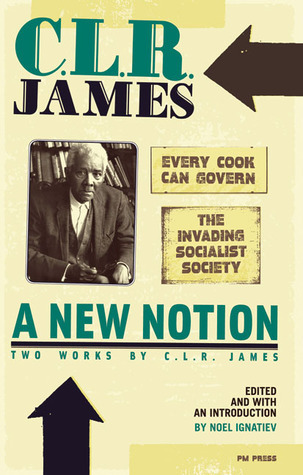
A New Notion: Two Works by C.L.R. James: Every Cook Can Govern/The Invading Socialist Society
by C.L.R. James
Rating: 3.4 ⭐
C.L.R. James was a leading figure in the independence movement in the West Indies, and the black and working-class movements in both Britain and the United States. As a major contributor to Marxist and revolutionary theory, his project was to discover, document, and elaborate the aspects of working-class activity that constitute the revolution in today’s world. In this volume, Noel Ignatiev, author of How the Irish Became White , provides an extensive introduction to James’ life and thought, before presenting two critical works that together illustrate the tremendous breadth and depth of James’ worldview. “The Invading Socialist Society,” for James the fundamental document of his political tendency, shows clearly the power of James’ political acumen and its relevance in today’s world with a clarity of analysis that anticipated future events to a remarkable extent. “Every Cook Can Govern,” is a short and eminently readable piece counterpoising direct with representative democracy, and getting to the heart of how we should relate to one another. Together these two works represent the principal themes that run through James’s implacable hostility toward all “condescending saviors” of the working class, and undying faith in the power of ordinary people to build a new world.

C.L.R. James is one of the leading Marxist interpreters of colonialism and anti-colonial struggle in the 20th century. Famous for his literary and cultural, as well as theoretical, writings, his thinking engaged with a vast range of issues including civil rights, race, class, socialism, cricket, and cultural production. Notes on Dialectics , first publsihed in 1948, is his key theoretical work. It os one of the most complex and original Marxist documents ever to come out of the U.S., where James lived for 15 years. It provides a thorough reexamination of of the Hegelian foundations of Marxist theory and a new interpretation of the history of thelabor movement through a close engagement with Hegel's Logic . To this day, the book represents a brilliant example of a living, productive engagement with Marxist theory and politics. This new edition, with a new introduction from leading James scholars, ensures that this classic books will continue to reach a new generation of scholars and students of Marxist theory as well as activists.

Every Cook Can Govern and What Is Happening Every Day: 1985 Conversations
by C.L.R. James
Rating: 3.8 ⭐
Book by Cyril Lionel Robert James

C. L. R. James and Revolutionary Marxism: Selected Writings of C.L.R. James 1939-1949
by C.L.R. James
Rating: 4.2 ⭐
C. L. R. James was one of the most influential Marxists of his generation. His important contributions ranged from the subjects of Black liberation to contemporary philosophy and even touched on the anticolonial potential of cricket. In this collection of hard-to-find articles and essays, his towering intellect and engaging style touch on a diverse array of topics. Scott McLemee writes the weekly column “Intellectual Affairs” for Inside Higher Ed . Paul Le Blanc is a professor of history at La Roche College, and he has written on and participated in the US labor, radical, and civil rights movements.

You Don’t Play With Revolution collects seven never-before-published lectures by Marxist cultural critic C.L.R. James, delivered during his stay in Montréal in 1967-1968. Ranging in topic from Marx and Lenin to Shakespeare and Rousseau to Caribbean history and the Haitian Revolution, these lectures demonstrate the staggering breadth and clarity of James’ knowledge and interest. Little information exists in print on the critical period James spent working with West Indian intellectuals and students in Canada in the late 1960s; this collection highlights the themes we have come to associate with James’ critical project and situates them in a new light. Readers just beginning to delve into James’ work will find this collection accessible and engaging, an ideal introduction to a complex and multi-faceted body of scholarship. Editor David Austin has also included two seminal interviews produced with James during his stay in Canada, and a series of letters James exchanged with the West Indian university students who made these lectures possible. You Don’t Play With Revolution also includes an introduction by Robert A. Hill, co-founder of the C.L.R. James Study Circle and historical advisor to the new James archive at Columbia University. C.L.R. James (1901-1989) was born in Trinidad and was a prominent anti-colonial scholar and cultural critic throughout his life. With Grace Lee and Raya Dunayevskaya, he helped define and popularize the autonomist Marxist tradition in the United States and Canada. David Austin is founder and trustee of the Alfie Roberts Institute, an independent research institute based in Montréal.

C.L.R. James is the author of unquestionably the best book ever written about cricket, Beyond a Boundary —indeed, one of the finest books written about sport, period. James wrote about cricket all his life, though he only ever published one other book on the game, and this is it. This collection features appreciations of great cricketers from Bradman to Botham, Dexter to David Gower, pieces on cricket controversies like the Bodyline series and the D'Oliviera affair, letters to friends like John Arlott and V.S. Naipaul, and above all writings on James's first love, West Indies cricket—on Gary Sobers, Sir Frank Worrell, Learie Constantine, and even the early promise of a young Guyanian called Clive Lloyd.

A survey of Negro rebellion as seen by a famous black activist.

Published by CLR James (under the name JR Johnson) while he was with the Trotskyist SWP.

The Making Of The Caribbean Peoples & CLR James The Black Plato Of Our Generation
by C.L.R. James
Rating: 3.8 ⭐
Two historic lectures the first: The Making Of The Caribbean Peoples by CLR James first given in Toronto in 1966, and the second: CLR James The Black Plato Of Our Generation by Robert Lalljie given in Liverpool in 2006.

Special Delivery: The Letters of C.L.R. James to Constance Webb, 1939-1948
by C.L.R. James
Rating: 5.0 ⭐
C. L. R. James's correspondence with Constance Webb, the young American woman who eventually became his wife, began in 1939 and lasted a decade. Passionate, poetic, and wonderfully readable, the letters chart an extraordinary friendship and gripping period in the life of C. L. R. James as a revolutionary activist in America.Beginning with James's first letters to Webb (written whilst visiting Trotsky in Coyoacan, Mexico) and ending with his letters from 'exile' in Nevada, the correspondence is simultaneously an intimate record of a romantic relationship and a profound meditation on politics, art, and American civilization. Whether debating with Richard Wright in New York, lecturing in Los Angeles, or singing arias aboard ship in the Gulf of Mexico, James is always a superb traveling quick to draw historical and political lessons from everyday life, and always able to illuminate experience through art.Something powerful was unlocked by James's experience of America. And at the centre of this experience was his attempt to bridge the gap of race, age, and gender between himself and Constance Webb. Already celebrated while unpublished, these letters form one of the major resources on James's life and thought during his American period. But they also tell a story as intellectually stimulating as it is affecting.


Les Jacobins noirs: Toussaint Louverture et la Révolution de Saint-Domingue
by C.L.R. James
Rating: 5.0 ⭐

The Life of Captain Cipriani: An Account of British Government in the West Indies, with the pamphlet The Case for West-Indian Self Government
by C.L.R. James
Rating: 3.5 ⭐
The Life of Captain Cipriani (1932) is the earliest full-length work of nonfiction by the Trinidadian writer C. L. R. James, one of the most significant historians and Marxist theorists of the twentieth century. It is partly based on James's interviews with Arthur Andrew Cipriani (1875–1945). As a captain with the British West Indies Regiment during the First World War, Cipriani was greatly impressed by the service of black West Indian troops and appalled at their treatment during and after the war. After his return to the West Indies, he became a Trinidadian political leader and advocate for West Indian self-government. James's book is as much polemic as biography. Written in Trinidad and published in England, it is an early and powerful statement of West Indian nationalism. An excerpt, The Case for West-Indian Self Government, was issued by Leonard and Virginia Woolf's Hogarth Press in 1933. This volume includes the biography, the pamphlet, and a new introduction in which Bridget Brereton considers both texts and the young C. L. R. James in relation to Trinidadian and West Indian intellectual and social history. She discusses how James came to write his biography of Cipriani, how the book was received in the West Indies and Trinidad, and how, throughout his career, James would use biography to explore the dynamics of politics and history.
An early pamphlet from the Third Camp "Workers Party" explaining why African-Americans should oppose entry into the Second World War. Written pseudonymously by C.L.R. James.