
Bruce Catton
Bruce Catton was a distinguished American historian and journalist, best known for his influential writings on the American Civil War. Renowned for his narrative style, Catton brought history to life through richly drawn characters, vivid battlefield descriptions, and a deep understanding of the political and emotional forces that shaped the era. His accessible yet meticulously researched books made him one of the most popular historians of the twentieth century. Born in Petoskey, Michigan, and raised in the small town of Benzonia, Catton grew up surrounded by Civil War veterans whose personal stories sparked a lifelong fascination with the conflict. Though he briefly attended Oberlin College, Catton left during World War I and served in the U.S. Navy. He later began a career in journalism, working as a reporter, editor, and Washington correspondent. His experience in government service during World War II inspired his first book, The War Lords of Washington (1948). Catton achieved national acclaim with his Army of the Potomac trilogy—Mr. Lincoln’s Army (1951), Glory Road (1952), and A Stillness at Appomattox (1953)—the last of which earned him the Pulitzer Prize for History and the National Book Award. He went on to publish a second trilogy, The Centennial History of the Civil War, and contributed two volumes to a biography of Ulysses S. Grant, begun by Lloyd Lewis. His other notable works include This Hallowed Ground, The American Heritage Picture History of the Civil War, and Waiting for the Morning Train, a memoir of his Michigan boyhood. In 1954, Catton became the founding editor of American Heritage magazine, further shaping the public’s understanding of U.S. history. In 1977, he was awarded the Presidential Medal of Freedom. Catton’s legacy endures through his vivid portrayals of America’s most defining conflict and his enduring influence on historical writing.
31 Books Written
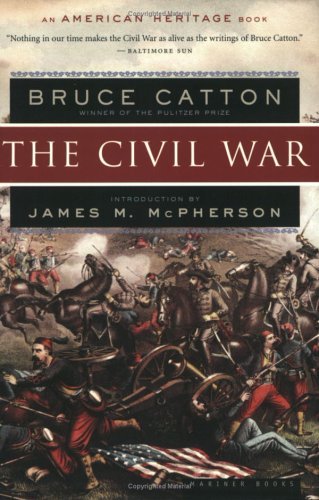
Infinitely readable and absorbing, Bruce Catton’s The Civil War is one of the most widely read general histories of the war available in a single volume. Introduced by the critically acclaimed Civil War historian James M. McPherson, The Civil War vividly traces one of the most moving chapters in American history, from the early division between the North and the South to the final surrender of Confederate troops. Catton's account of battles is a must-read for anyone interested in the war that divided America, carefully weaving details about the political activities of the Union and Confederate armies and diplomatic efforts overseas.

When first published in 1953, Bruce Catton, our foremost Civil War historian was awarded both the Pulitzer Prize and the National Book Award for excellence in nonfiction. This final volume of The Army of the Potomac trilogy relates the final year of the Civil War.

A vivid account of the early battles, first in the Pulitzer Prize-winning “One of America’s foremost Civil War authorities” (Kirkus Reviews). The first book in Bruce Catton’s Pulitzer Prize–winning Army of the Potomac Trilogy, Mr. Lincoln’s Army is a riveting history of the early years of the Civil War, when a fledgling Union Army took its stumbling first steps under the command of the controversial general George McClellan. Following the secession of the Southern states, a beleaguered President Abraham Lincoln entrusted the dashing, charismatic McClellan with the creation of the Union’s Army of the Potomac and the responsibility of leading it to a swift and decisive victory against Robert E. Lee’s Army of Northern Virginia. Although a brilliant tactician who was beloved by his troops and embraced by the hero-hungry North, McClellan’s ego and ambition ultimately put him at loggerheads with his commander in chief—a man McClellan considered unworthy of the presidency. McClellan’s weaknesses were exposed during the Battle of Antietam, the bloodiest day in American military history, which ended in a stalemate even though the Confederate troops were greatly outnumbered. After Antietam, Lincoln ordered McClellan’s removal from command, and the Union entered the war’s next chapter having suffered thousands of casualties and with great uncertainty ahead. America’s premier chronicler of the nation’s brutal internecine conflict, Bruce Catton is renowned for his unparalleled ability to bring a detailed and vivid immediacy to Civil War battlefields and military strategy sessions. With tremendous depth and insight, he presents legendary commanders and common soldiers in all their complex and heartbreaking humanity.

A thrilling, page-turning piece of writing that describes the forces conspiring to tear apart the United States--with the disintegrating political processes and rising tempers finally erupting at Bull Run. "...a major work by a major writer, a superb re-creation of the twelve crucial months that opened the Civil War."--The New York Times.

A detailed and intimate portrait of U. S. Grant from this Pulitzer Prize winning historian reveals why Lincoln knew he was the one general who could win the war. This exhaustively researched biography gives us a new understanding of the man, the growing strength of his character, and the great war itself.

Volume II of The Army of the PotomacThe critical months between the autumn of 1862 and midsummer 1863 is the focus of Glory Road. During this time the outcome of the Civil War is determined, as the battles at Fredericksburg, Rappahannock and Chancellorsville set the state for Union victory as Gettysburg.

The final volume of Bruce Catton's monumental Centennial History of the Civil War traces the war from Fredericksburg through the succeeding grim and relentless campaigns to the Courthouse at Appomattox and the death of Lincoln.This is an eloquent study of the bitterest years of the war when death slashed the country with a brutality unparalleled in the history of the United States. Through the kaleidoscope tone and temper of the struggle, two men, different in stature, but similar in dedication to their awesome tasks, grappled with the burden of being leaders both in politics and war. In the north Lincoln remained resolute in the belief that a house divided against itself could not stand. His determination and uncanny vision of the destiny of the country and its people far transcended the plaguing tensions, fears, and frustrations of his cabinet and Congress. Mr. Lincoln’s use of vast resources is brilliantly contrasted to Davis’s valiant struggle for political and economic stability in a hopelessly fragmented and underdeveloped south. Though Davis never lacked for spirit and dedication, his handicaps were severe. This was not a war to be won by static ideals and romanticism. As Mr. Lincoln managed to expand and intensify the ideals that sustained the Northern war effort, Mr. Davis was never able to enlarge the South’s. This was a war to be won by flexibility in though, strength in supplies, and battles. And so they were fought––Fredericksburg, The Wilderness, Chancellorsville, Vicksburg, Gettysburg.

The second episode in this award-winning trilogy impressively shows how the Union and Confederacy, slowly and inexorably, reconciled themselves to an all-out war—an epic struggle for freedom.In Terrible Swift Sword, Bruce Catton tells the story of the Civil War as never before—of two turning points which changed the scope and meaning of the war. First, he describes how the war slowly but steadily got out of control. This would not be the neat, short, “limited” war both sides had envisioned. And then the author reveals how the sweeping force of all-out conflict changed the war’s purpose, in turning it into a war for human freedom.It was not initially a war against slavery. Instead, this was, Mr. Lincoln kept insisting, a fight to reunite the United States. At first, it was not even much of a fight. Cautious generals; inexperienced, incompetent, or jealous administrators; shortages of good people and supplies; excess of both gloom and optimism, kept each side from swinging into decisive action. As the buildup began, there were maddening delays. The earliest engagements were halting and inconclusive. After these first tests at arms, reputations began to crumble. Buell, Halleck, Beauregard Albert Sidney Johnston. Failed to drive ahead—for reasons good and bad. General McClellan (impaled in these pages on the arrogant words of his letters) captured more imaginations than enemies, and continued to accept serious over estimates of Confederate strength while becoming more and more fatally estranged from his own government.

This fascinating book tells the story of the Civil War as seen from the Union side. Through his brilliant and stirring narrative, Bruce Catton conveys the human aspect of history and translates meticulously researched historical fact into an absorbing chronicle of the war. This Hallowed Ground deals with the entire scope of the Civil War from the months of unrest and hysteria that led to Fort Sumter to the days of tragedy and hope that followed Appomattox. Along with the author, readers will relive the shock and shell and glory of the war. The true greatness of this book, however, lies in Catton's deeply moving analysis of the issues, and his search for the true meaning of the conflict.

A Pulitzer Prize–winning historian looks at the complex, controversial Union commander who ensured the Confederacy’s downfall in the Civil War. In this New York Times bestseller, preeminent Civil War historian Bruce Catton narrows his focus on commander Ulysses S. Grant, whose bold tactics and relentless dedication to the Union ultimately ensured a Northern victory in the nation’s bloodiest conflict. While a succession of Union generals—from McClellan to Burnside to Hooker to Meade—were losing battles and sacrificing troops due to ego, egregious errors, and incompetence, an unassuming Federal Army commander was excelling in the Western theater of operations. Though unskilled in military power politics and disregarded by his peers, Colonel Grant, commander of the Twenty-First Illinois Volunteer Infantry, was proving to be an unstoppable force. He won victory after victory at Belmont, Fort Henry, and Fort Donelson, while brilliantly avoiding near-catastrophe and ultimately triumphing at Shiloh. And Grant’s bold maneuvers at Vicksburg would cost the Confederacy its invaluable the Mississippi River. But destiny and President Lincoln had even loftier plans for Grant, placing nothing less than the future of an entire nation in the capable hands of the North’s most valuable military leader. Based in large part on military communiqués, personal eyewitness accounts, and Grant’s own writings, Catton’s extraordinary history offers readers an insightful look at arguably the most innovative Civil War battlefield strategist, unmatched by even the South’s legendary Robert E. Lee.

The great armies of North and South came to Gettysburg because the roads led them there. A little country market town, Gettysburg was touched by fate, early in July 1863, to become important because of those roads. If General lee, with most of the Confederate Army concealed behind South Mountain, wanted to concentrate in the east for the battle that might win the war, he had to come through Gettysburg. If General Meade, in Maryland, wanted to bring the Federal Army north to intercept Lee, he had to come to Gettysburg.In this battle account, Bruce Catton has clarified for all time the causes of the conflict, he had narrated and analysed the course of events, paying full heed to the human tragedies brought about, and he has examined the military and political consequences of Gettysburg.Further, Mr Catton has selected 41 illustrations by Matthew Brady and others, along with contemporary drawings, paintings, and engravings reproduced in black and white - and has directed the preparation of new maps of the area and the battle. Maps and pictures are made doubly helpful by the informative captions in depth that he has written.'Gettysburg: The Final Fury' is a fresh new document. It is a total view of the battle of Gettysburg, which was the determining event of the Civil War.

A comprehensive examination of the military and political aspects of America's Civil War

Mr. Lincoln's Army/Glory Road/A Stillness at Appomattox

Here is Pulitzer Prize-winning author Bruce Catton's unsurpassed account of the Civil War, one of the most moving chapters in American history. Introduced by Pulitzer Prize-winner James M. McPherson, the book vividly traces the epic struggle between the Blue and Gray, from the early division between the North and South to the final surrender of Confederate troops.

Bruce Catton, Pulitzer-Prize winner and one of the most acclaimed historians of the Civil War, vividly recreates the 1863 Battle of Gettysburg. From the opening shots to General George Pickett's ill-fated charge, he tells the dramatic story of the battle that resulted in more than 51,000 Union and Confederate casualties and changed the course of the war.

A concise biography of the legendary Union general and controversial US president from “one of America’s foremost Civil War authorities” (Kirkus Reviews). Pulitzer Prize–winning historian Bruce Catton explores the life and legacy of one of the nation’s most misunderstood heroes: Ulysses S. Grant. In this classic work, Grant emerges as a complicated figure whose accomplishments have all too often been downplayed or overlooked. Catton begins with Grant’s youth and his service as a young lieutenant under General Zachary Taylor in the Mexican-American War. He recounts Grant’s subsequent disgrace, from his forced resignation for drinking to his failures as a citizen farmer and salesman. He then chronicles his redemption during the Civil War, as Grant rose from the rank of an unknown solider to commanding general of the US Army and savior of the Union. U. S. Grant and the American Military Tradition details all of his signature campaigns: From Fort Henry, Shiloh, and the Siege of Vicksburg to Robert E. Lee’s surrender at Appomattox Court House, Grant won national renown. Then, as a two-term president, Grant achieved a number of underrated successes that must figure into any telling of his life. From Grant’s childhood in Ohio to his final days in New York, this succinct and illuminating biography is required reading for anyone interested in American history.

Bruce Catton, whose name is identified with Civil War history, grew up in Benzonia, Michigan, probably the only town within two hundred miles, he says, not founded to cash in on the lumber boom. In this memoir, Catton remembers his youth, his family, his home town, and his coming of age.With nostalgia, warmth, and humor, Catton recalls it all with a wealth of the logging industry and its tremendous effect on the face of the state, the veterans of the Grand Army of the Republic who first sparked his interest in the Civil War, the overnight train trips on long-gone "sleepers," the days of great resort hotels, and fishing in once clear lakes.Although he writes of a time and place that are no more, his observations have implications that both underline the past and touch the future.

Pulitzer Prize-winning writer Bruce Catton was America’s greatest Civil War historian, and he made the events of that seminal conflict come alive for millions. In this, his final book, edited from many hours of tapes after Catton’s death, he goes right to the heart and soul of what brought this nation to the battlefield. He reflects not only on military history, but also on the actual experience of army life for the common soldier; 17 period drawings by soldier-artist John Geyser, a young private in the Union Army, enhance the insightful words. Catton plunges into the spirit of the time to uncover the motives and emotions that caused the flood of war.Pulitzer Prize-winning writer Bruce Catton was America’s greatest Civil War historian, and he made the events of that seminal conflict come alive for millions. In this, his final book, edited from many hours of tapes after Catton’s death, he goes right to the heart and soul of what brought this nation to the battlefield. He reflects not only on military history, but also on the actual experience of army life for the common soldier; 17 period drawings by soldier-artist John Geyser, a young private in the Union Army, enhance the insightful words. Catton plunges into the spirit of the time to uncover the motives and emotions that caused the flood of war.

U. S. Grant: The Civil War Years: Grant Moves South and Grant Takes Command
by Bruce Catton
Rating: 4.6 ⭐
Pulitzer Prize–winning historian Bruce Catton’s acclaimed two-book biography of complex and controversial Union commander Ulysses S. Grant.In these two comprehensive and engaging volumes, preeminent Civil War historian Bruce Catton follows the wartime movements of Ulysses S. Grant, detailing the Union commander’s bold tactics and his relentless dedication to achieving the North’s victory in the nation’s bloodiest conflict. While a succession of Union generals were losing battles and sacrificing troops due to ego, egregious errors, and incompetence in the early years of the war, an unassuming Federal army colonel was excelling in the Western theater of operations. Grant Moves South details how Grant, as commander of the Twenty-First Illinois Volunteer Infantry, though unskilled in military power politics and disregarded by his peers, was proving to be an unstoppable force. He won victory after victory at Belmont, Fort Henry, and Fort Donelson, while sagaciously avoiding near-catastrophe and ultimately triumphing at Shiloh. His decisive victory at Vicksburg would cost the Confederacy its invaluable the Mississippi River. Grant Takes Command picks up in the summer of 1863 when President Abraham Lincoln promoted Grant to the head of the Army of the Potomac, placing nothing less than the future of an entire nation in the hands of the military leader. Grant’s acute strategic thinking and unshakeable tenacity led to the crushing defeat of the Confederacy in the Overland Campaign in Virginia and the Siege of Petersburg. In the spring of 1865, Grant finally forced Robert E. Lee’s surrender at Appomattox Court House, ending the brutal conflict. Although tragedy struck only days later when Lincoln was assassinated, Grant’s triumphs on the battlefield ensured that the president’s principles of unity and freedom would endure. Based in large part on military communiqués, personal eyewitness accounts, and Grant’s own writings, this engrossing two-part biography offers readers an in-depth portrait of the extraordinary warrior and unparalleled strategist whose battlefield brilliance clinched the downfall of the Confederacy in the Civil War.

Here, in this essay by Bruce Catton, winner of the Pulitzer Prize and the National Book Award, is the story of Antietam, the first, major Civil-War battle fought on Northern soil and the bloodiest single-day clash in American history.

Reflecting the state of the art in scholarship, The American Heritage New History of the Civil War provides a rich and dramatic recreation of the four years of this bloody war. Fascinating sidebars and contemporary documents tells the story of the war in the voices of those who experienced it. The interactive CD-ROM features a multimedia Civil War strategy game. 800+ photos, many in color. 3-D maps. Printed endpapers. Full-cloth case.

No one has ever told America's story with more grace, clarity, and emotional power than Pulitzer Prize winner Bruce Catton. In his books, ranging from the celebrated Civil War trilogies to the account of his boyhood in back-country Michigan, Catton brought the people of the past to such vivid life that he became the nation's best-loved and most widely read historian. Bruce Catton's friend and associate for many years, Oliver Jensen, has assembled this volume of selections of Catton's works - as a memorial to the man and a tribute to the historian. The excerpts chosen for Bruce Catton's America include portions of A Stillness at Appomattox, which won both the Pulitzer Prize and the National Book Award; The American Heritage History of the Civil War, awarded a special Pulitzer Prize Citation; and representative selections from many other books and articles. The book also includes several previously unpublished pieces. Bruce Catton helped to create American Heritage magazine in 1954 and continued to influence it for the next twenty-four years - first as editor, then as senior editor and a frequent contributor. He spent much of his adult life as a newspaperman in the Midwest and Washington, D.C., and became a historian "by logical extension." Although best known as the greatest writer on the Civil War, he had wide-ranging interests. To those who are familiar with Bruce Catton's work, these selections will appear as old friends whose company never fails to provide enjoyment, stimulation, and a deep sense of worth. For those who have not yet read him, Bruce Catton's America will be an introduction to historical writing at its best.

The late Pulitzer-Prize-winning historian Bruce Catton is known to millions of readers for his absorbing works on the Civil War. In this book, he turns to his native Michigan to tell a story of what happened when a primitive wilderness changed into a bustling industrial center so fast that it was as if the old French explorer Etienne Brule "should step up to shake hands with Henry Ford." The idea that abundance was "inexhaustible--that fatal Michigan word," as the author calls it--dominated thinking about the state from the days when Commandant Cadillac's soldiers arrived at Detroit until his name became a brand of car. Viewed in this light, Michigan is a case study of all America, and Americans in any state will be fascinated. In a colorful, dramatic past, Mr. Catton finds understanding of where we are in the present and what the future will make us face.

The Civil war is the thing that makes America different. It was our most tremendous experience, and it's not quite like anything that ever happened to anyone else. The story of the war needs retelling because it helped to shape the future of the human race.

s/t: Abraham Lincoln, Jefferson Davis & the March to the Civil WarUsing the early lives and careers of Abraham Lincoln and Jefferson Davis as theme and framework, two of America's finest historians outline each step in the tragic march to the Civil War. By showing how these two major figures--both Kentucky-born--developed divergent attitudes, the Cattons simultaneously reveal why the North and South became increasingly isolated from each other during the 1850s, and why war became inevitable. Also captured: the epic sweep of the era, with its great new railroads, land-hungry westward expansion, and developing industrial and agricultural empires.

The best way to examine the presidency now, writes the Pulitzer Prize-winning historian Bruce Catton, "is to examine the lives and personalities of the men who have held it, because the presidency today is in many ways the sum of large and small contributions made by the different presidents." Here, in the first volume of American Heritage's history of presidents are the dramatic stories of the first eight men to hold the George Washington, John Adams, Thomas Jefferson, James Madison, James Monroe, John Quincy Adams, Andrew Jackson, and Martin Van Buren.

s/t: The Civil War & Its Meaning in American CultureA fascinating study of the first modern war and its effect on American Culture.

The Cattons, popular-historian father & academic-historian son, offer "a combination of narrative & interpretive essay" on early America that seeks "not to break new ground but to impose our own thoughts & order upon conventional historical material." The book's building blocks are the European background of settlement, colonial growth, the revolution, the adoption of the Constitution, the emergence of political parties & the War of 1812. The authors are familiar with much of the pertinent & recent historical literature. Their facts are consistently accurate & their evaluation of the individual historical components of their story are sensible. But their broad interpretive overlay is little more than a rehash of the old patriotic, Whiggish account of the inexorable development of America as a land of democracy & material opportunity (except for blacks & Indians) & of Americans as an individualistic & hard-working people. Intrinsic to this genre is retrospective history, & the authors see in the early 18th-century colonial societies the seeds of everything from Lexington & Concord to the rise of industry. But, to their credit, the Cattons are willing to confront facts that do not strictly conform to the traditional outlines of the American dream story. They note, for example, that England practiced religious toleration before the colonies & that most indentured servants never achieved material success. Consequently, the book has the major virtue of textbook reliability (& the concomitant flaw of textbook staleness) couched, for everyday history buffs, in dramatic, colloquial prose.--Kirkus (edited)

The Centennial of the Civil War was memorialized from 1961 to 1965. Publication of Bruce Catton's trilogy highlighted this era. Unlike his previous trilogy, these books focused not only on military topics, but on social, economic & political topics as well.The Coming Fury (1961)—Explores the causes & events leading to the start of the war, culminating in its 1st major combat, the 1st Battle of Bull Run. Terrible Swift Sword (1963)—Both sides mobilize for a massive war effort & the story continues thru 1862, ending with the Battle of Fredericksburg. Never Call Retreat (1965)—The war continues thru Vicksburg, Gettysburg & the bloody struggles of 1864-65 before the final surrender.

Enlisting in the Union Army, a seventeen-year-old from Michigan ends up in the cavalry under "Fighting Phil" Sheridan headed for Virginia.

Non-fiction Writing Vol IV
by Bruce Catton