
Betty Friedan
American feminist Betty Naomi Friedan (née Bettye Naomi Goldstein) wrote The Feminine Mystique in 1963 and cofounded the National Organization for Women in 1966. This book started the "second wave" of feminism.
30 Books Written

"If you’ve never read it, read it now." ―Arianna Huffington, O, The Oprah Magazine Landmark, groundbreaking, classic―these adjectives barely do justice to the pioneering vision and lasting impact of The Feminine Mystique . Published in 1963, it gave a pitch-perfect description of “the problem that has no name”: the insidious beliefs and institutions that undermined women’s confidence in their intellectual capabilities and kept them in the home. Writing in a time when the average woman first married in her teens and 60 percent of women students dropped out of college to marry, Betty Friedan captured the frustrations and thwarted ambitions of a generation and showed women how they could reclaim their lives. Part social chronicle, part manifesto, The Feminine Mystique is filled with fascinating anecdotes and interviews as well as insights that continue to inspire. This 50th–anniversary edition features an afterword by best-selling author Anna Quindlen as well as a new introduction by Gail Collins.
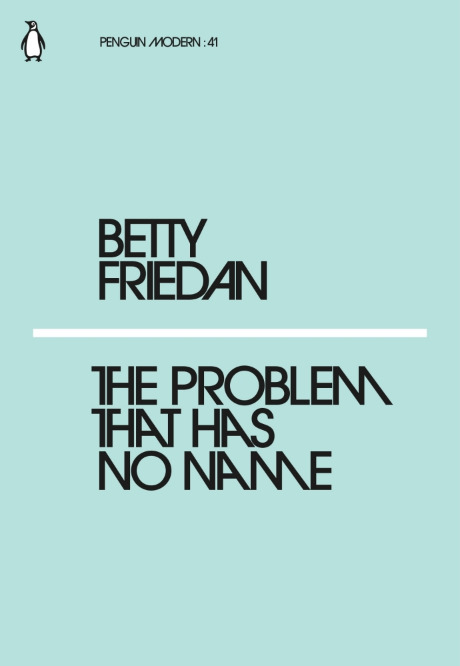
'What if she isn't happy - does she think men are happy in this world? Doesn't she know how lucky she is to be a woman?'The pioneering Betty Friedan here identifies the strange problem plaguing American housewives, and examines the malignant role advertising plays in perpetuating the myth of the 'happy housewife heroine'.Penguin Modern: fifty new books celebrating the pioneering spirit of the iconic Penguin Modern Classics series, with each one offering a concentrated hit of its contemporary, international flavour. Here are authors ranging from Kathy Acker to James Baldwin, Truman Capote to Stanislaw Lem and George Orwell to Shirley Jackson; essays radical and inspiring; poems moving and disturbing; stories surreal and fabulous; taking us from the deep South to modern Japan, New York's underground scene to the farthest reaches of outer space.

Struggling to hold on to the illusion of youth, Friedan wrote, we have denied the reality and evaded the new triumphs of growing older. We have seen age only as decline. In this powerful and very personal book, Betty Friedan charted her own voyage of discovery, and that of others, into a different kind of aging. Friedan found ordinary men and women, moving into their fifties, sixties, seventies, discovering extraordinary new possibilities of intimacy and purpose. In their surprising experiences, Friedan first glimpsed, then embraced, the idea that one can grow and evolve throughout life in a style that dramatically mitigates the expectation of decline and opens the way to a further dimension of "personhood." The Fountain of Age suggests new possibilities for every one of us, all founded on a solid body of startling but little-known scientific evidence. It demolishes those myths that have constrained us for too long and offers compelling alternatives for living one's age as a unique, exuberant time of life, on its own authentic terms.

First published in 1981, The Second Stage is eerily prescient and timely, a reminder that much of what is called new thinking in feminism has been eloquently observed and argued before. Warning the women's movement against dissolving into factionalism, male-bashing, and preoccupation with sexual and identity politics rather than bottom-line political and economic inequalities, Friedan argues that once past the initial phases of describing and working against political and economic injustices, the women's movement should focus on working with men to remake private and public arrangements that work against full lives with children for women and men both. Friedan's agenda to preserve families is far more radical than it appears, for she argues that a truly equitable preservation of marriage and family may require a reorganization of many aspects of conventional middle-class life, from the greater use of flex time and job-sharing, to company-sponsored daycare, to new home designs to permit communal housekeeping and cooking arrangements.Called "utopian" fifteen years ago, when it seemed unbelievable that women had enough power in the workplace to make effective demands, or that men would join them, some of these visions are slowly but steadily coming to pass even now. The problem Friedan identifies is as real now as it was years "how to live the equality we fought for," and continue to fight for, with "the family as new feminist frontier." She writes not only for women's liberation but for human liberation.

A portrait of the author of "The Feminine Mystique" takes readers from her lonely childhood and Smith College education through her years as a housewife and mother, to her founding of NOW and her efforts to keep the movement from becoming extremist.

"It Changed My Life": Writings on the Women's Movement, with a New Introduction
by Betty Friedan
Rating: 3.7 ⭐
“It changed my life.” That’s what Betty Friedan heard over and over from women throughout the United States after the publication of her radical best-seller, The Feminine Mystique , sparked the beginning of contemporary feminism. The first stirring and uncertain years of the women’s movement helped many women put a name to the sense of invisibility, powerlessness, and depression that Friedan famously called “the problem that has no name.”First published in 1976, “It Changed My Life” is a compellingly readable collection of reports from the front, back in the days less than a generation ago when women were routinely shut out of the professions and higher education, underpaid, condescended to, and harassed without consequences to the harassers. The book describes the political campaigns for equal pay and job opportunities, for the outlawing of sex discrimination, for the Equal Rights Amendment, and for legalized abortion, the creation of National Organization for Women, the National Abortion Rights Action League, and the National Women’s Political Caucus, and analyzes the antifeminist backlashes. Encounters with Simone de Beauvoir and Indira Gandhi are juxtaposed with moving and vivid personal struggles of many ordinary women. Among those women was Friedan herself, who frankly recorded her astonishment, gratification, and anger as the movement she helped create grew beyond all her hopes, and then raced beyond her control into a sexual politics she found disturbing.A classic of modern feminism, “It Changed My Life” brings back years of struggle for those who were there, and recreates the past for the readers of today who were not yet born during these struggles for the opportunities and respect to which women can now feel entitled. In changing women’s lives, the women’s movement has changed everything.

"A basic restructuring of our economy is needed now," writes Betty Friedan in her latest book, Beyond Gender. "And this restructuring can't be accomplished in terms of women versus men, black versus white, old versus young, conservative versus liberal. We need a new political movement in America that puts the lives and interests of people first. It can't be done by separate, single-issue movements now, and it has to be political to protect and translate our new empowerment with a new vision of community, with new structures of community that open the doors again to real equality of opportunity."As the author of The Feminine Mystique and head of the National Organization for Women, Betty Friedan helped spark a movement that revolutionized the fight for equal rights and opportunities for women. Now, in Beyond Gender, Friedan argues that the old solutions no longer work. The time has come, she contends, for women and men to move forward from identity politics and gender-based, single-issue political activism. Without yielding on particular women's issues, she calls for a "paradigm shift"—a transformation of the intellectual and political structure within which those issues are viewed.Friedan's "new paradigm" embraces the entire world of work, family, and community, where some of the most crucial questions of 1990s America have been raised. To explore them, Friedan initiated a conversation among policy experts, scholars, corporate and labor leaders, journalists, and political thinkers. Guiding their conversation with her own reflections, Friedan explores the social anxiety caused by corporate downsizing and displacement of middle-aged male employees—including the impact on working wives who suddenly become their family's sole provider. She confronts the expansion of part-time and temporary work due to outsourcing, which disproportionately affects women workers. She describes the loss of community life and community space in the fast-paced, consumption-oriented suburbs. And she discusses the breakdown of family structure in many parts of American society.Beyond Gender combines enthusiasm, curiosity, scholarship, and practical expertise as it revisits the relations among jobs, home, and society. Once again, Betty Friedan has challenged her readers to rethink the context within which they view both the relations of the sexes and the relations of the marketplace.

In mid-1962, Playboy founder Hugh Hefner was given a partial transcript of an interview with Miles Davis. It covered jazz, of course, but it also included Davis’s ruminations on race, politics and culture. Fascinated, Hef sent the writer—future Pulitzer-Prize-winning author Alex Haley, an unknown at the time—back to glean even more opinion and insight from Davis. The resulting exchange, published in the September 1962 issue, became the first official Playboy Interview and kicked off a remarkable run of public inquisition that continues today—and that has featured just about every cultural titan of the last half century.To celebrate the Interview’s 50th anniversary, the editors of Playboy have culled 50 of its most (in)famous Interviews and will publish them over the course of 50 weekdays (from September 4, 2012 to November 12, 2012) via Amazon’s Kindle Direct platform. Here is the interview with the feminist crusader Betty Friedan from the September 1992 issue.




It Changed My Life
by Betty Friedan

THE FEMININE MYSTIQUE.
by Betty Friedan
THE FEMININE MYSTIQUE.
by Betty Friedan
The Second Rage
by Betty Friedan

Second Stage - Revised Edition
by Betty Friedan
![[Sheet Music]: Liberation, Now! Theme of Women's Liberation](https://m.media-amazon.com/images/S/compressed.photo.goodreads.com/books/1698041104i/139902510.jpg)
[Sheet Music]: Liberation, Now! Theme of Women's Liberation
by Betty Friedan

La mística de la feminitat 1.: El problema no plantejat
by Betty Friedan

My Tribute to Mary Daly: A Book of Revelations
by Betty Friedan
I died of heart failure on February 4, 2006, in Washington, D.C. Now I am a ghost writer. In life, I was one of the leading voices of the feminist and Women’s Rights movement of the Twentieth Century. The work that I started is still being carried out today by the millions of feminists I inspired over the years. I broke new ground by exploring the idea of women finding personal fulfillment outside of their traditional roles. I helped advance the Women’s Rights movement. As an icon in the Women’s Rights movement, I did more than write about confining gender stereotypes—I became a force for change. I fought for abortion rights. I wanted women to have a greater role in the political process. What few know is that I had a life-long relationship with Mary Daly. At times, Mary was caring. At times, Mary was daring. At times, Mary was brilliant. At times, Mary was scary. At times, Mary was devious. At times, Mary was wicked. At times, Mary was downright funny. I loved her. I still love her. This e-book is my tribute to Mary Daly. In it I examine one of Mary’s favorite women in advertising. Mary rightly felt that advertising holds the best key to understanding what I have called the "Feminine Mystique." I have also included a selection of Mary’s favorite feminist stories. If you are a birthed man reading this blurb, I seriously suggest you close this page. Read no further. My tribute to Mary Daly is not for you. Whether you know it or not, whether you like it or not, being a birthed man means perpetuating the horrific religion known as The Patriarchy. We live in a profoundly anti-female society, a misogynistic "civilization" in which men collectively victimize women, attacking us as personifications of their own paranoid fears, as The Enemy. Within this society it is men who rape, who sap women's energy, who deny women economic and political power. I hate them. Open Access Policy You are free to share, copy, or redistribute the materials in this text in any medium or format. You are free to adapt, reuse, modify, transform, or build upon the materials in this text for any purpose whatsoever.

新しい女性の創造
by Betty Friedan

新しい女性の創造
by Betty Friedan