
Benjamin I. Page
Benjamin I. Page is a Gordon S. Fulcher Professor of Decision Making at Northwestern University. He is also a Faculty Associate at the Institute for Policy Research. Page holds a PhD from Stanford University and a JD from Harvard Law School. Page works on American politics and U.S. foreign policy, specializing in public opinion, democratic policy making, the media, and economic inequality. He is best known for his work (with Robert Y. Shapiro) on the “rationality” of public opinion: the general stability, coherence, and responsiveness to new information of Americans’ collective policy preferences. He is currently studying the political attitudes and behavior of wealthy Americans – the top 1% of U.S. wealth-holders – investigating how they often disagree with average citizens but tend to get their way in policy making. Page’s past civic involvement has been limited, but he is now committed to helping Americans understand the barriers that stand in the way of democratic responsiveness. Professor Page's interests include public opinion and policy making, the mass media, empirical democratic theory, political economy, policy formation, the presidency, and American foreign policy. He is author of a number of articles, including "Effects of Public Opinion on Policy" and "What Moves Public Opinion," both in the American Political Science Review, and of 11 books, including Living with the Dragon: How the American Public Views the Rise of China (with Tao Xie, Columbia University Press, 2010); Class War?: What Americans Really Think about Economic Inequality (with Lawrence R. Jacobs, University of Chicago Press, 2009); The Rational Public: Fifty Years of Trends in Americans' Policy Preferences (with Robert Shapiro, University of Chicago Press, 1992), Who Deliberates: Mass Media in Modern Democracy (University of Chicago Press, 1996) and What Government Can Do: Dealing with Poverty and Inequality (with James Simmons, University of Chicago Press, 2000). His research interests include public opinion, policy making, the mass media, and U.S. foreign policy. He is currently engaged in a large collaborative project to study Economically Successful Americans and the Common Good.
14 Books Written

In 2016, when millions of Americans voted for Donald Trump, many believed his claims that personal wealth would free him from wealthy donors and allow him to “drain the swamp.” But then Trump appointed several billionaires and multimillionaires to high-level positions and pursued billionaire-friendly policies, such as cutting corporate income taxes. Why the change from his fiery campaign rhetoric and promises to the working class? This should not be surprising, argue Benjamin I. Page, Jason Seawright, and Matthew J. As the gap between the wealthiest and the rest of us has widened, the few who hold one billion dollars or more in net worth have begun to play a more and more active part in politics—with serious consequences for democracy in the United States.Page, Seawright, and Lacombe argue that while political contributions offer a window onto billionaires’ influence, especially on economic policy, they do not present a full picture of policy preferences and political actions. That is because on some of the most important issues, including taxation, immigration, and Social Security, billionaires have chosen to engage in “stealth politics.” They try hard to influence public policy, making large contributions to political parties and policy-focused causes, leading policy-advocacy organizations, holding political fundraisers, and bundling others’ contributions—all while rarely talking about public policy to the media. This means that their influence is not only unequal but also largely unaccountable to and unchallengeable by the American people. Stealth politics makes it difficult for ordinary citizens to know what billionaires are doing or mobilize against it. The book closes with remedies citizens can pursue if they wish to make wealthy Americans more politically accountable, such as public financing of political campaigns and easier voting procedures, and notes the broader types of reforms, such as a more progressive income tax system, that would be needed to increase political equality and reinvigorate majoritarian democracy in the United States.

Democracy in America?: What Has Gone Wrong and What We Can Do About It
by Benjamin I. Page
Rating: 3.6 ⭐
America faces daunting problems—stagnant wages, high health care costs, neglected schools, deteriorating public services. Yet the government consistently ignores the needs of its citizens, paying attention instead to donors and organized interests. Real issues are held hostage to demagoguery, partisanship beats practicality, and trust in government withers along with the social safety net. How did we get here? Through decades of dysfunctional government. In Democracy in America? veteran political observers Benjamin I. Page and Martin Gilens marshal an unprecedented array of evidence to show that while other countries have responded to a rapidly changing economy by helping people who’ve been left behind, the United States has failed to do so. Instead, we have actually exacerbated inequality, enriching corporations and the wealthy while leaving ordinary citizens to fend for themselves. What’s the solution? More democracy. More opportunity for citizens to shape what their government does. To repair our democracy, Page and Gilens argue, we must change the way we choose candidates and conduct our elections, reform our governing institutions, and curb the power of money in politics. By doing so, we can reduce polarization and gridlock, address pressing challenges, and enact policies that truly reflect the interests of average Americans. This book presents a damning indictment. But the situation is far from hopeless. With increased democratic participation as their guide, Page and Gilens lay out a set of proposals that would boost citizen participation, curb the power of money, and democratize the House and Senate. The only certainty is that inaction is not an option. Now is the time to act to restore and extend American democracy.

Recent battles in Washington over how to fix America’s fiscal failures strengthened the widespread impression that economic issues sharply divide average citizens. Indeed, many commentators split Americans into two opposing uncompromising supporters of unfettered free markets and advocates for government solutions to economic problems. But such dichotomies, Benjamin Page and Lawrence Jacobs contend, ring false. In Class War? they present compelling evidence that most Americans favor free enterprise and practical government programs to distribute wealth more equitably. At every income level and in both major political parties, majorities embrace conservative egalitarianism—a philosophy that prizes individualism and self-reliance as well as public intervention to help Americans pursue these ideals on a level playing field. Drawing on hundreds of opinion studies spanning more than seventy years, including a new comprehensive survey, Page and Jacobs reveal that this worldview translates to broad support for policies aimed at narrowing the gap between rich and poor and creating genuine opportunity for all. They find, for example, that across economic, geographical, and ideological lines, most Americans support higher minimum wages, improved public education, wider access to universal health insurance coverage, and the use of tax dollars to fund these programs. In this surprising and heartening assessment, Page and Jacobs provide our new administration with a popular mandate to combat the economic inequity that plagues our nation.

The Rational Public: Fifty Years of Trends in Americans' Policy Preferences
by Benjamin I. Page
Rating: 3.6 ⭐
This monumental study is a comprehensive critical survey of the policy preferences of the American public, and will be the definitive work on American public opinion for some time to come. Drawing on an enormous body of public opinion data, Benjamin I. Page and Robert Y. Shapiro provide the richest available portrait of the political views of Americans, from the 1930's to 1990. They not only cover all types of domestic and foreign policy issues, but also consider how opinions vary by age, gender, race, region, and the like.The authors unequivocally demonstrate that, notwithstanding fluctuations in the opinions of individuals, collective public opinion is remarkably it reflects a stable system of values shared by the majority of Americans and it responds sensitively to new events, arguments, and information reported in the mass media. While documenting some alarming case of manipulation, Page and Shapiro solidly establish the soundness and value of collective political opinion. The Rational Public provides a wealth of information about what we as a nation have wanted from government, how we have changed our minds over the years, and why.For anyone interested in the short- and long-term trends in Americans' policy preferences, or eager to learn what Americans have thought about issues ranging from racial equality to the MX missile, welfare to abortion, this book offers by far the most sophisticated and detailed treatment available.
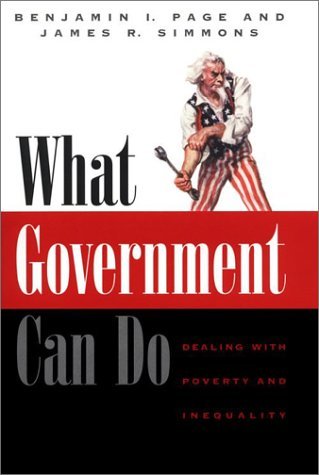
It is often said that the federal government cannot or should not attempt to address America's problems of poverty and inequality—because its bureaucracy is wasteful or its programs ineffective. But is this true? In this book, Benjamin I. Page and James R. Simmons examine a number of federal and local programs, detailing what government action already does for its citizens and assessing how efficient it is at solving the problems it seeks to address. Their conclusion, surprisingly, is the polar opposite of the prevailing rhetoric— What Government Can Do is an insightful and compelling argument that it both can and should do more.

The Foreign Policy Disconnect: What Americans Want from Our Leaders but Don't Get
by Benjamin I. Page
Rating: 3.5 ⭐
With world affairs so troubled, what kind of foreign policy should the United States pursue? Benjamin Page and Marshall Bouton look for answers in a surprising place: among the American people. Drawing on a series of national surveys conducted between 1974 and 2004, Page and Bouton reveal that—contrary to conventional wisdom—Americans generally hold durable, coherent, and sensible opinions about foreign policy. Nonetheless, their opinions often stand in opposition to those of policymakers, usually because of different interests and values, rather than superior wisdom among the elite. The Foreign Policy Disconnect argues that these gaps between leaders and the public are harmful, and that by using public opinion as a guideline policymakers could craft a more effective, sustainable, and democratic foreign policy. Page and Bouton support this argument by painting a uniquely comprehensive portrait of the military, diplomatic, and economic foreign policies Americans favor. They show, for example, that protecting American jobs is just as important to the public as security from attack, a goal the current administration seems to pursue single-mindedly. And contrary to some officials’ unilateral tendencies, the public consistently and overwhelmingly favors cooperative multilateral policy and participation in international treaties. Moreover, Americans’ foreign policy opinions are seldom divided along the usual lines: majorities of virtually all social, ideological, and partisan groups seek a policy that pursues the goals of security and justice through cooperative means. Written in a clear and engaging style, The Foreign Policy Disconnect calls, in an original voice, for a more democratic approach to creating such a policy.

Public deliberation is essential to democracy, but the public can be fooled as well as enlightened. In three case studies of media coverage in the 1990s, Benjamin Page explores the role of the press in structuring political discussion.Page shows how the New York Times presented a restricted set of opinions on whether to go to war with Iraq, shutting out discussion of compromises favored by many Americans. He then examines the media's negative reaction to the Bush administration's claim that riots in Los Angeles were caused by welfare programs. Finally, he shows how talk shows overcame the elite media's indifference to widespread concern about Zoe Baird's hiring of illegal aliens. Page's provocative conclusion identifies the conditions under which media outlets become political actors and actively shape and limit the ideas and information available to the public.Arguing persuasively that a diversity of viewpoints is essential to true public deliberation, this book will interest students of American politics, communications, and media studies.

Living with the Dragon: How the American Public Views the Rise of China
by Benjamin I. Page
Rating: 3.0 ⭐
It is widely believed that most Americans not only distrust but also despise China. Considering the country's violent political history, unprecedented economic rise, and growing military capabilities, China has become America's strongest market competitor and arguably the most challenging global threat to the United States.Nevertheless, a full consideration of American opinion proves the opposite to be true. Carefully analyzing all available polls and surveys, Benjamin I. Page and Tao Xie find most Americans favor peaceful engagement with China. The public view has been surprisingly coherent and consistent, changing only in response to major events and new information.While a majority of Americans are not happy that China's economy is projected to become as large as that of the United States, they are prepared to live with it. "Unfair" Chinese trade practices and their impact on American jobs and wages are a concern, along with the quality and safety of Chinese-made goods. However, Americans favor free trade with China, provided it is tempered with environmental and workplace protections. They also believe that the United States should "balance" Chinese power through alliances with neighboring countries, such as Japan. Yet they oppose military action to defend Taiwan. Page and Xie examine these opinions in relation to facts about China and in light of current U.S. debates on diplomacy and policy.

Examines the impact of taxation, social welfare programs, government spending, and economic regulation on the incomes of ordinary American citizens

Struggle for Democracy, The, Plus NEW MyPoliSciLab for American Government -- Access Card Package
by Benjamin I. Page
Rating: 5.0 ⭐
Before purchasing, check with your instructor to ensure you select the correct ISBN . Several versions of Pearson's MyLab & Mastering products exist for each title, and registrations are not transferable. To register for and use Pearson's MyLab & Mastering products, you may also need a Course ID , which your instructor will provide.Used books, rentals, and purchases made outside of PearsonIf purchasing or renting from companies other than Pearson, the access codes for Pearson's MyLab & Mastering products may not be included, may be incorrect, or may be previously redeemed. Check with the seller before completing your purchase.For courses in American GovernmentThis package includes MyPoliSciLab ®Examine how American democracy is developingThe Struggle for Democracy offers students the tools they need to critically analyze our political system and make judgments about how well our government works. Taking a fresh approach to common American government topics, authors Edward Greenberg and Benjamin Page provide an analytical framework for understanding how politics and government work, and encourage students to consider the questions “How democratic are we?” and “Can government do anything well?” In order to boost student engagement with key concepts, the 2014 Elections and Updates Edition incorporates coverage of contemporary issues that dominate today’s headlines, as well as the most up-to-date data.Enhance learning with MyPoliSciLabMyPoliSciLab for the American Government course extends learning online, engaging students and improving results. Media resources with assignments bring concepts to life, and offer students opportunities to practice applying what they’ve learned. And the Writing Space helps educators develop and assess concept mastery and critical thinking through writing, quickly and easily. Please this version of MyPoliSciLab does not include an eText.0134113845 / 9780134113845 The Struggle for Democracy, 2014 Elections and Updates Edition plus MyPoliSciLab for American Government — Access Card Package, 11/ePackage consists • 0133914747 / 9780133914740 The Struggle for Democracy, 2014 Elections and Updates Edition, 11/e• 0133930645 / 9780133930641 MyPoliSciLab for American Government Valuepack Access CardThe Struggle for Democracy , 2014 Elections and Updates Edition is also available via REVEL ™, an immersive learning experience designed for the way today's students read, think, and learn.

Book by Benjamin I. Page
The American presidency
by Benjamin I. Page
Representation as well as competence: Congress and President in U.S. foreign policy
by Benjamin I. Page
Choices and Echoes in Presidential Elections: Rational Man and Electoral Democracy
by Benjamin I. Page