
Barry Schwartz
an American psychologist. Schwartz is the Dorwin Cartwright Professor of Social Theory and Social Action at Swarthmore College. He frequently publishes editorials in the New York Times applying his research in psychology to current events.
27 Books Written

The Paradox of Choice: Why More Is Less, Revised Edition
by Barry Schwartz
Rating: 3.9 ⭐
• 6 recommendations ❤️
In the spirit of Alvin Tofflers' Future Shock, a social critique of our obsession with choice, and how it contributes to anxiety, dissatisfaction and regret.Whether were buying a pair of jeans, ordering a cup of coffee, selecting a long-distance carrier, applying to college, choosing a doctor, or setting up a 401(k), everyday decisions — both big and small — have become increasingly complex due to the overwhelming abundance of choice with which we are presented.We assume that more choice means better options and greater satisfaction. But beware of excessive choice: choice overload can make you question the decisions you make before you even make them, it can set you up for unrealistically high expectations, and it can make you blame yourself for any and all failures. In the long run, this can lead to decision-making paralysis, anxiety, and perpetual stress. And, in a culture that tells us that there is no excuse for falling short of perfection when your options are limitless, too much choice can lead to clinical depression.In The Paradox of Choice, Barry Schwartz explains at what point choice - the hallmark of individual freedom and self-determination that we so cherish - becomes detrimental to our psychological and emotional well-being. In accessible, engaging, and anecdotal prose, Schwartz shows how the dramatic explosion in choice — from the mundane to the profound challenges of balancing career, family, and individual needs — has paradoxically become a problem instead of a solution. Schwartz also shows how our obsession with choice encourages us to seek that which makes us feel worse.

An eye-opening, groundbreaking tour of the purpose of work in our lives, showing how work operates in our culture and how you can find your own path to happiness in the workplace.Why do we work? The question seems so simple. But Professor Barry Schwartz proves that the answer is surprising, complex, and urgent.We’ve long been taught that the reason we work is primarily for a paycheck. In fact, we’ve shaped much of the infrastructure of our society to accommodate this belief. Then why are so many people dissatisfied with their work, despite healthy compensation? And why do so many people find immense fulfillment and satisfaction through “menial” jobs? Schwartz explores why so many believe that the goal for working should be to earn money, how we arrived to believe that paying workers more leads to better work, and why this has made our society confused, unhappy, and has established a dangerously misguided system.Through fascinating studies and compelling anecdotes, this book dispels this myth. Schwartz takes us through hospitals and hair salons, auto plants and boardrooms, showing workers in all walks of life, showcasing the trends and patterns that lead to happiness in the workplace. Ultimately, Schwartz proves that the root of what drives us to do good work can rarely be incentivized, and that the cause of bad work is often an attempt to do just that.How did we get to this tangled place? How do we change the way we work? With great insight and wisdom, Schwartz shows us how to take our first steps toward understanding, and empowering us all to find great work.
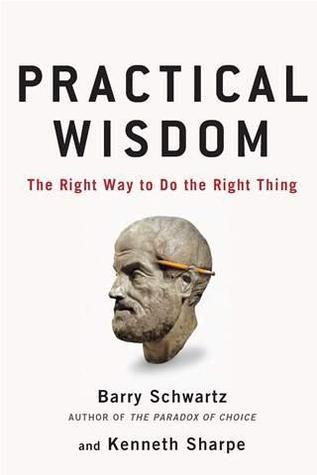
A reasoned yet urgent call to embrace and protect the essential, practical human quality that has been drummed out of our wisdom.It's in our nature to want to succeed. It's also human nature to want to do right. But we've lost how to balance the two. How do we get it back?Practical Wisdom can help. "Practical wisdom" is the essential human quality that combines the fruits of our individual experiences with our empathy and intellect-an aim that Aristotle identified millennia ago. It's learning "the right way to do the right thing in a particular circumstance, with a particular person, at a particular time." But we have forgotten how to do this. In Practical Wisdom, Barry Schwartz and Kenneth Sharpe illuminate how to get back in touch with our how to identify it, cultivate it, and enact it, and how to make ourselves healthier, wealthier, and wiser.

How can you make smart decisions? Do more choices make you happier? What steps can you take to curtail stress when selecting from a sea of options? Barry Schwartz gives you practical and science-based answers to these questions in this audio series. The author of the seminal best seller The Paradox of Choice, Dr. Schwartz has spent five decades teaching decision science. Now, this 14-lecture audio course lets you experience the same panache that has wowed Swarthmore College undergraduates and business school students at UC Berkeley and NYU.

We all value freedom, family, friends, work, education, health, and leisure-"the best things in life." But the pressure we experience to chase the dollar in order to satisfy both the demands of the bottom line and the demands of our seemingly insatiable desire to consume are eroding these best things in life. Our children now value profit centers, not sports heroes. Our educational system is fast becoming nothing more than a financial investment where students are encouraged to expend more energy on making the grade than on learning about their world. Our business leaders are turning young idealists into cynics when they cut corners and explain that "everybody's doing it." The need to achieve in our careers intrudes so greatly on our personal world that we find ourselves weighing the "costs" of enjoying friendships rather than working. In this book, psychologist Barry Schwartz unravels how market freedom has insidiously expanded its reach into domains where it does not belong. He shows how this trend developed from a misguided application of the American value of individuality and self-pursuit, and how it was aided by our turning away from the basic social institutions that once offered traditional community values. These developments have left us within an overall framework for living where worth is measured entirely by usefulness in the marketplace. The more we allow market considerations to guide our lives, the more we will continue to incur the real costs of living, among them disappointment and loneliness.

“Provocative and richly textured. . . .Schwartz’s analyses of the inadequacies of contemporary scientific views of human nature are compelling, but the consequences are even more worthy of note.” ― Los Angeles Times Out of the investigations and speculations of contemporary science, a challenging view of human behavior and society has emerged and gained strength. It is a view that equates “human nature” utterly and unalterably with the pursuit of self-interest. Influenced by this view, people increasingly appeal to natural imperatives, instead of moral ones, to explain and justify their actions and those of others.

Barry Schwartz is back! The best-selling author of The Paradox of Choice and Why We Work, this eminent psychologist and leadership guru returns to help you tackle the biggest decisions of your life. His life-changing course weaves vivid case examples, research-based psychological insights, and deep wisdom. You’ll find vital takeaways you can use every day. In 2004, Schwartz started a movement to help people and organizations flourish by making smarter choices. Since then, millions have experienced the power of his ideas, including more than 25 million who watched his TED Talks. Not just another business book, this is a thoughtful audio course delivered by Professor Schwartz himself. With his signature wit, he distills decades of research and dozens of real-world cases into clear frameworks and practical, science-based answers. You’ll investigate fundamental questions: How can we find the best career path for ourselves? Why do so many smart leaders fail to create flourishing workplaces? What is wisdom, and how does help make happiness possible? Through this masterful course, you will discover that practical wisdom is the key to happiness. Dr. Schwartz goes one step further, suggesting what is true of work is also true of love. Gain the wisdom you need to become a better worker, manager, friend, romantic partner, and parent today. ©2019 Now You Know Media (P)2019 Now You Know Media


Examines the use of research in animal learning to develop theories of human behavior and analyzes the applications of these theories in management and other areas

A leading psychologist and philosopher challenge the shortcomings of rational choice theory—and propose a new framework for understanding decision-making For many decision scientists, their starting point—drawn from economics—is a quantitative formula called rational choice theory, allowing people to calculate and choose the best options. The problem is that this framework assumes an overly simplistic picture of the world, in which different types of values can be quantified and compared, leading to the “most rational” choice. Behavioral economics acknowledges that irrationality is common but still accepts the underlying belief from economics of what a rational decision should look like. In this book, Barry Schwartz and Richard Schuldenfrei offer a different way to think about the choices we make every day. Drawing from economics, psychology, and philosophy—and both inspired by and challenging Daniel Kahneman’s Thinking, Fast and Slow—they show how the focus on rationality, narrowly understood, fails to fully describe how we think about our decisions, much less help us make better ones. Notably, it overlooks the positive contribution that framing—how we determine what aspects are most important to us—contributes to good decisions. Schwartz and Schuldenfrei argue that our choices should be informed by our individual “constellation of virtues,” allowing for a far richer understanding of the decisions we make and helping us to live more integrated and purposeful lives.

Abraham Lincoln in the Post-Heroic Era: History and Memory in Late Twentieth-Century America
by Barry Schwartz
Rating: 4.0 ⭐
By the 1920s, Abraham Lincoln had transcended the lingering controversies of the Civil War to become a secular saint, honored in North and South alike for his steadfast leadership in crisis. Throughout the Great Depression and World War II, Lincoln was invoked countless times as a reminder of AmericaOCOs strength and wisdom, a commanding ideal against which weary citizens could see their own hardships in perspective.aBut as Barry Schwartz reveals in "Abraham Lincoln in the Post-Heroic Era, "those years represent the apogee of LincolnOCOs prestige. The decades following World War II brought radical changes to American culture, changes that led to the diminishing of all heroesOCoLincoln not least among them. As Schwartz explains, growing sympathy for the plight of racial minorities, disenchantment with the American state, the lessening of patriotism in the wake of the Vietnam War, and an intensifying celebration of diversity, all contributed to a culture in which neither Lincoln nor any single person could be a heroic symbol for all Americans. Paradoxically, however, the very culture that made Lincoln an object of indifference, questioning, criticism, and even ridicule was a culture of unprecedented beneficence and inclusion, where racial, ethnic, and religious groups treated one another more fairly and justly than ever before. Thus, as the prestige of the Great Emancipator shrank, his legacy of equality continued to flourish.aDrawing on a stunning range of sourcesOCoincluding films, cartoons, advertisements, surveys, shrine visitations, public commemorations, and moreOCoSchwartz documents the decline of LincolnOCOs public standing, asking throughout whether there is any path back from this post-heroic era. Can a new generation of Americans embrace again their epic past, including great leaders whom they know to be flawed?a As the 2009 Lincoln Bicentennial approaches, readers will discover here a stirring reminder that Lincoln, as a man, still has much to say to usOCoabout our past, our present, and our possible futures.a

A political analysis examining the cause and effect across all observable facts in order to determine the relevant dynamics impacting on this presidential election.

A rabbi must at times go along with the spirit and the winds of society, but at the same time be prepared to go against those winds. Ultimately a rabbi must be a bridge and remain both steadfast and flexible. This philosophical position is a delicate balance that means a rabbi must cultivate a keen awareness of who they are as well as their changing circumstances. A rabbi should be at once spirited, spiritual, empathetic, sympathetic, full of compassion, but always true to his calling, no matter the consequence. Above all a rabbi must also have the qualities described in Numbers 27:18. A leader must be “ish asher ruach bo,” a man who harbors the spirit of the Almighty deep within him. This requires wisdom, piety, courage, and most of all, an unyielding love for the people he serves. This memoir describes such a rabbi, Rabbi Barry Dov Schwartz, a man of spirit.

100 Stock Market Observations: Simple observations from trading markets for over 20 years
by Barry Schwartz
Rating: 4.0 ⭐
Observe what I learned from trading the stock market for 20 years. Simple observations that can help you manage your trading and investing. I have witnessed many things in the market from insider trading trials to pure greed to millions being made and lost overnight. The stock market is not for the weak. Your money will be taken from you if you are not careful. Believe me, every day there are traders waiting to get a piece of your hard earned money. I have written 100 market observations that I've experienced throughout my years of trading and investing. Some of these are humorous, some are timely and some I learned the hard way. These observations will be relevant for many years to come. They have also guided me through numerous financial storms and bull markets. My personal goal is for you to live vicariously through me. I want you to see what I have seen. I want you to learn all of these observations, but if you can learn at least one and use it throughout your investing career, you will have made me extremely proud and happy. Read and use them wisely. I want you to be successful in investing and hopefully these observations can provide some insight. Invest with care, invest to grow!

From all corners of society we hear people ask: What's become of honesty, loyalty, courage, hard work, compassion, discipline, and commitment? Dr. Schwartz contends that we are ready to consider a change in our traditional values and aspirations, but before we can re-establish them, we need to ask why they are disappearing.
The Paradox of Choice Updated Edition: Why More Is Less
by Barry Schwartz
Whether we’re buying a pair of jeans, ordering a cup of coffee, purchasing shampoo from the drug store, selecting a long-distance carrier, applying to college, choosing a doctor, or setting up a 401(k), everyday decisions--both big and small—have become increasingly complex due to the overwhelming abundance of choice with which we are presented.Your students may assume that more choice means better options and greater satisfaction. However, they need to be aware of excessive choice overload can make you question the decisions you make before you even make them, setting you up for unrealistically high expectations and making you blame yourself for any failures. In the long run, this can lead to decision-making paralysis, anxiety, and perpetual stress. And, in a culture that tells us that there is no excuse for falling short of perfection when your options are limitless, too much choice can lead to clinical depression.In The Paradox of Choice, Barry Schwartz explains at what point choice becomes detrimental to our psychological and emotional well-being. By synthesizing current research in the social sciences, Schwartz makes the counterintuitive case that eliminating choices can greatly reduce the stress and anxiety of our lives. He offers eleven practical steps on how to limit choices to a manageable number, have the discipline to focus on those that are important and ignore the rest, and ultimately derive greater satisfaction from the choices you have to make.
White Racism Its History Pathology & Pra
by Barry Schwartz

Journal of the Abraham Lincoln Association. Volume 26. Complete. Numbers 1 & 2.2005.
by Barry Schwartz
Academic Journal

Academic Journal
The Swarthmore Papers, Vol. 1, No. 1: Educating for Civic Responsibility in a Multicultural World
by Barry Schwartz
Nghịch Lý Của Sự Lựa Chọn
by Barry Schwartz
Đây là cuốn sách có giá trị vì hai lý do. Thứ nhất, nó đã biện luận một cách đầy sức thuyết phục rằng chúng ta sẽ sống tốt hơn nếu có ít lựa chọn hơn, và rằng nhiều người trong chúng ta đang phải rất vất vả để đi đến những quyết định lựa chọn tốt nhất. Thứ hai, cuốn sách cũng dành một lời giới thiệu đầy hấp dẫn về xu hướng nghiên cứu hiện tại trong ngành tâm lý học về lựa chọn và cuộc sống con người. (Daniel Kahneman)"Thật khó vui sống khi ta luôn hối tiếc về mọi quyết định của mình bởi luôn nghĩ nó chưa chắc đã phải là quyết định tốt nhất. Dễ thấy rằng nếu thường xuyên hối hận, bạn sẽ kém hài lòng với những quyết định đủ tốt. Tệ hơn nữa là bạn thực sự có thể cảm thấy hối tiếc trước cả khi đưa ra quyết định. Bạn hay mường tượng việc mình sẽ cảm thấy thế nào nếu phát hiện ra vẫn còn những lựa chọn tốt hơn. Và chỉ cần có vậy, bạn sẽ bị sa lầy vào sự bất an và trăn trở về mọi quyết định thậm chí còn đang manh nha. Có vẻ như khi xã hội Mỹ càng phát triển hơn và người Mỹ được tự do theo đuổi và làm bất cứ điều gì họ muốn, thì họ càng ngày càng ít hạnh phúc hơn ."Mời bạn đón đọc.
Jouranl, Art Studies, Political Studies
The Communications Explosion
by Barry Schwartz
A hydrostatically consistent north American radiosonde data base at the Forecast Systems Laboratory, 1946-present
by Barry Schwartz

Prisoners of Their Passions
by Barry Schwartz

Why We Work: An Eye-opening Tour of the Purpose of Work in Our Lives
by Barry Schwartz
One Day University presents a series of audio lectures recorded in real-time from some of the top minds in the United States. Given by award-winning professors and experts in their field, these recorded lectures dive deep into the worlds of religion, government, literature, and social justice.Why do we work? The question seems so simple. But Professor Barry Schwartz will demonstrate that the answer is surprising, complex, and urgent. His class is an eye-opening, groundbreaking tour of the purpose of work in our lives, showing how work operates in our culture, including a focus on how people can find their own path to happiness in the workplace. We've long been taught that the reason we work is primarily for a paycheck. In fact, we've shaped much of the infrastructure of our society to accommodate this belief. Then why are so many people dissatisfied with their work, despite healthy compensation? And why do so many people find immense fulfillment and satisfaction through menial jobs? This audio lecture includes a supplemental PDF.Professor Barry Schwartz explores why so many believe that the goal for working should be to earn money, how we arrived to believe that paying workers more leads to better work, and why this has made our society confused, unhappy, and has established a dangerously misguided system. Through fascinating studies and compelling anecdotes Why We Work by Barry Schwartz dispels the myths of work. It takes us through hospitals and hair salons, auto plants, and boardrooms, showing workers from all walks of life, showcasing the trends and patterns that lead to more fulfilling workplaces.

Chie : Seisoin ruku wa naze onaji heya o 2do mo sojishitanoka.
by Barry Schwartz