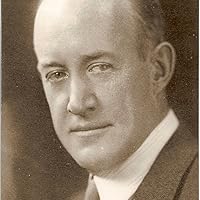
Austin Tappan Wright
Austin Tappan Wright was an American legal scholar and author. He was the son of classical scholar John Henry Wright and novelist Mary Tappan Wright, the brother of geographer John Kirtland Wright, and the grandfather of editor Tappan Wright King. Although Wright’s professional colleagues were aware he had literary interests outside his field and some anticipated he might eventually branch out into other areas of literature, these possibilities appeared precluded by his early death. During his lifetime he published just one work of fiction, the short story "1915?" in the Atlantic Monthly for April, 1915. Few people outside Wright’s own family knew he had long been working on an extensive Utopian fantasy about an imaginary country he called Islandia, with an elaborately worked-out history, culture and geography, comparable in scope to J. R. R. Tolkien’s life-long writings of Middle-earth. In his papers he left a 2300-page manuscript of a novel exploring the country, with appendices including a glossary of the Islandian language, population tables, a historic peerage, and a gazetteer and history of each of its provinces. Another book-length manuscript purported to be a general history of the country. After Wright’s death his widow typed and edited the manuscript for publication, and following her own death in 1937 their daughter Sylvia further edited and cut the text; the novel Islandia , shorn of Wright’s appendices, was finally published in 1942, along with a promotional pamphlet by Basil Davenport, An introduction to Islandia; its history, customs, laws, language, and geography, based on the original supplementary material. Islandia became a cult classic and ultimately spawned three sequels by Mark Saxton.
3 Books Written

Austin Tappan Wright left the world a wholly unsuspected legacy. After he died in a tragic accident, among this distinguished legal scholar's papers were found thousands of pages devoted to a staggering feat of literary creationa detailed history of an imagined country complete with geography, genealogy, literature, language and culture. As detailed as J.R.R. Tolkien's middle-earth novels, Islandia has similarly become a classic touchstone for those concerned with the creation of imaginary world.

Islandis: El cónsul americano
by Austin Tappan Wright
Cuando el estudiante universitario John Lang entabla amistad con Dorn, un joven proveniente de Islandis, descubre un misterioso reino situado en el hemisferio sur que no tiene apenas relaciones con otras naciones. Empujado por la curiosidad, John aprende el idioma y, cuando su tío, un empresario que quiere iniciar relaciones comerciales con los islandianos, le propone ir como cónsul de EE. UU., John partirá hacia ese recóndito territorio. Allí conocerá un pueblo poco desarrollado, pero muy avanzado a nivel social, y entrará en contacto con hombres enérgicos y mujeres valientes y enigmáticas, afectados por unas luchas políticas internas sobre la apertura al mundo exterior. Goran G. Gallarza, traductor de la obra, se pregunta en su introducció «Qué lleva a alguien a crear un mundo?». La respuesta es esta ficción utópica, trabajo de toda la vida de Austin Tappan Wright, en la que el arraigo a la tierra, el amor, la amistad y la lealtad constituyen un arte de vida, y que se ha comparado por la precisión en los detalles con la Tierra Media de Tolkien. Publicada póstumamente en 1942, Islandis (Islandia en el original) se convirtió en Estados Unidos en una novela de culto. Presentamos aquí el primero de los varios volúmenes de que se compone la saga.

An Islandian on the Islands
by Austin Tappan Wright